
Latest News
Millions start Hajj in shadow of Israel’s war on Gaza

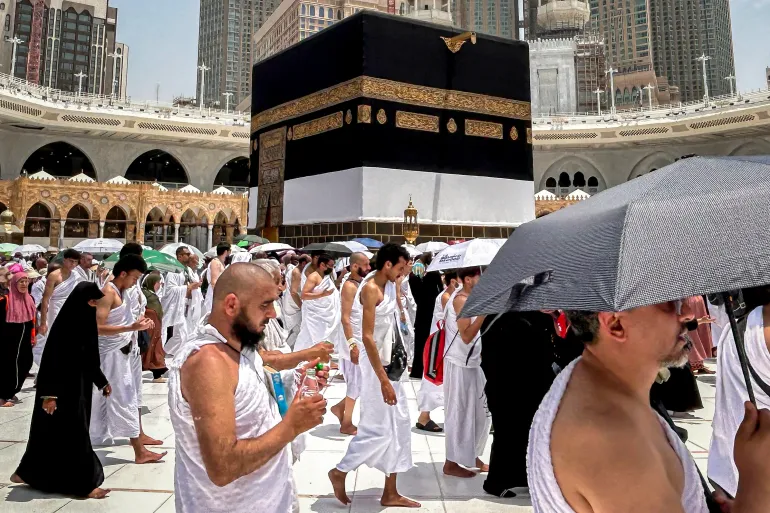
More than 1.5 million Muslim pilgrims have gathered in Saudi Arabia’s Mecca for the start of Hajj, taking place this year against the harrowing backdrop of Israel’s continued onslaught on the Gaza Strip.
The annual pilgrimage began on Friday with crowds of robed worshippers circling the Kaaba, the black cubic structure at Mecca’s Grand Mosque, many expressing sadness eight months into Israel’s war on Gaza.
“Our brothers are dying, and we can see it with our own eyes,” said 75-year-old Zahra Benizahra from Morocco.
Palestinians in Gaza were not able to travel to Mecca this year because of the closure of the Rafah crossing in May when Israel extended its ground offensive into the strip’s southern city of Rafah on the border with Egypt.
“We were deprived of Hajj because of the closure of the crossing and because of the war and destruction,” Amna Abu Mutlaq, 75, told Al Jazeera. “We are unable to leave and every time we try to leave, they tell us that the crossing is closed and we cannot leave. They deprived us of everything.”
Palestinian authorities said 4,200 people from the occupied West Bank had arrived in Mecca for the pilgrimage. One thousand more pilgrims, from the families of Palestinians killed or wounded in the war, who were already outside Gaza before Rafah was closed, were invited by King Salman of Saudi Arabia.
However, the Gulf kingdom’s minister in charge of religious pilgrimages, Tawfiq al-Rabiah, warned last week that “no political activity” would be tolerated during the event.
This year’s Hajj has also brought Syrian pilgrims to Mecca on direct flights from Damascus for the first time in more than a decade, part of an ongoing thaw in relations between Saudi Arabia and conflict stricken Syria Syria.
Syrians in rebel-held areas used to cross the border into neighbouring Turkey in their exhausting trip to Mecca for Hajj.
Saudi authorities expect the number of pilgrims attending Hajj to exceed two million this year.
One of the world’s largest religious gatherings, it involves a series of rituals in Mecca and its surroundings in western Saudi Arabia that take several days to complete.
Reporting from in front of the Great Mosque of Mecca, Al Jazeera’s Hashem Ahelbarra said: “We’re expecting pilgrims to perform the Friday prayers, to go to the plains of Mina to spend the night, and then tomorrow is going to be the very highlight of the Hajj with the day that they will spend in prayers, contemplation and incantations at the valley of Arafat.
“This is an extremely complex operation. The Saudis are deploying massive personnel throughout this journey to ensure smooth traffic and safety for all the pilgrims,” he said.
One of the five pillars of Islam, Hajj must be performed at least once by all Muslims who have the means to do so.
Some have waited for years for the chance to make the trip, with permits allocated by Saudi authorities on a quota basis for each country.
Nonaartina Hajipaoli, 50, told the AFP news agency she felt privileged to be among the 1,000 pilgrims who came this year from Brunei in Southeast Asia. “I’m speechless, I can’t describe what I feel,” she said.
The pilgrims will first perform the tawaf – circling seven times around the Kaaba. They will then head towards Mina, a valley surrounded by craggy mountains several kilometres outside Mecca, where they will spend the night in air-conditioned tents. The climax will come on Saturday with daylong prayers on Mount Arafat, where the Prophet Muhammad delivered his final sermon.
The pilgrimage is a moving spiritual experience for pilgrims who believe it absolves sins and brings them closer to God, while uniting the world’s more than two billion Muslims.
It is also a chance to pray for peace in many conflict-stricken Arab and Muslim countries, including Yemen and Sudan, where more than a year of war between rival generals has created the world’s largest displacement crisis.
As has been the case for several years, the gathering is taking place during the sweltering Saudi summer, with officials predicting average highs of 44 degrees Celsius (111 Fahrenheit).
Mohammed al-Abdulali, spokesman for the Saudi Ministry of Health, told the AFP news agency this week there were more than 10,000 documented cases of heat-related illnesses last year, 10 percent of which were heat stroke.
Mitigation measures this year include misting systems and heat-reflective road coverings.
“The authorities have been asking pilgrims to take precautionary measures amid high temperatures expected throughout the Hajj,” said Al Jazeera’s Ahelbarra.
A text message sent to pilgrims on Thursday instructed them to “drink water regularly, more than 2 litres daily” and to “always carry an umbrella”, warning that temperatures could climb to 48C (118F).
[Aljazeera]











Latest News
Heavy showers about (100-150) mm are likely at some places in the Central, Sabaragamuwa, Uva and Southern provinces

WEATHER FORECAST FOR 13 October 2026
Issued at 2.00 p.m. on 12 October 2026 by the Department of Meteorology
A low-pressure area may form over the southeastern Bay of Bengal by 13 October.
Under the influence of this system, an increase in rainfall is expected over the island and the deep and shallow sea areas around the island during the next few days from tomorrow (13).
The general public, as well as the naval and fishing communities, are requested to be attentive to the future forecasts and bulletins issued by the Department of Meteorology in this regard.
Heavy showers about (100-150) mm are likely at some places in the Central, Sabaragamuwa, Uva and Southern provinces.
Fairly heavy showers above 75 mm are likely at some places in the other areas of the island. Showers or thundershowers will occur in most parts of the island.
The general public is kindly requested to take adequate precautions to minimize damage caused by temporary localized strong winds and lightning during thundershowers.
Misty conditions can be expected at some places in the Sabaragamuwa, Central and Uva provinces during the early hours of the morning.

Maaz Sadaqat crashed 96 off 51,Sahibzada Farhan clobbered 73 off 44, and Pakistan scorched their way through the last 12 overs of their innings to mount a fearsome total of 215 for 3. Pakistan reaped 156 runs just in the last 12 overs of their innings, as a 73-run stand between Sadaqat and Farhan was followed by a manic 72-run partnership between Sadaqat and Hasan Nawaz.
Sri Lanka’s batting was woeful in response. They slumped to 64 for 5 by the 11th over, with none of their top seven managing to get to 30. They limped to 133 for 7, having had their hopes of leveling the series wrecked by quicks Mohammad Imran and Salman Mirza, who took five wickets between them.
Sadaqat propels Pakistan into the stratosphere
The openers had laid a decent platform with Pakistan having got to 55 for 1 by the end of the seventh over. But it was Sadaqat who injected the energy that truly set Pakistan on course to their mammoth total. Having gone at less than a run a ball in his first eight balls, Sadaqat unleashed a spectacular lofted square drive off Eshan Malinga to collect his first six, before pumping the same bowler down the ground later in the 10th over.
Sadaqat would go on to clobber six further sixes and five further fours. The big hits tended to come down the ground, while his fours were more square of the wicket. Of the 125 runs Pakistan plundered in the second half of their innings, 79 off 40 came from Sadaqat, who pummeled both pace and spin with equal relish. Off the sixteenth over, bowled by Maheesh Theekshana, Sadaqat thumped three sixes in the arc between long on and midwicket.
Sadaqat, whose previous top score in three T20Is had been 50, could have gone to triple figures off the last ball of the innings, but holed out to deep cover instead, unable to quite find the power to lift a Malinga slower ball over the ropes. He had utterly dominated the middle and late overs, however.
Farhan sets the tone
On another flat Rawalpindi deck, Farhan made the first big charge, although he waited until spin came on to really get into high gear. Theekshana was one of his main victims as well. Farhan’s first six came from a slog sweep off Theekshana in the seventh over, before he launched the same bowler over wide long on and cow corner off successive balls in the ninth over. Getting to his 12th T20I fifty off the 31st ball he faced, Farhan began to aim big blows off the seamers as well. He was caught at deep third off the bowling of Dasun Shanaka, in the 15th over.
Sri Lanka stumble in the powerplay
An excellent Salman Mirza bouncer took the glove of Lahiru Udara in the first over, ending the innings of one of Sri Lanka’s few form batters for a mere five runs. And although Sineth Jayawardena – playing his first international in a full-strength Sri Lanka side – hit three consecutive boundaries in the third over, Sri Lanka were unable to build up any momentum in the powerplay. By the end of the sixth over, they had laboured to 35 for 2.
Imran’s spell lights up the middle overs
A full house in Rawalpindi was treated to some excellent fast bowling by Imran, who finished with the game’s best figures of 3 for 11 from his four overs. Having got Jayawardena to top-edge a desperate pull shot at the end of his second over, Imran had Kusal Mendis caught behind off a slower delivery, before two balls later (a wide in between), he took Sahan Arachchige’s edge with a quick delivery angled across the left-hander. Wicketkeeper Khawaja Nafay made two diving grabs to convert these chances in the eighth over.
All through his unbroken spell, Sri Lanka’s batter struggled to so much as hit Imran off the square, despite the good batting conditions on offer. Imran mixed up his pace, frequently going to slower balls, but his line and length control were also excellent through the spell. When he finished his unbroken spell at the end of the 10th over, Sri Lanka’s required rate had climbed past 15.
Chamindu Wickramasinghe and Theekshana struck some late boundaries, but by the time they came to the crease, Sri Lanka did not have a realistic shot at levelling this series. They lost by 82 runs in the end.
Scores:
Pakistan 215 for 3 in 20 overs (Sahibzada Farhan 73, Fakhar Zaman 22, Maaz Sadaqat 96, Hasan Nawaz 19*; Maheesh Theekshana 1-55, Eshan Malinga 1-41,Dasun Shanaka 1-30) beat Sri Lanka 133 for 7 (Sineth Jayawardena 22, Kamnbdu Mendis 23, Chamindu Wickremasinghe 29, Maheesh Theekshana 32*; Salman Mirza 2=28, Mohammad Imran 3-11, Saim Ayub 1-19, Shadab Khan 1-19) by 82 runs
[Cricinfo]

At least 139 people, including 15 children, have died and 84 are missing after a boat capsized off the coast of Djibouti, according to the United Nations migration agency.
In a statement on Sunday, the International Organization for Migration (IOM) quoted survivors as saying that the incident happened near Guhere off Djibouti’s eastern coast in the Gulf of Aden near the Bab al-Mandeb strait from Thursday night to before dawn on Friday.
The boat was heading from Djibouti to Yemen with more than 300 people on board. More than 80 people – all Ethiopians – survived the shipwreck while Djiboutian search and rescue operations continued.
“Our teams are on the ground alongside local authorities to provide emergency assistance,” IOM Chief of Mission in Djibouti Alexandre Coissac said, lamenting the “devastating loss of life”.
That number only includes those buried by authorities in Djibouti. Others have been buried by the migrants themselves but they won’t be added to the official count until authorities can verify the bodies, Alexandre Coissac, IOM Chief of Mission in Djibouti, told the Associated Press.
“This tragedy is a stark reminder of the dangers faced by migrants along this migration corridor as they seek economic opportunities,” Coissac added.
[Aljazeera]

Navy Commander attends Trans-Regional Seapower Symposium in Italy

Heavy showers about (100-150) mm are likely at some places in the Central, Sabaragamuwa, Uva and Southern provinces

Elephant enrichment programme centred on the Thabbowa Reservoir proves successful
Showers above 75 mm are likely at some places in the Western, Sabaragamuwa, Central, Southern, Uva and North-Western provinces and in Anuradhapura and Mannar districts.

New prison regulations for monks serving jail terms soon: President’s Office

CP alleges NPP has taken the blame for illegal US sanctions on Iranian vessels

‘Dates have the highest sugar content to fight Coronavirus’

Sunday Island 27 December – Headlines

#SundayIsland 17th December – Headlines

Sunday Island – 28th March

Sunday Island Headlines – 21 March

Sunday Island – 21st February – Headlines
-

 Features5 days ago
The Sri Lankan who made Scottish history
-

 Features7 days ago
Preventing grievances from becoming communal
-

 Sports5 days ago
Nissanka absence opens door for Sri Lanka’s young guns
-

 News6 days ago
Gnansara Thera to be assigned to prison printing section: Officials
-

 News4 days ago
NDB fraud Rs 60mn more than reported
-

 News4 days ago
Removing monk’s robes matter for Sangha to decide: Mahanayake Theras
-

 Features5 days ago
Future of Sri Lanka’s state university system: Should it be shut down and reopened?
-
 News6 days ago
OIC of FCID summoned before Maligakanda Magistrate