
Features
Memories of the old Alma Mater

by Vijaya Chandrasoma
My father, an employee of the old Ceylon Civil Service, finally got a posting in Colombo, after many years in the outstations as we Sri Lankans refer, often disparagingly, to our boondocks.
We moved into an old house my mother owned on Fifth Lane, Colombo 3, a stone’s throw from Royal College, the leading government boys’ school in Sri Lanka. My father, being an old Anandian, would have preferred to have his sons study at his alma mater, Ananda College, the leading Buddhist boys’ school in Colombo. My father was, yet again, overruled by my mother, who persuaded him that we should seek admittance to Royal, pleading proximity and convenience. Being a snob at heart, I suspect she wanted us to attend Royal more for its upper-class, English/colonial overtones.
I was an above-average student at Royal Preparatory School and College, one of those students who ended their schooldays with average results expected of them by their parents. I participated in many sports, again with insubstantial success. I was compelled to end my school career prematurely in 1957, when my father went on assignment in London with the company for which he worked. My early departure was hardly a great loss to the school.
 I do recall a few incidents of my schooldays. I was an average cricketer, who due to the various quirks of cricketing bureaucracy – quirks that exist today at the highest levels of Sri Lankan cricket – achieved the captaincy of the Harward House Under 14 and Under 16 cricket teams. Harward was one of four Houses into which the student population at Royal was subdivided, the others at that time being Hartley, Marsh and Boake. More Houses have since been added to accommodate the increased student population at Royal.
I had an aversion to be a member of the school’s Scout troop, where a “leg glance” was rumored to have a different connotation to the delicate stroke played at cricket. I dodged enrollment by persuading my mother to get a letter from our family physician that the rigors of marching in the hot sun would be deleterious to my “weak constitution”.
I had been a regular member of the College Under 16 cricket team for early season games. Imagine my dismay when I went to the notice board one day, found that I had been dropped from the eleven and demoted to first reserve for the match to be played the next weekend. The only function of the first reserve was to carry out drinks during breaks.
I hoped a mistake had been made and immediately sought out the Under 16 cricket master who unfortunately also happened to be a scout master. With a sardonic smile, he told me that he had dropped me from the team because of his concern for my well-being. After all, as I was medically advised to avoid marching in the hot sun in the Scout troop, it would be irresponsible, even cruel, to ask me to play cricket under the same hot sun. That was the end of my college cricketing career, which hadn’t shown much promise, anyway.
I was also a contender for the college’s junior (Under 16) team for the Public Schools Tennis Tournament. Due to the illness of our star player, I crept into the team, being selected to represent in the College B team (doubles), in the 1956 Public Schools Championships. I silenced all critics when my partner, a star Rugby player and later a member of the Canadian Diplomatic Corps, and I beat the highly ranked Royal College A Team, to win the Junior Doubles. In straight sets, no less.
The main reason for bringing this up today was a conversation I had last week with a member of the aforementioned Royal College A team, who has remained a good friend over the decades. During our conversation, I told him that I had included this achievement in a lighthearted narrative about my life I was writing for my grandchildren. My friend, who had gone on to be a nationally ranked tennis player, and is today an illustrious Buddhist scholar of unblemished reputation, expressed surprise.
He said it cannot be, that I must have my facts mixed up, as he and his partner had never lost an event in the Public Schools Championships, in 1956 or any other year. There is no way I can find the records of such an insignificant tennis tournament 65 years ago. I tried, but the archives at Royal were closed for the vacation. I will try again, because I want to prove a point: that successful men tend to forget their few failures, while we mere mortals treasure and jealously guard our few successes in our memories.
One of my most enduring teenage memories was when I was running in the school sports meet in the 440-yards event. My father had been a national class hurdler, and a member of the Colombo University 4 X 100 relay team which held the national record for this event for many years. He was watching at the final bend, cheering me on, “Come on, Vicky, Come on Vicky”. An event made memorable only because it gave birth to the name I have been known as all my life.
Of course, no narrative of school memories by any Royalist of my vintage would be complete without deference to the greatest and most versatile teacher Royal had, among a coterie of excellent teachers: the late Bevill St. Elmo de Bruin. There was nothing he could not teach, be it in English Literature, Mathematics, and any sport played at Royal. Together with my father, he was responsible for my abiding love of the English language.
I left school in early 1958, and lost touch with him, until I failed a paper in Mathematics in my Prelims examination at Oxford in 1960. Twice. So I was rusticated, which meant that I could resume reading for my degree in Philosophy, Politics and Economics at Christ Church if I passed Prelims. I was spending my rustication in London, and heard along the grapevine that Bruno, as he was affectionately known to all, was also teaching at a school in London.
I got his address, visited him and explained my predicament to him. He immediately offered me three evenings a week to tutor me in Math, but not even his God given brilliance as a teacher was able to penetrate my mind with the torturous intricacies of calculus. So I failed. Again. One of the few failures of his career, many in mine.
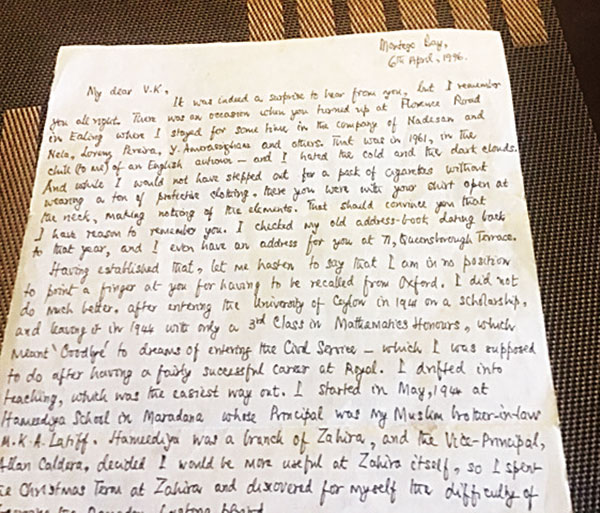
Fast forward to 1996. There were quite a few old boys in Los Angeles who had kept in touch with Bruno, or “Mr. Dibs” as he was called during his lengthy teaching career at Cornwall College in Montego Bay. I got his address and wrote to him, hoping he would remember me. His response in beautiful calligraphy, a letter which I treasure, states inter alia, “I remember you all right. That was in 1961, in the chill (to me) of an English autumn – and I hated the cold and the dark clouds. And while I would not have stepped out for a pack of cigarettes without wearing a ton of protective clothing, there you were with your shirt open at the neck, making nothing of the elements. That should convince you that I have reason to remember you”.
In my letter to him, I had told him how proud I was of my children, and praised my wife (this was in 1996, things have changed since). His conclusion: “If you remember Carl Muller, now a best -selling author sponsored by Penguin Books Ltd., he wrote about his third wife in much the same way that you praised your wife’s loyalty – even asking the Pope to canonize her. Please give your good lady my regards and best wishes. You can be proud of your wonderful family. God bless you all. Elmo de Bruin”.
25 years later, three out of four ain’t bad.
I believe Bruno or Mr. Dibs as he was known in Jamaica received Jamaica’s highest teaching honour, the Order of Distinction. He has been described as “a living treasure of Jamaica”. A treasure that was rightfully ours.
The only trouble I got into in my school career was during my final year, when we had forsaken our Kollupitiya home to live in government housing in North Colombo. I had to fend for myself for lunch. My mother gave me Rs. 1.50 to treat myself to a plate of mixed fried rice at a nearby Chinese restaurant. Some of us occasionally cycled to lunch at a vegetarian restaurant in Bambalapitya, the famous Saraswathie Lodge, a couple of miles from school. We used to polish off copious quantities of traditional Tamil food, followed by a Marcovitch Black & White cigarette, all at a cost of 47 cents, which enabled me to make a substantial profit from my lunch allowance.
These excursions had gained currency in the school, and prompted one of the school prefects to conduct a “raid”. We were caught red handed. The raider of the thosai joint reported us to the principal. I cannot remember the punishment meted out, only that it was not corporal.
This story is interesting only because the officious prefect who “copped” us was none other than the illustrious, though less so in his role of a college prefect in the incident under reference, Mr. Lalith Athulathmudali, who went on to be the President of the Oxford Union and a leading cabinet minister of the then ruling United National Party. He was tragically assassinated during the violence of presidential politics of the 1990s.
In those days, Mr. Athulathmudali lived in, I think, Deal Place, Colombo 3, and he had to walk down the drain, as 27th Lane was then called, passing our house on his way home. We had moved back to Fifth Lane at the time, after my father resigned from his government position at the Port of Colombo.
There were often one or more attractive aunts living with us while they were pursuing their university studies in Colombo. I was occasionally able to persuade one of them to make “funny faces and noises” from the balcony at the then pompous prefect, while I was greeting him most respectfully from ground level.
My classmates at Royal have ended up as masters of industry, eminent physicians, lawyers of international repute, towering above me in their achievements. I have no chance of equaling them in any way. So I plan to outlive them all.


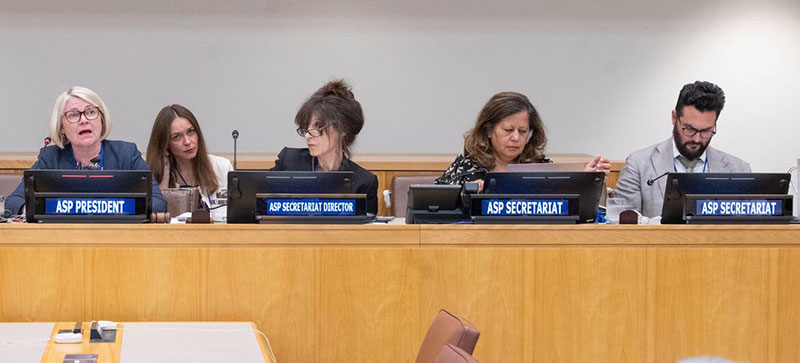
 US Secretary of State Marco Rubio’s warning to the International Criminal Court (ICC) was stark: ‘Either the ICC will end its threats, or we will end the ICC.’ It followed US central administration accusations that the court was unfairly targeting Americans on the basis of trumped-up war crimes charges.
However, a new plethora of sanctions has been clamped on the ICC by the US, which in turn has spurred accusations by sections of the world that the latter has unleashed an ‘assault’ on the international legal order.
What some of the sanctions would mean for the ICC was outlined by Rubio: ‘We will ban transactions with this rogue court, cutting off their resources and crippling their ability to operate against us.’
The ICC has shown consistency of purpose over the years. Despite some operational constraints it has indicted a large number of political strongmen from around the world, accused of war crimes and other governance excesses that come under its purview. Two such recent figures are: Russian President Vladimir Putin and Israeli Prime Minister Benjamin Netanyahu.
Rather than enjoy a mere nominal presence in the world community, the ICC has proved its effectiveness by detaining and bringing to justice scores of VIP politicians and others of their ilk who have been found guilty of human rights abuses and kindred excesses that come within the terms of reference of the ICC.
Accordingly, the international justice system would be stymied considerably as a result of the ICC being dis-empowered, particularly financially. Needless to say, potential and real perpetrators of the species of crime coming under the jurisdiction of the ICC would stand to gain most from such anarchic tendencies. That is, political repression globally would be enabled to enjoy a new lease of life.
A detailing of the types of crime coming under the purview of the ICC provides an idea of what it would cost the international community if the ICC’s operations are gravely hampered. They are mainly: genocide, war crimes, crimes against humanity and the crime of aggression.
That is, the part of the world to be worst affected would be the global South, since the latter is awash with the mentioned crimes. Needless to say, a chronically-disaffected South will sooner rather than later undermine the well being of the world dangerously. The world is already being put through these paces.
At the time of writing, ‘illegal migrants’ from the South, for example, are aggravating many a Western economy’s woes, besides creating for them acute law and order issues. The fact that these migrants’ presence goes on to become a virtual test of the migrant receiving states’ ability to forge domestic social inclusion in the face of jingoistic protests by mainly white supremacist groups is evidence of the latter. As is known, the US, to take just one example, has been up against this crisis for quite a while.
Accordingly, it will be in the best interests of the West if ‘illegal’ migrant arrivals on their shores are stemmed. If the socio-political and economic problems assailing the South are effectively managed through North-South collaborative, ‘trouble-shooting’ efforts the causes leading to ‘illegal’ migration and connected issues could be resolved at source as it were. For, it is the aggravation of the South’s material questions that lays the basis for the emergence of repressive and anti-democratic regimes in the hemisphere.
Until such time that the aforementioned issues in North-South relations are visited afresh and addressed urgently, a vibrantly functioning ICC would be needed. For, the latter would prove a deterrent to Southern political and military strongmen, highly prone to power abuse and like excesses, from coming into being in the wake of the South’s chronic material woes and the wars and conflicts that result from them.
It stands to reason then that the US would be acting in its own interests by enabling the ICC to perpetuate its mandate without hindrance. For a crop of issues that impinges negatively on internal law and order would be defused.
Meanwhile, there needs to be a meeting of minds among the rest of the West to put back in place a North-South dialogue process aimed at reducing some of the economic pressures that are weighing on the South.
Since economics usually drives politics it will be in the interests of the world community to scrutinizingly re-visit North-South issues of the past and put in place economic relief packages for Southern publics that would enable them to tide over their material hardships rather than permit the latter to aggravate into social disaffection and eventually armed militancy. It is the latter juncture that paves the way for the emergence of authoritarian rulers in the South who then go on to be a blight on their publics.
Accordingly, the Southern-based global development thinking of the past that envisaged a more equitable world economic order needs to be seen as an urgent need. That is, NAM’s international development paradigms need to be resuscitated to the extent possible.
It is unlikely that rightist governments of the West, such as the current Republican administration in the US, would find these projects feasible, but democratic states of Europe, led by perhaps the UK, are likely to think otherwise. For it would not be beneficial for the democratic world to be having on their hands repressive governments in the South who would be gravitating towards the major military and economic actors of the South, such as Iran and North Korea, who tend to be in constant power struggles with the West.
However, until such time that the mentioned, pro-people initiatives are given serious thought the ICC would need to be enabled by the international community to be in place comfortably and carry on with its mandate of bringing repressive rulers to book. Besides the ICC should pave the way for the peoples of the developing world to enjoy some substantial respite from the political repression and even terror which tend to be their lot.
Meanwhile, the wars of West Asia are relentlessly aggravating the economic hardships of people everywhere, driving the point home to enlightened sections that there is no alternative to peacemaking. A challenge is to convert the US under President Trump to this line of thinking.

 This week, I give you five simple, time-tested homemade remedies that help reduce the appearance of blemishes, control excess shine and leave your skin feeling softer and smoother.
The Honey and Lemon Brightening Dab:
For stubborn blemish marks, this is a classic. Mix one teaspoon of pure bee honey with three to four drops of fresh lemon juice. Apply gently, only on the affected spots, and leave for 10 minutes before rinsing with lukewarm water. While honey soothes and softens, lemon helps to brighten naturally. Use twice a week in the evening.
Besan and Rose Water Oil-Control Pack:
An ideal remedy to combat shine, especially on the T-zone. Take two teaspoons of besan (gram flour) and mix with sufficient rose water to form a smooth paste. Add a pinch of turmeric for its antiseptic goodness. Apply evenly, keep for 15 minutes and wash off. It absorbs excess oil without over-drying, leaving a beautiful matte finish.
Aloe Vera and Cucumber Ice Soother:
Blend fresh aloe vera gel with the juice of a grated cucumber and freeze the mixture in an ice tray. Each morning, wrap one cube in a soft muslin cloth and gently rub over a cleansed face for 30 seconds. It calms, tightens pores and imparts a baby-soft smoothness.
Oatmeal and Curd Gentle Polish:
Roughness and old blemish marks need gentle exfoliation. Combine one tablespoon of finely powdered oatmeal with one tablespoon of fresh curd (yoghurt). Massage very gently, in circular motions, for one minute, leave for five minutes and rinse. It removes dead cells and unveils softer, clearer skin.
Multani Mitti and Green Tea Magic Mask:
Brew some green tea and allow it to cool completely. Mix one and a half teaspoons of Multani Mitti (Fuller’s Earth) with the tea water to make a fine paste. Apply for 10 to 12 minutes – do not let it dry and crack completely – and wash off. It draws out impurities, fades blemishes and bestows a fresh, shine-free glow.
A Gentle Reminder:
As with any natural remedy, always do a patch test on your inner arm first. For those with oily or combination skin, avoid heavy coconut oil application and harsh scrubbing, as they tend to aggravate shine and blemishes.

 Dream of performing on a world stage? Well, here is your unique, golden opportunity!
The World Championships of Performing Arts (WCOPA) — the one and only official “Talent Olympics” — is the world’s premier global platform for aspiring singers, dancers, actors, models, instrumentalists, etc., to compete, shine and be discovered!
And, yes, this world stage is open to YOU, Sri Lankans living in Sri Lanka and overseas!
Held annually in glittering Las Vegas, WCOPA brings together over 70 countries, all competing for Gold, Silver and Bronze Medals, just like the traditional Olympics.

Lakisha Bernard: Will represent Team Sri Lanka at WCOPA 2027
Outstanding performers vie for the coveted titles of Junior and Senior Grand Champion Performer of the World, with winners and standout participants awarded over $500,000 in scholarships, cash awards and prizes to catapult their education and careers!
Sri Lanka is already making waves! At WCOPA 2026, Natharie Wickramasinghe, representing Team Sri Lanka, made the nation proud by winning a Bronze Medal in the Ethnic/Folklore Dance category!

Lakisha: Accomplished freelance Model and Fashion Design graduate
Recruitment for this prestigious competition is handled through a system of scouts and licensed National Directors — and this is where our very own Chris Rajendra, now based in Las Vegas, and National Director for Team Sri Lanka, comes into the scene.
If you are a singer, dancer, actor, model, instrumentalist — if you have talent burning inside you — contact Chris Rajendra today for registration and, who knows, you may find yourself in Las Vegas, and proudly draped in the Sri Lankan flag, at WCOPA 2027!
The contact address is: Chris Rajendra, wcopa.nationaldirector.sl@gmail.com
or chris.rajendra@gmail.com
Meanwhile, a star is born for 2027, in the form of Lakisha Bernard who is all set to represent Team Sri Lanka at WCOPA 2027.
Originally hailing from the sun-drenched coastal city of Colombo and now carving out her creative career in Canada, 22-year-old Lakisha is stepping into the international spotlight.
This accomplished freelance Model and Fashion Design graduate has officially been appointed as the Team Sri Lanka Promoter for Canada as she prepares to represent Team Sri Lanka at WCOPA in Las Vegas.
Lakisha brings a unique blend of high-fashion sensibility, captivating camera presence and expert garment design to the Team.
Having built her career, from local college shoots to high-glamour concepts, Lakisha’s inspiring journey embodies the true spirit of cultural bridge-building and creative resilience, bringing immense pride and recognition to Sri Lanka on the global stage.
WCOPA 2027 will be held at the legendary Westgate Hotel & Casino, Las Vegas, from 12th to 20th July – the very same iconic arena where the late, great Elvis Presley himself performed!
Your moment is now. Your stage is Las Vegas, so hurry and contact Chris Rajendra.

Showers or thundershowers will occur at most parts of the island

Prison rules to be revised over monks’ attire

AC President recuses himself from hearing prison attire case pertaining to Gnanasara Thera

Court orders steps to obtain INTERPOL Red Notice against Basil

CID informs Fort Magistrate’s Court investigation into money laundering case against Namal completed

No force used to make Gnanasara Thera wear prison garb – Prisons

‘Dates have the highest sugar content to fight Coronavirus’

Sunday Island 27 December – Headlines

#SundayIsland 17th December – Headlines

Sunday Island – 28th March

Sunday Island Headlines – 21 March

Sunday Island – 21st February – Headlines
-

 News6 days ago
NDB fraud Rs 60mn more than reported
-

 News6 days ago
Removing monk’s robes matter for Sangha to decide: Mahanayake Theras
-

 News4 days ago
Sri Lanka escalates anti-graft drive with Shiranthi’s jailing
-

 News5 days ago
NPP govt. reminded of its responsibilities as US warship leaves Colombo
-
 Latest News5 days ago
Farhan, Sadaqat help Pakistan ace 183 chase to go 1-0 up
-
 News6 days ago
BHC, Colombo: “LTTE remains a proscribed org. in the UK”
-

 Latest News3 days ago
Farhan and Sadaqat help Pakistan seal series in style
-

 News4 days ago
Iranian ships stranded, Lanka fears US sanctions