Connect with us

Latest News

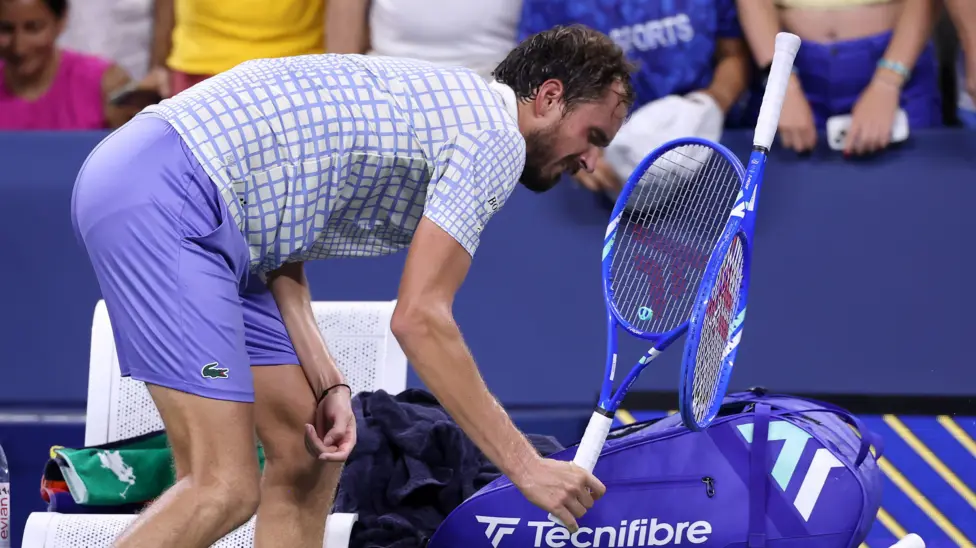
Medvedev beaten after photographer enters court

Published

on

Former world number one Daniil Medvedev has won only one Grand Slam match in the 2025 season [BBC]

A devastated Daniil Medvedev was knocked out of the US Open after a meltdown sparked by a photographer walking on to the court during his first-round defeat by Benjamin Bonzi.

Medvedev has produced some extraordinary moments at Flushing Meadows over the years – but what happened on the 2021 champion’s way to another humbling defeat was perhaps the most incredible.

As the Russian faced match point at 5-4 in the third set, the cameraman walked on to the playing surface between his French opponent Bonzi’s first and second serve.

Cue bedlam as the incident – and Medvedev’s reaction – changed the course of the match.

Medvedev, 29, raged after umpire Greg Allensworth decided Bonzi could have another first serve, whipping the New York crowd into a frenzy and forcing a delay of six minutes and 24 seconds.

Bonzi understandably lost focus as boos rained down and could not serve out victory.

Almost two hours later, shortly before 1am local time, he eventually secured a remarkable 6-3 7-5 6-7 (5-7) 0-6 6-4 win.

“I just expressed my emotions, my unhappiness with the decision, and then the crowd did what they did without me asking them too much,” said Medvedev, who has won just one Grand Slam match this year. “It was fun to witness.”

The photographer, who appeared to be trying to find a position in the long-lens pit at the side of the court, was later escorted out of Louis Armstrong Stadium by security.

“His credential has been revoked for the 2025 US Open,” United States Tennis Association organisers told BBC Sport.

[BBC]



Continue Reading
Click to comment

Leave a Reply

Your email address will not be published. Required fields are marked *

Latest News

Putin says Russia will take Donbas by force or Ukraine’s troops will withdraw

Published

on

By

President Vladimir Putin has warned again that Ukrainian troops must withdraw from Ukraine’s eastern Donbas region or Russia will seize it, rejecting any compromise over how to end the war in Ukraine.

“Either we liberate these territories by force, or Ukrainian troops will leave these territories,” he told India Today. Moscow controls around 85% of Donbas.

Ukrainian President Volodymyr Zelensky has ruled out ceding territory.

Putin’s comments come after President Donald Trump said his negotiators discussing a US peace plan believed Russia’s leader “would like to end the war” after Tuesday’s talks in Moscow.

Trump’s envoy Steve Witkoff, who was in Moscow, is due to meet Ukraine’s team in Florida.

Trump said Tuesday’s talks in the Kremlin were “reasonably good”, adding it was too soon to say what would happen as “it does take two to tango”.

The original iteration of the US peace plan proposed to hand over areas of the Donbas still under Ukrainian control to the de facto control of Putin – but the Witkoff team presented a modified version in Moscow.

In his India Today interview ahead of a state visit to Delhi, Putin said he had not seen the new version before his talks with Witkoff and Jared Kushner, Trump’s son-in-law.

“That’s why we had to go over every point, that’s why it took so long,” the Kremlin leader said.

He also said Moscow disagreed with parts of the US plan.

“At times we said that yes, we can discuss this, but to that we can’t agree,” Putin said.

He did not name the sticking points. At least two significant points of contention remain – the fate of Ukrainian territory seized by Russian forces and security guarantees for Ukraine.

Putin’s senior foreign policy adviser and key negotiator Yuri Ushakov earlier said straight after the talks that they produced “no compromise” on ending the war.

Ushakov also implied that the Russian negotiating position had been strengthened thanks to what Moscow said were its recent successes on the battlefield.

Ukraine has repeatedly accused Russia of stalling any ceasefire agreements, saying Moscow is seeking to seize more Ukrainian territory.

Commenting on the Kremlin talks, Ukrainian Foreign Minister Andrii Sybhia said Putin was “wasting the world’s time”.

Ukraine has long insisted on firm security guarantees for Ukraine in any deal.

On Wednesday, Zelensky said “the world clearly feels that there is a real opportunity to end the war” – but negotiations must be “backed by pressure on Russia”, which Kyiv and its European allies accuse of deliberately stalling any ceasefire agreements.

The Ukrainian president said last week his top negotiators had managed to make some key changes in the original US peace plan – seen as strongly favouring Moscow – during talks with an American delegation in Geneva on 23 November.

In a joint statement, US and Ukrainian negotiators said at the time they had drawn up an updated and refined peace framework – but provided no further details.

Top negotiators from Europe – who had voiced concern over the original US plan – were also in the Swiss city last week, meeting separately with the Ukrainian and the US teams.

In a separate development on Thursday, Germany’s Der Spiegel news website said it had obtained a confidential transcript of a conference call in which European leaders expressed concern over the US negotiations.

“There is a possibility that the US will betray Ukraine on the issue of territory without clarity on security guarantees,” French President Emmanuel Macron reportedly said, according to an English transcript of Monday’s conference call.

Meanwhile, German Chancellor Friedrich Merz was quoted as warning that Zelensky had to be “extremely careful in the coming days”.

“They are playing games, both with you and with us,” Merz reportedly said.

Finnish President Alexander Stubb was also quoted as saying: “We mustn’t leave Ukraine and Volodymyr alone with these guys.”

The BBC has not seen the reported transcript.

In response to a Der Spiegel inquiry, France’s Élysée Palace stated that “the president did not express himself in those terms”. The presidential office declined to provide details on how Macron expressed himself, citing confidentiality.

Stubb declined to comment to Der Spiegel, and Merz has not commented on the issue.

In a statement to the BBC, the White House said: “Secretary [Marco] Rubio, Special Envoy Witkoff, Mr Kushner, and the President’s entire national security team are working tirelessly to stop the killing between Russia and Ukraine.”

“They have held productive meetings to gather feedback from both sides on a plan that can foster a durable, enforceable peace,” the statement read.

Russia launched a full-scale invasion of Ukraine in February 2022, and Moscow currently controls about 20% of Ukrainian territory.

In recent weeks, Russian troops have been slowly advancing in south-east Ukraine, despite reported heavy combat casualties.

[BBC]

Continue Reading

Latest News

486 dead, 341 missing, 171,778 displaced as at 0600hrs today [05]

Published

on

By

The situation report issued by the Disaster Management Center at 0600hrs today [5th December] confirms that 486 persons have died and another 341 persons are missing after the devastating weather conditions in the past week.

171,778 persons have been displaced and have taken refuge at 1,231 safety centers established by the government.


Continue Reading

Foreign News

Oil, defence and geopolitics: Why Putin is visiting Modi in Delhi

Published

on

By

Modi and Putin share a warm relationship [BBC]

Russian President Vladimir Putin is starting a two-day visit to India, where he will meet Prime Minister Narendra Modi and attend an annual summit held by both countries.

Delhi and Moscow are expected to sign a number of deals during the visit, which comes months after the US increased pressure on India to stop buying Russian oil.

It also comes as US President Donald Trump’s administration holds a series of talks with Russia and Ukraine in an attempt to end the war.

India and Russia have been close allies for decades and Putin and Modi share a warm relationship. Here’s a look at why they both need each other – and what to watch for as they meet.

Why are relations with India key for the Kremlin?

Well, for a start, look at the numbers:

  • a population of nearly a billion and a half.
  • economic growth exceeding 8%. India is the world’s fastest growing major economy.

That makes it a hugely attractive market for Russian goods and resources – especially oil.

India is the world’s third largest consumer of crude oil and has been buying large volumes from Russia. That wasn’t always the case. Before the Kremlin’s full-scale invasion of Ukraine, only 2.5% of India’s oil imports were Russian.

That figure jumped to 35% as India took advantage of Russian price discounts prompted by sanctions against Moscow and Russia’s restricted access to the European market.

India was happy. Washington less so.

Earlier this year, the Trump administration slapped an additional 25% tariff on Indian goods, arguing that by purchasing oil from Russia, India was helping to fund the Kremlin’s war chest. Orders from India for Russian oil have since dropped. President Putin will be keen for India to keep buying.

For Moscow, weapons sales to India are another priority and have been since Soviet times. Ahead of Putin’s visit, there were reports that India plans to purchase state-of-the-art Russian fighter jets and air defence systems.

Russia, hit by a labour shortage, also sees India as a valuable source of skilled workers.

But there’s geopolitics at play, too.

The Kremlin enjoys demonstrating that Western efforts to isolate it over the war in Ukraine have failed.

Flying to India and meeting Prime Minister Modi is one way of doing that.

So is travelling to China and holding talks with Xi Jinping, as Putin did three months ago. He met Modi on the same trip. The image of the three leaders smiling and chatting together sent a clear message that, despite the war in Ukraine, Moscow has powerful allies who support the concept of a “multi-polar world”.

Russia lauds its “no limits partnership” with China.

It is just as vocal about its “special and privileged strategic partnership” with India.

That is a stark contrast to Moscow’s strained relationship with the European Union.

“I think the Kremlin is sure that the West, including Europe, totally failed,” believes Novaya Gazeta columnist Andrei Kolesnikov.

“We are not isolated, because we have connections to Asia and the Global South. Economically, this is the future. In that sense Russia returned as the main actor in these parts of the globe, like the Soviet Union. But even the Soviet Union had special channels and connections to the US, West Germany and France. It had a multi-vector policy.

“But now we are totally isolated from Europe. This is unprecedented. Our philosophers always said that Russia was a part of Europe. Now we’re not. This is a big failure and a big loss. I’m sure that part of Russia’s political and entrepreneurial class is dreaming of returning to Europe and of doing business not only with China and India.”

This week, though, expect to hear about Russia-India friendship, trade deals and increased economic cooperation between Moscow and Delhi.

Getty Images Russian S400 drives on their way to Red Square during the general rehearsal of Victory Day military parade marking the 80th anniversary of the victory over Nazi Germany in World War II, at Red Square in Moscow, Russia on 7 May 2025
Weapon sales to India are a priority for Russia [BBC]

Putin’s visit to Delhi is coming at a crucial time for Modi and India’s global ambitions.

India-Russia ties go back to the Soviet era and have endured irrespective of the changing geopolitical landscape.

Putin has arguably put more time and energy into this relationship than other Russian leaders before him.

As for Modi, despite coming under intense pressure from Western governments to criticise Russia over its war in Ukraine, he maintained that dialogue was the only way to resolve the conflict.

This was India’s “strategic autonomy” at play – with Modi occupying a particular place in the geopolitical order where he held close ties with Moscow while maintaining his relationship with the West at the same time.

That worked – until Trump returned to the White House. India-US ties have hit an all time low in recent months as the two countries have failed to resolve the tariff deadlock.

In this context, Putin’s visit assumes more significance for Modi than ever before because it will test India’s geopolitical autonomy. He will be walking the proverbial diplomatic tightrope here.

Modi would want to show Indians at home and in the wider world that he still counts Putin as his ally and hasn’t given into pressure from Trump, whom he has earlier called his “true friend”.

But he has also faced pressure from his allies in Europe – just this week, the German, French and UK ambassadors in India wrote a rare joint article in a major newspaper criticising Russia’s stance on Ukraine.

And so, Modi will have to ensure that the strengthening of India-Russia ties does not overshadow ongoing trade talks with the US and his partnership with Europe.

“For India, the challenge is strategic balance – protecting autonomy while navigating pressure from Washington and dependence on Moscow,” said the Global Trade Research Initiative (GTRI), a Delhi-based think-tank.

Getty Images U.S. President Donald Trump delivers remarks during a meeting with New York City Mayor-elect Zohran Mamdani in the Oval Office of the White House on November 21, 2025 in Washington, DC
President Trump has imposed an additional 25% tariff on India as penalty for buying Russian oil [BBC]

Modi’s other priority will be to unlock the potential of bilateral trade between India and Russia.

Analysts have often said that the economic relationship between the two strong allies has underperformed for decades.

Their bilateral trade rose to $68.72bn at the end of March 2025, up from just $8.1bn in 2020. This was largely due to India sharply increasing discounted Russian oil purchases. This has skewed the balance heavily in favour of Russia and that is something Modi would want to correct.

With Indian firms already reducing oil purchases from Russia to avoid sanctions from Washington, the two countries will look at other areas to boost trade.

Defence is the easiest pick. India’s defence imports from Russia reduced to 36% between 2020 and 2024, from the peaks of 72% in 2010-2015 and 55% between 2015 and 2019, according to Stockholm International Peace Research Institute.

This was largely due to India’s attempt to diversify its defence portfolio and boost domestic manufacturing.

But a closer look at these numbers tells a different story. Several Indian defence platforms still rely heavily on Russia. Many of its 29 air force squadrons use Russian Sukhoi-30 jets.

India’s limited armed conflict with Pakistan in May this year proved the indispensable role of Russian platforms like the S-400 air defence systems in its armed forces but it also showed the vulnerabilities that the country urgently needs to fix.

Reports suggest that India wants to buy the upgraded S-500 systems and the Su-57 fifth-generation fighter jet. Pakistan’s purchase of the China-made J-35 fifth-generation stealth fighter has not gone unnoticed in Delhi, and it would want to secure a comparable jet as soon as possible.

But Russia is already facing a shortage of critical components due to sanctions and the war in Ukraine. The deadline to deliver some units of the S-400 have reportedly been delayed to 2026. Modi will seek some guarantees on timelines with Putin.

Modi would also want Russia’s economy to open space for Indian products to fix the massive trade imbalance.

“Consumer-oriented and high-visibility categories remain marginal: smartphones ($75.9m), shrimp ($75.7m), meat ($63m) and garments at just $20.94m underscore India’s limited penetration in Russia’s retail markets and electronics value chains despite geopolitical churn,” GTRI said.

Modi aims to position Indian goods in Russia’s market, especially once the war ends and Moscow is reintegrated into the global economy.

He would seek to lessen trade dependence on oil and defence, aiming for a deal that strengthens ties with Russia while leaving room to deepen relations with the West.

“Putin’s visit is not a nostalgic return to Cold War diplomacy. It is a negotiation over risk, supply chains and economic insulation. A modest outcome will secure oil and defence; an ambitious one will reshape regional economics,” GTRI said.

[BBC]

Continue Reading

Trending