
News
MCC inconsistent with Constitution

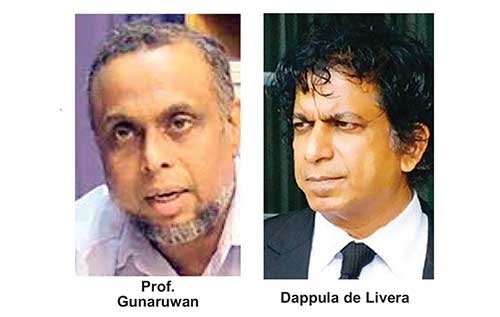
AG agrees with Prof. Gunaruwan report
By Shamindra Ferdinando
Attorney General Dappula de Livera, PC, has informed President Gotabaya Rajapaksa that the Millennium Challenge Corporation (MCC) Compact, Project Implementation Agreement, as well as Articles of Association of MCA (Millennium Challenge Act), Sri Lanka, are violative of cerain provisions of the Constitution.
The AG has said so in a 20-page report sent to Dr. P.B. Jayasundera, Secretary to the President.
The President’s Office on Sept. 3, 2020, sought the AG’s opinion on the MCC Compact and related matters in the wake of the Cabinet-appointed Prof. Gunaruwan Committee strongly advising against going ahead with the US initiative. The US sought Sri Lanka’s consent for the Acquisition and Cross Servicing Agreement (ACSA), Status of Forces Agreement (SOFA) and MCC. The previous government finalised ACSA in early August 2017.
Dr. Jayasundera made available the Gunaruwan report to the AG.
The outgoing US administration in Dec 2020 announced Sri Lanka had been left out of the MCC project.
AG’s Coordinating Officer State Counsel Nishara Jayaratne confirmed the MCC et al were inconsistent with the Constitution and other laws.
The Island,
however, learns that the AG’s Department on two previous occasions, in letters dated Oct 10, 2018 and June 10, 2019, addressed to Jonathan G. Nash, Chief Operating Officer, MCC, and Director General, External Resources Department, respectively, asserted that the Compact and the Programme Implementation Agreement (PIA) were in line with the Sri Lankan law.
The first letter was sent during Jayantha Jayasuriya’s tenure as the AG and the second under incumbent AG without his approval, sources said. Dappula de Livera succeeded Jayasuriya in April 2019 about a week after the April 21 Easter Sunday carnage. Jayasuriya is the incumbent Chief Justice.
Prof. Gunaruwan’s Committee soon after the last presidential election in Nov 2019 failed to obtain the AG’s Department opinion in spite of making representations through the Prime Minister’s Office.
In the run-up to 2019 parliamentary election, then Finance Minister Mangala Samaraweera said the Attorney General had approved the US project though the Sri Lanka Podujana Peramuna (SLPP) called it a sell-out.
The following is the text of the letter dated Oct 10, 2018 captioned ‘Legal Status of Proposed MCC Compact signed by Sanjay Rajaratnam, PC, Senior Additional Solicitor General, addressed to Jonathan G. Nash, Chief Operating Officer, MCC:
“I refer to your communication dated 27th September, 2018 in respect of the above captioned matter. In this regard, I am made to understand that the delegation from the Government of Sri Lanka was able to have fruitful discussion with the Millennium Challenge Corporation Team in resolving some of the outstanding issues.
“Having gleaned through the proposed Millennium Challenge Compact, the draft Program Implementation Agreement (PIA) as well as the Points of Discussion (without prejudice) between the negotiating parties which has been made available to me, I wish to at the very outset opine that no existing laws of Sri Lanka inhibit the Compact and the PIA being implemented in Sri Lanka. If I may elucidate further, the covenants of the Compact and the PIA do not infringe any existing domestic law or any previous undertakings given by the Government of Sri Lanka. It is acknowledged that the Compact imposes legal obligations on both parties to the Agreement
“Further, consequent to the negotiations and discussions had between parties, it is proposed that the Government of Sri Lanka would seek the passage of a law in Parliament to establish the MCA- Sri Lanka as a non-profit Company limited by guarantee under the Companies Act No.07 of 2007 to implement the provisions of the Compact. It is envisaged that the proposed enactment would encompass the Compact and the PIA as Annexures, which would form an integral part of this enactment.
“Thus, I am of the view that the passage of the said enactment by Parliament would result in the Compact and the PIA, having the parity of status of a domestic law in Sri Lanka.
“In the Context of the above, it is requisite that Section 7.1 of Article 7 of the Compact referring to the provisions on Entry Into Force, would be revised with the deletion of the sentence pertaining to the Compact prevailing over the domestic laws of Sri Lanka.
“However, in order to assuage any concerns with regard to the implementation of the Compact, by an unlikely event of a legislation in the future which may impinge or infringe the said compact, upon notification by the Ministry of Finance and Mass Media (the relevant Ministry) of this fact, a legal opinion would be tendered that the proposed legislation if proceeded with would violate the covenants of the Compact. This would enable the relevant Ministry to forward its observations to the Cabinet of Ministers and Parliament, that the Attorney-General has opined that the proposed Bill if enacted would violate the Compact.
“In the circumstances, I believe that the aforementioned matters would confirm the legal status of the Compact and its entry into force.”
“Copies were sent to Ms. Caroline Nguyen, Managing Director- Europe, Asia Pacific and Latin America Millennium Challenge Corporation and J. Charitha Ratwatte, Head of Policy Development and Chief of Party MCC- Sri Lanka Project.”



A specialists committee has been appointed by the Secretary to the Ministry of Agriculture, Livestock, Lands and Irrigation adhering to the decision of the Cabinet of Ministers dated 29.12.2025 for submitting appropriate recommendations analyzing the provisions of the draft bill formulation in regard to Animal Welfare.
Based on the recommendations of the said Committee, the Legal Draftsman has been instructed at the meeting of the Cabinet of Ministers held on 18.05.2026 to prepare the final bill on the animal welfare.
Wherefore, the Legal Draftsman has formulated the draft bill and the clearance of the Attorney General has been received in the connection.
Accordingly, the Cabinet of Ministers granted approval to the resolution furnished by the Minister of Agriculture, Livestock, Lands and Irrigation to publish the said draft bill in the
Government Gazette Notification and subsequently forward the same to the Parliament for its concurrence.
Under the legal provisions for elections in this country since 2004, it is mandatory for voters who come to mark their votes to verify their identity through a valid identity card, and it is also mandatory for all such voters to be marked with an appropriate mark using indelible ink. The dual purpose of these two functions is to prevent a voter from voting more than once in a single election.
It has been observed that having to follow two different
methods at the same time to achieve the same objective hinders the efficiency of the duties performed at the polling stations and also incurs additional costs to the government.
Therefore, it has been deemed appropriate to remove the legal provisions regarding the use of indelible ink and marking the voter with the appropriate mark from all election acts.
Accordingly, the development activities of the province, as well as national security, will benefit. Therefore, the Cabinet of Ministers has approved the resolution furnished by the
President to take necessary steps to remove the legal provisions
• Section 36 of the presidential Election Act, No 15 of 1981
• Section 38 of the Parliamentary Election Act, No 01 of 1981
• Section 36 of the Provincial Council Election Act, No 02 of 1988
• Section 53 A of the Local Government Elections Ordinance (262 Authority)
• Section 21 of the Referendum Act No 7 of 1981
News
Showers will occur in the Western, Sabaragamuwa and North-western provinces and in Galle, Matara, Kandy and Nuwara-Eliya districts


WEATHER FORECAST FOR 24 JUNE 2026
Issued at 05.30 a.m. on 24 June 2026 by the Department of Meteorology
Several spells of showers will occur in the Western, Sabaragamuwa and North-western provinces and in Galle, Matara, Kandy and Nuwara-Eliya districts. Showers or thundershowers may occur at a few places in the Uva province and in Ampara and Batticaloa districts after 2.00 p.m.
Fairly strong winds about (30-40) kmph can be expectedat times over the Western slopes of the central hills, the Northern, North-central, North-western and Southern provinces and in Trincomalee district.
The general public is kindly requested to take adequate precautions to minimize damage caused by temporary localized strong winds and lightning during thundershowers.

Munoz sends Colombia into World Cup knockouts with 1-0 win over DR Congo

Animal Welfare Draft Bill to be Gazetted
Legal provisions on marking voters using indelible ink during elections removed

Showers will occur in the Western, Sabaragamuwa and North-western provinces and in Galle, Matara, Kandy and Nuwara-Eliya districts

Court vacancy row throws Parliament into turmoil; sittings disrupted

Climate, pollution, forest loss now hitting economy: BASL chief

‘Dates have the highest sugar content to fight Coronavirus’

Sunday Island 27 December – Headlines

#SundayIsland 17th December – Headlines

Sunday Island – 28th March

Sunday Island Headlines – 21 March

Sunday Island – 21st February – Headlines
-

 News6 days ago
Creditor receives USD 2.5 mn as Lankan public bears loss from theft of Treasury funds
-

 News5 days ago
Creditor not yet paid
-

 News5 days ago
Consumers bearing 22% tax burden despite 18% VAT claim: Dr. Harsha de Silva
-

 Opinion7 days ago
Beyond diagnosis: A strategic design for 7% growth by 2029 (Part I)
-

 Features4 days ago
Nanda Pethiyagoda Wanasundara as three generations of family saw her
-

 Features3 days ago
Sri Lanka developing independent hydrographic capabilities
-

 Opinion6 days ago
SriLankan Airbus struck by lightning
-

 Latest News3 days ago
Sooryavanshi thumps fastest List A fifty as India A win tri-series