
Latest News
Mathews 141, Chandimal 107 put Sri Lanka 212 ahead


Angelo Mathews amassed 141, Dinesh Chandimal struck a 15th Test century, and together the pair put on 232 for the fourth wicket, as Sri Lanka surged to a 212-run lead on a flat SSC surface. A thoroughly inexperienced Afghanistan attack were doughty through parts of the day, picking up six wickets, but were up against batters intent on driving home Sri Lanka’s advantage.
Debutant Naveed Zadran and legspinner Oais Ahmad picked up two wickets each, with Ahmed dismissing Mathews hit wicket off what turned out to be the last ball of the day. Mathews had gone deep in the crease to smack a legside long hop for four through deep backward square. But in the follow-through, the toe of his bat clipped the top of his leg stump, leaving Mathews to sink to his knees in despair.
Still, it was a tough day for the bowlers. Left-arm spinner Zia-ur-Rehman – also playing his first Test – put in some of the tightest spells on a pitch that had not begun to turn yet, but could not get a breakthrough from his 28 overs. Mohammad Saleem, the third debutant in this attack, could not quite finish off the day, walking off the field after delivering the first ball of his 13th over with a suspected leg injury.
It was the Mathews-Chandimal stand that drove Sri Lanka’s dominance on day two. Mathews had been tested by Nijat Masood’s short ball early in the day, but once he saw through that period, settled into one of his steady innings, finding frequent singles square of the wicket. He’d occasionally look for the big shots as well, particularly when a few dot balls had built. He hit each of the spinners for sixes in the second session, lofting Rehman into the sight-screen first, before launching Ahmed over long on much later, and adding another six – cow corner off Ahmed this time – in the third session.
His tempo rarely changed, right through his 259-ball innings. His first fifty came off 100 balls, his second off 85. And beyond those early battles with Masood, no one really looked like troubling him for long. This was his 16th Test hundred, which brings him up to fourth-equal on the Sri Lankan all-time list, alongside Tillakaratne Dilshan, Marvan Atapattu, and Dimuth Karunaratne.
Chandimal, likewise, did not have particularly difficult battles with the spinners, who did the bulk of the bowling after lunch. Where Mathews tended to stay in the crease, Chandimal was much more given to venturing out, as he looked for either singles down the ground, or the big shots inside out over extra cover, as well as over midwicket. His scoring areas were largely in front of the stumps, with very little coming through third man.
His century was quicker than Mathews’ coming off 168 balls. He was eventually out for 107, nicking an away seamer from Naveed behind, after Afghanistan had taken the second new ball. That wicket brought two more – that of Dhananjaya de Silva, who thought he had struck his first ball past Hashmatullah Shahidi at mid-off, only for Shahidi to make a diving stop, and throw down the stumps while still on the ground before de Silva even got close to recovering his ground (he had travelled three-quarters of the way of the surface and Mathews had not committed to the run). And then Mathews’ wicket meant Sri Lanka lost 3 for 30 to end the day.
Before Mathews and Chandimal took the game away, Afghanistan had had a decent first session, even if there was little chance of them preventing a significant Sri Lanka lead. Naveed had had Nishan Madushka caught to a leg gully trap in the third over, before Masood bounced Kusal Mendis out, having him caught at fine leg for 21.
Karunaratne ensured Sri Lanka’s total raced past Afghanistan’s though, finding easy singles, and proactively seeking boundaries, as he barreled ahead at better than a run-a-ball. Having started the day on 42, he strode to a half-century off the seventh ball he faced. He was out for 77 off 72, coming down the track to make an Ahmed delivery a full toss, but then promptly clipping it to short midwicket.
Brief scores:
Sri Lanka 410 for 6 in 101.2 overs (Nishan Madushka 37, Dimuth Karunarathne 77, Angelo Mathews 141, Dinesh Chandimal 107, Sadeera Samarawickrema 21*; Naveed Zadran 2-80, Qais Ahmed 2-93) lead Afghanistan 198 in 62.4 (Rahmat Shah 91; Vishwa Fernando 4-51) overs by 212 runs







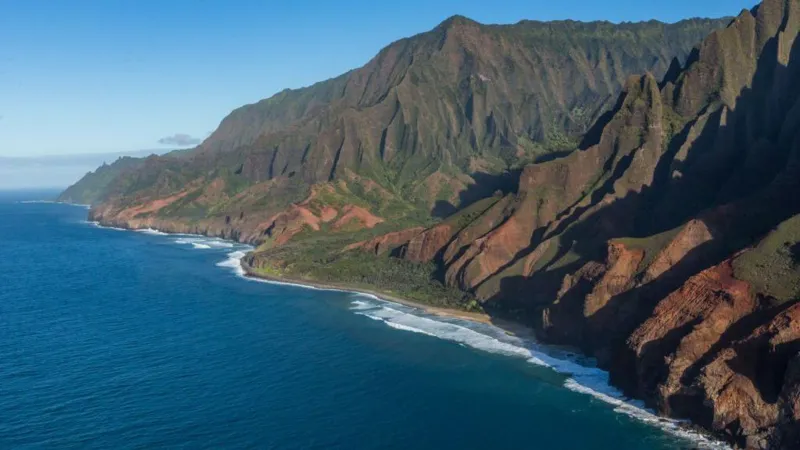
Three people have died after a helicopter crashed off the Hawaiian island of Kauai, police said.
The helicopter was carrying one pilot and four passengers, police said in a statement. Two survivors were taken to a hospital for treatment.
Police said the helicopter was operated by Airborne Aviation, a company whose website advertises “a doors-off thrill seekers adventure tour” of the picturesque island’s waterfalls, canyons, and beaches.
The US Coast Guard said the helicopter crash-landed about 100 yards off Kalalau beach. Authorities have not yet identified the victims.
Police said they responded to an alert of the crash at around 15:45 local time (01:45 GMT), along with the Coast Guard and fire department.
Kauai’s Mayor Derek Kawakami praised the recovery effort, telling local media: “Here on Kaua’i, whenever somebody puts their feet on our soil, they are one of ours.
“We treat them like one of ours, they are a part of our family, and our first responders respond with that spirit in mind.”
Andrew Williams, search and rescue mission co-ordinator for the Coast Guard in Honolulu, said: “We are greatly saddened by the loss of three lives in this helicopter crash and thinking of those individuals’ families and friends.”
Helicopter tours are a popular way for visitors to tour the island, which is where the blockbuster film Jurassic Park was shot.
Airborne Aviation’s 50-minute tour of the island offered a maximum of four passengers and costs $348 (£262) per passenger, according to its website.
BBC News has contacted Airborne Aviation for comment.
The incident is the latest fatal crash in Kauai involving a tour helicopter. Three people were killed when a helicopter operated by a different tour company crashed in July 2024.
The 2024 crash was caused by “an encounter with turbulence due to downdraft winds that resulted in mast bumping and an inflight breakup”, a report by the National Transportation Safety Board said.
[BBC]
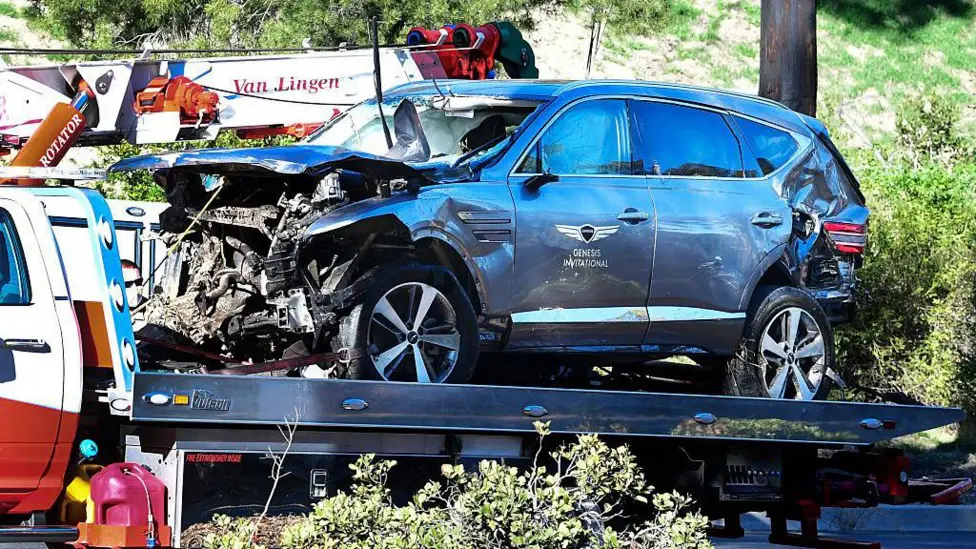
Tiger Woods has been charged with driving under the influence after rolling his car in a crash in Florida, police have confirmed.
The Martin County Sheriff’s Office said the 15-time major champion was also charged with property damage and refusal to submit to a lawful test.
Woods, 50, rolled his Land Rover after clipping a pressure cleaner truck while trying to overtake it at “a high rate of speed”, according to Sheriff John Budensiek.
The golfer, who had to crawl out of the passenger door of his vehicle, passed a breathalyser test after the crash but refused a urine test.
No-one sustained any injuries in the incident which took place on Beach Road in Jupiter Island just before 14:00 local time on Friday (about 19:00 GMT).
Sheriff Budensiek told a news conference: “The DUI investigators came to the scene and Mr Woods did exemplify signs of impairment.
“They did several tests on him. He did explain the injuries and surgeries that he’s had and we did take that into account, but they did some in-depth roadside tests.
“When it was determined, he was placed under arrest and taken to the Martin County jail.
“At the Martin County jail, and even on scene, we were really not suspicious of alcohol being involved in this case and that proved to be true.
“Mr Woods did a breathalyser test with triple zeros, but when it came time for us to ask for a urinary analysis test, he refused.”
Budensiek also said Woods had been “co-operative but was trying not to incriminate himself”.
“He has a right to refuse that test,” added the sheriff. “There is a statute which he will be charged with for refusing to take that test, but we will never get definitive results as to what he was impaired on at the time of the crash.”
US president Donald Trump was asked about the crash on Friday, saying: “I feel so badly. [Woods has] got some difficulty. There was an accident. That’s all I know.
“He’s a very close friend of mine, he’s an amazing person, an amazing man.”
Sheriff Budensiek said Woods would remain in jail for eight hours then be released on bond. The charges are misdemeanours, not felonies.
The BBC has contacted the golfer’s representatives for comment.
This is not the first time Woods has been involved in a car accident – he has played a limited schedule since the serious crash in 2021 that left him with extensive injuries and fortunate to be alive.
In 2017 police officers also found him slumped at the wheel of his parked Mercedes-Benz not far from his Florida home.
A toxicology report found Woods had several legal medications in his system and marijuana’s active ingredient, and he was sentenced to a year’s probation after pleading guilty to reckless driving.
In 2009 Woods hit a fire hydrant, a tree, and several hedges in a bizarre collision outside his home.
The incident sparked accusations of extramarital affairs which led to the end of his seven-year marriage and the loss of lucrative sponsorship deals.
[BBC]
Latest News
Heat Index at Caution Level in the Western, Sabaragamuwa, Southern, Eastern, North-western, Northern and North-central provinces and in Monaragala district
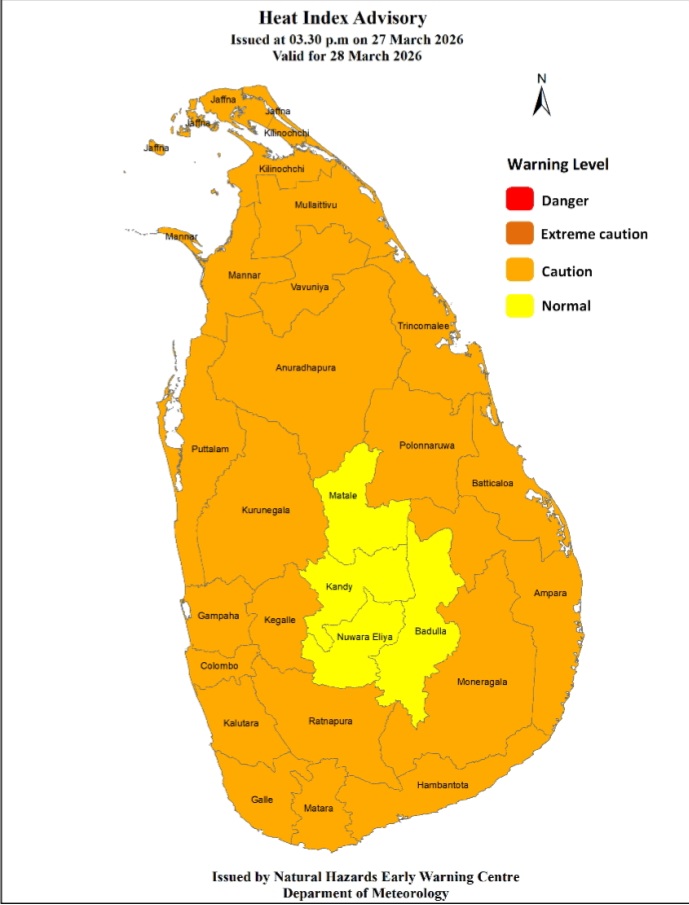
Warm Weather Advisory
Issued by the Natural Hazards Early Warning Centre of the Department of Meteorology
Issued at 3.30 p.m. on 27 March 2026, valid for 28 March 2026.
The ‘Heat index‘, the temperature felt on human body is likely to increase up to ‘Caution level’ at some places in the Western, Sabaragamuwa, Southern, Eastern, North-western, Northern and North-central provinces and in Monaragala district
The Heat Index Forecast is calculated by using relative humidity and maximum temperature and this is the condition that is felt on your body. This is not the forecast of maximum temperature. It is generated by the Department of Meteorology for the next day period and prepared by using global numerical weather prediction model data.

Effect of the heat index on human body is mentioned in the above table and it is prepared on the advice of the Ministry of Health and Indigenous Medical Services.
ACTION REQUIRED
Job sites: Stay hydrated and takes breaks in the shade as often as possible.
Indoors: Check up on the elderly and the sick.
Vehicles: Never leave children unattended.
Outdoors: Limit strenuous outdoor activities, find shade and stay hydrated.
Dress: Wear lightweight and white or light-colored clothing.
Note:
In addition, please refer to advisories issued by the Disaster Preparedness & Response Division, Ministry of Health in this regard as well. For further clarifications please contact 011-7446491.

Courtesy call by the Heads of Mission- Designate on Prime Minister

Three dead after helicopter crash in Hawaii

Woods charged with driving under influence after crash

Showers may occur at a few places in the Rathnapura, Kaluthara, Galle, and Matara districts during the evening or night

SC finds Keheliya, others, guilty of violating FRs of public through corrupt drug procurement deal

Sajith nudges govt. to follow India’s example in giving relief to consumers by slashing taxes on fuel

‘Dates have the highest sugar content to fight Coronavirus’

Sunday Island 27 December – Headlines

#SundayIsland 17th December – Headlines

Sunday Island – 28th March

Sunday Island Headlines – 21 March

Sunday Island – 21st February – Headlines
-

 News4 days ago
Senior citizens above 70 years to receive March allowances on Thursday (26)
-

 Features19 hours ago
A World Order in Crisis: War, Power, and Resistance
-

 Features6 days ago
Trincomalee oil tank farm: An engineering marvel
-

 News2 days ago
Energy Minister indicted on corruption charges ahead of no-faith motion against him
-

 News3 days ago
US dodges question on AKD’s claim SL denied permission for military aircraft to land
-

 Features6 days ago
The scientist who was finally heard
-

 Business3 days ago
Dialog Unveils Dialog Play Mini with Netflix and Apple TV
-

 Sports2 days ago
SLC to hold EGM in April