
Features
Match against Djokovic; Partying PM; Prince turned Mr Nobody, and no hope

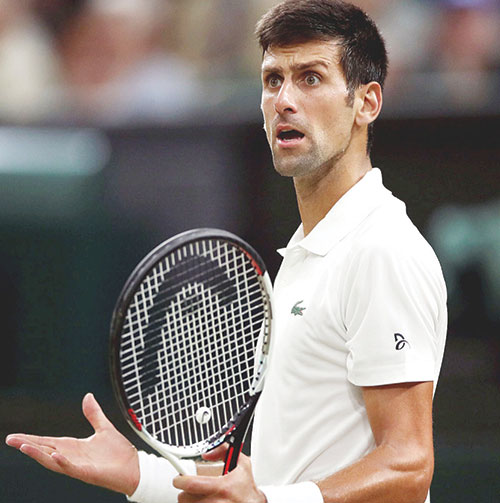
Slightly old hat but arguments for or against Novak Djokovic being allowed to stay in Melbourne for the Australian Open will swirl around and then die down, sadly, but inevitably. The sports world will go on; Australian might will continue; and people will soon forget and go about their business. May even be that when the winners of AO are announced only a couple of persons will remember him who was such a wonderful player who hardly ever lost his cool and seemed so steady and even relaxed when on tennis courts. Remember Robert Frost in his poem, Out, Out succinctly mentioning this fact at the end when the boy whose arm was cut by an electric saw breathed his last.
“And they, since they Were not the one dead, turned to their affairs.”
So very tragically true of all persons; all who brag, rant and pound their feet will die and not many will remember them.
Comments
 The Editor of this paper commented on it and seemed to stand for ‘the Law holds for all’. He made no mention of the health waiver the world’s Number One tennis wizard got which he traded on to go to Melbourne in the first place.
Dr Upul Wijayawardhana in his piece printed beside the editorial on Tuesday 18 – “Australian antics and Djokovic’s disgrace” mentioned this. “It is surprising that Djokovic was given a medical exemption to enter Australia by … Tennis Australia and the State Government of Victoria after testing positive for coronavirus.” He got the permission to enter the AO, so he did, though there were controversial issues.
So, Cass in her emotional and yes, unreasonable, sense, sides with the tennis player. He should have been segregated and allowed participation in the tournament. We do not ask they consider his attempt at being the tennis world’s first to win 21 grand slams, but that here was an outstanding sportsman who got clearance to enter and was even permitted release from segregation in a hotel and allowed to resume preparing for the tournament to start on the 17th. It seemed to be a tussle between a state government and that of Australia and poor Novak was A pawn, as it were.
Now, the Aussie Open has lost its glamour and even interest to this ole soul – Cassandra. She hoped Nadal and others would withdraw from the OA. But since it was not their deportation, they go along. Hopefully they will publicly comment in support of their co-sportsman. Nadal already spoke out.
Ordinary citizen of UK
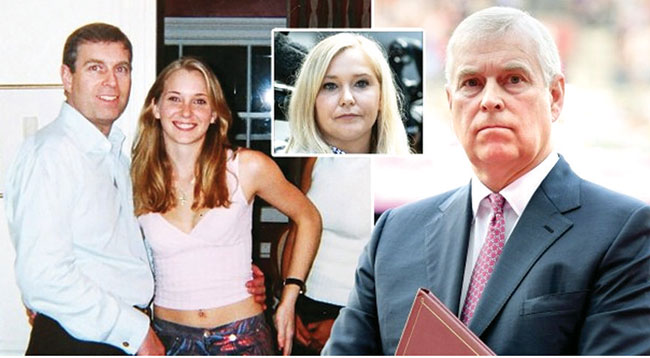
Poor Prince Andrew: his carnal desire has got him in a dirty soup! Will he, now be stripped of all titles and even won military honours, go forth to court to battle his case as Mr Andrew Windsor with perhaps Mountbatten added as a middle surname? What a downfall and comedown!
Cass has been having an emailed argument about whether Virginia G is a gold digger or not, and whether it can be accepted Andrew raped, as is accused, a teenager way back around two to three decades ago.
Cass’ arguing friend seems to see the issue in the light of what Virginia G wants to crush: – power, money and connections used against the underprivileged. She has spelled out her legal pursuit of Andrew thus. Noble aim but why select only this former prince? Surely there were others earlier – Epstein himself. To Cass she has schemed her way adroitly, seeing Epstein imprisoned and committing suicide (it is said, though belief is he was done in, with all the secrets of the rich and powerful within him), and his aide and abettor in the crime of trafficking underage girls – Ghislaine Maxwell – convicted to prison for 50 odd years. Virginia would surely have banked on raking in a great amount of lucre and of course publicity, fat and middle aged as she now is. True, Andrew (we dare call him that) was accepting what Epstein offered him, but to Cass and her incisive eye, it would definitely not have been rape.
What came across sharply to Cass was the difference between her much younger correspondent’s opinion and Cass’. To the younger one Andrew was all black and Virginia a sweet little kid pounced upon and sullied against her wishes. Cass emerged rather old fashioned, believing in the adage that boys will be boys and men are allowed much more than girls/women who are censured more. Yes, that was the attitude of Sri Lankan society or what Cass knew of in her Kandy upbringing. We do not know whether a negotiation has been worked out or whether the ex-Prince faces the pretending Innocent in an American court of law with #metoo etc very strong over in the USA. The gracious duty-bound Queen is the greatest loser in this randy, rapacious business.
No storm in a teacup
The previous Cassandra Cry, referred to the bring-your-own-alcohol and observe- Covid-restrictions party in June 2019 in the garden of No 10 Downing Street. She classified it as a storm in the Brit’s cuppa. Not so, not so many means. This party has resulted in a loud call to the PM to resign, perhaps not only the premiership but his Parliament seat too, which means being thrown out of the Conservative Party leadership. Boris Johnson is a bird of the Andrew feather – loves fun and partying. But he marries his girlfriends, one by one! The storm is brewing and it’s getting hotter for the PM as ex employers throw in their tuppenny worth – all damning!
Us in Paradise?
We continue in Fool’s Paradise with fireplaces in gardens; fear of lack of medicines; rising costs and sharing the anger of helpless farmers shedding tears. “Half of USD 6.7 mn paid to China would have helped save Maha yield.” So pronounced SJB’s MP Rohini Kaviratna. Inexplicable, unbelievable, the pinnacle of absurdity not to import chemical fertiliser, weedicides and pesticides now that it has been realised the move to organic farming was too precipitous and cost the country and its people so very much. And to add fuel to the fire an announcement is made that a fresh order for organic manure has been sent to that seaweed company in China. We never learn. It’s corruption at whatever cost. And with no money to import fertiliser much is spent on food like beetroot and rice.
Chandra Jayaratne in The Island of Tuesday January 18 lists all our country and people’s travails in his article ‘People’s wishes.’ Cass painfully counted the words in one line of his article and computed that his very long first paragraph of 42 lines had approx 300 words – all of our country troubles. Him being the excellent writer with keen brain and good sense to match, writes very precisely. The list of woes was that long! So, you can imagine what dire straits we are in. His second paragraph lists origins of these maladies: “unprofessional, arrogant, egoistic, even childish … heading towards a failed state.”
Please, please wake up, those in power and do what needs to be done to brake the speeding to bankruptcy. We really do not want ‘splenour and prosperity’. We only want to live fairly decent lives, and that is not stymied by the pandemic. The ‘gloom and despondency and poverty’ are man-made.
On that note Cass says bye bye with no hope in her.





The Mediation (Civil and Commercial Disputes) Bill was passed by the Parliament on Thursday, June 11, 2026. Harshana Nanayakkara, Minister of Justice and National Integration, introduced the Bill, and explained its provisions and value for Sri Lanka and global developments in the use of mediation. Encouragingly, it was passed unanimously.
Sri Lanka’s commitment to provide legislative support for the use of mediation is timely and most welcome. Given that the backlog of cases pending before courts is over a staggering 1.1 million, it is clear that Sri Lanka is yet another country that remains challenged to find responses to make dispute resolution more efficient. The impact of laws delays is serious and damaging not only to the disputants personally, but also for businesses and the economic development of the country. The delays in concluding cases impacts the economy adversely, both directly and indirectly, but are often seen only as an access to Justice concern. This is unfortunate. In many jurisdictions across the globe, alternative dispute resolution processes (ADR), such as mediation, have been introduced to alleviate laws delays. While Sri Lanka enacted legislation (1988) to provide for mediation in respect of minor community disputes of a low monetary threshold, the enactment of the new law heralds a commitment to provide for the recognition of a disciplined regime for its use for higher value civil and commercial disputes.
The new law provides for the recognition of mediation as a dispute resolution option that can be voluntarily selected by parties, and for a governance regime to ensure that mediations are conducted in compliance with certain standards which are globally accepted. It provides statutory recognition to the principle that a mediated settlement agreement that has been signed by the disputants, is valid in law. It does not provide for any management control by government or establish entities. In addition to the voluntary reference by parties, a court can also refer a dispute in an action before it, to mediation, at its discretion, after considering all circumstances and if considered appropriate. The voluntary nature of the process is not affected because, while the court can refer the dispute to mediation and the parties must then engage in the mediation, there is no compulsion for the parties to settle against their will.
The law sets out the obligations of Mediators, disputants and the Service Provider. Certain categories of disputes cannot be referred to mediation. These are disputes the settlement of which requires the inclusion of terms that can be given effect to, only on a decree of court, such as the termination of a marriage or a declaration of nullity of marriage or the adoption of a child or the partition of land to obtain rights in rem. A schedule sets out eleven (11) categories of actions that cannot be settled by mediation. However, matters relevant to such disputes may be mediated for the purpose of submitting terms of settlement to court for consideration of incorporation in a judgement, decree or order in compliance with applicable law.
The new law also provides that in a mediation, certain key principles of the process must be complied with. These include the confidentiality and the without prejudice rule in respect of matters discussed at the mediation; the rule that Mediators must be neutral and impartial; the party centric nature of the process that provides primacy to the wishes of the disputants including that it is they that determine the outcome and that a settlement is reached only if all disputants agree to the terms; the noncoercive role of the mediator whose duty is to facilitate and manage the process using mediation specific skills and techniques, but is debarred from imposing a decision. Although a settlement agreement is valid in law, provision is included to obtain a decree of court, based on the terms of the settlement. A mediated settlement agreement can be set aside on an application made to court, on specific limited grounds which are provided for, including that it is offensive to the public policy of the country. If the parties are unable to agree on a settlement, a certificate of non-settlement is issued. The provisions of the law are based on international best practices and principles articulated in the 1988 UN Mediation Convention (the Singapore Convention) and the UNCITRAL model law.
The popularity of mediation has grown for its value in being time efficient, cost effective and party centric. Parties have control over the outcome and have the space to discuss their concerns, fears and interests and need never agree to settle unless fully satisfied that settlement terms address their interests. Disputants are free to walk out of a mediation process at any time, if dissatisfied with the progress. The discussions are confidential and a valuable feature is that the process offers an opportunity to reduce acrimony which is prevalent in most disputes, and to restore fractured relationships which is very important in family and business related disputes. This benefit and the prospects for governments to reduce the cost of the administration of justice, by using mediation, is articulated in the preamble to the 2018 UN Convention on International Settlement Agreements Resulting from Mediation (2018) which states that the use of mediation results in significant benefits.
Pursuant to the interest generated within the country regarding the value of using Mediation for commercial dispute resolution, and heralding what we like to see as the initial steps of a Mediation boom in the country, several positive advancements have taken place –
* Parties have opted to include mediation in the dispute resolution clause in contracts;
* Given that mediating disputes requires very specialised techniques and skills, many professionals, including predominantly Lawyers, have engaged in training programmes offered by international training bodies that offer accreditation;
* Trained Mediators are engaged in an effort to form themselves as a professional Organisation;
* Mediation Advocacy training programmes have been held to train Lawyers on their niche role in the mediation process. That role is distinctly different to that of a court Lawyer who’s obligations are centred on an adversarial approach where the dispute is adjudicated in terms of the law alone. Hence lawyers need training to be useful within a non-adversarial process which is party centric and has a focus on reaching a settlement, based on the interests of disputants.
* Sri Lanka enacted the Recognition and Enforcement of International Mediated Settlement Agreements Act No. 5 of 2024 (the UN Mediation Convention Act) and ratified the Convention becoming the 14th country to do so. Sri Lanka will be seen as an investor friendly country in respect of dispute resolution where mediation is used, since it offers an enforcement regime which is recognised universally.
* The landmark determination of the Supreme Court (SC SD 22 of 2025) in the challenge by the Bar Association to the constitutionality of the Mediation (Civil and Commercial Disputes) Bill, found that none of the provisions of the Bill were unconstitutional and gave a judicial sign off to statutory provisions that seek to ensure that mediation services are provided in this country, in a disciplined manner in compliance with universally accepted standards.
* Perhaps, inspired by the statutory obligation imposed on judges to attempt pretrial settlement of disputes, in terms of the Small Claims Court Act and the Small Claims Court Procedure Act (both of 2022) and the Civil Procedure Code provisions on Pretrial Conference and Pretrial Orders, 125 District Judges were recently trained (with support from the ADB) in Mediation. The training provided a dual benefit – it provided training in skills that are required to settle disputes and equally importantly, provided a comprehensive understanding of how mediation will function when judges themselves refer disputes for settlement by private mediators.
* Trained Mediators are already conducting mediations with success.
* A not-for-profit guarantee company, the International ADR Centre – www.iadrc.lk ) was established in 2018 as a joint venture of the Ceylon Chamber of Commerce and the Institute for the Development of Commercial Law & Practice (ICLP) to promote ADR and is actively engaged in promoting mediation through training, disseminating information and creating awareness among stakeholders, including the business sector. In addition to the International ADR Centre, “Udecide” is a project that promotes training of mediators and other activities that enrich the mediation culture.
* Commercial Mediation has been included in the Masters level programme at the Colombo University;
* The Sri Lanka Law College offers a component on Mediation in the Post Attorney Diploma programme, which commenced recently.
The private sector was actively engaged in the drafting of the Mediation Bill under the leadership of the International ADR Centre, which held many stakeholder consultations to obtain feedback from those that were conversant with the subject. The Centre had previously assisted the government to draft the UN Mediation Convention Act (Act No. 5 of 2024).
Several international Organisations that previously provided for resolution of disputes by arbitration, have provided for institutional rules to provide mediation services. These include WIPO and the ICC. Specifically, in relation to Investor State dispute resolution (ISDR), the International Bar Association (IBA) adopted its Mediation Rules in 2012 and ICSID (of the World Bank group) adopted its Mediation Rules in 2022. UNCITRAL, which is currently working on reforming ISDR, promotes mediation, observing that the use of mediation could reduce the costs of ISDS and also preserve relationships between the investor and the State. UNCITRAL has formulated provisions on and Guidelines for, Mediation for investor state dispute resolution.
(To be continued)
by Dhara Wijayatilake
Attorney-at-Law; Former Secretary to the Ministry of Justice; Director and Secretary General of the International ADR Centre.
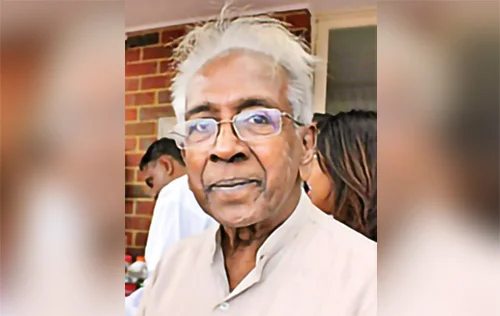
The passing of Dr. Devanesan Nesiah a few days ago brought back memories that spanned more than four decades. Devanesan signed the witness register at my marriage in 2002. It was a year of hope. The Ceasefire Agreement between the government and the LTTE had brought a respite from a war that had devastated the country for nearly two decades. The possibility of peace seemed real. It was fitting that Devanesan should be present on that occasion because his entire life was dedicated to building bridges across divides and seeking rational and humane solutions to conflict. He was a friend, mentor, and guide whose life embodied values that Sri Lanka, indeed the world, needs today.
In reflecting on Dr. Nesiah’s life, we need to be reminded that the forces that unite us as a people in Sri Lanka are stronger than those that divide us, and that the bonds of human affection can transcend even the deepest divisions of ethnicity, history and politics. I first met him in 1984. I had just had my very first newspaper article published in the Jaffna-based Saturday Review. The editor was Gamini Navaratne, a Sinhalese. This was a reminder that even during the darkest period of ethnic conflict, the bonds between communities remained strong. The article I had written was based on my encounters with the anti-Tamil violence of July 1983.
At that time, Dr Nesiah was the Government Agent of Jaffna. Tens of thousands of Tamil people who had fled violence in the south had been transported to the north by a government that had failed to protect them. He came up to me at an event, introduced himself, and told me that he liked what I had written. He also said that he would soon be leaving for Harvard University’s Kennedy School of Government and that we could meet there. Over the next three years, Devanesan and his wife Anita adopted me into their family. I used to visit them two or three times a week, not only to be given meals by Anita but to discuss matters with Devanesan. These included the academic papers and newspaper articles that were written. Later, Anita earned her PhD in religion and served on the boards of many civic organisations, including the National Peace Council.
Practical Solution
In 1992, we had both returned to work in Sri Lanka when Devanesan invited me to accompany him to Jaffna to celebrate the eightieth birthday of his father, K Nesiah, the distinguished educationist affectionately known as Professor Nesiah. The older Nesiah had been a leading member of the Jaffna Youth Congress. This remarkable movement championed complete independence from British rule, national unity, and the eradication of social inequalities based on caste and communal identity.
At a time when many feared that independence would lead to majoritarian domination, the leaders of the Youth Congress chose instead to place their faith in a shared Sri Lankan future. They believed that people from different communities could build a common nation while preserving their distinctive identities. So did Devanesan. This vision remains relevant today. It needs to be actualized.
The tragedy of Sri Lanka’s post-independence history is not that diversity exists. Diversity exists in every society. The tragedy is that we often allow diversity to become a source of fear, though we share many of the same values of family, hospitality, respect for elders and compassion towards others. During our visit to Jaffna in 1992, we met representatives of the LTTE administration, including Raheem. The discussion turned to the controversial issue of merging the Northern and Eastern Provinces. Dr Nesiah argued that if the merger could not be achieved due to political opposition, it might be more rational to seek greater powers for provincial councils instead. Raheem disagreed. Devanesan was interested in finding practical ways to achieve justice and coexistence. That was characteristic of him.
Devanesan Nesiah was a student of conflict and strategy. He became a doctoral student of Professor Thomas Schelling, who would later receive the Nobel Prize for his pioneering work on conflict and cooperation. Schelling’s insight was that even in the midst of conflict, there are usually common interests that adversaries share. Even adversaries locked in a struggle usually depend on each other for the outcome they each want. The challenge is to identify those common interests and build upon them. Conflict is not simply a contest between enemies. It is also a search for ways to coexist. Together as students and peace practitioners, we applied those theories to the Sri Lankan context to understand what was going on and to share that understanding with the Sri Lankan people.
Rational Empathy
Dr Nesiah spoke his mind, truth to power. He was a man of logic, rationality, and principle. His integrity came at a cost. His public service career experienced many ups and downs because he refused to accommodate irrational or corrupt demands. There were periods when he was sidelined into that administrative limbo known as the “pool” and assigned no substantive responsibilities for refusing to give in to political demands. Like the rest of his larger family, most notably the Hoole family of Jaffna, he would not abandon his principles. In 2018, to protest the action of President Maithripala Sirisena in sacking the then government he returned his Deshamanya Award (Pride of the Nation) national civil honourn which was soon thereafter overturned by the Supreme Court as being unconstitutional. His commitment was not to personal advancement, but to what he believed was right.
My wife Sumadhu recalls a story he told her. One day, while travelling on official duty, he told her how he had seen a thalagoya, a monitor lizard, trussed up and being taken away for slaughter. The sight of the creature’s suffering affected him deeply. He said he saw tears in its eyes and described the moment of awakening. From that day onwards, he gave up eating meat.
The story brings to mind the biblical story of the conversion of St Paul on the road to Damascus and the Buddhist exhortation, “May all living beings be well and happy.” But the deeper significance lies not in religious comparison. It lies in the awakening of empathy.
That was the essence of Dr Devanesan Nesiah’s worldview. The prejudices that society often imposes through ethnicity, religion, caste, or gender had little hold on him. He saw them as human constructs that often served to privilege some while excluding others. Such were his values that made him an extraordinary human being. Dr. Nesiah lived according to that understanding. He showed that integrity can survive amidst conflict. He reminded us that reason and compassion are not opposites but partners, that what unites us as Sri Lankans inhabiting our common island home has always been greater than what divides us, and we need to build our institutions accordingly.
I am proud that he was my friend. I am grateful that he was my mentor.
by Jehan Perera

 If Colombo’s nightlife had a pulse, you’d find it 23 floors up, at Gatz, City of Dreams, Cinnamon Life.
The entertainment lounge has shed its old skin and stepped out supper-club style — think dim lights, clinking glasses, and live music that doesn’t ask you to choose between dinner and a show. You get both.
What’s more, at the new look Gatz the music never stops and it’s all happening seven nights a week … with live entertainment, and this is the scene, beat by beat:
Monday and Tuesday: Top Hats with Daniella/Naomi, from 7.00 pm onwards.

Sohan, Kamal Munasinghe (GM, Cinnamon Life) and Imran of
Funtime Entertainments
One of Colombo’s most sought-after bands is now a Monday-Tuesday ritual.
With a super repertoire, Top Hats can swing from lounge jazz to dancefloor fire. Big venues love them. Now Gatz gets to claim them.
Wednesday: Enroute with Gananath & Debbie – from 7.00 pm onwards.
Want New York at sunset? This is it. Gananath & Debbie transport you straight to the heady days of Frank Sinatra, Dean Martin, and Ray Charles …old-school cool, live and unfiltered.
Thursday to Sunday: Terry & the Big Spenders – from 8.00 pm onwards.
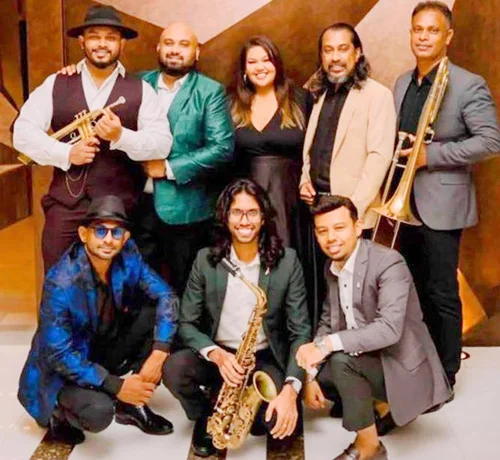
Terry & The Big Spenders
The crowd favourite. A super big band sound that owns the 70s, 80s and 90s.
If you’ve been waiting for horns, harmonies, and nostalgia with volume, Terry & the Big Spenders deliver it nightly. No wonder they’re a huge hit.
Gatz is now an entertainment lounge, in Supper Club style, with Happy Hour very day, from 6.00 pm to 8.00 pm because the night, they say, should start with a toast.
And, from July, weekends at the Gatz go global. Local and foreign guest stars will be around to entertain you. Gatz is certainly booking big.
Wow! That would be another exciting experience for those patronising the most talked about venue in town.
In charge of the new setup is our legendary entertainer/singer Sohan Weerasinghe, along with Imran of Funtime Entertainment.
The twosome, with invaluable assistance from the General Manager, Kamal Munasinghe, and the entire team at Cinnamon Life, have built Gatz into more than a venue. They have turned it into the “Heartbeat of the City.”
So come for happy hour. Stay for Terry’s horns, Sing-along with Enroute and Dance with Top Hats, all on the 23rd floor, and while Colombo sparkles below the bands will take you higher.
Remember, the heartbeat is loudest at Gatz.

Top Hats

Tuesday at T20 World Cup: New Zealand eye first win; Ireland run into England

‘Spider-Man of Yemen’ dies falling into volcanic crater

Norwegian crown princess’s son found guilty of two counts of rape

Trump says deal to end war with Iran already signed and details to be released ‘pretty soon’

Showers will occur in the Western, Sabaragamuwa and North-western provinces and in Galle, Matara, Kandy and Nuwara-Eliya districts

Easter Sunday carnage: WR asks AG to question Dappula on ‘grand conspiracy’ claim

‘Dates have the highest sugar content to fight Coronavirus’

Sunday Island 27 December – Headlines

#SundayIsland 17th December – Headlines

Sunday Island – 28th March

Sunday Island Headlines – 21 March

Sunday Island – 21st February – Headlines
-
 News4 days ago
CIABOC summons Yoshitha over his participation in British Navy training programme
-
 News6 days ago
Local firms move millions of dollars overseas for phantom imports: Govt.
-
 Midweek Review6 days ago
July 09: An inexcusable overall security failure and exceptional contingency plan
-

 News3 days ago
Commonwealth lawyers urge Lanka to uphold rule of law
-

 News6 days ago
AI raises concerns over arrest of Sallay and rapper under PTA
-

 Sports1 day ago
Tharanga set for high-profile javelin clash in Ostrava
-

 Features2 days ago
Politics of protected species
-

 News4 days ago
Justice Minister responds to social media claims he represented Easter Sunday ringleader