
Business
March 2020 quarter earnings decline by 52.0% YoY for 266 companies: First Capital

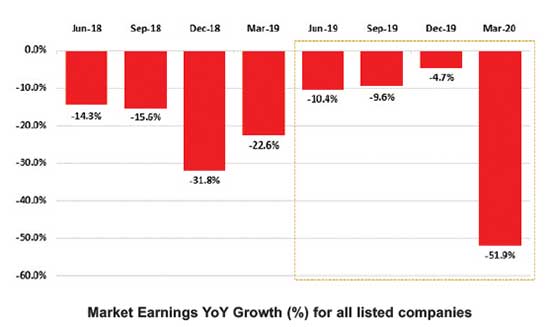
The quarter ended in March 2020 reported a decline in earnings by 52.0% year -on-year for 266 companies, according to a report released by First Capital Research.
“March quarter earnings dipped by 51.9%YoY to LKR 33.6Bn primarily owing to sluggish performance in Diversified Financials (-87%YoY), Capital Goods (63%YoY), Food, Beverage & Tobacco (-72%YoY), Telecommunication (-52%YoY) and Consumer Services (-101%YoY)”, it said.
The report further said: “Upbeat quarterly performance was only witnessed in the following sectors; Banks (+32%YoY) followed by Food, Staples, and Retailing (+96%YoY) and Materials (+8%YoY)”.
“Lackluster performance in Diversified Financials, Capital Goods and Food, Beverage and Tobacco sectors was mainly owing to subdued economic growth which was heightened by the Covid-19 pandemic striking the island. PLC profit dipped by -90%YoY due to high impairments because of the slowdown in the economy caused a reduction in disposable income of customers and business volumes”.
“Consequently, there was a rise in non-performing loans in the sector which was the main factor for the decline in earnings of Commercial Credit and Finance Plc – (-56%YoY), LOLC Finance Plc (-29%YoY), LB Finance Plc (-19%YoY) as well. Therefore, primarily led by the above-mentioned counters, the Diversified Financial sector recorded a decline of 87%YoY”.
“Plunge in earnings by 63%YoY in Capital Goods was chiefly driven by SHL earnings reporting a loss of LKR 3.3Bn (-11033%YoY) followed by the decline in earnings in BRWN (-53%YoY) and SPEN (-45%YoY)”.
“Notably, JKH recorded a growth of 18%YoY primarily due to the growth in profits in Consumer Foods, Retail and Property segments, overall, the Capital Goods sector recorded a decline in earnings”.
|Banking sector witnessed a profit growth of 32%YoY to record LKR 14.6Bn primarily driven by COMB (+20%YoY), HNB (+57%YoY) and SAMP (+27%YoY). COMB, HNB and SAMP profits were boosted due to financial investment gains (forex and mark to market gains) coupled with the removal of NBT and Debt Repayment Levy which improved the bottom line”.
“Cargills Ceylon Plc recorded an impressive growth of 134%YoY driven by the growth in FMCG and retail space, benefiting the Food, Staples and Retailing sector to record a growth of 96%YoY”, First Capital report said.







The power of momentum was the focus when Ceylinco Life, Sri Lanka’s life insurance market leader for an unbroken 22 years, celebrated the exceptional achievements of its top-performing sales force at its Annual Awards Ceremony 2026, held at Cinnamon Life Colombo.
Bringing together more than 300 of the company’s highest achievers, the event recognised Sales Officers who attained High Flyers status, qualified for the prestigious Million Dollar Round Table (MDRT), or earned ‘Sales Superstar’ status in 2025, each having met rigorous performance benchmarks. In total, close to 370 awards were presented at the ceremony, which was attended by over 450 participants including the company’s Board of Directors and senior management.
Themed ‘Unstoppable Champions,’ the awards ceremony underscored the spirit of resilience, ambition and consistent excellence that defines Ceylinco Life’s sales force, positioning the awardees as drivers of the company’s sustained market leadership.
The event was graced by Chief Guest Srinivasa Rao, Managing Director – Life and Health (South Asia and South East Asia) at Munich Re, and featured an evening of scintillating entertainment with performances by Sanka Dineth, Shashika Nisansala, the Naadro Band and Prashanthini, complemented by dance acts from Muddrika Dance Studio.
Among the highlights of the evening was the presentation of two Toyota Axio motor cars to R. P. Edirisinghe and S. S. H. M. T. Laksiri in recognition of their consistent excellence in qualifying as High Flyers and MDRT members. The top honours at the awards ceremony were presented to Mr A. S. L. Fernando as Best Agency Head, H. D. Pathirana as Best Agency Supervisor, A. I. P. Manjula as Best Life Insurance Advisor, and J. Meera as Best Regional Sales Manager.

Top Korean nameplate Kia has reinforced its presence in Sri Lanka with the opening of a striking new showroom at the iconic Altair high-rise in Colombo, marking a significant step in the brand’s continued expansion and customer engagement in the country.
The new facility, unveiled exclusively to media on 7th April 2026, occupies approximately 2,700 square feet of prime space at Retail 3 of the Altair development.
Strategically positioned at the entrance to the complex for maximum visibility and accessibility, the showroom places Kia at the heart of one of Colombo’s most prominent luxury residential and lifestyle destinations.
Designed in line with Kia’s global brand guidelines, the showroom presents a modern, customer-centric environment that reflects the company’s focus on innovation, quality and service excellence. The space is intended to offer an immersive retail experience, enabling customers to explore the brand’s evolving portfolio in a setting that mirrors international standards.
“The opening of this new showroom signals Kia’s renewed commitment to Colombo, strengthening its proximity to customers while enhancing convenience and accessibility for those seeking to engage with the brand,” Kia Motors Lanka Chairman Mahen Thambiah said. “It represents a key milestone in our strategy to deepen customer relationships and expand the Kia footprint across key urban locations.”
Taking centre stage at the new showroom is the all-new Kia Tasman, the brand’s first-ever double cab pickup, which makes its debut in Sri Lanka in tandem with the opening. The introduction of the Tasman underscores Kia’s drive to diversify its offering and respond to the evolving demands of customers across multiple segments.
In addition to the Tasman, visitors to the Altair showroom can experience Kia’s full range of vehicles, further enhancing the brand’s appeal to a broad spectrum of automotive enthusiasts.

After nearly three decades on the mat, Sri Lankan martial arts instructor H. M. Nalin Sri Tikiri Bandara has built a career that stretches from local dojos in Kandy to international training arenas in the United Arab Emirates, shaping a growing generation of students through what he describes as “a lifelong journey of discipline and self-development.”
With more than 28 years of experience, Bandara has emerged as a prominent figure in martial arts education for children, youth and adults, particularly across Sri Lanka and the UAE, where he is currently based in Abu Dhabi.
Bandara’s martial arts journey began at a young age and has since spanned multiple disciplines, including Kyokushin Karate, Ashihara Karate, Mumonkai Karate, Brazilian Jiu-Jitsu and yoga.
He holds several international dan rankings, including 3rd Dan in Kyokushin Karate (Japan), 4th Dan in Ashihara Karate (Australia), 2nd Dan in Mumonkai Karate (Japan), and 1st Dan under Josui Kai Kan Karate (Japan). Years of training camps, seminars and competitions abroad, he says, have helped refine both technical skill and teaching philosophy.
Bandara is the founder and chief instructor of Nalin Dojo, which operates across multiple locations, including a main branch in Abu Dhabi and an established centre in Kandy. He also runs expansion programmes in schools and fitness centres in the UAE.
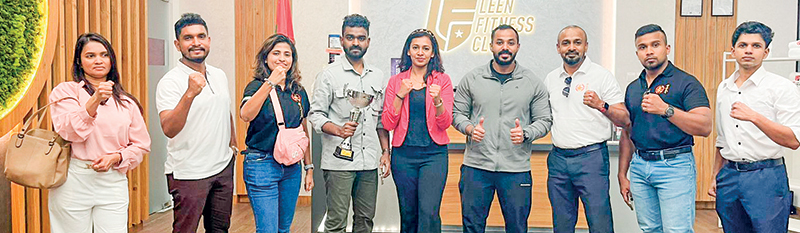


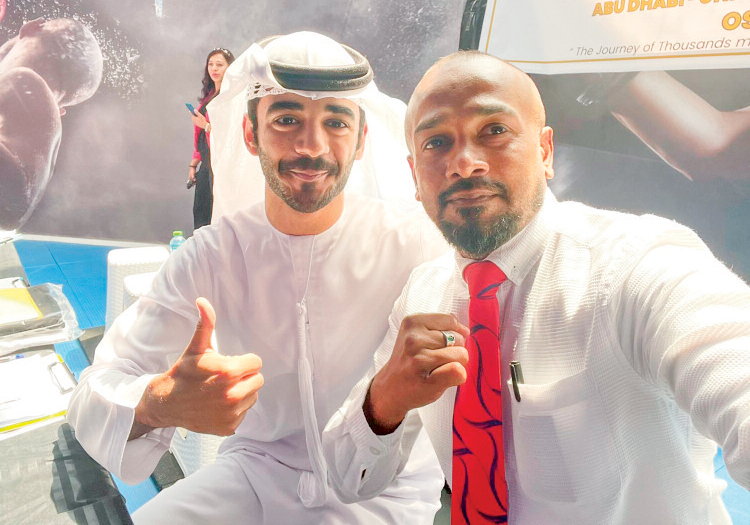 Collectively, his programmes have trained more than 2,000 students, ranging from children as young as four to adults.
He also serves as branch chief and representative of the World Karate Alliance Kyokushin Bugakukai, and contributes to the development of full-contact karate at national level in Sri Lanka.
At the core of his teaching is a hybrid approach he calls “Yoga Martial Arts”, blending karate discipline, yoga-based mental conditioning, Brazilian Jiu-Jitsu principles and sports science.
The focus, he says, extends beyond physical combat to character formation, emphasising discipline, respect, confidence-building and mental resilience.
“Martial arts is not just about fighting, it is about building better human beings,” Bandara said.
Much of his work is directed at children and adolescents, particularly in an era he describes as increasingly dominated by digital distractions.
He argues that structured martial arts training can reduce screen dependency, improve concentration, and strengthen emotional stability, while promoting healthier lifestyles.
“Children’s future is the future of the community,” he said, underscoring his belief that early discipline shapes long-term social outcomes.
Beyond regular training, Bandara organises grading examinations, workshops, school programmes and community fitness initiatives in both Sri Lanka and the UAE.
He has continued such activities even during periods of global disruption, maintaining regular engagement with students and instructors.
Looking ahead, Bandara plans to expand his dojo network across the UAE and internationally, while developing structured youth development programmes and training future instructors.
His long-term ambition is to build a sustainable martial arts ecosystem that integrates physical excellence with character education.
In a career defined by discipline and continuity, Bandara represents a generation of martial arts instructors blending traditional combat systems with modern wellness principles — and, in the process, attempting to shape not just fighters, but future citizens.
by SK Samaranayake

Malinga, Reddy sink Chennai Super Kings chase to defend under-par 194 in Hyderabad

Stubbs, Miller win Delhi Capitals a thriller against Royal Challengers Bengaluru

Showers predicted in the Western, Central, Sabaragamuwa, Uva, North-western, North-central and Southern provinces after 1.00 pm.

Heat Index at Caution Level in the Northern, North-central, North-western, Western, Sabaragamuwa, Eastern and Southern provinces and in Monaragala district

‘Agents of the devil’ seeking to block Easter probe, Cardinal warns

Nation to mark Easter Sunday attacks with countrywide observances, march for justice

‘Dates have the highest sugar content to fight Coronavirus’

Sunday Island 27 December – Headlines

#SundayIsland 17th December – Headlines

Sunday Island – 28th March

Sunday Island Headlines – 21 March

Sunday Island – 21st February – Headlines
-

 Latest News6 days ago
PNS TAIMUR & ASLAT arrive in Colombo
-

 Latest News6 days ago
Prasidh, Buttler set up comfortable win for Gujarat Titans
-

 News4 days ago
PNS TAIMUR & ASLAT set sail from Colombo
-

 Latest News5 days ago
“I extend my heartfelt wishes to all Sri Lankans for a peaceful and joyous Sinhala and Tamil New Year!” – President
-
 Latest News6 days ago
Heat Index at Caution level’ in the Northern, North-central, North-western, Western and Southern provinces and in Trincomalee district.
-
 Latest News6 days ago
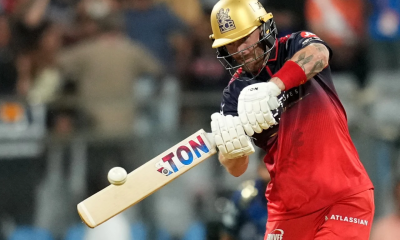
Salt and Patidar power RCB past Mumbai Indians
-

 Latest News5 days ago
US blockade of Iran would worsen global energy crisis, analysts say
-

 News1 day ago
Heroin haul transported on 50-million-rupee contract