
Features
Maldives – Nation of 1.190 islands

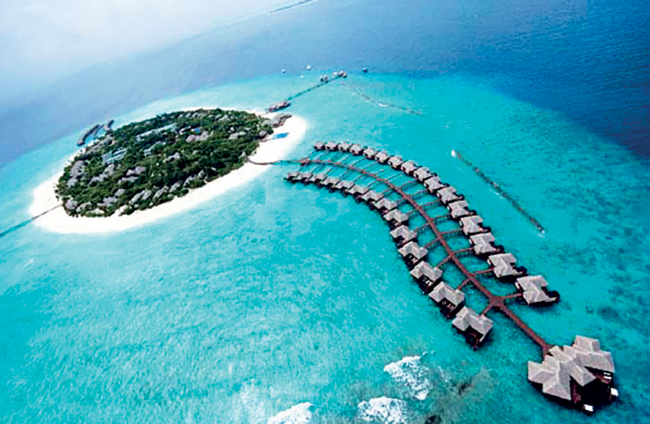
by ACB Pethiyagoda
(This article was written after a visit to the Maldives in the early nineties)
The beauty and splendor of these islands have been written of during the past several centuries by well known travellers. Marco Polo described them as “Flowers of the Indies”, Ibin Batuta said these were ‘One of the Wonders of the World,” Fah Hsien, the Chinese, Papas of Alexandria, Scholastics of Thebes and H.C.P. Bell of the Ceylon Civil Services are other notables who have written about this archipelagic nation.
It was Ibn Batuta, the Moroccan traveller, who remained in the Maldives for only about 18 months and lost no time in marrying four noble women of the Court of Kadihah, daughter of Sultan Ahbendjaly whose husband was her Chief Vizar. Unfortunately for Batuta, who having won the confidence of some members of the Royal family and having been offered the post of Kazi, was compelled to flee the country (with or without his wives it is not known) in about 1345 due to the apparent jealousy of the Chief Vizar who was himself the second husband of the lady Sultan Kadihah.
H.C.P. Bell, the first Commissioner of Archaeology of the Government of Ceylon, in Sessional Papers of 1881 which were laid before the Legislative Council of Ceylon wrote that the “Early history of these islands is buried in obscurity — the natural result of their complete isolation and comparative insignificance. Indeed, except for scant glimpses afforded by the accounts of a few causal travellers, whom accident has taken them there from time to time, the world in the later half of the 19th century knows little or nothing of the whole or part of the history of the Maldives.

“The Maldivians themselves possess no known historical records of any antiquity and would seem to be utterly ignorant of their antecedents beyond such vague and unreliable shreds of information as may have been handed down by traditions.” That is quite a mouthful, but it was Bell’s usual style.
From the earliest of times, trading contacts with the Arabs, Persians, Malaysians, Indians, Indonesians, Sinhalese and with even some African countries have certainly left their influence on the people and culture of the Maldivians. Their language itself, known as Dhivehi is derived from Sanskrit, with both Arabic and Hindi influence which is unmistakable to linguists.
After the Malabar raiders were got rid of the Maldivians formed a closer association, with strengthened diplomatic representations with Ceylon, a relationship which has existed from as far back as 1645. Thereafter, in 1887 the Maldivians accepted British Suzerainty for the benefit of military protection from them and this arrangement ended in 1965. The British did not station their representative in the islands nor did they interfere in their administration.
It is to the credit of the Maldivians that such a small nation was able to remain independent for so long with several powerful nations around them. This is on account of their farsighted diplomacy and on account of the country not being rich in natural resources except fish, which in those times was not as valuable as it is now because it could not be preserved for transport over long distances.
The period of British Suzerainty covered the years of the Second World War and Gan and Cocoa islands were important British bases with large numbers of Ceylonese serving in them with distinction and a few who were said to have not been amenable to discipline. That however, is another story.
Archaeological findings bear ample evidence of the prevalence and practise of Buddhism in the country prior to 1153 AD. In that year, Shaikh Yusuf ud-din of Tabriz, a pious Saint introduced Islam to the country during the rule of King Komala who changed his name to Mohommed Ibin Abdulla and assumed the Islamic title of Sultan after his conversion to Islam.
Ibn Batuta wrote of this conversion to Islam giving credit to Abdul Barakath Yusuf but that version does not appear to be accepted. It could be that Yusuf accompanied the Saint and remained in the islands to spread the religion. What is important is, historically, socially culturally and since 1153 AD the Maldivians have been true followers of Islam and that there is no other religion practised in the republic.
“Islam is the strength and backbone of Maldivians society permeating as it does the entire educational system….” It is the State Religion but there is, a “delicate blend of tradition and modernity.” Women are not in purdah and have equal opportunities with men in regard to education and employment. Hence, their contribution to the economic and social development of their country is no less than that of the contribution made by their men. They are seen and heard and listened to all over the republic.”
As mentioned earlier the country gained independence in 1965. This was during the tenure of office of the President, Ibrahim Nasir who was the Prime Minister under the titular Sultan. It became a Republic in 1968 with an elected President and a national Assembly. The current President, His Excellency Maumoon Abdul Gayoom assumed office on November 11, 1978, having polled 92.9% of the votes at a referendum. He is a Master of Arts in Islamic Studies from Alazhar University and lectured in Islamic Law and Philosophy at Ahmadu Bello University in Nigeria.
In his own country he held several high positions in Government since 1971 and was his country’s permanent representative at the United Nations in 1976 and 1977. He is a true friend of Sri Lanka and once said “Sri Lanka and the Maldives have embraced warm friendly relations for centuries. Our countries bondage of friendship stretches beyond geographical proximity.” President Gayoom’s administration is committed to an open Government ensuring the observance of the principles of democracy.
The first written Constitution of the Maldives was proclaimed in 1982 but is is said that there is evidence of the system of Government and administration accepting traditional principles of democracy as time honoured customs. The present constitution is that of a sovereign and independent Republic with Islam as its State Religion and Dhivehi as the State Language. However, English is widely used in Government’s administration and in the private sector.
The Maldive islands are on the equator in the Indian Ocean consisting of 26 atoll formations, the word atoll being derived from the word `atholu’ in Dhevehi. These atolls are groups of islands of varying numbers in each, all making a total of 1,190 islands. Of these, only 199 are inhabited and 74 others are set apart exclusively as tourist resorts.
The republic is some 720 km. South West of Sri Lanka and cover a total area of about 90,000 Square km. measuring 820 km. from North to South and 120 km. East to West at the longest and broadest points. The islands which consist of only about 1% of the total area are formed from layers of coral and none are more than six feet above sea level at the highest point. Gan with several garment factories, the longest island was developed by the British when they closed their base in Ceylon in 1956 by mutual agreement with the government of Ceylon which came into power that year. The British left Gan 20 years later leaving a fully developed island with roads and infrastructure which the Maldivians took over and set up industries with foreign investors.
The soils of the islands are poor and are alkaline due to their derivation from coral rock. There are no rivers or springs and all crops are dependent on the rains from the South West Monsoon. Hence the only crops grown are on a ‘chena’ or shifting agriculture basis in some of the inhabited islands and consist of various kinds of millets, tubers such as manioc, chillies, onions, cabbage, beans, brinjals, various gourds etc. and fruits such as watermelon, banana, papaw, mango and lemon. Coconut is an important crop and is found on many of the islands including the resorts.
To the tourist fishing is an important sport as diving. Fishing trips both by day and night are organized for modest fees for a few hours by local motorized Dhonis or baththal the traditional boat, or for very high fees in modern yachts and speed boats with sophisticated gear. The sportsmen and women bring in skipjack, groupers, snappers and other reef fish. Big game fish outside the atoll enclosures consist of marlin, barracuda, yellow fin tuna etc.
There are no indigenous animals but the islands area haven for large numbers and species of seabirds.Conservation of its wealth in its waters is important to the Maldivians. ‘Hence the use of harpoons and catching dolphins, whales, whale shark etc. is strictly prohibited and observed.
The most spectacular floral and fauna are found from just below the surface of the sea to hundreds of feet below. Fish with all the colours of the rainbow in their thousands, corals, crustaceans, turtles etc. and numerous varieties of sea weed make a world of psychedelic colour which defy description. Fishing accounts for about 40% of those in gainful employment with a catch of some 99,000 metric tons in 1993. This was for home consumption, local sale and for export, canned or frozen.
The per capita consumption of fish in the Maldives is about the highest in the world and is about the only form of animal protein consumed by its people. Skipjack is the main catch and upto about 1972, it was the main export product, in the form of Maldive Fish after a process of boiling, salting, smoking and sun drying. The sole buyer of the product was Sri Lanka and on account of our foreign exchange problems and restrictions on imports of all but essentials the Maldivians were forced to find other markets for their foreign exchange earnings from fish. They were thus compelled to freeze or can their exportable fish.
The climate in the Maldives is humid and hot (average 86 degrees Fahrenheit) in spite of the influence of the cool sea breeze. The South West Monsoon from April to November brings about 84 inches of rain while the North – East Monsoon from December to March is a dry period in most years.With little or no resources for significant industrial or agricultural development and to support a growing population with its increasing needs from outside the country, the Maldivians turned to tourism for its foreign exchange earnings.
Hence, from an almost non-existent industry in 1972 with just a handful of tourists 1993 recorded 241,000 arrivals, in 1994 it rose to 279,600 and in 1995 to 300,000 arrivals. The main reasons for this rapid growth is of course on account of ‘the gem like islands depict the rare vision of a tropical paradise. Palm fringed islands with sparkling white beaches, turquoise lagoons, clear warm waters and coral reefs teeming with abundant varieties of marine flora and fauna.” Apart from these, there are no ogling oafs and gawking peddlers of bead chains, cheap clothing or even other wares as in some Sri Lankan sea side holiday resorts.
This makes the Maldives an ideal destination for the holiday maker in search only of, and with no interest other than in tranquillity and peace with sunshine and warm clear waters to laze in. Other reasons for this phenomenal growth is the opening of the Male International Airport in late 1981 to receive wide bodied jets from Colombo, Singapore and Trivandrum; a Cabinet Minister solely in charge of the subject and more than likely the comparatively slower growth of the industry in Sri Lanka since about 1978. About 85% of the visitors are from Western Europe with West Germany and Italy forming the majority and with smaller numbers from France, Sweden etc.
A typical visit to the Maldives is one in which the visitor arrives at Hulule Airport and goes through immigration with little bother except that the odd official may want to know, particularly from dark skinned people, whether they have a minimum of US$ 25 for each day of stay. The Customs check is quick if one does not carry alcohol or firearms both of which are strictly taboo. After awhile, the Tour Guide with whose Company one has booked escorts him to a Dhoni many of which are now powered by 15 or 20 HP Honda or Yamaha diesel engines.
The journey starts with leaping from one Dhoni to another (if his particular boat is some distance away) with plenty of willing hands to ensure that he does not end up squashed between two boats in the lapping waters below!
Ziaraarafushi in Kaafu Atoll the destination in this case is two and half hour journey with the first hour or so on the open top deck on foam rubber cushions admiring the beauty of the changing colours of the waters from clear light blue to shades of green and finally to deep blue as the depth of the water increases. Fish, corals and other islands and their beaches in the distance add to the beauty of the view. Retirement to the enclosed lower deck becomes necessary as the sea gets rough and waves hit the upper deck. It is hot and humid down there and exhaust fumes from the engine somehow find their way adding to the discomfort.
The Captain of the boat has three helpers who once the going is steady hasten to the lower deck and promptly fall fast asleep on the cushioned benches. Fishing is second nature to the Maldivians hence on these trips too they throw a few lines and haul a skipjack or two every now and then; a bonus payment or a bigger fish curry for dinner!
The Captain stands with his back to the starpole and guides the boat with his bare foot or even his shoulder blades without the aid of a compass, and in total dependence on his experienced eye, never flinching even when accepting one of the many lighted cigarettes his assistants, when they are awake, pass on to him throughout the journey.
Ziaraarafushi is one of the 74 resort islands, leased to foreign developers and has some one hundred chalets. Visitors are met at the jetty by the staff with wheel barrows marked ‘Luggage’ in bold red letters. The complex consists of the single and double room chalets, large dining hall, a reception area with a shop displaying beach wear, toiletries, handicrafts made from bones of large fish, picture post cards etc.; the main indoor recreational area is a large hall with the bar at one end. Liquor is expensive, a can of beer is sold at US$ 3.5 to 4 with a peg of Sri Lankan Gin selling at about the same price. In these circumstances, the price of Scotch is prohibitive.

Floors of all common areas are sand covered with half walls all round. Roofs are covered with woven coconut palm fronds with wire mesh spread over as a protection against strong winds. The chalets have cement floors which are sometimes covered with linoleum and consist of a shower and toilet and sit-out. The furniture and linen are simple and adequate but the charges are about double or a little more for more comfortable accommodation and very much better food at Sri Lankan three or four star hotels in the coast.
The food is simple, consisting of baked or boiled fish with cabbage, beans, tomatoes and cucumber for both main meals and an egg with limited quantities toast for breakfast. The meals are bland and monotonous and the food served to the staff is more appetising to the Sri Lankan pallet as it consists of rice and hot fish curry with grated coconut. Talking about food, an European woman said “As long as I don’t have to cook and wash I don’t care as the sun, sea and sand are there for my annual holiday.” Perhaps she speaks for large numbers of the tourists who come to the Maldives. There are, however, some resorts which boast of several coffee shops and restaurants in each offering varied and excellent cuisine at relatively higher prices.
There are no Maldivians permanently resident on Ziaraarafushi just as in all the other resort islands as the Government wishes to preserve the culture of its people uninfluenced by foreign habits and customs. Likewise inhabited islands have no hotels and visits to them by tourists are allowed only with guides for a few hours in the day in what is described as ‘proper attire’. This is a most laudable practice.
The staff at all levels consist mostly of Sri Lankans, Indians and Pakistanis and they like the visitors are birds of passage leaving the unspoilt Maldivians to their traditions and religion uninterfered with.Those resorts in the islands, hotels and guest houses in Male, had a bed strength of just under 10,000 in 1993 with about 65% utilization bringing the Government about three fifths of its ‘visible export receipts.”
To service the tourists and the local population with their requirements of internal transport by sea, there were 1,434 mechanised Dhonis, a few luxury yachts and 313 trolling vessels in 1993. A mere 15 sailing Dhonis and 22 rowing boats were available mostly for pleasure rides.Male, the capital and Seat of Government and main commercial centre is entirely different from the resort islands “for, if the islands depend on Male for all their trading and administration, Male depends on the islands for its livelihood.” It is busy town with Government Offices, Schools, Shops of all grades and sizes, Hospitals and residences of all the important officials and the not so important with a population of around 60,000 out of a total of just over 238,000 in the Republic in 1993.
In that year, Male, Hulule and Gan had most of the 5,330 bicycles, 3,466 motor cycles and 454 cars, vans and trucks. The authorized vehicles, more often than not are driven on low gear most of the time due to the crowded and narrow roads.The President’s residence or Mulee Aage, the Grand Friday Mosque which can accommodate 5,000 worshipers at a time, National Museum in the Sultan Park, marine drive, docks and fish markets are important land marks in clean, tidy and bustling Male.

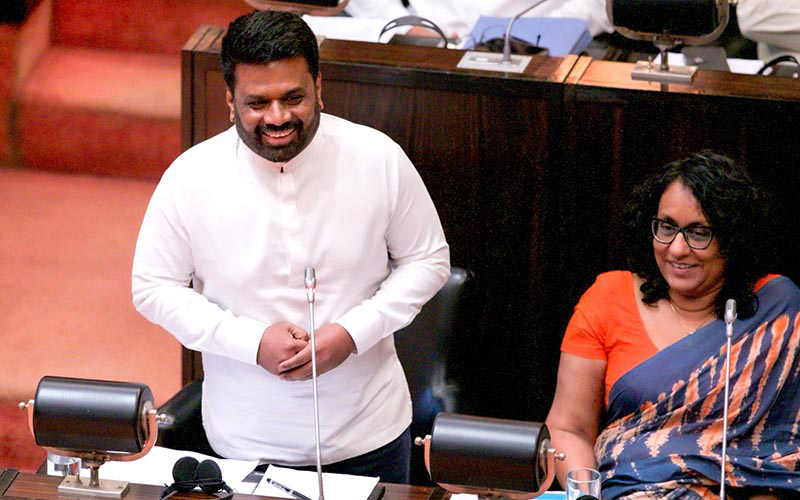
The long standing foreign policy of Sri Lanka was Non-Alignment. However, in the context of emerging geopolitical rivalries, there was a need to question the adequacy of Non-Alignment as a policy to meet developing challenges. Neutrality as being a more effective Policy was first presented in an article titled “Independence: its meaning and a direction for the future” (The Island, February 14, 2019). The switch over from Non-Alignment to Neutrality was first adopted by former President Gotabaya Rajapaksa and followed through by successive Governments. However, it was the current Government that did not miss an opportunity to announce that its Foreign Policy was Neutral.
The policy of Neutrality has served the interests of Sri Lanka by the principled stand taken in respect of the requests made by two belligerents associated with the Middle East War. The justification for the position adopted was conveyed by President Anura Kumara Dissanayake to Parliament that Iran had made a formal request on February 26 for three Iranian naval ships to visit Sri Lanka, and on the same evening, the United States also requested permission for two war planes to land at Mattala International Airport. Both requests were denied on grounds of maintaining “our policy of neutrality”.
WHY NEUTRALITY
Excerpts from the article cited above that recommended Neutrality as the best option for Sri Lanka considering the vulnerability to its security presented by its geographic location in the context of emerging rivalries arising from “Pivot to Asia” are presented below:
“Traditional thinking as to how small States could cope with external pressures are supposed to be: (1) Non-alignment with any of the major centers of power; (2) Alignment with one of the major powers thus making a choice and facing the consequences of which power block prevails; (3) Bandwagoning which involves unequal exchange where the small State makes asymmetric concessions to the dominant power and accepts a subordinate role of a vassal State; (4) Hedging, which attempts to secure economic and security benefits of engagement with each power center: (5) Balancing pressures individually, or by forming alliances with other small States; (6) Neutrality”.
Of the six strategies cited above, the only strategy that permits a sovereign independent nation to charter its own destiny is neutrality, as it is with Switzerland and some Nordic countries. The independence to self-determine the destiny of a nation requires security in respect of Inviolability of Territory, Food Security, Energy Security etc. Of these, the most critical of securities is the Inviolability of Territory. Consequently, Neutrality has more relevance to protect Territorial Security because it is based on International Law, as opposed to Non-Alignment which is based on principles applicable to specific countries that pledged to abide by them
“The sources of the international law of neutrality are customary international law and, for certain questions, international treaties, in particular the Paris Declaration of 1856, the 1907 Hague Convention No. V respecting the Rights and Duties of Neutral Powers and Persons in Case of War on Land, the 1907 Hague Convention No. XIII concerning the Rights and Duties of Neutral Powers in Naval War, the four 1949 Geneva Conventions and Additional Protocol I of 1977” (ICRC Publication on Neutrality, 2022).
As part of its Duties a Neutral State “must ensure respect for its neutrality, if necessary, using force to repel any violation of its territory. Violations include failure to respect the prohibitions placed on belligerent parties with regard to certain activities in neutral territory, described above. The fact that a neutral State uses force to repel attempts to violate its neutrality cannot be regarded as a hostile act. If the neutral State defends its neutrality, it must however respect the limits which international law imposes on the use of force. The neutral State must treat the opposing belligerent States impartially. However, impartiality does not mean that a State is bound to treat the belligerents in exactly the same way. It entails a prohibition on discrimination” (Ibid).
“It forbids only differential treatment of the belligerents which in view of the specific problem of armed conflict is not justified. Therefore, a neutral State is not obliged to eliminate differences in commercial relations between itself and each of the parties to the conflict at the time of the outbreak of the armed conflict. It is entitled to continue existing commercial relations. A change in these commercial relationships could, however, constitute taking sides inconsistent with the status of neutrality” (Ibid).
THE POTENTIAL of NEUTRALITY
It is apparent from the foregoing that Neutrality as a Policy is not “Passive” as some misguided claim Neutrality to be. On the other hand, it could be dynamic to the extent a country chooses to be as demonstrated by the actions taken recently to address the challenges presented during the ongoing Middle East War. Furthermore, Neutrality does not prevent Sri Lanka from engaging in Commercial activities with other States to ensuring Food and Energy security.
If such arrangements are undertaken on the basis of unsolicited offers as it was, for instance, with Japan’s Light Rail Project or Sinopec’s 200,000 Barrels a Day Refinery, principles of Neutrality would be violated because it violates the cardinal principle of Neutrality, namely, impartiality. The proposal to set up an Energy Complex in Trincomalee with India and UAE would be no different because it restricts the opportunity to one defined Party, thus defying impartiality. On the other hand, if Sri Lanka defines the scope of the Project and calls for Expressions of Interest and impartially chooses the most favourable with transparency, principles of Neutrality would be intact. More importantly, such conduct would attract the confidence of Investors to engage in ventures impartial in a principled manner. Such an approach would amount to continue the momentum of the professional approach adopted to meet the challenges of the Middle East War.
CONCLUSION
The manner in which Sri Lanka acted, first to deny access to the territory of Sri Lanka followed up by the humanitarian measures adopted to save the survivors of the torpedoed ship, earned honour and respect for the principled approach adopted to protect territorial inviolability based on International provisions of Neutrality.
If Sri Lanka continues with the momentum gained and adopts impartial and principled measures recommended above to develop the country and the wellbeing of its Peoples, based on self-reliance, this Government would be giving Sri Lanka a new direction and a fresh meaning to Neutrality that is not passive but dynamic.
by Neville Ladduwahetty

The interference into affairs of other nations by the USA’s Central Intelligence Agency (CIA) started in 1953, six years after it was established. The Anglo-Iranian Oil Company supplied Britain with most of its oil during World War I. In fact, Winston Churchill once declared: “Fortune brought us a prize from fairyland beyond our wildest dreams.”
When in 1951 Dr. Mohammad Mosaddegh was reluctantly appointed as Prime Minister by the Shah of Iran, whose role was mostly ceremonial, he convinced Parliament that the oil company should be nationalised.
Mohammed Mosaddegh
Mosaddegh said: “Our long years of negotiations with foreign companies have yielded no result thus far. With the oil revenues we could meet our entire budget and combat poverty, disease and backwardness of our people.”
It was then that British Intelligence requested help from the CIA to bring down the Iranian regime by infiltrating their communist mobs and the army, thus creating disorder. An Iranian oil embargo by the western countries was imposed, making Iranians poorer by the day. Meanwhile, the CIA’s strings were being pulled by Kermit Roosevelt (a grandson of former President Theodore Roosevelt), according to declassified intelligence information.
Although a first coup failed, the second attempt was successful. General Fazlollah Zahedi, an Army officer, took over as Prime Minister. Mosaddegh was tried and imprisoned for three years and kept under house arrest until his death. Playing an important role in the 1953 coup was a Shia cleric named Ayatollah Abol-Ghasem Mostafavi-Kashani. He was previously loyal to Mosaddegh, but later supported the coup. One of his successors was Ayatollah Ruhollah Mostafavi Musavi Khomeini, who engineered the Islamic Revolution in 1979. Meanwhile, in 1954 the Anglo-Iranian Oil Company had been rebranded as British Petroleum (BP).
Map of the Middle East
When the Iran-Iraq war broke out (September 1980 to August 1988), the Persian/Arabian Gulf became a hive of activity for American warships, which were there to ensure security of the Gulf and supertankers passing through it.

CIA-instigated coup in Iran in 1953 Dr. Mohammad Mosaddegh
The Strait of Hormuz, the only way in and out of the Gulf, is administered by Oman and Iran. While there may have been British and French warships in the region, radio ‘chatter’ heard by aircraft pilots overhead was always from the US ships. In those days, flying in and out of the Gulf was a nerve-wracking experience for airline pilots, as one may suddenly hear a radio call on the common frequency: “Aircraft approaching US warship [name], identify yourself.” One thing in the pilots’ favour was that they didn’t know what ships they were flying over, so they obeyed only the designated air traffic controller. Sometimes though, with unnecessarily distracting American chatter, there was complete chaos, resulting in mistaken identities.
Air Lanka Tri Star
Once, Air Lanka pilots monitored an aircraft approaching Bahrain being given a heading to turn on to by a ship’s radio operator. Promptly the air traffic controller, who was on the same frequency, butted in and said: “Disregard! Ship USS Navy [name], do you realise what you have just done? You have turned him on to another aircraft!” It was obvious that there was a struggle to maintain air traffic control in the Gulf, with operators having to contend with American arrogance.
On the night of May 17, 1987, USS Stark was cruising in Gulf waters when it was attacked by a Dassault Mirage F1 jet fighter/attack aircraft of the Iraqi Air Force. Without identifying itself, the aircraft fired two Exocet missiles, one of which exploded, killing 37 sailors on board the American frigate. Iraq apologised, saying it was a mistake. The USA graciously accepted the apology.
Then on July 3, 1988 the high-tech, billion-dollar guided missile cruiser USS Vincennes, equipped with advanced Aegis weapons systems and commanded by Capt. Will Rogers III, was chasing two small Iranian gun boats back to their own waters when an aircraft was observed on radar approaching the US warship. It was misidentified as a Mirage F1 fighter, so the Americans, in Iranian territorial waters, fired two surface-to-air Missiles (SAMs) at the target, which was summarily destroyed.
The Vincennes had issued numerous warnings to the approaching aircraft on the military distress frequency. But the aircraft never heard them as it was listening out on a different (civil) radio frequency. The airplane broke in three. It was soon discovered, however, that the airplane was in fact an Iran Air Airbus A300 airliner with 290 civilian passengers on board, en route from Bandar Abbas to Dubai. Unfortunately, because it was a clear day, the Iranian-born, US-educated captain of Iran Air Flight 655 had switched off the weather radar. If it was on, perhaps it would have confirmed to the American ship that the ‘incoming’ was in fact a civil aircraft. At the time, Capt. Will Rogers’ surface commander, Capt. McKenna, went on record saying that USS Vincennes was “looking for action”, and that is why they “got into trouble”.
Although USS Vincennes was given a grand homecoming upon returning to the USA, and its Captain Will Rogers III decorated with the Legion of Merrit, in February 1996 the American government agreed to pay Iran US$131.8 million in settlement of a case lodged by the Iranians in the International Court of Justice against the USA for its role in that incident. However, no apology was tendered to the families of the innocent victims.
These two incidents forced Air Lanka pilots, who operated regularly in those perilous skies, to adopt extra precautionary measures. For example, they never switched off the weather radar system, even in clear skies. While there were potentially hostile ships on ground, layers of altitude were blocked off for the exclusive use of US Air Force AWACS (Airborne Warning and Control System) aircraft flying in Bahraini and southern Saudi Arabian airspace. The precautions were even more important because Air Lanka’s westbound, ‘heavy’ Lockheed TriStars were poor climbers above 29,000 ft. When departing Oman or the UAE in high ambient temperatures, it was a struggle to reach cruising level by the time the airplane was overhead Bahrain, as per the requirement.
In the aftermath of the Iran Air 655 incident, Newsweek magazine called it a case of ‘mistaken identity’. Yet, when summing up the tragic incident that occurred on September 1, 1983, when Korean Air Flight KE/KAL 007 was shot down by a Russian fighter jet, close to Sakhalin Island in the Pacific Ocean during a flight from New York to Seoul, the same magazine labelled it ‘murder in the air’.
After the Iranian coup, which was not coincidentally during the time of the ‘Cold War’, the CIA involved itself in the internal affairs of numerous countries and regions around the world: Guatemala (1953-1990s); Costa Rica (1955, 1970-1971); Middle East (1956-1958); Haiti (1959); Western Europe (1950s to 1960s); British Guiana/Guyana (1953-1964); Iraq (1958-1963); Soviet Union, Vietnam, Cambodia (1955-1973); Laos, Thailand, Ecuador (1960-1963); The Congo (1960-1965, 1977-1978); French Algeria (1960s); Brazil (1961-1964); Peru (1965); Dominican Republic (1963-1965); Cuba (1959 to present); Indonesia (1965); Ghana (1966); Uruguay (1969-1972); Chile (1964-1973); Greece (1967-1974); South Africa (1960s to 1980s); Bolivia (1964-1975); Australia (1972-1975); Iraq (1972-1975); Portugal (1974-1976); East Timor (1975-1999); Angola (1975-1980); Jamaica (1976); Honduras (1980s); Nicaragua (1979-1990); Philippines (1970s to 1990s); Seychelles (1979-1981); Diego Garcia (late 1960s to present); South Yemen (1979-1984); South Korea (1980); Chad (1981-1982); Grenada (1979-1983); Suriname (1982-1984); Libya (1981-1989); Fiji (1987); Panama (1989); Afghanistan (1979-1992); El Salvador (1980-1992); Haiti (1987-1994, 2004); Bulgaria (1990-1991); Albania (1991-1992); Somalia (1993); Iraq (1991-2003; 2003 to present), Colombia (1990s to present); Yugoslavia (1995-1995, and to 1999); Ecuador (2000); Afghanistan (2001 to present); Venezuela (2001-2004; and 2025).
If one searches the internet for information on American involvement in foreign countries during the periods listed above, it will be seen how ‘black’ funds were/are used by the CIA to destabilise those governments for the benefit of a few with vested interests, while poor citizens must live in the chaos and uncertainty thus created.
A popular saying goes: “Each man has his price”. Sad, isn’t it? Arguably the world’s only superpower that professes to be a ‘paragon of virtue’ often goes ‘rogue’.
God Bless America – and no one else!
BY GUWAN SEEYA
Features
Mannar’s silent skies: Migratory Flamingos fall victim to power lines amid Wind Farm dispute

By Ifham Nizam
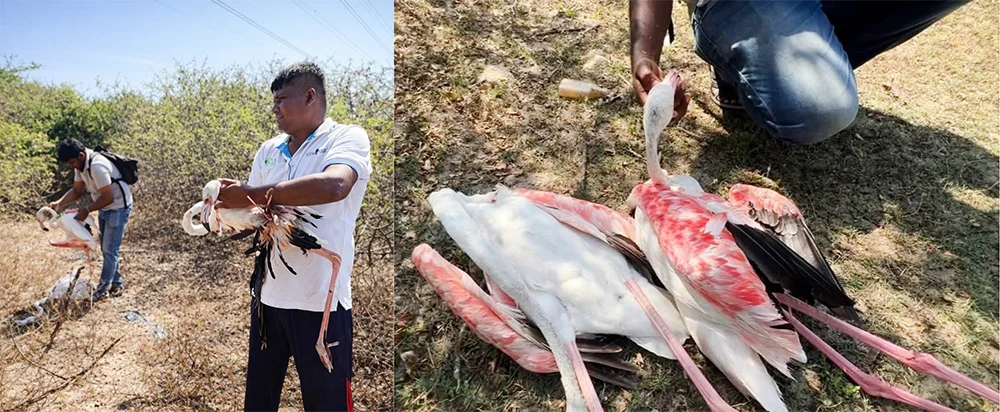
A fresh wave of concern has gripped conservationists following the reported deaths of migratory flamingos within the Vankalai Sanctuary—a globally recognised bird habitat—raising urgent questions about the ecological cost of large-scale renewable energy projects in the region.
The incident comes at a time when a fundamental rights petition, challenging the proposed wind power project, linked to India’s Adani Group, remains under examination before the Supreme Court, with environmental groups warning that the very risks they highlighted are now materialising.
At least two flamingos—believed to be part of the iconic migratory flocks that travel thousands of kilometres to reach Sri Lanka—were found dead after entanglement with high-tension transmission lines running across the sanctuary. Another bird was reportedly struggling for survival.
Professor Sampath Seneviratne, a leading ornithologist, expressed deep concern over the development, noting that such incidents are not isolated but indicative of a broader and predictable threat.
“These migratory birds depend on specific flyways that have remained unchanged for centuries. When high-risk infrastructure, like poorly planned power lines, intersect these routes, collisions become inevitable,” he said. “What we are witnessing now could be just the beginning if proper mitigation measures are not urgently implemented.”
Environmentalists argue that the Mannar region—particularly the Vankalai wetland complex—is one of the most critical stopover sites in South Asia for migratory waterbirds, including flamingos, pelicans, and various species of waders. The sanctuary’s ecological value has also supported a niche with growing eco-tourism sector, drawing birdwatchers from around the world.
Executive Director of the Centre for Environmental Justice, Dilena Pathragoda, said the incident underscores the urgency of judicial intervention and stricter environmental oversight.
“This tragedy is a direct consequence of ignoring scientifically established environmental safeguards. We have already raised these concerns before court, particularly regarding the location of transmission infrastructure within sensitive bird habitats,” Pathragoda said.
“Renewable energy cannot be pursued in isolation from ecological responsibility. If due process and proper environmental impact assessments are bypassed or diluted, then such losses are inevitable.”
Conservation groups have long cautioned that the installation of wind turbines and associated grid infrastructure—especially overhead transmission lines—within or near sensitive habitats could transform these landscapes into lethal zones for avifauna.
An environmental activist involved in the ongoing legal challenge said the latest deaths validate earlier warnings.
“This is exactly what we feared. Development is necessary, but not at the cost of biodiversity. When projects of this scale proceed without adequate ecological assessments and safeguards, the consequences are irreversible,” the activist stressed.
The debate has once again brought into focus the delicate balance between renewable energy expansion and biodiversity conservation. While wind energy is widely promoted as a clean alternative to fossil fuels, experts caution that “green” does not automatically mean “harmless.”
Professor Seneviratne emphasised that solutions do exist, including rerouting transmission lines, installing bird diverters, and conducting comprehensive migratory pathway studies prior to project approval.
“Globally, there are well-established mitigation strategies. The issue here is not the absence of knowledge, but the failure to apply it effectively,” he noted.
The timing of the incident is particularly worrying. Migratory flamingos typically remain in Sri Lanka until late April or May before embarking on their return journeys. Conservationists warn that if hazards remain unaddressed, larger flocks could face similar risks in the coming weeks.
Beyond ecological implications, experts also highlight potential economic fallout. Wildlife tourism—especially birdwatching—contributes significantly to local livelihoods in Mannar.
Repeated reports of bird deaths could deter eco-conscious travellers and damage the region’s reputation as a safe haven for migratory species.
Environmentalists are now calling for immediate intervention by authorities, including a temporary halt to high-risk operations in sensitive zones, pending a thorough environmental review.
They stress that protecting animal movement corridors—whether elephant migration routes or avian flyways—is a fundamental pillar of modern conservation.
As the controversy unfolds, one question looms large: can Sri Lanka pursue sustainable energy without sacrificing the very natural heritage that defines it?
Pathragoda added that for now, the sight of fallen flamingos in Mannar stands as a stark reminder that development, if not carefully planned, can carry a heavy and irreversible cost.

Presidential Suite at Sri Jayewardenepura General Hospital opened to the public

Cabinet Sub-Committee appointed to streamline the Public Service meets for the second time

PSL 2026: Teams allowed to submit two XIs and pick one after toss

Japan Premier League [JPL], building cricket from the ground up

Showers may occur at a few places in the Sabaragamuwa province and in Galle, Matara, Kalutara and Nuwara-Eliya districts in the evening

Energy Minister indicted on corruption charges ahead of no-faith motion against him

‘Dates have the highest sugar content to fight Coronavirus’

Sunday Island 27 December – Headlines

#SundayIsland 17th December – Headlines

Sunday Island – 28th March

Sunday Island Headlines – 21 March

Sunday Island – 21st February – Headlines
-

 News3 days ago
Senior citizens above 70 years to receive March allowances on Thursday (26)
-

 Features5 days ago
Trincomalee oil tank farm: An engineering marvel
-
 News14 hours ago
Energy Minister indicted on corruption charges ahead of no-faith motion against him
-

 News2 days ago
US dodges question on AKD’s claim SL denied permission for military aircraft to land
-

 Features5 days ago
The scientist who was finally heard
-

 Business2 days ago
Dialog Unveils Dialog Play Mini with Netflix and Apple TV
-

 News3 days ago
CEB Engineers warn public to be prepared for power cuts after New Year
-
 News3 days ago
Japanese boost to Sri J’pura Hospital, an outright gift from Tokyo during JRJ rule