
Opinion
Making O/L English literature more accessible


In his feature article, titled “Reduce O/Level STRESS”, appearing in The Island of 03 May, Anton Peiris makes a timely intervention to introduce an alternative mathematics course for O/L students, which will be tailored to suit the capacity of a considerable number of students who find the customary mathematics paper too challenging. This is surely a more pragmatic and student-friendly approach, because for the past few years we have been trapped in the split between two extremes: either in support of a pass in math to be made compulsory for all A/L students or the exemption of Arts students from this requirement. “Maths Studies” would be a happy compromise between the two extremes, which would stand in good stead for many O/L students. with a gift for Arts subjects to pursue their goals without math being an undue hindrance or, conversely, its total exemption turning out to be a free license for laxity.
O/L English literature seems to be another subject not available to many students due to at least two reasons: first, the want of qualified teachers and, second, the standards being set too high for the average student, as in the case of math. This deters many students who are not competent enough to meet the high-end demand for “appreciating literary texts” from gaining many other benefits literature would otherwise offer them, if provided as a more watered down package, as in “Maths Studies.” In short, the introduction of a less daunting variant such as “Literature Studies” for the average student, for whom the regular “English Literature” is virtually a taboo, can ensure the same gains “Maths Studies” intends to bring to those less proficient in math.
Such leniency would not be wholly out of tune with the learning outcomes of O/L English Literature, enunciated in the relevant syllabus issued by the NIE, which states:
The national goal of making an informed reader means a critical thinker as well. The learner must be able to appreciate any “well written” book and recognize a “good book” when he sees one. It is a training for life. But the whole enterprise of studying literature has been coloured by non-educational, even non-humanistic objectives. For most students and more for their parents, English literature has become a symbol of prestige, culminating in a fantasy of a distinction pass at the GC.E. (O/L) examination. (http://www.nie.lk/pdffiles/tg/e10tim130.pdf)
This goes to provide at least two good reasons for introducing a less demanding option like “Literature Studies” for the average student. As the latter part of the above paragraph admits, for many students, as well as their parents, studying English literature has become a “symbol of prestige.” This is sad because promoting such snobbery flies in the face of all the lofty ideals contained in the first three sentences, such as making the student well informed, critical and sensitized enough to appreciate good literature, etc. As such, it would not be undesirable, in the least, to aim at moulding a reasonably broadminded and sensitive person, by adjusting the syllabus to focus more on increasing their general awareness of the richness of world literature, without making the study of O/L literature a strenuous exercise of gaining a set of “skills,” which may be more suitable for the purpose of grooming critics rather than making students read for pleasure. Arguably, the emphasis on critical appreciation of the texts might be one reason why the students end up becoming stuck-up, as described in the above passage.
There is no doubt that the regular O/L literature course prepares the student to study literature at the A/Ls – hence the need for its continuation. However, a more student-friendly variant intended for encouraging the average student to read literature, without the unnerving prospect of having to write a critical essay on each of the prescribed texts she has to read, is sure to cultivate the reading habit among students. The performance evaluation defined in the NIE syllabus cited below proves the rigid test-oriented and technical nature of the process:
Appreciation of English literary texts is tested as a component of the G.C.E. (O/L) examination formatively as well as summatively at the end of a two-year course of study. At school level, it is assessed formally at term tests. It is also assessed informally in the classroom using a variety of techniques, both oral and written. Conventionally literature is tested by written examinations. The test items most frequently used are the context question and the critical essay. The context question is more effective since it directly tests the candidate’s familiarity with the texts.
Undoubtedly, a more student-friendly and less formulaic syllabus intended for coaxing the average student to read for pleasure, may ideally minimize the focus on critical writing aspect and the emphasis on a knowledge of the textual mechanics. Instead, such a syllabus may include a prudent selection of interesting biographical details of writers and their famous works, their dominant themes and the relevant social contexts, short samples of texts not intended for critical evaluation but for familiarizing them with various writing forms, etc. – anything that will stimulate the reading habit of the student who may even be encouraged to read the translations in their mother tongue, if time permits.
The most important outcome would be to make them keen readers. The essential fine-tuning with regard to the selection of teaching materials and testing can be done by the syllabus designers and teachers who know the terrain well. Thus, as in the case of math, the modified syllabus of literature would help students who are not adequately proficient to follow the standard literature course, to find a more manageable way of developing a liking for literature.
SUSANTHA HEWA


Nihal Seneviratne’s funeral on Wednesday was one of the best attended in recent times. He passed away on Tuesday after a short spell in hospital and no wonder a great many people came to bid him a final goodbye. He was not only a truly accomplished public servant with a 33-year long career in the legislature but was also God’s good man – humble, pleasant and ever ready to go out of his way to help anybody.
Like his predecessor as Secretary General of Parliament, Sam Wijesinha, Nihal passed the 91+ years landmark in his lifetime. These two top officials who headed the administration of the legislature for many long years were very different from each other. Sam made the office of Clerk to the House of Representatives he took over from retiring Ralph Deraniyagala, a very visible institution while Nihal, recruited as Assistant to the then Clerk Assistant in 1965 during Deraniyagala’s time, preferred to do his job away from the limelight.
He was affectionately nicknamed Galba from his days at the Royal Primary School in the 1940s – a teacher had asked him “Seneviratne, what’s in your lunchbox?” and he had replied “Gulbunis, Sir” – acquiring a nickname that withstood the ravages of time. Coincidentally, he married into the famous Perera and Sons bakery family and even his wife, Srima, often referred to him as “Galba.”.
His choice of career was somewhat accidental. Having taken an Ll.B. degree from Peradeniya in 1959 he had undergone the mandatory two years at the Law College to be enrolled as an advocate. He had won a scholarship to the US when an advertisement for the parliament vacancy was published. His close friend, Rajah Kuruppu (“Crumbs” to him) had typed out an application, got him to sign it and sent it off.
He was interviewed and selected. Therein lies an interesting story. The interview board comprised the Speaker (Pelpola), Leader of the House (CP de Silva), Leader of the Opposition (Dudley Senanayake) and the Clerk (Deraniyagala). When he said he was a Royalist, both Dudley and CP who were Thomians said “wrong school!”
Nihal asked Deraniyagala whether he could complete his American scholarship and take up the appointment on his return. This was refused but but he was told he’d be sent to the House of Commons for training. Nihal accepted these terms and a long career ending at the pinnacle ensued.
Srima used to joke that when she was engaged to Nihal, she would tell her friends that she was marrying an assistant clerk!
As an All Island JP, Nihal was of immense service to friends and acquaintances attesting various documents. Hundreds of these have been signed on his dining table. He would often offer to visit friends’ homes when attestations were required without making them come to him.
Nihal Seneviratne appropriately wore a Royal College tie when he was laid out after passing away. He had always been passionate about his old school, serving as Secretary of the Royal College Union and being its Vice President Emeritus when he died. The school was well represented st his funeral.
He also did much to keep the alive the memory of his late brother, Professor KN (Bull) Seneviratne, well known professor of pathology and founder of the Post Graduate Institute of Medicine, who passed away prematurely many years ago, organizing an annual oration in his memory. Despite challenges of age, he flew to Australia to visit his sister living there as often as he could.
Nihal published two books of memoirs with ringside stories of momentous events in the legislature of his time that included the JVP bomb lobbed into a committee room of parliament killing one MP and seriously injuring Lalith Athulaththmudali. JRJ miraculously escaped while then PM Premadasa was also hurt. The grenade bounced off the table at which the president, prime minister and chief government whip sat and exploded under Athulathmudali’s chair. Seneviratne had to cope with the mayhem that followed.
He was on the hot seat when the attempt to impeach President Premadasa was “entertained” by Speaker MH Mohamed who thereafter abandoned it. Therein lies a story that Nihal has written about. He was never consulted by the speaker and the original motion has vanished into thin air and is not in the parliament archives.
Not only Srima, his wife, children Satyajith and Shanika, and his three granddaughters who spoke warmly of their seeya when his last book was launched, but also a host of family, friends, subordinates, colleagues and many more will miss this remarkable human being who non-ostentatiously wore an important title during a long career in the national legislature.
Manik de Silva

(Continued from January 02, 2026)
From my perspective, it is obvious that Sri Lanka as a country/nation is still left in the lurch politically, economically and morally. The biggest problem is that there is no inspiring leadership. Strong moral leadership is a key component of good governance. ‘Raja bhavatu dhammiko’ (May the ruler be righteous) is the perennial chant of the bhikkhus we hear every morning. A country’s moral leadership is interwoven with its ethical foundation, which, in Sri Lanka’s case, is built on Buddhist moral values, which resonate with the best found in other faiths.
The two dynamic social activist monks, mentioned towards the end of Part I of this article, are being targeted for severe public denunciation as rabid racists in the media in Sri Lanka and abroad due to three main reasons, in my view: First, they are victims of politically motivated misrepresentation; second, when these two monks try to articulate the problems that they want responsible government servants such as police and civil functionaries to address in accordance with the law, they, due to some personality defect, fail to maintain the calm sedateness and composure normally expected of and traditionally associated with Buddhist monks; third, (perhaps the most important reason in this context), these genuine fighters for justice get wrongly identified, in public perception, with other less principled politician monks affiliated to different political parties. Unlike these two socially dedicated monks, monks engaged in partisan politics are a definite disadvantage to the parties they support, especially when they appear on propaganda platforms. The minstrel monk mentioned later in this writeup is one of them.
The occasional rowdy behaviour of Madakalapuwa Hamuduruwo is provoked by the deliberate non-responsiveness of certain unscrupulous government servants of the Eastern Province (who are under the sway of certain racist minority politicians) to his just demands for basic facilities (such as permits for plots of land and water for cultivation) for traditional Sinhalese dwellers in some isolated villages in the area ravaged by war. That is something that the government must take responsibility for. The well-known Galagoda-aththe Thera had long been warning about the Jihadist threat that finally led to the Easter Sunday attacks, but he was in jail when it actually happened. The Yahapalana government didn’t pay any attention to his evidence-based warnings. Instead they shot the messenger. Had the authorities heeded his urgent calls for alarm, the 275 men, women and children dead, and the 500 or so injured, some grievously, would have been safe.
The Mahanayakes should have taken a leaf out of Cardinal Malcolm Ranjith’s book. The Cardinal knows that his responsibility is to look after his flock as a single unanimously approved/accepted leader of the Catholic Church. He fulfills that responsibility well. But, the Mahanayakes couldn’t have resorted to the Cardinal’s strategies which he chooses in accordance with his Catholic/Christian conscience (ultimately fashioned by Christian moral values). The Mahanayakes however, like the Cardinal, could have brought pressure on any one or all of the Presidents and the Prime Ministers elected/appointed since the end of the separatist conflict in 2009 to implement Article 9 of the existing Constitution in its letter and spirit and the powerful earlier Antiquities Ordinance of 1940 fully (I hope it is not in abeyance now) to protect the extensive Buddhist archaeological heritage sites spread throughout the North and East, which have been encroached on and vandalised for decades now, and to look after the poverty-stricken Sinhalese peasants who have somehow managed to survive in the isolated villages in the the Batticaloa District.
A few errant monks, in my opinion, owe their existence primarily to the failure of two groups of people, opportunistic politicians and the indifferent Sangha leadership, to put it plainly. Politicians use monks for securing the Buddhist vote to come to power, and the Mahanayake theras fail to take a united stand against them. As a rule, politicians forget about monks after getting elected to power, apparently, in the hope of not alienating non-Buddhist voters, who naturally favour candidates of their own at elections. Their leaders acquire the influence they need to survive in politics by rubbing those in power the right way. But those non-Buddhist voters are as innocent and peace-loving as the traditionally hoodwinked Buddhist voters.
In this context, I remember having watched a YouTube video uploaded over four months ago featuring MP Namal Rajapaksa. The video (2025-08-30) contained a news clip taken from a mainstream TV channel that showed the young MP being snubbed by a certain Anunayake Thera in Kandy. This was when the MP, during his audience with the high priest, mentioned to him how a retired senior naval officer who had done so much selfless service in ridding the country of Tamil separatist terrorism had been arrested and remanded unjustly (as it appeared) under the present government which is being accused of succumbing unnecessarily to global Tamil diaspora pressure. The monk’s dismissive and insensitive comment in response to MP Namal Rajapaksa’s complaint revealed the senior monk’s blissful ignorance and careless attitude: “We can’t say who is right, who is wrong.” Are we any longer to believe that the Maha Sangha that this monk is supposed to represent are the guardians of the nation?
Please remember that the country has been plunged into the current predicament mainly due to the opportunistic politicians’ policy of politics for politics’ sake and the Mahanaykes’ inexplicable “can’t-be-bothered” attitude. It is not that they are not doing anything to save the country, the people, and the inclusive, nonintrusive Buddhist culture
A young political leadership must emerge free from the potentially negative influence of these factors. SLPP national organiser MP Namal Rajapaksa, among a few other young politicians like him of both sexes, is demonstrating the qualities of a person who could make a successful bid for such a leadership position. In a feature article published in The Island in September 2010 (well over fifteen years ago) entitled ‘Old fossils, out! Welcome, new blood!’ I welcomed young Namal Rajapaksa’s entry into politics on his own merits as a Sri Lankan citizen, while criticising the dynastic ambitions of his father, former president Mahinda Rajapaksa. Namal was already a Cabinet minister then, I think. I have made complimentary observations on his performance as a maturing politician on several occasions in my subsequent writings, most recently in connection with the Joint Opposition ‘Maha Jana Handa’ rally at Nugegoda that he organised on November 21, 2025 on behalf of the SLPP (The Island December 9 and 16). A novel feature he had introduced into his programme was having no monk speakers. I, for one, as a patriotic senior Sri Lankan, wholeheartedly approve of that change from the past. Let monks talk about politics, if they must, from a national platform, not from party political stages. That is, they should provide a disciplined, independent ethical voice on broad societal issues. Ulapane Sumangala Thera is approximating that in his current outspoken criticism of PM Harini Amarasuriya’s controversial education reforms. But I am not sure whether he will continue with non-partisan politics and also infuse some discipline and decency into his speech.
Namal should avoid the trodden path in a plausible manner and get rid of the minstrel monk who insists on accompanying him wherever he goes and tries to entertain your naturally growing audiences with his impromptu recitations”.
This monk reminds me of Rafiki the old mandrill in the 1994 The Lion King animation movie. But there is a world of difference between the monk and the mandrill. The story of The Lion King is an instructive allegory that embodies a lesson for a budding leader. One bright morning, while the royal parents are proudly watching behind him, and, as the sun is rising, Rafiki, the old wise shaman, presents lion king Mufasa’s new born cub, Simba, from the top of Pride Rock to the animals of the Pride Lands assembled below. Rafiki, though a bit of an eccentric old shaman, is a wise spiritual healer, devoted to his royal master, the great king Mufasa, Simba’s father. The film depicts how Simba grows from a carefree cub to a mature king through a life of troubles and tribulations after the death of his father, challenged by his cruel younger brother Scar, Simba’s uncle. Simba learns that ‘true leadership is rooted in wisdom and respect for the natural order, a realisation that contrasts Mufasa’s benevolent rule with Scar’s tyranny’.
Years later, another dawn, animals gather below the Pride Rock, from where Rafiki picks up the wiggling little first born cub of King Simba and Queen Nala and raises him above his head. All the animals cheer and stamp their feet.
The film closes with Simba standing at the top of Pride Rock watching the sunset beyond the western hills.
“Everything is all right, Dad”, Simba said softly. “You see, I remember …. He gazed upward. One by one each star took its place in the cold night sky.
The film describes the Circle of Life, the interconnectedness and interdependence of all living things, and the cycle of birth, death, and renewal. For me, this is a cheerful negation of T.S. Eliot’s pessimistic philosophical reflection on life: “Eating and drinking, dung and death”.
Namal has already developed his inherited political leadership skills, which he will be capable of enhancing further with growing experience. Let’s hope there are other promising, potential young leaders of both sexes as well, to offer him healthy competition eventually, so that, in the future, the country will be ruled by the best leaders. Concluded
by Rohana R. Wasala ✍️
Opinion
A new era of imperial overreach: Venezuela, international law, and the Long Shadow of Empire

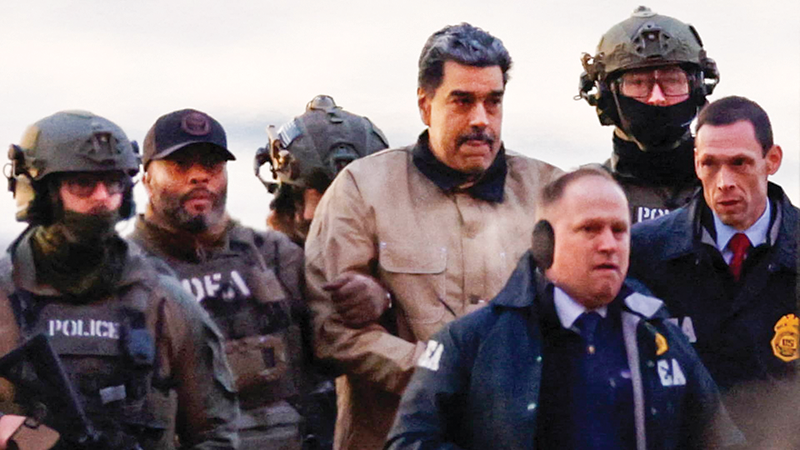
The recent illegal bombing of civilian infrastructure in the Bolivarian Republic of Venezuela, followed by the illegal abduction of President Nicolás Maduro and First Lady Cilia Flores, has sent shockwaves across the Global South. These actions represent a profound escalation in the long history of external interference in Latin America. The targeting of power stations, water systems, and other essential facilities has deepened the suffering of ordinary Venezuelans, echoing the strategy used against Iraq in the years preceding the 2003 invasion. Such attacks on civilian infrastructure constitute clear violations of international humanitarian law and may amount to war crimes.
The seizure of Venezuela’s democratically-elected leadership is also an act of international piracy, drawing comparisons to earlier episodes in which powerful states removed leaders who resisted external domination. The assassination of Congolese Prime Minister Patrice Lumumba in 1961, the invasion of Panama and removal of leader Manuel Noriega in 1989, and the forced removal of Haitian President Jean‑Bertrand Aristide in 2004 come to mind.
The abduction of Maduro and Flores are part of a pattern in which powerful nations intervene to reshape political landscapes in ways that align with their strategic and economic interests. It is part of a series of unilateral US foreign policy decisions, often violating international law, that have drawn significant international criticism.
These developments bring into question the very nature of modern imperialism. The United States’ actions in Venezuela resemble the gunboat diplomacy once practised by the British Empire. During the height of British colonial power, it routinely deployed the Royal Navy to intimidate or coerce nations into compliance. That era only came to a symbolic end when the forces of the newly established People’s Republic of China forced the last British Yangtze gunboat, HMS Amethyst, out of Chinese waters in 1949. The contemporary US interventions, whether through military strikes, unilateral economic sanctions, or covert operations, represent a modernised form of the same imperial logic.
Historical comparisons can also be made to the 1956 Suez Crisis, when Britain, France, and Israel invaded Egypt in an attempt to seize control of the Suez Canal. At that time, US President Dwight D. Eisenhower, a Republican and former general, stood on the right side of history when he opposed the invasion and joined the international community in pressuring the aggressors to withdraw. Analysts often highlight this moment as an example of the United States aligning itself with anti‑colonial sentiment and the principles of national sovereignty.
This stance was consistent with the ideals of the American Revolution, when George Washington and other revolutionaries resisted the imperial policies of King George III. The British monarch’s actions were widely seen as serving the interests of the East India Company and other commercial elites. Critics of current US foreign policy suggest that the motivations behind recent actions in Venezuela and Iran bear uncomfortable similarities to those earlier imperial dynamics.
According to these perspectives, the pressures placed on Venezuela today are driven by strategic considerations:
- Control over vast oil reserves, among the largest in the world
- Protection of the US dollar from global de‑dollarisation efforts
- Geopolitical positioning against states such as Venezuela and Iran
- Support for Israel, embroiled in a long-standing, illegal occupation of Palestine – opposed actively by both Venezuela and Iran.
These arguments frame the situation not as an isolated incident, but as part of a broader geopolitical strategy reminiscent of the lead‑up to the 2003 invasion of Iraq.
It seems that President Donald Trump, the driving force behind the illegal aggression against Venezuela and Iran, lacks the sagacity and knowledge of US history of past presidents like George Washington and Eisenhower.The illegal invasion of Iraq by President George W Bush in 2003 embroiled the US in a conflict that denuded its military capacity, depleted the US treasury and accelerated the decline of the US as a world economic and military power.
The US is no longer even as strong as it was prior to the Iraq invasion. The Russo-Ukraine war has revealed the weakness of the Western military, both in production and technological terms – the US has been forced to reverse-engineer Iranian drones, for example. The US economy is reeling, its apparent strength in GDP terms belied by its lack of productive capability.
The attempts by the US to isolate its perceived enemies through sanctions and expropriations of foreign reserves have backfired. Foreign governments are reluctant to buy US bonds – essential for keeping the American economy afloat. The de-dollarisation trend has accelerated, as nations seek to protect themselves from unilateral US economic action.
Trump’s blatant disregard for international law in his treatment of both Venezuela and Iran are likely to force countries of the Global South to seek alternative groupings to safeguard themselves from US aggression. The growth of the Shanghai Co-operation Organisation and the establishment of the Alliance of Sahel States are symptomatic of the unease of the Global South.
The unfolding crisis in Venezuela has therefore become a focal point for debates about sovereignty, international law, and the future of global power relations. For many in the Global South, the events are viewed through the lens of historical memory of colonialism, intervention, and the struggle for self‑determination. Whether the international community will respond with the same unity that confronted the Suez invasion remains to be seen, but the stakes for global norms and regional stability are undeniably high.
(Asia Progress Forum is a collective of like-minded intellectuals, professionals, and activists dedicated to building dialogue that promotes Sri Lanka’s sovereignty, development, and increasing leadership in the Global South.)
by Asia Progress Forum

Rescuers race to find dozens missing in deadly Philippines landfill collapse

Trump seeks $100bn for Venezuela oil, but Exxon boss says country ‘uninvestable’

US military strikes Islamic State group targets in Syria, officials say

Gardner and Wareham lead Giants to opening-game victory

Experts: NPP education reforms unsuitable for SL

Sajith: Ashoka Chakra replaces Dharmachakra in Buddhism textbook

‘Dates have the highest sugar content to fight Coronavirus’

Sunday Island 27 December – Headlines

#SundayIsland 17th December – Headlines

Sunday Island – 28th March

Sunday Island Headlines – 21 March

Sunday Island – 21st February – Headlines
-

 News5 days ago
Interception of SL fishing craft by Seychelles: Trawler owners demand international investigation
-
 News5 days ago
Broad support emerges for Faiszer’s sweeping proposals on long- delayed divorce and personal law reforms
-

 Opinion2 days ago
The minstrel monk and Rafiki, the old mandrill in The Lion King – II
-

 Features2 days ago
The Venezuela Model:The new ugly and dangerous world order
-

 Latest News1 day ago
Rain washes out 2nd T20I in Dambulla
-

 Business1 day ago
Sevalanka Foundation and The Coca-Cola Foundation support flood-affected communities in Biyagama, Sri Lanka
-

 News4 days ago
Prez seeks Harsha’s help to address CC’s concerns over appointment of AG
-
 News6 days ago
Private airline crew member nabbed with contraband gold