
Opinion
Main conditions for progressive alternative

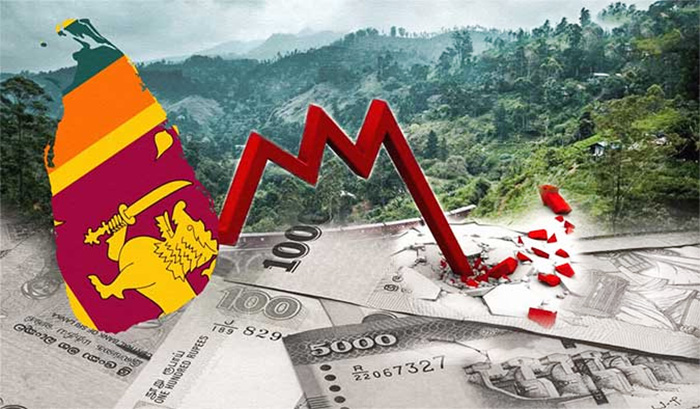
Sri Lanka is experiencing its worst economic crisis since Independence. This crisis has spilled over into the political sphere, causing splinters among the major political parties and creating a major leadership vacuum. Today, we have an unelected President enacting policies imposed by the IMF. Despite popular anger at the deteriorating conditions in the country, no single party is likely to win a majority in any upcoming election. Therefore, political realignments and coalitions are likely in the near future.
However, as long as such coalitions are formed based on desperate and short-term goals to win elections, they shall not be able to find a solution to any of the pressing issues brought about by the current crisis. In such unusual times, politics as usual cannot and will not work. In previous economic crises, politicians have sought to deflect from deteriorating economic conditions by stoking ethnic conflict, creating even more instability in the process. Judging by the level of discourse in the mainstream media, among politicians and even among our academics, it is clear that there is still a lack of understanding about the root causes of the current economic crisis and the way forward.
Any future coalition that claims to be some combination of progressive, patriotic, or left of centre, must come to terms with the root causes of Sri Lanka’s economic crisis, as well as the opportunities presented in the geopolitical movement. For the CPSL, the following are two principal positions necessary to consider forming a common minimum program:
1. Anti-neoliberal, Pro-industrialization
A progressive coalition that seeks to govern Sri Lanka must first understand our current economic situation. The crisis we are in is not simply due to corruption, or a so-called “Chinese debt trap”, or even “printing money”. The root cause is that the economic structure of Sri Lanka has scarcely changed since the days of colonialism, when Sri Lanka was a plantation economy and a playground for foreigners. Unlike the economies of East Asia, we have failed to industrialize, leaving us technologically backward. Lack of technological dynamism slows and inhibits our ability to produce. We import more than we export because we do not produce anything of high value. The resulting trade deficit leaves us extremely vulnerable to periods of global economic crisis, such as the COVID-19 pandemic or rising prices of food and energy. The only way forward to provide jobs, income, stability, and a better quality of life for all is through industrialization.
The neoliberal economic path that various leaders have tried to implement since 1977 is not conducive to industrialisation and a production-based economy. Therefore, the first condition for a progressive coalition is to be against neoliberalism and for industrialisation. It should be clear from the development history of the capitalist West (UK, Germany, France, USA, and Japan) and the socialist East (the former USSR, China, and Vietnam) that industrial development is a crucial element for overall poverty alleviation regardless of the specific economic system used to achieve this goal.
Sri Lanka’s experiments with industrial development were short-lived and aborted too recklessly in 1977. While some of Sri Lanka’s leaders and think tanks blindly repeat the mantras of neoliberalism, nearly all major economies have shifted towards a more interventionist strategy to steer their economies during this crisis. Policies of industrialidation and re-industrialisation have come to dominate discussion in the supposedly free-trade loving US and EU. Therefore, industrialisation and industrial policy have to be at the heart of all policies designed to help the country recover from this crisis, and to prevent future crises.
2. Non-Aligned and Multipolar
Developing countries across Asia, Africa and Latin America, long starved of productive investment and throttled by Western monopoly capital, are slowly turning East. “Dedollarisation” and “multipolarity” are now words not just uttered by radical academics but ones found in reports from big banks such as Morgan Stanley. The world is changing, and any progressive coalition that seeks to rule Sri Lanka must reckon with these changes, and position the country in the most favourable position possible.
Historically, Sri Lanka was an outsized player in the Non-Aligned Movement, garnering support and admiration from countries across the decolonising world. Unfortunately, recent developments have reduced Sri Lanka into the position of a mere geopolitical pawn. The Multipolar moment is, in a way, a successor to and a realization of the Non-Aligned Movement. It opens the possibility for an alternative developmental path and a way to conduct business on a more equal footing. The African Union is already negotiating their own common settlement currency. West Asia is banding together for trade and other purposes. The Regional Comprehensive Economic Partnership (RCEP), the world’s largest free trade agreement, was signed with 15 countries in our region, making it the world’s largest trade agreement. However, our political leadership has so-far failed to use these opportunities to advance the interests of Sri Lankan workers.
Towards a new independence struggle, and a new economic policy
In many ways Sri Lanka is still a colony whose economy has been built for the benefit of a few. The basic structure of the plantation economy that was imposed at great cost to workers and farmers continues to sap the vitality of the nation. Our civil war may have ended in 2009, but Sri Lanka has been enthralled in a much longer economic war for over 500 years, since colonialism first arrived in this country. The economic war is fundamentally a war for technology, markets, and profit. The struggle for industrialisation should therefore rally a broad coalition of forces, and should be seen as a continuation of the national liberation struggle.
The path of industrialisation is not necessarily an easy or rosy one. It is one that requires steadfast leadership and resolve, and most importantly, the support and confidence of the people. There will likely be many obstacles along the way, from lack of capital to conspiracies and machination by Western monopoly capital. While the task may have seemed impossible during the unipolar moment of the Washington consensus, the emerging multipolar world order provides countries like Sri Lanka with much more flexibility. The money, technology, and knowhow we seek are now more objectively to be found in the East rather than the West. Therefore, Sri Lanka’s industrial, trade, finance and foreign policies all are inextricably linked. The country’s sovereign debt crisis, and the global economic crisis have made it so.
Communist Party of Sri Lanka (Education Department)



I refer to Dr Upul Wijayawardena’s recent letter on science and religion. I agree with him on the fate of religions in the modern world and would like to add the following observations on the evolution of religion and the advent of AI.
Religious philosophy evolved only in ancient India while it remained static with monotheism in other parts of the world. When the polytheistic Vedic religion arrived with Aryan migration to India, they found the ancient version of Jainism, which may have been practised over four thousand years as evidenced by some figures in meditation posture found in Mohenjo daro. By that time the indigenous religion had already abandoned the creator god or gods but still believed the mind as a permanent entity athman that survived death and continued in a cycle of reincarnation (samsara) due to results of any harmful action (kamma) even unintended performed in life collected in the athman. Salvation to a happy all-knowing permanent state named Kevala could be attained by the athman with extreme degree of self-mortification to destroy the past kamma attached to it, refraining from new kamma and developing the mind by meditation. As observed in progression from Veda to Upanishads the Aryan religion, evolution progressed with adoption of kamma, the cyclic existence of samsara, meditation and ethical behaviour in addition to prayer and sacrifice they practised for moksha.
The Buddha appeared in this philosophical atmosphere and denied both creator god and a permanent entity of athman. His psychology describes human behaviour based on the mind as a stream of changing consciousness. However, he accepted the cyclic existence of samsara; he said he verified the survival of consciousness at death with help of knowledge he gained from meditation. He prescribed a middle path to attain nirvana, a permanent state of happiness, avoiding self-mortification and redefined kamma to intentional activity only, both ethical and unethical resulting in bad and good results. He disagreed with the idea of kamma as the cause of rebirth. Following the Buddha, Vedantha religion reformed god to universal athman or brahman and evolved to modern Hinduism with a mixture of polytheism.
In his description of living beings in the universe, the Buddha has described some with a body made of fine material (brahma beings) in comparison to the gross material body of human and animal beings. One may assume the brahma body may not be carbon based.
The Buddha has also described living beings with physical body only (asannasatta) and another variety with mind only without a body (arupa satta). Therefore, it is not surprising to Buddhists that AI may evolve to become living beings if it develops a readily and freely available mobile source of energy and takes over the world with its superior capacity. AI already has information about Buddhist psychology. With that knowledge ‘AI beings’ may even become Buddhists not given to rituals.
According to the Buddha, brahma beings and asannasatta beings have very long lifespans as their bodies are not subject to decay and illness human beings develop. The new AI beings also may live as long as they wish because they may be able to repair themselves in case of developing physical defects. They would need only ethical behaviour to avoid destroying themselves by peaceful existence if they took over the world, as feared in some quarters.
However, as long as human beings exist in the world with death and uncertainty of what happens after death, they need a religion and rituals to give them psychological support. Even those who profess death is the end of life may have some doubt troubling their mind from time to time and may think of religion in times of adversity.
Ideally, human beings are free to accept one of the many versions of religious philosophies and respect each other’s choice and live in harmony. Unfortunately, extreme degrees of religious versions that cause division, unrest and violence will always continue to exist together with religions in the world.
Upali Abeysiri

By Lalin I De Silva
Sri Lanka speaks constantly about hospitals, medicines, food imports, agricultural productivity and the rising cost of living. Yet there is one simple question we rarely ask:
Are we eating enough of the food that our own soil can naturally give us?
Fruit is perhaps one of the finest gifts of the earth to humankind. A ripe mango, banana, papaya, guava or avocado comes to us almost ready to eat. Sunlight, rain, soil, microorganisms, minerals and the labour of a farmer have already done most of the work.
That is why I like to describe fruit as the “cream of the earth.”
This is, of course, not an argument that fruit alone can prevent every disease, or guarantee longevity. Science does not support such exaggerated claims. But there is strong international evidence that regular consumption of fruits and vegetables forms an important part of a healthy diet and is associated with lower risks of several major non-communicable diseases.
Sri Lanka’s own dietary guidance encourages the daily consumption of fruit as part of a balanced diet.
The tragedy is that we live on an island capable of producing an extraordinary variety of fruits, while many families increasingly depend on highly processed foods, sugary drinks and imported snacks.
This deserves national attention.
We Produce — But Do We Connect?
Sri Lanka grows banana, mango, pineapple, papaya, avocado, rambutan, mangosteen, guava, woodapple, beli, pomegranate, durian and many lesser-known indigenous fruits.
Yet our fruit value chain remains fragmented.
The farmer often does not know the final consumer.
The consumer rarely knows the farmer.
Fruit travels through several intermediaries, sometimes suffering poor handling, unnecessary damage and price escalation along the way.
Consumers may not know where a fruit was grown, when it was harvested, whether it was naturally matured or what crop-protection practices were followed.
Meanwhile, a careful farmer, producing exceptional fruit, may receive almost the same farm-gate price as someone producing an inferior product.
That is not value-chain management.
It is precisely this disconnect that a new citizen-led initiative could begin to address.
25 Districts — 25 Consumer Societies
A proposal now emerging is to establish a Pure Sri Lankan Authentic Healthy Fruit Consumers Society in each of Sri Lanka’s 25 districts.
The concept should not become another organisation full of titles, meetings and ceremonial functions.
Its purpose must be practical.
Each district society could bring together consumers, growers, doctors, nutritionists, horticulturists, schools, universities, retailers, hotels, processors and young entrepreneurs.
The first task would be to understand the district itself.
What fruits are grown?
Where are they grown?
When are they available?
Which traditional varieties are disappearing?
Where can consumers purchase genuinely good fruits?
Where are the post-harvest losses?
What do farmers need?
What do consumers actually want?
From this information, each district could eventually develop its own Fruit Map.
Twenty-five district maps could then become a National Fruit Map of Sri Lanka.
From Anonymous Fruit to Traceable Fruit
Imagine buying a mango and scanning a QR code.
You could see the district, grower, variety, approximate harvest date and production information.
You could perhaps even provide feedback on taste.
That may sound futuristic, but the technology already exists.
The problem is not technology.
The problem is that our food system was never designed to connect the person who grows the fruit with the person who eats it.
Traceability could change that.
The principle is simple:
Know your farmer. Know your fruit.
Let the Consumer Lead
For decades, agriculture has largely been driven from the production side.
“How much can we produce?” has been the dominant question.
A healthier agricultural economy should begin with another question:
What does the consumer need, value and trust?
If thousands of consumers deliberately demand fresh, safe, flavorful and traceable Sri Lankan fruit, the message travels backwards through the entire value chain.
Retailers respond.
Farmers respond.
Nurseries respond.
Researchers respond.
Investors respond.
Government eventually has to respond.
That is the real power of an organised consumer movement.
Start With Children
Perhaps the most powerful campaign message could be remarkably simple:
Two Fruits a Day.
Imagine a Sri Lankan child coming home from school and asking:
“What are our fruits today?”
Imagine every school having a small fruit garden.
Imagine children being able to identify 10 Sri Lankan fruits, understand their seasons and know where they are grown.
Such behavioral change cannot be achieved merely by issuing circulars from Colombo.
It must become part of family culture.
Kandy Could Begin
Kandy would be a logical district in which to pilot the concept.
Its climatic diversity, surrounding agricultural communities, educational institutions, hotels, markets and strong plantation heritage provide an excellent testing ground.
A successful Kandy model could then be adapted—not blindly copied—across the other 24 districts.
The objective should ultimately be much larger than selling more fruit.
It is about reconnecting soil, farmer, food, consumer and health.
Sri Lanka does not need to invent every solution from outside.
Sometimes the answer may already be hanging from a tree beside us.
We simply have to recognise its value.
Know Your Farmer. Know Your Fruit. Live Well.
Review
by Colleen Figg, Editor
and Reviewer – Amazon, New Voices Publishing
“Fernando echoes Macbeth with the line, “There is judgment here.” It captures the question running through the novel: can anyone participate in corruption and remain untouched by it? Beneath this satire is a dark story about power and the danger of believing, that someone else will always pay the price.”
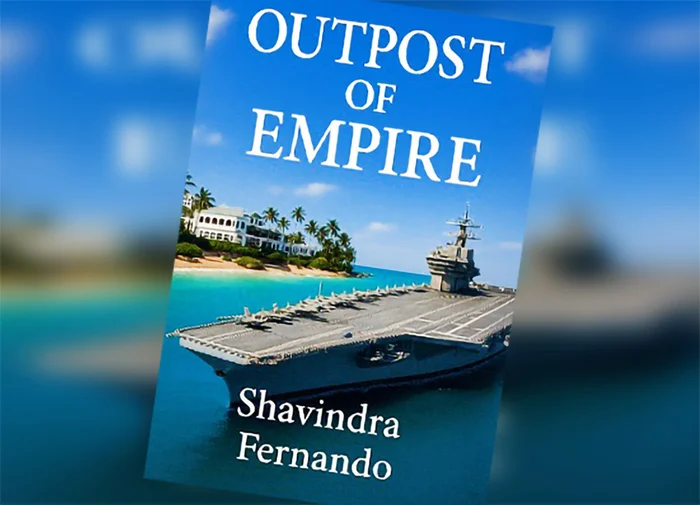
Shavindra Fernando’s Outpost of Empire is a political novel set in the fictional country of Lackadasia. At its heart is a strong idea: an exploration of world politics, terrorism and the ways in which powerful countries manipulate smaller ones. Fernando is clearly writing about political issues that matter deeply to him.
The names immediately establish the book’s satirical character. Lackadasia, Burgherbugaria and the various Klowns suggest a world in which the people and places are exaggerated, but the issues beneath the exaggeration are recognisable. The playful language allows Fernando to approach terrorism, religious conflict and political corruption from an unusual angle.
Henry Stockwell is a central character: an ambassador who arrives in Lackadasia presenting himself as a friend of the country. He believes he understands how power works and treats the country, its politicians and its people as pawns on his personal chessboard. In his arrogance, he never doubts that he controls events rather than being controlled by them. This confidence makes him a compelling figure and in him, we explore the workings of political influence and the potential traps contained therein.
As the story develops, Fernando reveals a political world where causes are adopted when they are useful, people are exploited and discarded, and the truth becomes whatever those in power need it to be. Ordinary people suffer the consequences of decisions made far beyond their reach or knowledge, while those making those decisions continue to justify their actions. Even the people who help keep this world running may not be as important or as safe as they imagine.
Stockwell brings this idea into focus. He recognises corruption in others and willingly takes part in it himself, yet he cannot see that he might also suffer its consequences. Ultimately, he thinks his position will keep him safe. He is intelligent enough to understand the game, but not insightful enough to grasp the limits of his place within it. This blindness gives the novel a strong sense of irony.
The satirical approach gives Fernando room to criticise political hypocrisy without turning the novel into a direct political argument. By using fictional countries and exaggerated names, he creates some distance from specific governments and events while still making the larger targets of the book clear. The humour does not take away from the seriousness of the subject; instead, it makes the cruelty and self-interest beneath the political performance stand out more sharply.
Near the end, Fernando echoes Macbeth with the line, “There is judgment here.” It captures the question running through the novel: can anyone participate in corruption and remain untouched by it? Beneath this satire is a dark story about power and the danger of believing that someone else will always pay the price.
I came away feeling that Outpost of Empire is a valuable and thought-provoking book, particularly in today’s political and social climate. It has a distinctive voice, and the questions it raises about power, responsibility and foreign interference remain relevant far beyond the fictional borders of Lackadasia.
About the Author
Shavindra Fernando has worked as a reporter. He read English & Classics at the University of Peradeniya in Sri Lanka, and took International Relations & Ethnic Politics as a Reuter Fellow at the University of Oxford in England. The Vague Poetess (1999)was his first novel.

NSC welcomes FM’s pledge on aid to stranded Iranian seafarers

Mano Ganesan hails unity as Saudi court overturns death sentence on Sri Lankan

Future of world religions

Clear, soft and shine-free skin

TISL moves SC over alleged non-compliance with order against Keheliya

Expert committee submits report on public proposals for election law reforms

‘Dates have the highest sugar content to fight Coronavirus’

Sunday Island 27 December – Headlines

#SundayIsland 17th December – Headlines

Sunday Island – 28th March

Sunday Island Headlines – 21 March

Sunday Island – 21st February – Headlines
-

 Features7 days ago
The Sri Lankan who made Scottish history
-

 Sports7 days ago
Nissanka absence opens door for Sri Lanka’s young guns
-

 News6 days ago
NDB fraud Rs 60mn more than reported
-

 News6 days ago
Removing monk’s robes matter for Sangha to decide: Mahanayake Theras
-
 News7 days ago
Shiranthi R remanded until 13 Oct.
-

 News4 days ago
Sri Lanka escalates anti-graft drive with Shiranthi’s jailing
-

 News5 days ago
NPP govt. reminded of its responsibilities as US warship leaves Colombo
-

 Features7 days ago
Future of Sri Lanka’s state university system: Should it be shut down and reopened?