
Business
Mahindra IDEAL Finance among 15 Best Workplaces for Millennials in Sri Lanka – 2022

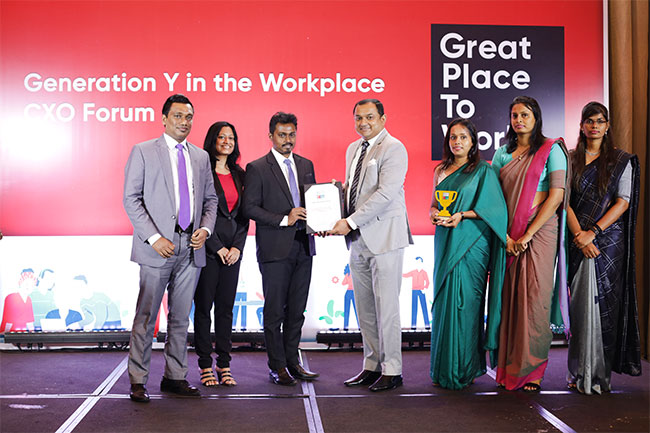
One of Sri Lanka’s fastest-growing licensed finance companies, Mahindra IDEAL Finance Limited recently marked yet another milestone on its journey of being an employer of choice, as it was ranked amongst the 15 Best Workplaces for Millennials™ in Sri Lanka 2022, by Great Place to Work®. The achievement is significant as Mahindra IDEAL Finance has been working hard to position itself and deliver on being the employer of choice for young professionals looking to build careers in the financial services space. The accolade was presented to Mahindra IDEAL Finance Limited at the Great Place to Work® in Sri Lanka awards ceremony, held on the 6th of September 2022 at the Hilton Colombo.
Expressing pleasure at receiving the accolade, Mr Duminda Weerasekare, Chief Executive Officer at Mahindra IDEAL Finance said, “It is a privilege to be ranked among the 15 Best Workplaces for Millennials™ in Sri Lanka for 2022. We believe our sincere intention of caring for and moulding our young team, while moving forward despite external challenges, has been recognized. This also helps us to better present our proposition to young professionals considering a career in the financial services sector, as we are presently in the midst of a massive islandwide network expansion drive. If you are looking to make a name for yourself in this space, then Mahindra IDEAL Finance could be the ideal platform for you.”
From its inception, Mahindra IDEAL Finance has been committed to being a caring and trustworthy employer, understanding the fundamental truth that human capital is the most valuable capital of all. Particularly during the pandemic, the Company went to exceptional lengths to ensure the safety, security and health of its employees in all aspects, both physical and psychological, at work and at home. Mahindra IDEAL Finance has also striven to foster and drive a performance-based culture that provides a meritocratic mechanism for advancement to provide maximum potential for personal and professional development, in the shortest possible time. The Company values each of its team members individually and is keenly cognizant of their roles in making Mahindra IDEAL Finance one of Sri Lanka’s leading and fastest-growing licensed finance companies.
The ranking of the Great Place to Work® List of Best Workplaces for Millennials™ in Sri Lanka 2022 was undertaken in accordance with Great Place to Work®’s rigorous 2 lens model of the Trust Index© employee survey and the Culture Audit© people practice analysis framework and matched the global qualification criteria required to be a Great Workplace. The study was conducted by assessing 72,350 employees at an 85% response rate across more than 160 organizations in Sri Lanka from July 2021 to June 2022. Nearly 20,000 Millennials responded to the anonymous survey. The assessment for the list of Best Workplaces for Millennials also further considered organizations with 20% or more millennials, with 70% or more having a positive perception of their employer. Organizations that scored higher on collaboration, work-life balance, non-discrimination by age, meaningful work, making a difference, contributing to society and pride in the organization, attributes considered valuable by millennials, were also ranked higher in the list.
Having been tipped as one of the Best Workplaces ™ in Sri Lanka for 3 years consecutively, Mahindra IDEAL Finance Limited is an employer of choice within the financial services space in Sri Lanka. The Company’s rapid network expansion drive, which is creating many new opportunities for young and aspiring professionals, was launched subsequent to Mahindra and Mahindra Financial Services Limited, India acquiring a controlling stake in IDEAL Finance Limited in 2021, soon after which Fitch Ratings upgraded the Company’s rating to AA – (lka) with a stable outlook, in recognition of the Company now being backed by a global financial services giant.











Business
Cost-effective clearance of goods across borders to determine worth of Customs Paperless Declaration

By Ifham Nizam
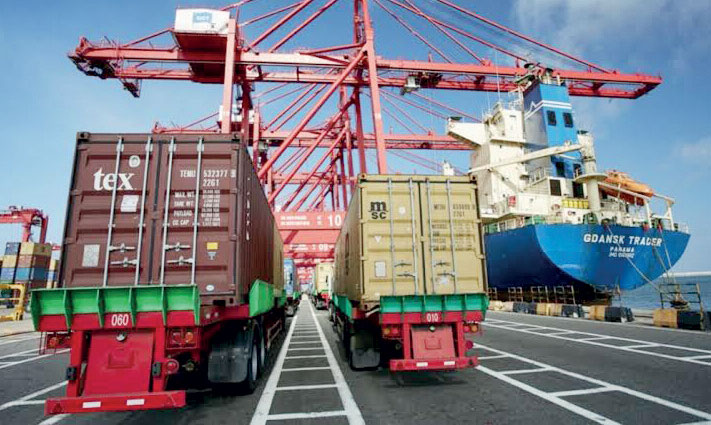
The introduction of the Customs Paperless Declaration from October 1 could mark an important step in Sri Lanka’s efforts to modernise trade, but its real value will depend on whether it reduces the time and cost of moving goods through the country’s borders, Customs House Agents & Traders Association President Mohamed Niyas said.
Niyas warned that digitising Customs declarations alone would not necessarily translate into faster cargo clearance or lower costs for businesses.
‘Expecting a dramatic improvement in clearance speed under the present conditions is like expecting Ferrari performance from a Morris Minor configuration, he said.
For importers and exporters, the issue extends well beyond paperwork. Every additional hour or day that cargo remains in the clearance chain can have wider consequences for businesses, including increased port and storage-related costs, additional working-capital requirements, uncertainty over delivery schedules and disruptions to production and distribution.
Niyas said the competitiveness of Sri Lanka’s trading sector ultimately depended on how efficiently goods could move through the country’s border-clearance system.
‘The real bottleneck is not merely the absence of paper. It is the entire clearance ecosystem—the limitations of the existing ASYCUDA World system, excessive regulatory interventions by Other
Government Agencies, multiple approvals, physical examinations, manual interventions, fragmented processes and institutional constraints, he said.
He cautioned that unless these bottlenecks were addressed, there was a risk that the paperless initiative would merely digitise existing bureaucracy.
‘If these underlying constraints remain unchanged, there is a real risk that the new paperless system could become another “copy-and-paste road show”—where an old, complex clearance process is simply transferred onto a digital screen without fundamentally changing the process itself, Niyas said.
For businesses dependent on imported raw materials, machinery, components and other inputs, clearance efficiency can directly affect the wider supply chain.
Delays at the border can create uncertainty for manufacturers, distributors and retailers, while exporters can face difficulties meeting delivery schedules when imported inputs or export consignments are held up.
Niyas therefore argued that the success of the October 1 initiative should be judged by its impact on trade flows rather than by the number of declarations processed electronically.
‘Paperless does not automatically mean faster, he said. ‘Digitising a slow process does not make the process fast. It only makes the slow process digital.’
He said Sri Lanka needed to move towards what he described as “process-less Customs”—a system in which unnecessary procedures are eliminated rather than simply converted into electronic procedures.
Among the reforms he called for are simplification of Customs declarations and approval workflows, improvements to the functionality of ASYCUDA World, greater use of risk-based inspections and better integration of Other Government Agency approvals.
Niyas also called for the elimination of repetitive document submissions and physical endorsements, greater use of pre-arrival processing, sufficient capacity for digital document uploads and clearly defined service-level timelines for Customs and OGAs.
By Sanath Nanayakkare
As global attention has fixed on the high-level diplomatic choreography at the United Nations General Assembly in New York, a subtler, yet profound geopolitical signal was sent from Colombo, yesterday.
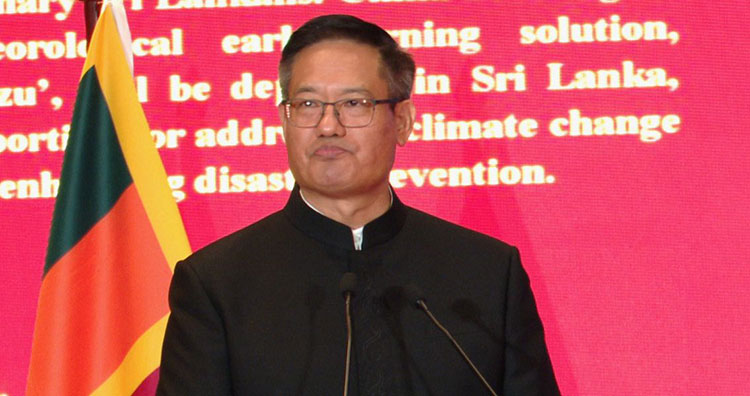
In a major address marking the founding anniversary of the People’s Republic of China, newly appointed Chinese Ambassador Wei Huaxiang chose to anchor bilateral relations not just in modern trade or infrastructure, but in a shared respect for Sri Lanka’s legacy of non-aligned independence.
By explicitly invoking Sri Lanka’s foundational role in the 1976 Non-Aligned Summit, Beijing was doing something unexpected in an era defined by fierce great-power rivalry: it was officially validating a small island nation’s right to maintain an independent foreign policy stance.
The Strategic Value of Independence
For decades, nations caught in the crosshairs of major-power competition have faced intense pressure to pick sides. Yet, Ambassador Wei’s embrace of Colombo’s non-aligned tradition signaled a different diplomatic playbook. Instead of demanding alignment, Beijing was framing its partnership as a reliable counterbalance to regional pressures. By honouring Sri Lanka’s diplomatic autonomy, China was effectively reassuring smaller economies that sovereign independence and robust economic cooperation can coexist.
Beyond Ports and Industrial Zones
This diplomatic framing reframed the narrative surrounding major collaborative ventures like the Colombo Port City and Hambantota Port. While foreign analysts often view these projects exclusively through the lens of strategic rivalry, Beijing’s diplomatic messaging tied them back to a historical ethos of solidarity—evoking memories of the 1952 Rubber-Rice Pact.
By marrying economic projects with a stated respect for non-alignment, China is positioning itself as a steadfast stakeholder that respects Sri Lanka’s internal agency during difficult economic and political seasons.
As both nations look toward major milestones in 2027—including the 70th anniversary of diplomatic ties—this nuanced diplomatic move revealed how historic traditions are being leveraged to navigate modern multipolar realities.
For global observers, the takeaway was clear: in the shifting architecture of Asian geopolitics, respecting a nation’s historical neutrality may just be the most effective way to secure a lasting partnership, a diplomatic masterclass that Ambassador Wei Huaxiang executed in style.

Sri Lanka Insurance Life (SLIC Life), the nation’s largest and strongest Life Insurer, is pleased to announce the appointment of Dr. Sameera Dharmasena as its new Chief Executive Officer, effective 22nd September 2026.
Dr. Dharmasena is a distinguished insurance professional with over 21 years of experience in the Sri Lankan insurance industry, having held senior leadership positions across several leading insurance companies affiliated with some of Sri Lanka’s largest business conglomerates. His extensive career spans both local and multinational insurance environments, bringing together broad industry expertise, strategic leadership and a strong commitment to the advancement of the insurance profession.

‘Vision’ Programme Marks Two Years

Costa Rica minister fired for unapproved meeting with Trump in US

At least 41 die as boat capsizes in DRC’s Lake Tanganyika

Showers will occur at times in the Western, Sabaragamuwa, Southern, Central and North-western provinces

Sajith vows to scrap 22A under future govt.

Two retired female Navy officers remanded over disappearance of two women during war

‘Dates have the highest sugar content to fight Coronavirus’

Sunday Island 27 December – Headlines

#SundayIsland 17th December – Headlines

Sunday Island – 28th March

Sunday Island Headlines – 21 March

Sunday Island – 21st February – Headlines
-

 News6 days ago
Shanakiyan urges urgent action over reported death sentence for Lankan in Saudi Arabia
-

 News5 days ago
Namal Rajapaksa Buddhist gambit fails, bail denied
-

 Features5 days ago
Why the spelling Sri Lankan names in English vary
-

 Features5 days ago
Three bands, a new identity: Sri Lankan wolf snake recognised as distinct species
-

 Business5 days ago
SLIIT holds largest-ever convocation
-

 News5 days ago
Govt monitors reported Saudi death sentence – Foreign Ministry
-

 News5 days ago
Vehicle prices drop by up to Rs. 1 mn, says importers’ body
-

 Business5 days ago
All-new Bolero MaXX Pik-Up unveiled in Lanka