
Latest News
Luus and Wolvaardt lead South Africa’s fightback after Rana’s eight-for

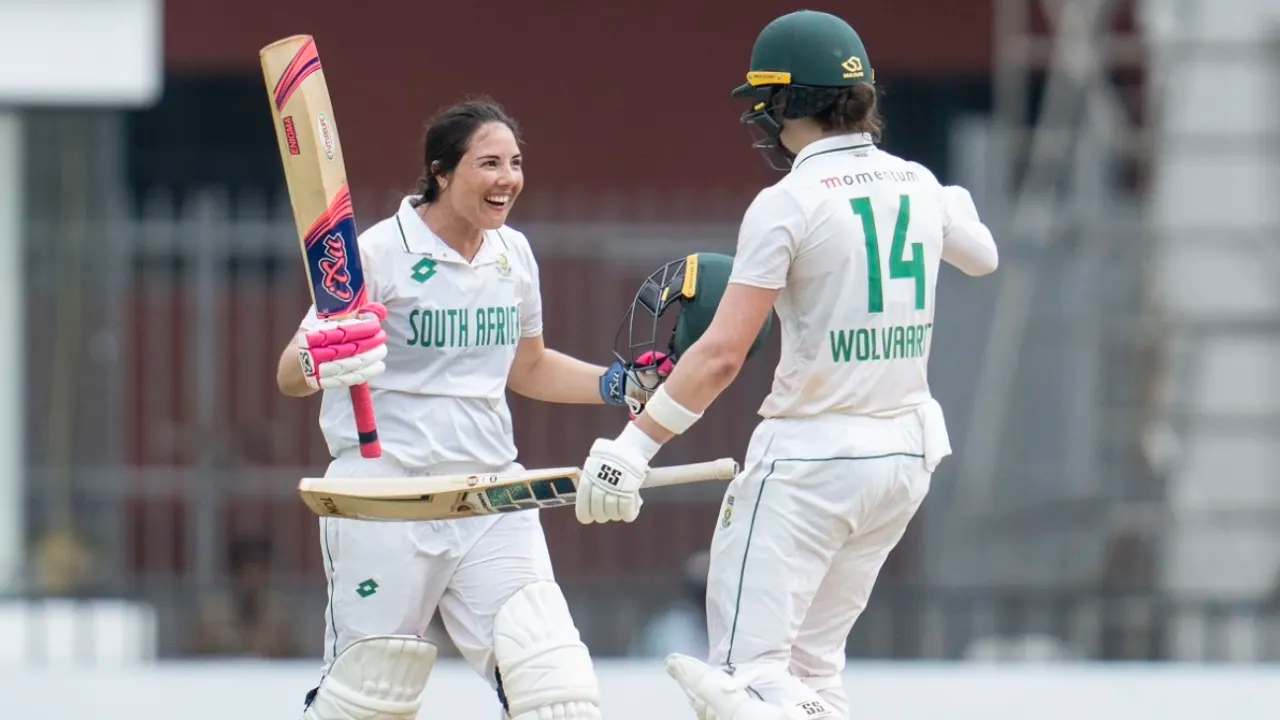
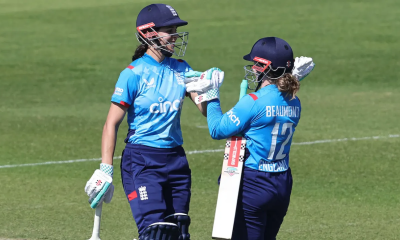
For the second consecutive day, South Africa’s batters showed great grit to stay in the game after being put on the back foot by the India bowlers in the one-off women’s Test in Chennai. If Sune Luus and Marizanne Kapp fought hard on the second day after India declared at 603 for 6, Luus was at it again on Sunday, in the company of Laura Wolvaardt this time, which helped South Africa cut down the deficit to 105 runs after they were bowled out for 266 in the first innings.
At stumps on the third day, South Africa were 232 for 2 in their second innings, with Luus scoring her first Test hundred and Wolvaardt remaining unbeaten on 93. South Africa will hope for more of the same on the fourth and final day to push the game to a draw.
It was an eventful opening session for India on a hazy morning where Sneh Rana’s sensational bowling on a pitch offering more turn fetched her five wickets – to go with three from Saturday – to give her figures of 8 for 77. South Africa lost six wickets for 30 runs after starting the day on 236 for 4.
Rana got the first breakthrough in her third over, the fifth of the day, when she dismissed a well-set Kapp for 74 with an almost unplayable delivery. Kapp was done in by the extra bounce as the ball, after pitching on off and middle, popped up to beat her outside edge and take the top of off stump. This triggered a collapse as three balls later, Rana removed Sinalo Jafta, who inside-edged one to Shubha Satheesh at short leg.
Three overs later, Deepti Sharma picked up her second wicket. This time the ball stayed low when debutant Annerie Dercksen missed with her prod and was hit on her back pad. South Africa took the review but it was in vain. In the following over, Rana took her sixth when Nadine de Klerk perished whipping towards square leg where Rajeshwari Gayakwad dived in front to complete the catch. No. 7 and No. 8 came soon after as Rana finished off the innings.
Rana became only the second Indian woman to pick up eight wickets in an innings in Test cricket after Neetu David, now India’s chair of selectors, who took 8 for 53 in a two run loss against England in Jamshedpur in 1995.
India enforced the follow-on with South Africa 337 runs behind. They then lost Anneke Bosch early to low bounce when she was trapped in front by Deepti in the first over. But Wolvaardt nailed her cover drives and looked assured in her approach.
At lunch, South Africa were 29 for 1. India struggled from that point, going wicketless for close to 66 overs across the second and third sessions.
In this period, Luus and Wolvaardt shared a mammoth 190-run partnership for the second wicket to provide South Africa hope of a draw. It was South Africa’s highest partnership for any wicket in women’s Tests.
South Africa came out in the afternoon session determined to play the long game and they succeeded, scoring 95 runs in 34 overs to take tea at 124 for 1. Luus, who made 65 off 164 balls in the first innings, carried forward that form and temperament, moving to 64 off 121 balls at the end of the second session.
Having been trapped lbw to one that kept low from Rana in the first innings, Wolvaardt used the depth of the crease more in the second dig. She pulled short deliveries through square leg and drove the fuller ones to long-on.
India toiled hard to break the stand with Harmanpreet Kaur trying as many as seven bowlers, including herself. But they weren’t disciplined with their lengths and speeds. Perhaps not being used to such a long time in the middle affected them. Deepti also dropped two catches – Kapp benefiting both times – in the last two overs of the day.
Wolvaardt and Luus, though, reaped the rewards of patience on a pitch that got slower after the first session.
Consuming more than 200 balls meant Luus and Wolvaardt also had gotten used to the low bounce, with only the odd delivery popping up in the last two sessions of the day. Luus spent 234 minutes at the crease, hitting 18 fours. When she reached her half-century, Luus brought out the rocking-baby-cradle celebration, a gesture for the team’s strength and conditioning coach Zane Webster, who is an expectant father. She scored her maiden century in the final session, and became only the second South African to score a hundred in India in women’s Tests.
The huge stand was finally broken by Harmanpreet when she cleaned up Luus in the 74th over. The low bounce came to her aid as Luus went back to pull but missed.
With Kapp at the other end, Wolvaardt marched on to finish unbeaten. That has raised hopes of a South African lead on the last day, a scenario that looked near-impossible at the start of Sunday.
For India, Jemimah Rodrigues was off the field for a majority of the last two sessions because of cramps.
Brief scores:
South Africa Women 232 for 2 in 85 overs (Sunee Luus 109, Laura Wolvaardt 93*, Harmanpreet Kaur 1-24, Deepti Sharm 1-56) and 266 in 84.3 overs (Laura Wolvaardt 20, Anneke Bosch 39, Marizanne Kapp 74, Sune Luus 65, Nadine de Klerk 39; Sneh Rana 8-77, Deepti Sharma 2-47) trail India Women 603 for 6 dec in 115.1 overs (Shafali Verma 205, Smriti Mandhana 149, Jemimah Rodrigues 55, Richa Ghosh 86, Harmanpreet Kaur 69; Delmi Tucker 2-141) by 105 runs









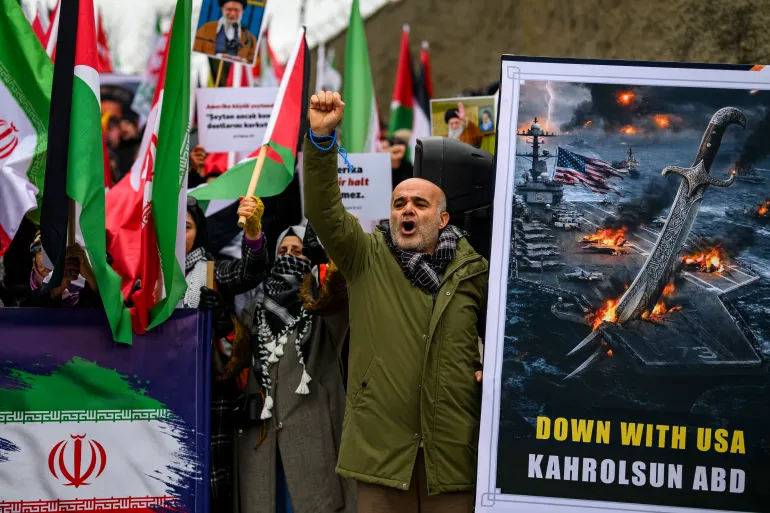
United States President Donald Trump has confirmed that talks with Iran are continuing to try to de-escalate tensions in the Gulf, even as the US military announced shooting down an Iranian drone that approached its aircraft carrier in the Arabian Sea.
Trump told reporters at the White House on Tuesday that Washington was negotiating with Iran “right now”, but declined to say where the talks were taking place.
“[The talks] are all over. But they are negotiating. They’d like to do something, and we’ll see if something is going to be done,” he said.
“They had a chance to do something a while ago, and it didn’t work out. And we did ‘Midnight Hammer’, I don’t think they want that happening again,” he added, referring to the operation last June in which the US Air Force and Navy struck three Iranian nuclear facilities.
Trump, who has been pushing Teheran to agree to talks over its nuclear programme, has repeatedly threatened to attack the country again over a recent crackdown on antigovernment protests. The US president sent the USS Abraham Lincoln to the Gulf last week, leading to fears of a possible military confrontation.
The carrier strike group, which brought roughly 5,700 additional US troops, joined three destroyers and three littoral combat ships that were already in the region.
Tensions have been easing in recent days amid a push by regional powers for a resolution.
Iranian President Masoud Pezeshkian said earlier on Tuesday that he had instructed the country’s foreign minister to “pursue fair and equitable negotiations, guided by the principles of dignity, prudence, and expediency”, provided that a “suitable environment exists”.
“These negotiations shall be conducted within the framework of our national interests,” Pezeshkian added
[Aljazeera]
Seven million people’s cancer could be prevented each year, according to the first global analysis.
A report by World Health Organization (WHO) scientists estimates 37% of cancers are caused by infections, lifestyle choices and environmental pollutants that could be avoided.
This includes cervical cancers caused by human papilloma virus (HPV) infections which vaccination can help prevent, as well as a host of tumours caused by tobacco smoke from cigarettes.
The researchers said their report showed there is a “powerful opportunity” to transform the lives of millions of people.
Some cancers are inevitable – either because of damage we unavoidably build up in our DNA as we age or because we inherit genes that put us at greater risk of the disease.
But researcher Dr Isabelle Soerjomataram said “people are surprised to hear” that nearly four in 10 cancers can be prevented as it is “a substantial number”.
The International Agency for Research on Cancer, part of the WHO, analysed 30 preventable factors known to increase the risk of cancer.
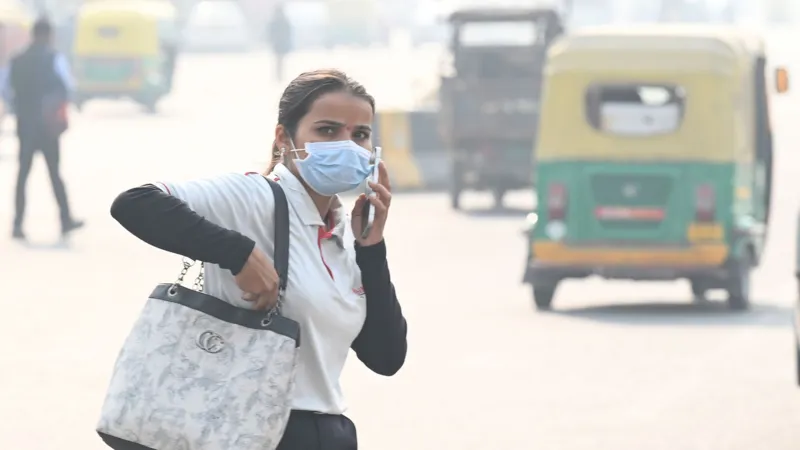
These include smoking and ultraviolet (UV) radiation which can directly damage our DNA; obesity and too little physical activity which alter inflammation and hormones in the body to raise cancer risk; and air pollution which can wake up dormant cancer cells.
The agency’s report also looked at nine cancer-causing infections including HPV, hepatitis viruses which lead to liver cancer and the stomach bug H. pylori.
The team used data on cancer cases from 2022 and from the 30 risk factors a decade earlier – across 185 countries – to perform their statistical analysis.
The big three contributors to more than 18 million cancer cases around the world were found to be:
- smoking tobacco which caused 3.3 million cancers
- infections causing 2.3 million cancers
- alcohol use leading to 700,000 cancers

However, the overall figures mask a nuanced picture of cancer risk around the world.
There is a stark sex-divide with 45% of men’s cancers being preventable compared with 30% in women, partly down to higher levels of smoking among men.
In women living in Europe, the top three preventable causes of cancer are smoking, closely followed by infection and then obesity.
While in sub-Saharan Africa, infections dominate and account for nearly 80% of preventable cancers in women.
This means any measures to tackle these cancers would need to be tailored to each region or country.
“This landmark study is a comprehensive assessment of preventable cancer worldwide, incorporating for the first time infectious causes of cancer alongside behavioural, environmental, and occupational risks,” said Soerjomataram, the deputy head of the IARC Cancer Surveillance Unit.
“Addressing these preventable causes represents one of the most powerful opportunities to reduce the global cancer burden.”
The report, published in the journal Nature Medicine, showed lung cancer (linked to smoking and air pollution) stomach cancer (linked to H. pylori infection) and cervical cancer (linked to HPV infection) made up nearly half of all preventable cases of cancer.
Dr Andre Ilbawi, team lead for cancer control at WHO, said the study was “good news” as it showed something could be done and he pointed to the success of countries that have introduced policies to tackle smoking or vaccinate against HPV.
“The percentage of preventable cancers can change over time and our goal is to get it as close to zero as possible,” he said.
[BBC]

BCB receives investigation report on sexual misconduct allegation

Trump confirms talks with Iran as US military shoots down Iranian drone

Shower will occur in the Northern, North-central, Eastern and Uva provinces and in Nuwara-Eliya and Matale districts

House erupts over suspension of Deputy Secretary General

78th Independence Day celebrations at Bogambara Stadium

Colombo-Kandy railway line to be fully restored this year – Minister Bimal

‘Dates have the highest sugar content to fight Coronavirus’

Sunday Island 27 December – Headlines

#SundayIsland 17th December – Headlines

Sunday Island – 28th March

Sunday Island Headlines – 21 March

Sunday Island – 21st February – Headlines
-
 Opinion5 days ago
Sri Lanka, the Stars,and statesmen
-
 Business6 days ago
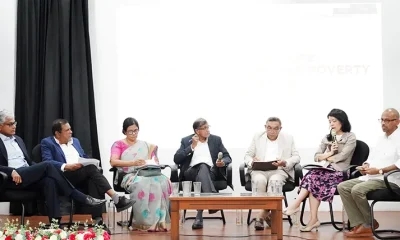
Climate risks, poverty, and recovery financing in focus at CEPA policy panel
-

 Business4 days ago
Hayleys Mobility ushering in a new era of premium sustainable mobility
-

 Business1 day ago
SLIM-Kantar People’s Awards 2026 to recognise Sri Lanka’s most trusted brands and personalities
-
 Business4 days ago
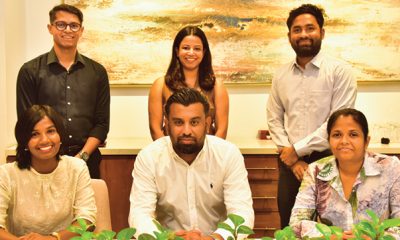
Advice Lab unveils new 13,000+ sqft office, marking major expansion in financial services BPO to Australia
-
 Business4 days ago
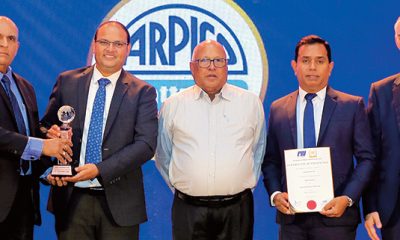
Arpico NextGen Mattress gains recognition for innovation
-

 Business3 days ago
Altair issues over 100+ title deeds post ownership change
-

 Business3 days ago
Sri Lanka opens first country pavilion at London exhibition