
Sports
Lord’s to host final of ICC Women’s T20 World Cup 2026


The final of the ICC Women’s T20 World Cup 2026 will be held at Lord’s on Sunday 5 July, it was announced ahead of a launch event today at the iconic London venue which will be attended by some of the top names of British women’s sport.
Lord’s, which was also the venue for the thrilling final of the ICC Women’s Cricket World Cup between England and India in 2017, is one of seven venues confirmed for the ICC Women’s T20 World Cup 2026, alongside Old Trafford Cricket Ground, Headingley, Edgbaston, Hampshire Bowl, The Oval and Bristol County Ground.
The tournament kicks off on Friday 12 June before culminating at Lord’s, 33 fixtures and 24 days later, showcasing the best of the global women’s game and seeking to take women’s cricket into the mainstream.
An expanded competition will see 12 teams descend on England and Wales to compete for the prestigious trophy that is currently held by New Zealand.
The schedule of the tournament, which will see teams competing in two groups before the knockout stage, will be announced in due course.
Eight countries are already sure of their place, with the final four participants to be decided through a Women’s T20 World Cup Qualifier next year.
England and Wales were awarded hosting rights for the ICC Women’s T20 World Cup 2026 in 2022, with the seven host venues selected subsequently following evaluation of various criteria.
The official launch of the tournament at Lord’s will feature some of the biggest names in British women’s sport, including England Head Coach Charlotte Edwards, England stars Tammy Beaumont, Sophia Dunkley, Sophie Ecclestone and Lauren Bell, and England rugby player Ellie Kildunne*.*
It will set out a vision for the tournament to be a sporting spectacle which can accelerate equality in cricket and change the game for good, taking women’s cricket into the mainstream permanently.
The International Cricket Council (ICC) Chair Jay Shah and the England and Wales Cricket Board (ECB) Chief Executive Richard Gould welcomed the confirmation of the venues.
ICC Chair Jay Shah said: “The confirmation of venues represents a defining moment as we build towards the ICC Women’s T20 World Cup 2026. This tournament will bring together the world’s finest players in a celebration of skill, spirit and sportsmanship.
“The United Kingdom’s rich diversity has always shown passionate support for all teams, something we witnessed so memorably at past events. The sell-out Women’s Cricket World Cup final at Lord’s in 2017 remains a landmark in the rise of the women’s game, and I cannot think of a more fitting stage for the final.”
“As we turn our focus to preparing for the tournament, we are excited by the promise of thrilling T20 action that will not only captivate fans here but also serve as a showcase for cricket’s return on the Olympic stage in Los Angeles 2028.”
ECB Chief Executive Richard Gould said: “We are hugely excited for the ICC Women’s T20 World Cup 2026, and thrilled to be able to confirm the seven iconic venues that will host the tournament.
“It is of course extra special to announce that the final will be taking place at Lord’s. It is one of the finest venues in world cricket and every cricketer dreams of being part of occasions like a World Cup final at Lord’s.
“This will be the biggest women’s cricket event ever staged in England and Wales and is undoubtedly an opportunity to take the game to more people than ever before and welcome in new fans – young and old.
“Crucially though this isn’t just about scale, it’s about providing a world-class experience for players, fans and broadcasters alike, ensuring that the tournament reflects the elite performance of the players on the pitch.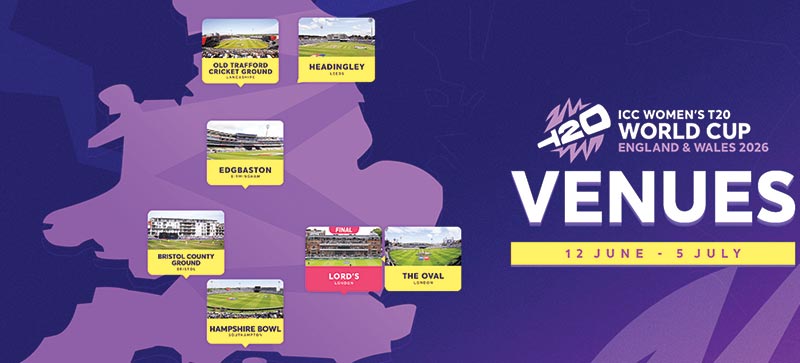

“We want this competition to be part of a long-term movement, and not just a single moment in time. This World Cup will grow a new generation of fans who didn’t grow up with women’s cricket but will never imagine sport without it.”
The ICC’s global women’s events have been on an ascendancy since the ICC Women’s Cricket World Cup 2017 with increased attendances at venues and more viewership across broadcast and digital platforms.
The ICC Women’s T20 World Cup 2020 final between Australia and India in Melbourne saw a record 86,174 spectators in attendance while the finals of the subsequent T20 World Cups in Cape Town (2023) and Dubai (2024) were also sold out in markets where women’s cricket had never been ticketed before.
[ICC]


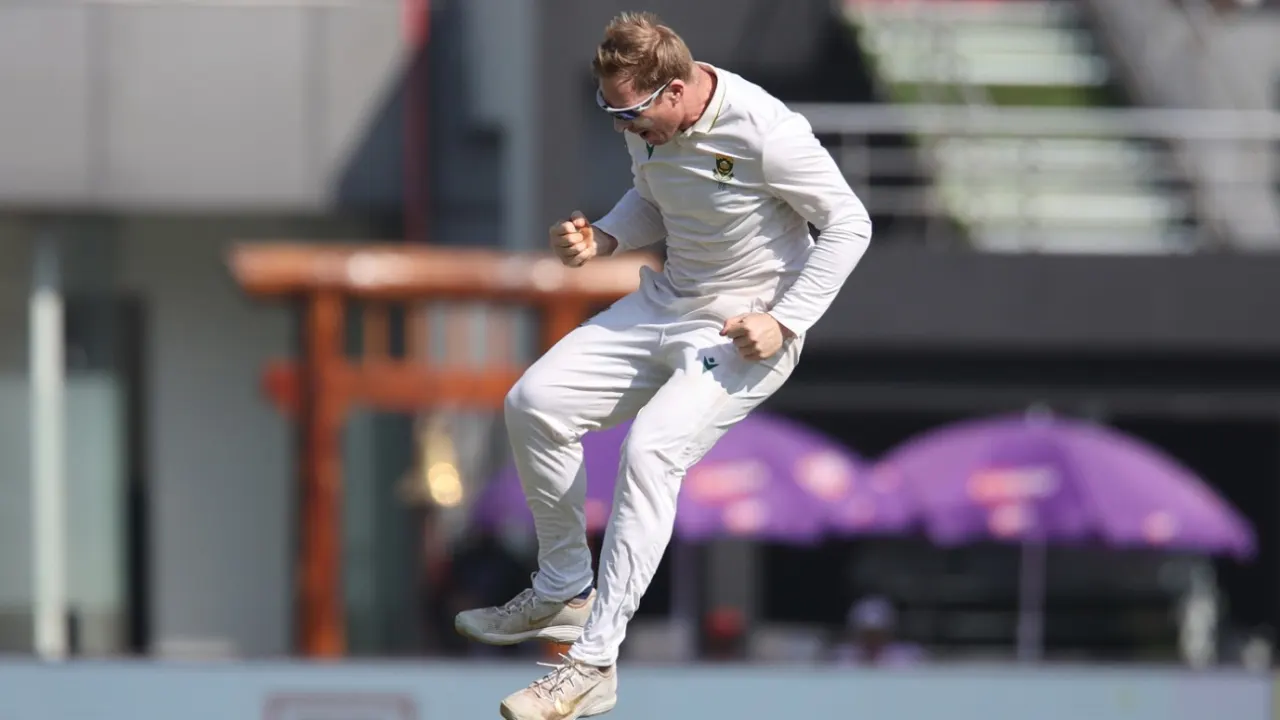
Aiden Markram, Laura Wolvaardt and Simon Harmer were the biggest winners at the Cricket South Africa (CSA) Awards 2026, picking up the highest individual honours after stellar seasons across formats. Fast bowler Lungi Ngidi and wicketkeeper-batter Quinton de Kock also went home with multiple awards.
Harmer, 37, was named Test Player of the Year after spearheading South Africa’s red-ball attack during the awards cycle, between April 2025 and 2026. The offspinner enjoyed a prolific return in this period, where he took 30 wickets in four matches. After taking eight wickets in the Rawalpindi Test against Pakistan to help draw the series, he led South Africa to a famous series sweep against India with match hauls of 8 for 51 and 9 for 101 in Kolkata and Guwahati respectively.
Wolvaardt, meanwhile, continued to set the benchmark in women’s cricket. South Africa’s captain was named the Women’s Player of the Year, SA Women’s Players’ Player of the Year and Women’s ODI Player of the Year, completing the awards sweep. Across the eligibility period, she piled up runs in all conditions and played a key role in South Africa’s run to the ODI World Cup final in 2025, finishing as the top scorer of the tournament with 571 runs at an average of 71.37, including centuries in the semi-final and final. Wolvaardt was South Africa’s leading run-scorer in the ODI series in New Zealand before dominating the home T20I series against India, where she scored 330 runs in five matches and was named Player of the Series.
The biggest winner among the men’s all-format awards was Markram, who claimed both the SA Men’s Player of the Year and SA Men’s Players’ Player of the Year awards, after a season in which he led South Africa to major success across formats, most noticeably in the World Test Championship (WTC) final against Australia last year.
Ngidi, meanwhile, collected the Men’s T20 International Player of the Year award and the SA Fans’ Player of the Year prize. His dismissal of Jos Buttler during South Africa’s second ODI against England was also voted the Best Men’s Delivery of the year.
Matthew Breetzke’s breakthrough campaign earned him the Men’s ODI International Player of the Year award, while Dewald Brevis and Kayla Reyneke were recognised as the International Men’s and Women’s Newcomers of the Year, respectively.
The SA20 awards reflected the competition’s standout performers. De Kock, the tournament’s leading run-scorer, was named both SA20 Batter of the Season and Betway SA20 Player of the Season (MVP). Ottneil Baartman collected the SA20 Bowler of the Season award after finishing as the leading wicket-taker, while Jordan Hermann was named SA20 Rising Star of the Season.
Among the domestic awards, Kyle Simmonds and Mignon du Preez were named the men’s and women’s Most Valuable Players, while Robin Peterson, JP Triegaardt and Sandile Masengemi received the top coaching honours in their respective competitions.
CSA also recognised contributions beyond performances on the field. Arno Jacobs was named CSA Umpires’ Umpire of the Year, Lubabalo Gcuma received the CSA Umpire of the Year award, and Sinalo Jafta was presented with the Makhaya Ntini Power of Cricket Award.
[Cricinfo]
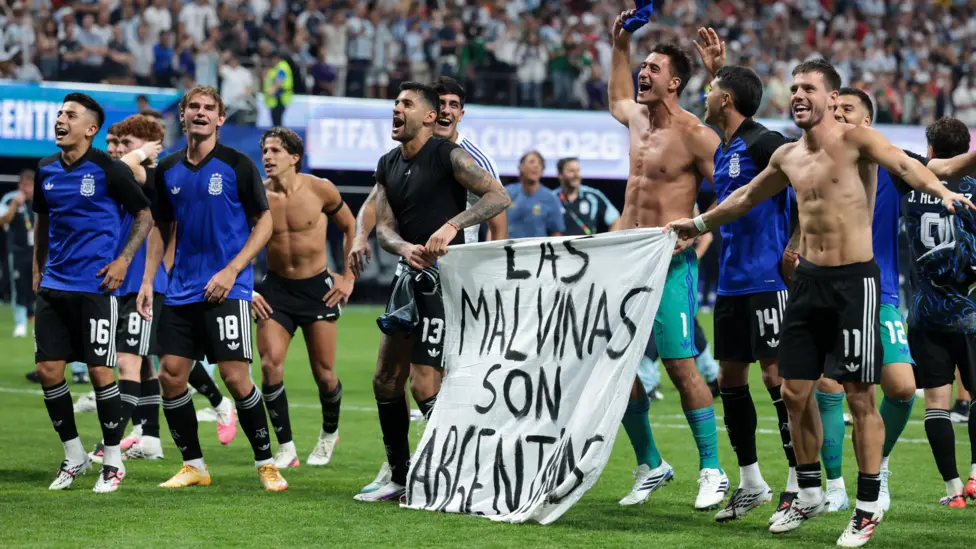
Argentina face the prospect of a Fifa fine after their players celebrated the World Cup semi-final win against England with a banner in support of their country’s claims to the Falkland Islands.
The defending world champions produced a dramatic late comeback in Atlanta, scoring twice to defeat Thomas Tuchel’s side 2-1 and book a showdown with Spain in Sunday’s final.
After the final whistle, Argentina players celebrated while holding a banner reading “Las Malvinas son Argentinas”, which translates as “The Falklands are Argentine”.
The Falkland Islands, a British overseas territory in the south-west Atlantic Ocean, remain the subject of a sovereignty dispute between Britain and Argentina.
The two nations went to war over the group of islands, situated 300 miles off Argentina’s east coast, from April to June 1982.
The 74-day conflict led to the deaths of 655 Argentine and 255 British servicemen. Three people from the islands also died.
In 2014, Fifa fined the Argentine Football Association 20,000 pounds after its players held up a banner with the same message before a friendly against Slovenia.
World football’s governing body said the gesture had breached rules on political action and team misconduct.
[BBC]
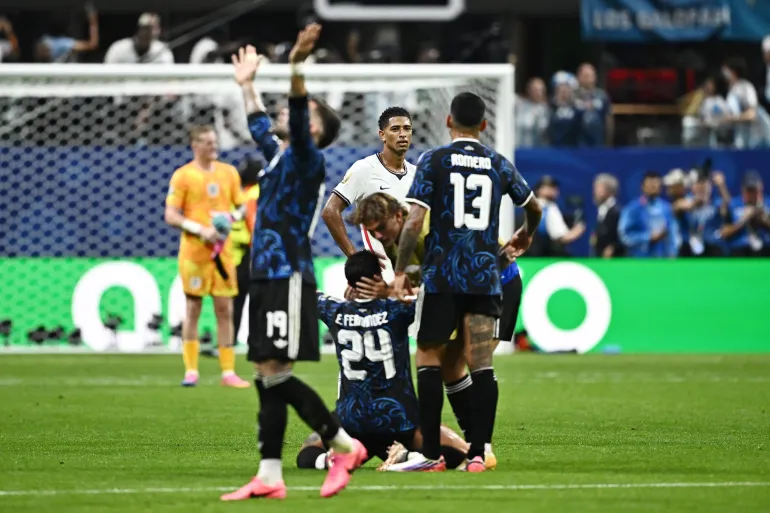
Lautaro Martinez scored a 92nd-minute winner as Lionel Messi inspired World Cup holders Argentina to a stunning comeback to beat England 2-1 and set up a final with European football champions Spain.
England had been on course to reach their first FIFA World Cup final since 1966 after Anthony Gordon fired them into the lead 10 minutes into the second half of the semifinal in front of 68,239 fans in Atlanta on Wednesday.
The great rivalry between these nations has produced several memorable contests on the World Cup stage through the years, and this will be remembered as the stuff of legends in Argentina as the South Americans denied England with two late sucker punches.
Messi set up Enzo Fernandez to fire in an 85th-minute equaliser, and then, with extra time looming, crossed for substitute Lautaro Martinez to head in the winner in the second minute of stoppage time.
It was maybe not quite up there with Diego Maradona’s legendary display in putting England to the sword in 1986, but the goals this time brought Argentina back from the dead and kept alive their hopes of winning back-to-back World Cups.
No team has retained the trophy since Brazil in 1962, and now, Messi will become just the second player after Brazilian great Cafu to appear in three World Cup finals. Italy are the only other side to defend a World Cup crown.
The 2026 final will take place at New York New Jersey Stadium in New Jersey on Sunday, as the first 48-team World Cup boils down to a confrontation between the reigning champions of Europe and South America.
Messi had waited until the age of 39 to get the chance to play against England, and he will now face Spain for the first time in a competitive game.
His career appeared to be complete when he dragged Argentina to glory in 2022 in Qatar, but he is clearly not done yet.

England, though, will have huge regrets as they head to Miami to play France in Saturday’s third-place playoff, a game neither team will want to contest.
The prospect of a first World Cup final appearance since their sole triumph 60 years ago was a momentous one, and they were so close, but will live to regret sitting back after Gordon’s opener.
Given the deep-rooted rivalry between these nations, this was always likely to be a game with an edge, and there was a palpable sense of tension at Atlanta Stadium.
Argentina’s players were clearly fired up, partly by a determination to hold onto their World Cup crown but also by a sense of what this fixture means.
That translated into a niggly contest, pockmarked by fouls in the first half, including Elliot Anderson being booked for scything down Messi.
There were no real chances to speak of in the first half, but England struck in the 55th minute.
Kane was involved in the buildup as the ball eventually came to Morgan Rogers on the right, and he whipped in a low cross towards the back post where Gordon stole in front of Nahuel Molina to score.
But this was the stadium where Argentina produced a stunning comeback from 2-0 down to beat Egypt in the last 16, and they were not done.
They threw everything at their opponents, as Jordan Pickford made a great save from a Nico Gonzalez header, and Alexis Mac Allister was then denied by the post in the 76th minute.
Fernandez was denied from range by Pickford, but moments later, he equalised, controlling a Messi pass on the edge of the area and letting fly past the goalkeeper.
Argentina smelled blood, and Mac Allister again hit the post before England failed to clear, and Martinez headed in the winner from an exquisite Messi cross to spark chaotic scenes of celebration and leave England completely deflated.
[Aljazeera]
The key men for Thomas Tuchel’s side during this campaign have been Jude Bellingham and captain Harry Kane, yet they failed to deliver on this occasion, and England’s players slumped to the turf at full-time.

Venezuela earthquake: Number of known dead rises to nearly 5,000 victims

A few showers may occur in the Western, Sabaragamuwa and North-western provinces and in Kandy, Nuwara-Eliya, Galle and Matara districts

Harmer, Markram and Wolvaardt win top honours at CSA awards

War of words erupts between Minister Chandrasekar and Archchuna in North

Cardinal seeks dismissal of Sallay’s petition

Money laundering case against Yoshitha, fixed for pre-trial conference

‘Dates have the highest sugar content to fight Coronavirus’

Sunday Island 27 December – Headlines

#SundayIsland 17th December – Headlines

Sunday Island – 28th March

Sunday Island Headlines – 21 March

Sunday Island – 21st February – Headlines
-

 Features5 days ago
Prison riots and politics: NPP’s biggest challenge and Sri Lanka’s biggest opportunity
-

 Editorial6 days ago
What’s the world coming to?
-
 Features2 days ago
Dirty Money
-

 Editorial5 days ago
Much ado about crime: Fish or cut bait
-
 Features5 days ago
More on Saudi Arabia: ARAMCO and beyond
-

 Latest News3 days ago
Oil prices hit 1-month high as US-Iran attacks dim Strait of Hormuz outlook
-

 Midweek Review2 days ago
The sordid tale of theft and tragedy at Finance Ministry
-

 Features4 days ago
Deepening Democracy – Constitutions and Constitutionalism