
Opinion
Looking beyond burning aircraft at Haneda


By GEORGE BRAINE
On Tuesday, as I watched, live on TV, the aircraft burning on Haneda airport’s tarmac, the thought that drove me crazy was “Where are the passengers? Are they still inside the aircraft?”
I live in Sapporo, the capital of Japan’s northernmost island, and each time I leave Japan, I first take the 90-minute flight from Sapporo to Haneda or Narita, one of the airports in Tokyo. In fact, I had just returned home on December 26 after a trip to Sri Lanka. The burning aircraft had arrived from Sapporo, my hometown.
Later, we were told that all 367 passengers and 14 crew members had evacuated. Then, videos from inside the aircraft taken by passengers began to emerge. The aircraft was filled with smoke and some passengers were almost lying on the floor. A flight attendant, with a flashlight, was urging passengers to leave. The windows were lit up with the fires burning outside, a scene from hell. But, there was no panic; no one was opening the overhead bins to grab their carry-on bags, pushing other passengers aside, screaming their heads off, or arguing with the flight attendants.
Perhaps, this could have happened only in Japan. Over 40 years, I have taken a thousand flights on numerous airlines. I observe the behaviour of flight attendants. Some thumb their noses at passengers, especially on those from poor countries. Some are haughty, assuming they are god’s gift to the passengers. The meal trays are not picked up even long after the meals are done. Even on long haul flights, the toilets are not cleaned regularly, and become horrors. Some attendants have arguments among themselves. Once, on a Sri Lankan flight, I overheard a supervisor berating a young flight attendant in filth; he assumed I was a foreigner who did not understand Sinhala.
Passenger behaviour is no better. The most annoying are those who lean their seats back all the way, literally lying on the lap of the passenger behind them. Before the aircraft comes to a stop at the end of a flight, some passengers get off their seats and open the overhead bins to take their carry-on bags, a very dangerous practice. Others are loud talkers and become a nuisance. Some mess up the toilets, not giving a thought to other users.
On Japanese flights, most passengers watch videos on their phones, read, or nap. If at all, they speak in whispers. Barely anyone leans the seat back. The toilets are clean. The flight attendants make a special effort to speak to me in their often limited English.
On that ill-fated JAL 516 flight, I need not have worried about the passengers. Under the guidance of the flight attendants, who are trained to evacuate all passengers within 90 seconds, all 367 passengers got off safely. In fact, the aircraft was nose down, the tail lying at a higher angle. Passengers who used the third chute, at the back, had to walk up and then slide down a chute that was higher off the ground. But, everyone managed.
What happened was truly a miracle. It may have happened only in Japan, where the people are stoically polite and kind, and the culture is collective.
Those flight attendants deserve medals.

by Usvatte
My friend, Sena Thoradeniya, has summoned up energy to raise two questions about my observations in your newspaper on 14 September, 2026. They both referred to comments I made about President Dissanayake and Prime Minister Amarasuriya.
I observed that President Dissanayake, having graduated in physics at Kelaniya, would be familiar with elementary calculus: differentiation and integration. It is a misapprehension to believe that one needs any knowledge of theoretical physics to be familiar with elementary calculus. Nor is it necessary that one needs to have published research for the same purpose. Those were the first lessons in calculus that our Mathematics Master and Principal, Mr. D. A. Devendra taught five of us in the first term 1952 at Hikkaduva Central School. Of the five, two still live and recall those lessons vividly. Dissanayake would surely have learnt them at his school in Anuradhapura. At Kelaniya his teachers probably included Dr. H. Somadasa, two years my junior at Hikkaduva, with a Ph.D. in number theory at Aberytswyth, Wales and Professor (physics) Charles Dahanayke, a renowned teacher of physics and my neighbour in Colombo. Dissanayake is unlikely to have been admitted to Physics at Kelaniya unless he had scored well in mathematics and physics with other subjects. Those elements of calculus have been learnt by millions of young men (and later women) since Isaac Newton and Gottfried Leibnitz. That Dissanayake from a school in Anuradhapura scored high enough to gain admission to Kelaniya to study physics is commendation enough for his intellectual capacity.
All of us know, some personally, the barriers to learning in places like Anuradhapura and Kuliyapitiya, compared to the facilities in Colombo, Galle. Jaffna and Kandy. I used that information to press the point that he was, in learning, entirely different from his predecessors and present competitors. One does not need to research in theoretical physics to know something as simple as the first lesson in calculus. Dirac made his momentous discovery sometime in the 1930s and by 1950 it must have been solidly in the teaching material in schools and universities. Dissanayake graduated in 1995 and, at least, must have heard of Dirac and the ‘God Particle’.
Paul Dirac was a legendary figure among graduate students when I was at Cambridge. He had written the shortest Fellowship and Ph.D. theses. He had had an interesting relationship with his father who was a French speaking Swiss and had insisted that he speaks French at table. Amrtya Sen, who was in 1965 a young Fellow of Trinity College and a teacher in the Economics and Politics Faculty at that time, had also written very short theses and not several volumes as many do.
I read about Higgs Boson in a wonderful book Inward Bound written by physicist Abraham Pais and, in The Science Times (Tuesdays) edited by Gina Kolata of the New York Times, and occasionally in Nature and other popular writings.
I was on the editorial board of Samskrti for some time. Amaradasa Virasinghe and Gananath Obeysekera had started that literary review in 1953 when I was in school and many of us read it avidly. Together with Susil Sirivardana, we decided to expand the scope of the journal to include social studies and science, which effort Sena knew well. The probable readership had increased manifold. In order to help prospective writers to pick up themes to write on, we held a popular lecture, one Saturday a month. I invited Dr. Harini Amarasuriya, then teaching at the Open University, Nawala, to speak to us on the scope and nature of sociology. She made a short fine introduction. That is where I learnt of August Compte. She was invited to a Seminar in Britain on the sociology of education, where I had strayed into from 1971. I did not read her paper, although she had promised to let me have it. I had good reason to respect her scholarship. It would be shocking had she not read Le`vy-Strauss. Many besides anthropologists read Le`vy-Strauss.
Sena stressed the obvious when he said that in public speeches made by these two politicians, there was no evidence of their expertise in physics and sociology. It would have been completely out of place to speak about elementary particles to a crowd in Beruvala or Anuradhapura. But one’s education, in subtle ways, informs the material and the ways that the material is presented in public speeches. Simply listen to Members of Parliament speak and you can guess roughly the level of education each had achieved: grade 2 in primary school or Quondam Professor of Law at Oxford.
I am sorry that Sena identified ‘an exaggerated parade of claims and sheer implausible boasts’ in what I wrote. It is entirely plausible, indeed certain, that an undergraduate in the Department of Physics in any university would be familiar with differentiation and integration.
An unprejudiced reading of my text will demonstrate that it contained no such claims and boasts. Mine was a pretty simple statement of the nature of differences between the present lot in government and the lots that were in power earlier. I related those differences to help understand the line up for and against the 22nd Amendment to the Constitution. and not to build false images of any politician, man or woman. I am too old to set out, even in the formidable company of Sena, on the ‘long march’ to Mao.
By Chandre Dharmawardana
chandre.dharma@yahoo.ca)
The official narrative surrounding Sri Lanka’s economic recovery is optimistic and up-beat. President Anura Kumara Dissanayake has repeatedly assured the public that the nation, which faced catastrophic bankruptcy in 2022, is finally entering “safe waters.” This political optimism is backed by data from the Central Bank of Sri Lanka (CBSL [1]), which projects an annual economic growth rate of approximately 5%, bolstered by the country’s recent structural upgrade to “middle-income” status. On paper, the macroeconomic indicators suggest a remarkable turnaround.
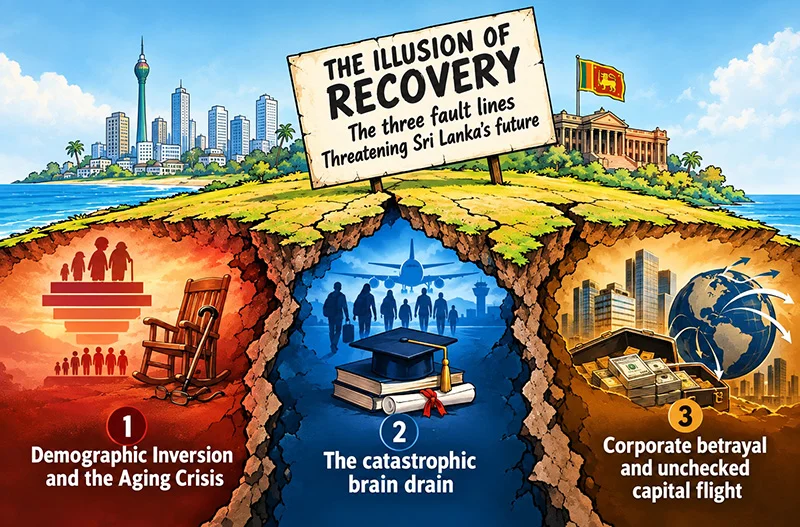
However, this statistics-based triumph masks a much darker, systemic reality. Below the surface of stabilised foreign reserves and GDP growth lie at least three dystopian structural fault lines: massive capital flight, an unprecedented brain drain, and a severe demographic inversion. Together, these factors form a quiet crisis that threatens to rapidly destabilise Sri Lanka, rendering its current economic recovery fragile and potentially unsustainable. In addition, we must factor in the devastating effects of climate change and sea-level rise that will play out unabated.
Independent economists note that “safe waters” at the state level have yet to translate to ordinary citizens. The 5% growth and upgraded income status have been achieved through aggressive taxation (VAT hikes) and high energy costs, meaning that while the state’s coffers are recovering, real household poverty remains painfully high and becoming worse, while the rich-poor gap is widening.
Fault Line 1: Corporate betrayal and unchecked capital flight
While the government actively pursues high-profile political figures for historical financial crimes, the most devastating drainage of Sri Lanka’s wealth is happening legally and semi-legally through the corporate elite. Capital flight has severely hollowed out the state’s financial foundation.
Research from global watchdogs like Global Financial Integrity (GFI) reveals that trade mis-invoicing, i.e., the practice of under-invoicing exports and over-invoicing imports to illicitly park profits in offshore accounts, has stripped Sri Lanka of billions of dollars annually (GFI, 2024, [2]).
This is compounded by massive migration within the garment and manufacturing sectors. Facing exorbitant domestic energy tariffs and steep Value Added Tax (VAT) hikes, major conglomerates have steadily relocated production capacities or established vital subsidiaries in more cost-effective hubs, including Kenya, Jordan, and Oman (National Chamber of Exporters, 2025, [3]).
The state’s recent investigation into over $1 billion in “phantom imports”, where advance payments were sent abroad via Telegraphic Transfers without any goods ever entering the country, demonstrates that the private sector continues to drain the country of the very foreign exchange required to sustain its recovery.
While big capital has systematically flown out of the country, exploiting critical financial loopholes intentionally created during the Yahapalanaya (Maithripala-Ranil) era, successive administrations have persistently attempted to deflect blame for Sri Lanka’s financial collapse onto external or secondary factors. A glaring example of this misdirection occurred when major international media outlets, most notably The New York Times, claimed that Chinese infrastructure loans and “debt-trap diplomacy” were primarily responsible for the country’s economic insolvency—a narrative that independent economic data has since thoroughly debunked. Similarly, a favourite rhetorical theme among all political leaders is that bribery and state-level corruption by their rivals were the singular drivers of the crisis.
Neither geopolitical debt nor political corruption has been as structurally catastrophic as the quiet, massive flight of private investment capital. This exodus was critically accelerated when the Yahapalanaya administration, under Finance Minister Ravi Karunanayake, systematically dismantled the nation’s regulatory guardrails by repealing the robust Exchange Control Act No. 24 of 1953 and replacing it with the highly liberalised Foreign Exchange Act No. 12 of 2017. This legislative shift effectively decriminalised unauthorised foreign currency retention, removed stringent tracking mechanisms on export proceeds, and opened the floodgates for legal and semi-legal capital flight in the critical years leading up to the Gotabaya Rajapaksa administration and its financial collapse. By prioritising the convenience of the corporate elite over national reserve security, these policy manoeuvers permanently starved Sri Lanka of vital foreign liquidity at the exact moment it was in dire need of retaining and attracting stable investment capital.
The removal of these Exchange control and Foreign exchange acts would seem entirely destructive to Sri Lanka in hindsight today. However, both Ranil Wickremesinghe and Ravi Karunanayake are avowed neo-liberal ideologues who would have viewed the removal of those legislations as part of their idea of full free trade and over-arching globalisation. However, perhaps unknown to them, globalisation had hollowed out the Western manufacturing base; nationalist populism and tea-party politics had already raised its head in the West. Finally, the Covid epidemic drew the curtain on the era of neoliberalism, with even the more ardent “Ayn Randyan” opponent of state intervention conceding to massive state intervention to face Covid.
To evaluate which factor has a greater structural impact on Sri Lanka’s economic stability, we must look at data from international watchdog groups like Global Financial Integrity (GFI) alongside localized corruption cases since the beginning of the Sirisena-Wickremesinghe administration (2015) up to 2026. We do this in Table 1.
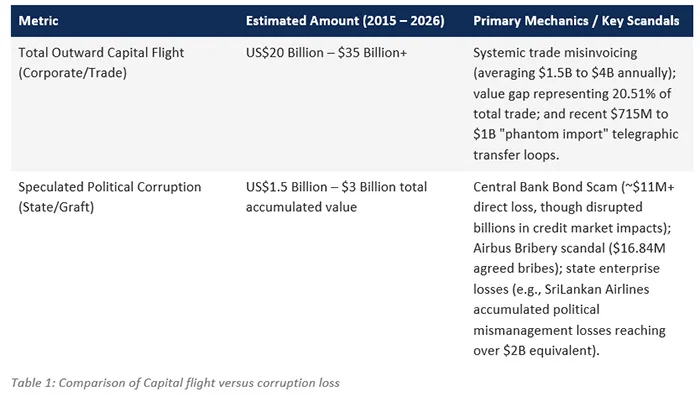
MetricEstimated Amount (2015 – 2026)Primary Mechanics / Key Scandals
Total Outward Capital Flight (Corporate/Trade)US$20 Billion – $35 Billion+Systemic trade misinvoicing (averaging $1.5B to $4B annually); value gap representing 20.51% of total trade; and recent $715M to $1B “phantom import” telegraphic transfer loops.Speculated Political Corruption (State/Graft)US$1.5 Billion – $3 Billion total accumulated valueCentral Bank Bond Scam (~$11M+ direct loss, though disrupted billions in credit market impacts); Airbus Bribery scandal ($16.84M agreed bribes); state enterprise losses (e.g., SriLankan Airlines accumulated political mismanagement losses reaching over $2B equivalent).Table 1: Comparison of Capital flight versus corruption loss
The data reveals that corporate capital flight dwarfs political corruption by an order of magnitude, making it the far more critical structural threat to the country’s economic baseline. Ultimately, while the media and politicians focus on the theatre of political arrests, the quiet, systemic white-collar flight of capital by the country’s “Big Tycoons” acts as a far more lethal haemorrhage dragging Sri Lanka back down into financial collapse.
Fault Line 2: The catastrophic brain drain
An economy cannot expand at a sustained 5% rate without human capital. Yet, Sri Lanka is currently experiencing an unprecedented exodus of its professional class. The economic collapse of 2022, followed by the subsequent imposition of heavy income taxes, soaring inflation, and a diminished quality of life, triggered a massive wave of migration.
Unlike the labour migration of previous decades, which consisted primarily of low-skilled workers sending back remittances, the current “brain drain” consists of the nation’s intellectual bedrock: doctors, software engineers, university professors, accountants, and aviation technicians. According to data from the Sri Lanka Bureau of Foreign Employment (SLBFE, [4]), record numbers of professionals have left the island for Europe, the Middle East, and Australia. The impact on critical infrastructure is already dystopian. Government hospitals frequently report a severe shortage of specialized consultants and anesthetists, while the domestic tech sector faces a crippling deficit of senior developers. Sri Lanka is effectively funding the free education of its youth, only for foreign economies to reap the productivity and tax revenues of those graduates.
The articles by (i) Hasini Lecamwasam entitled “The emptying university: why are academics leaving? (Island, 15th September 2026) [5], and Prof. Amarasiri de Silva’s article entitled Sri Lanka’s university crisis: Brain drain and union action demand urgent reform (Island, 14th September 2026) [6], specifically expose the dire situation faced by the existing 17 Sri Lankan Universities today, even though President AKD hopes to open 50 more universities shortly. Realistically, the available resources completely rule out the President’s proposal. Sri Lanka spends roughly 1.5% to 2% of its Gross Domestic Product on public education, one of the lowest in the world. Meanwhile many degree-certificate granting institutions (“private universities”) that have commodified higher education have sprung up to fill the need.
In any case, as we explain in the next section, the population is Sri Lanka has peaked, and its population pyramid has inverted, with fewer youth than older adults. There will be closure of schools as rural areas become hollowed out, and decreased enrolment in regional universities.
Fault Line 3: Demographic Inversion and the Aging Crisis
Perhaps, the most irreversible threat to Sri Lanka’s long-term stability is its rapidly changing demographic profile. Sri Lanka is currently undergoing a severe population inversion, transitioning into an aging society at a much faster rate than its regional peers.
Due to a combination of declining fertility rates, increased life expectancy, and the mass migration of reproductive-age young professionals, the demographic pyramid has flipped. For the first time in modern history, the population of elderly citizens (aged 60 and above) is growing faster than the younger demographic required to support them. According to United Nations and World Bank demographic assessments, Sri Lanka is projected to have one of the oldest populations in South Asia within the coming decade (World Bank, 2025 [7]).
This inversion creates a devastating double-bind for the state:
· Shrinking Tax Base: As young people leave or age out of the workforce, the pool of taxable income contracts.
· Exploding Welfare Costs:
The state faces ballooning expenditure requirements for geriatric healthcare, social safety nets, and pensions.
· The flight of businesses seeking cheap labour:
As the young workforce shrinks, manufacturing and businesses leave the country to relocate in other countries where labour is cheap. This flight of capital was discussed by us as “fault line number 1”.
Unlike Western nations that grew wealthy before they grew old, Sri Lanka is facing a demographic crisis while still trying to climb out of bankruptcy. According to recent data from the Sri Lankan Census and demographic researchers (De Silva 2025 [8]), Sri Lanka’s population peaked at 22.1 million in 2022 and has already entered a structural contraction. Sri Lanka’s total Fertility Rate (TFR) has collapsed to an ultra-low 1.3 children per woman—a rate lower than many highly developed Western nations, and well below the 2.1 needed for sustaining the population from extinction.
Sri Lanka had a rapid population increase after WWII, thanks to its adoption of modern agriculture (Green Revolution), control of infectious diseases such as malaria. However, Sri Lanka could not profit from the potential of its demographic bulge as a labour force. It moved towards a sluggish Marxist economy that sought state control and dismantled its plantation sector, placed draconian control over foreign exchange and investments.
Right after Independence, Sri Lanka prioritised universal free education and extensive reproductive health literacy. Meanwhile, free education led to exceptionally high female literacy rates early on. Historically, whenever female education rises, birth rates plummet—even if the nation’s GDP per capita remains relatively low.
From 1956 to 1977, Sri Lanka implemented economic policies directed towards increasing state control every aspect of the economy with foreign exchange controls. A stagnant economy led to youth uprisings that took the form of intra- and inter-ethnic conflicts that took a toll of youth populations. While an open economy was heralded in 1977 youth uprisings had already established themselves. Even children were mercilessly recruited as child soldiers by the LTTE and forced into an unwinnable conflict where about 7% of the population in the North and East (Tamils) were pitted against the government that drew strength from some 80% (Sinhalese and Muslims) of the remaining population.
Furthermore, many in the local work pool found it more lucrative to go to the Gulf countries as migrant workers, depleting the local availability of labour.
When Sri Lanka opened its economy in 1977 it succeeded in using its cheap labour pool to establish a world-class industrial base in clothes and similar industries. However, the rate of population growth slackened with increased literacy and today the population pyramid has completely inverted, with its labour pool shrinking and implying a demographic nightmare of ethnic extinction for Sri Lankans.
Countries such as Sri Lanka that do not have the financial power of countries such as South Korea or Japan (which are able to resort to robotics and AI agents) may have to turn to sperm and ova banks, in-vitro fertilisation, as well as state sponsored group parenting to sustain its population or simply face extinction. The need for such technologies was anticipated by scientists such as J. B. S. Haldane in 1924 [9], with corresponding themes were built into fictional works such as Aldous Huxley’s “Brave New World”. (To be concluded)

World Gratitude Day
by Lalith de Silva
Senior Advisor for Governance and Transformation
As we commemorate World Gratitude Day on 21 September, perhaps it is an appropriate time for all of us to pause and ask ourselves a few simple but profound questions:
What have I received? Who contributed to what I have become? What is my responsibility in return? And what can I give back?
We live in a world where we are constantly encouraged to seek “more”—more income, a better career, a higher standard of living, greater recognition, greater comfort and greater success.
There is nothing wrong with aspiration. Individuals need aspirations, and nations need progress.
However, while constantly pursuing what we do not yet have, we can easily overlook something equally important: recognising and appreciating what we already have and what we have already received.
That is where gratitude begins.
Gratitude is much more than simply saying “thank you”. It is recognising the good we have received, appreciating the people, institutions, society and natural environment that have contributed to our lives, and allowing that appreciation to influence our behaviour, responsibilities and actions.
An Ancient and Universal Human Virtue
Gratitude does not belong to any one religion, nation or culture. The world’s major religious and philosophical traditions have recognised its importance for thousands of years.
For Sri Lanka, a particularly meaningful illustration comes from the Buddhist tradition.
Following his Enlightenment, before beginning his great teaching mission, the Buddha is traditionally described as spending the second week gazing at the Bodhi tree in appreciation and gratitude for the shelter it had provided him.
There is a profound message in this simple act.
Even after attaining Enlightenment, the Buddha did not take for granted the benefit received from a tree. Buddhist teachings also associate gratitude and thankfulness with the qualities of a good and virtuous person.
Christianity, Islam, Hinduism and other religious traditions similarly emphasise thanksgiving, appreciation, duty, compassion and service in different forms.
The underlying human message is universal:
Do not take the goodness we receive in life for granted. Recognise it. Appreciate it. And respond to it through positive action.
None of us succeeds alone
If we look honestly at our lives, none of us can truly claim to be entirely “self-made”.
Before we could walk, someone carried us. Before we could read, someone taught us. Before we could earn, someone fed, protected and supported us.
Parents and caregivers made sacrifices. Teachers gave us knowledge. Friends encouraged us. Organisations gave us opportunities. Doctors, nurses and other healthcare professionals cared for us. Farmers produced our food. Thousands of workers and service providers make our everyday lives possible.
Our lives also depend upon air, water, sunlight, soil, trees and complex natural ecosystems.
Our country provides education, infrastructure, institutions, security, cultural heritage and opportunities through which we build our lives.
Gratitude begins when we stop treating all these contributions as things to which we are automatically entitled.
It reminds us of a fundamental truth: we are interconnected and interdependent.
Gratitude and Happiness
Modern research in psychology and wellbeing has examined the relationship between gratitude and subjective wellbeing, life satisfaction, positive emotions, stronger relationships and behaviours that benefit others.
This is particularly relevant because many of us unconsciously postpone happiness.
“I will be happy when I earn more.”
“I will be happy when I receive that promotion.”
“I will be happy when this problem is over.”
Yet when one goal is achieved, another often appears.
Gratitude does not tell us to abandon ambition. Instead, it teaches us to build tomorrow without becoming blind to the goodness that exists today.
Gratitude may not change what we have, but it can change how we see what we have.
This does not mean that gratitude is a cure for illness, psychological distress, poverty or injustice. Such problems require appropriate professional, social, economic and institutional responses.
Gratitude does not ask us to deny suffering. Rather, it can help us recognise that even during difficult periods there may still be people, relationships, opportunities and sources of support worth appreciating.
From gratitude to compassion and responsibility
The wider social value of gratitude emerges when we move beyond the feeling of “I am grateful” and ask:
“If I am grateful, what is my responsibility?”
If I appreciate the sacrifices my parents made for me, what is my responsibility towards them?
If teachers and educational institutions contributed to my development, what can I contribute to the next generation?
If an organisation gave me opportunities, am I serving that organisation honestly and responsibly?
If my country provided education, infrastructure, opportunities and rights, what am I giving back to my country?
This changes our thinking from:
“What more can I get?”
to:
“What have I received, and what can I contribute?”
Recognising the contributions of others can encourage humility. Understanding their sacrifices can deepen empathy and compassion. Recognising how much we have received can encourage generosity, service and a greater sense of responsibility.
Gratitude therefore has the potential to move beyond personal wellbeing and become a foundation for responsible citizenship.
What Does This Mean for Our National Challenges?
Sri Lanka, like many countries, must address serious social and national challenges, including corruption, fraud, crime, substance and alcohol misuse, violence, misuse of public property and waste of public resources.
Gratitude is not a single solution to these complex problems.
We need strong laws, effective and independent institutions, transparency, accountability, education, appropriate treatment and rehabilitation, economic opportunities and good governance.
But alongside all of these, there is another important dimension:
Human character.
Laws are essential, but laws alone cannot create an ethical society.
Law seeks to control wrongdoing from outside. Good character can help prevent wrongdoing from within.
Consider a public official who genuinely thinks:
“This authority has been entrusted to me by the people.”
That mindset can influence how authority is exercised.
Consider a leader who thinks:
“This position is not merely a privilege; it is a responsibility.”
That can influence leadership behaviour.
Consider a citizen who understands:
“Public resources do not belong to somebody else. They belong collectively to all of us.”
That can influence how public property is treated.
Gratitude can therefore help encourage a movement from entitlement to responsibility, from selfishness to compassion, from exploitation to stewardship, and from merely receiving to giving back.
It cannot replace law, governance or accountability. But it can contribute to the character and values upon which good institutions ultimately depend.
Begin with Our Children
If we want to influence the future culture of our nation, we should begin with our children.
Teaching a child to say “thank you” is a good beginning. But we can go further.
“I am grateful to my parents.”
Then what is my responsibility towards them?
“I am grateful to my teachers and school.”
What is my responsibility as a student?
“I am grateful for my country.”
What kind of citizen should I become?
At this point gratitude becomes more than good manners.
It becomes character education.
Schools can help children connect gratitude with respect, responsibility, care for public property, kindness, service and good citizenship.
What Can We Do on 21 September?
World Gratitude Day should not become simply another commemorative day on the calendar. It can become a starting point for practical action.
Individuals can contact someone who has made a difference in their lives and sincerely thank them. A telephone call, letter or simple message of appreciation can be deeply meaningful. We can go further by doing something useful for another person or for our community.
Families can spend a few minutes together identifying what they appreciate about one another. We often assume that the people closest to us know how much we value them. Expressing it can strengthen relationships.
Schools, universities and Pirivenas can organise short discussions, essays, art, debates, gratitude letters and community-service activities around gratitude, responsibility and good citizenship.
Public and private organisations can recognise the contributions of employees, customers and communities and ask an important organisational question: What have we received from society, and what can we give back?
Religious and community organisations can highlight gratitude, compassion, service and responsibility through their own traditions while recognising gratitude as a universal human value.
A Simple National Initiative
The Government can also facilitate national awareness of World Gratitude Day on 21 September.
This need not require a large budget or elaborate celebrations.
A national awareness message could encourage citizens to reflect on gratitude. Schools and public institutions could be encouraged to undertake simple voluntary activities. Community service could be promoted. Public institutions could recognise people whose often-unnoticed work contributes to society.
Most importantly, World Gratitude Day could encourage a national conversation about gratitude, responsibility, service, integrity and good citizenship.
Such an initiative should be inclusive and non-sectarian, recognising gratitude as a universal human virtue shared across Sri Lanka’s religious, ethnic and cultural communities.
In future years, Sri Lanka might also consider developing the period around 21 September into a National Gratitude Week, allowing schools, government institutions, businesses, religious organisations, civil society and communities to develop activities appropriate to them.
The purpose should not be ceremony for ceremony’s sake. The objective should be to encourage reflection followed by action.
From One Day to a Way of Life
One day cannot transform Sri Lanka.
But one day can begin a practice.
Practice → Habit → Character → Culture → National Transformation
Repeated practice can become habit. Habits influence character. Character influences behaviour. When enough people practise similar values, they begin to influence the culture of families, organisations, communities and eventually society.
On 21 September, therefore, let us begin with four simple principles:
Pause. Recognise. Appreciate. Give Back.
Pause and look at our lives.
Recognise the people, opportunities, institutions, society and natural environment that have supported us.
Appreciate what we have received.
Then ask:
“If I am grateful, what is my responsibility—and what can I give back?”
Sri Lanka needs economic transformation. We need institutional and governance reform. We need technological progress and greater opportunities for our people.
But alongside all of these, we also need human transformation—a transformation that strengthens gratitude, compassion, responsibility, integrity and commitment to the common good.
The journey can be expressed simply:
Gratitude → Happiness → Compassion → Responsibility → Integrity → Good Character → Stronger Communities → A Better Nation
Let World Gratitude Day on 21 September become an opportunity to begin that journey.
Let us make gratitude not merely a feeling, but a practice; not merely a practice, but a habit; and ultimately a way of life.
Let us ignite a Gratitude Revolution—from the individual to the family, from the family to the community, and from the community to the nation.

Niroshan Dickwella in Sri Lanka’s T20I squad for the first time since 2021

ICC’s agenda for 2027-31: more T20Is, fewer bilateral ODIs

CIF, the world’s favorite multi-surface cleaning brand, arrives in Sri Lanka

A Joint Regional Initiative to Ensure the Digital Safety of Children

PM meets with IMF delegation

Ms. P. M. Jayadeera (Engineer) appointed Director General of Irrigation

‘Dates have the highest sugar content to fight Coronavirus’

Sunday Island 27 December – Headlines

#SundayIsland 17th December – Headlines

Sunday Island – 28th March

Sunday Island Headlines – 21 March

Sunday Island – 21st February – Headlines
-

 News7 days ago
US embassy won’t comment on IGP’s probe into joint drug raid
-

 News5 days ago
Shanakiyan urges urgent action over reported death sentence for Lankan in Saudi Arabia
-

 News6 days ago
Bid for Basil’s extradition nears final stage: Police
-

 News4 days ago
Namal Rajapaksa Buddhist gambit fails, bail denied
-

 Business7 days ago
All-new Bolero MaXX unveiled in Sri Lanka
-

 Opinion7 days ago
A journalist who wrote across the divide
-

 Features4 days ago
Why the spelling Sri Lankan names in English vary
-

 Features4 days ago
Three bands, a new identity: Sri Lankan wolf snake recognised as distinct species