
News
LOLC Group reports Rs. 41 Bn profit, crosses Rs. 2 Tn in assets


The LOLC Group has reported a profit after tax of Rs. 41 billion for the financial year 2024/25, marking an 89% increase over the previous year. The Group’s total assets surpassed Rs. 2 trillion, reaching Rs. 2.03 trillion—a 17% rise—driven by global expansion and robust performance in financial services.
Operating in over 25 countries, LOLC has strengthened its position as Sri Lanka’s most internationally diversified conglomerate, with interests in financial services, plantations, manufacturing, power, pharmaceuticals, and leisure.
Key drivers of growth included a strong financial services performance, with LOLC Finance PLC contributing a pre-tax profit of Rs. 30.8 billion. The Group’s asset quality improved significantly, as non-performing loans dropped from 10.48% to 4.97%.
LOLC deepened its investments in Africa’s tea industry by acquiring Lipton’s plantations in Kenya, Rwanda, and Tanzania. Domestically, it secured controlling stakes in Sierra Cables PLC, Pussellawa Plantations, and Tea Smallholder Factories PLC, increasing its annual tea production capacity to 100 million kilograms.
With a growing presence in Africa and strategic ambitions in South America, LOLC is positioning itself as a global player, while capitalizing on Sri Lanka’s economic recovery to strengthen its local operations.


Text and Pix by SK Samaranayake
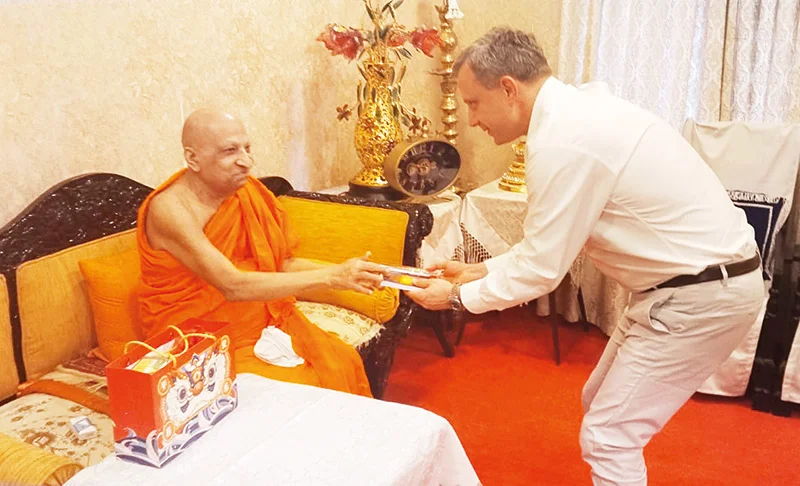
Most Venerable Tibbotuwawe Sri Sumangala Mahanayake Thero of the Malwathu Chapter has urged the United States to consider adopting more flexible policies on tax frameworks imposed on Sri Lanka, saying such an approach would be beneficial to the country.
The Mahanayake Thero made the remarks during a meeting with newly appointed US Ambassador to Sri Lanka Eric Meyer, who paid a courtesy call on the Mahanayake Thero at the Malwathu Maha Vihara in Kandy yesterday (23).
During the meeting, the Mahanayake Thero also expressed appreciation for the support and assistance extended to Sri Lanka by the US government.
Following his visit to the Malwathu Maha Vihara, Ambassador Meyer proceeded to the Asgiri Maha Vihara, where he met Most Venerable Warakagoda Sri Gnanaratana Mahanayake Thero of the Asgiri Chapter and received his blessings. Asgiri Chapter Deputy Registrar Dr. Ven. Muruddeniye Dhammaratana Nayake Thero was also present.
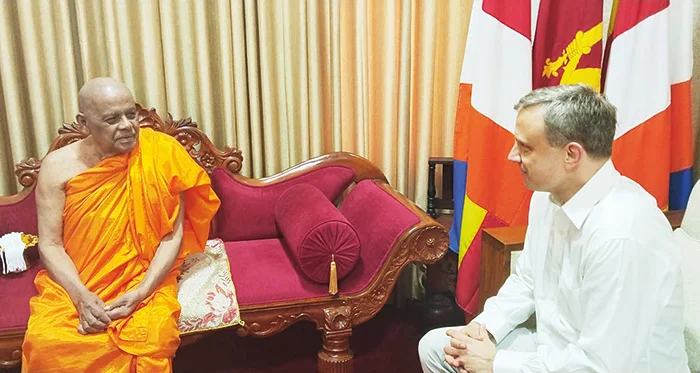
Ambassador Meyer with Most Venerable Warakagoda Sri Gnanaratana
Mahanayake Thera of the Asgiri Chapter
Speaking to the media after the visits, Ambassador Meyer described it as a great honour to assume his diplomatic post in Sri Lanka and to receive the blessings of the Mahanayake Theros of the Malwathu and Asgiri Chapters.
The Ambassador said the United States and Sri Lanka have maintained diplomatic relations for a long period and expressed his intention to further strengthen bilateral ties during his tenure.
He also said he hoped to provide all necessary support to Sri Lanka as he carried out his diplomatic responsibilities.
Ambassador Meyer recalled that his first visit to Sri Lanka was as a tourist 25 years ago, adding that his return to the country as US Ambassador was a significant occasion for him.

SLPP MP and National Organiser Namal Rajapaksa was further remanded until September 30 by the Colombo Fort Magistrate’s Court yesterday in connection with an investigation linked to the controversial SriLankan Airlines Airbus aircraft procurement deal.
The court was scheduled to deliver its order on Rajapaksa’s bail application yesterday. However, the Magistrate directed the Criminal Investigation
Department (CID) to clarify several matters relating to the bail application and submit the relevant information to court on 30 September.
The Magistrate said the court would thereafter deliver its order on the bail application.
The latest order extends Rajapaksa’s remand after he was previously ordered to remain in custody until September 23.
The investigation centres on alleged financial irregularities involving approximately US$2 million in connection with the procurement of Airbus aircraft by SriLankan Airlines.
Rajapaksa was recently named as a suspect in the money laundering investigation following instructions from the Attorney General after investigators submitted material relating to the aircraft procurement deal.
The case concerns the controversial procurement of Airbus aircraft for SriLankan Airlines in 2013 and alleged irregularities surrounding financial transactions connected to the deal.
Sri Lanka is emerging as a possible new operational base for transnational cyber-scam networks, amid a sharp increase in raids targeting foreign nationals suspected of involvement in online fraud, according to law-enforcement data and regional analysis by East Asia Forum (EAF).
An EAF report by Junqing Zhang, a postdoctoral researcher at the Faculty of Political Science, Chulalongkorn University, said that Sri Lankan authorities have conducted more than a dozen raids on suspected cyber-fraud operations since the beginning of the year, arresting or deporting hundreds of foreign nationals, many of whom had entered the country on tourist visas.
Police reported in August that 1,093 foreign nationals had been arrested in cybercrime raids in Sri Lanka in 2026, compared with 573 arrests recorded throughout 2024. Several operations have been conducted in the western coastal areas, with suspects including Chinese, Indian and other Southeast Asian nationals.
The increase comes amid intensified crackdowns on large-scale scam compounds in Cambodia, Myanmar, Thailand and Laos, many of which have been linked to Chinese-speaking criminal networks. Chinese authorities have also expanded joint operations, repatriations and judicial cooperation with governments across Southeast Asia as part of a broader campaign against online fraud.
However, the increase in scam activity in Sri Lanka does not by itself establish that criminal networks have relocated directly from Southeast Asia. Sri Lanka may instead be emerging as one of several destinations in a wider regional displacement of cybercrime operations.
The mobility of such networks was highlighted in April, when Sri Lankan authorities intercepted nine Chinese nationals arriving from Kunming who were reportedly carrying hundreds of electronic devices. The incident followed another operation in which more than 150 foreign nationals were detained over alleged online fraud.
Chinese authorities have publicly supported Sri Lankan investigations into such cases, reflecting growing concern over overseas scam operations, involving Chinese nationals.
Unlike the large compounds that have attracted attention in Southeast Asia, scam operations can increasingly be organised through smaller teams operating from multiple locations. This decentralised model makes them more difficult for authorities to detect and dismantle.
Sri Lanka offers several factors that could facilitate such temporary operations, including relatively accessible tourist and digital-nomad visas, comparatively low accommodation and office costs, telecommunications infrastructure and established cross-border financial networks. Its geographical position between South and Southeast Asia also makes it attractive to mobile criminal groups.
Authorities, however, face the challenge of moving beyond raids and arrests of frontline operators. Immigration monitoring, financial investigations, telecommunications regulation and cybercrime investigations need to be better coordinated to identify the organisers and financial networks behind such operations.
Law-enforcement agencies also need to distinguish between organised crime suspects and possible trafficking victims. International investigations have found that some people working in online scam operations in Southeast Asia were recruited through deception or coercion and subsequently forced to participate in criminal activities.
The growing presence of transnational scam networks could also have wider implications for Sri Lanka, including risks to its tourism and investment reputation, financial system and already stretched law-enforcement resources.
Experts have increasingly warned that enforcement action in one country can push scam networks into other jurisdictions rather than eliminate them. Sri Lanka’s experience, therefore, highlights the need for greater regional intelligence-sharing, coordinated financial investigations and cooperation on digital evidence if the networks behind online scams are to be dismantled rather than merely displaced.

Mahanayake Thera urges US to adopt flexible tax policies

No hiding place after another batting collapse

IMF talks conclude without staff-level agreement as Sri Lanka prepares November Budget

Namal further remanded

Crimes punished and unpunished

Why ‘Southasianness’ should continue to matter for the ‘SAARC Eight’

‘Dates have the highest sugar content to fight Coronavirus’

Sunday Island 27 December – Headlines

#SundayIsland 17th December – Headlines

Sunday Island – 28th March

Sunday Island Headlines – 21 March

Sunday Island – 21st February – Headlines
-

 News7 days ago
US embassy won’t comment on IGP’s probe into joint drug raid
-

 News5 days ago
Shanakiyan urges urgent action over reported death sentence for Lankan in Saudi Arabia
-

 News6 days ago
Bid for Basil’s extradition nears final stage: Police
-

 News4 days ago
Namal Rajapaksa Buddhist gambit fails, bail denied
-

 Features4 days ago
Why the spelling Sri Lankan names in English vary
-

 Features4 days ago
Three bands, a new identity: Sri Lankan wolf snake recognised as distinct species
-

 Business4 days ago
SLIIT holds largest-ever convocation
-

 News4 days ago
Govt monitors reported Saudi death sentence – Foreign Ministry