
News
Local clothing firm appeals to expat Lankans to help grow international sales to earn forex for Lanka


A 100% Lankan clothing brand competing with several global companies on e-commerce platforms appeals to the Sri Lankan expatriate community to help grow the company’s international sales volume and bring in much needed foreign currency to Sri Lanka at this crucial hour for the country.
Ranil Willaddarage, CEO and founder of GFlock says, “This is not a charity appeal. This is a win-win transaction for Sri Lankan expatriates across the world that offers value for their hard-earned foreign currency, and the money in turn being used to import essential commodities for their fellow countrymen. As a nation, we have hit rock bottom. The only way to go if we keep on fighting with each other is six feet under. We cannot start attacking each other again, destroy public property, set fire to private assets and fall even further. Everyone has to come together as a nation and overcome this terrible situation.”
When asked to elaborate on his solution to the foreign exchange crisis, he says, “Our company offers a sustainable solution that can help save this country. Most of our Sri Lankan expatriate community purchases their clothing from brands such as Zara, Mango, Myer, Uniqlo, H&M, and Shein. Most of these brands are based in Europe and other developed countries in the Asia-Pacific region. Sri Lankans living in the United States, Canada, Australia and Europe tend to spend an average amount of $300-$500 as their annual clothing budget on aforementioned foreign brands. My kind request to our Sri Lankan communities abroad is to spend their clothing budget at Gflock, and place orders through our global online store, which is brought to them through the efforts of the creative workforce in Sri Lanka.”
“We know that a fashion company is a business that can earn a lot of revenue. If we take Zara, another brand with a fast fashion business model like ours, their annual revenue is between $ 20-25 billion. H&M also has similar revenue. The Shein brand founded 14 years ago in Nanjing, China, now ships to over 220 countries. With highly competitive prices and their online-only B2C model, Shein’s annual revenue is now at a staggering USD 15 billion. With the arrival of the pandemic, their annual revenue increased exponentially within the course of three years and the $3.5 billion revenue in 2019 grew to a massive $15.7 billion by 2021.”
“Taking inspiration from this and with the help of Sri Lankan expats, within 5-7 years it should be possible for us to reach an annual income of USD 5 billion. The Gflock business model is established in a way that can be scaled up as needed. My team and I have the specialized knowledge, experience and integrity required for that. So I request our Sri Lankans living abroad to think about their home country that is on the verge of collapse when spending their monthly clothing budget and buy from GFlock, a brand founded and run by the creative younger generation in their home country. Apart from that, I appeal to them to be a brand ambassador for this business by promoting the goal of saving our country with at least five more expats and get them to buy clothes from us. If that can be achieved, we will be able to get rid of the oil and gas queues, the shortage of medicines, and the shortage of food and bring the country back to normalcy sooner than we think.”
“1/3 of the profit from our business is spent on providing a monthly essential goods package worth Rs. 8000 to our indirect employees who function as garment workers. Every week we practice gratitude by publishing photos of such acts on our Facebook page and thanking all our customers who contributed toward these worthy causes. Also, we initiated the project of giving away a free plant with every purchase on World Environment Day -2018. Within the course of four years, since its inception, we have managed to create over 30,000 such meaningful bonds that link our brand and customers together with Mother Nature.”
“When the customers realize their purchase contributes to a greater good that goes beyond just a piece of clothing, it gives them a high sense of self-satisfaction, and the next time they make a purchase they do it intending to support a greater good. As owner of GFlock, I am prepared to offer 51% of the business’s shares to the Sri Lankan public in 2025. By implementing this model combined with the expected income, we shall be able to create a strong public movement that can help achieve inclusive prosperity for Sri Lankans.”
Willaddarage said GFlock releases 40-50 new designs every week, categorized under casual wear, work wear, evening wear, menswear, linen and denim for local and international customers through their three retail stores in Sri Lanka and GFlock.com online store, where they ship their products globally.

By Shamindra Ferdinando
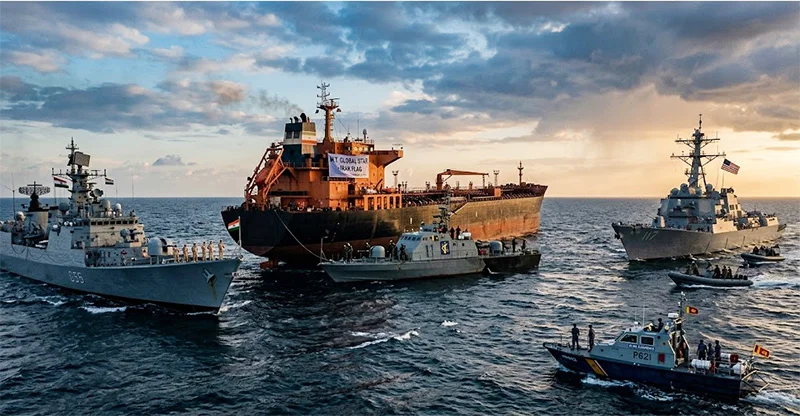
Iran has sought the Indian intervention, at the highest level, to provide lifesaving support to the crews of empty Iranian vessels stranded just outside Sri Lanka’s 12-nautical mile territorial waters off Galle.
Sources familiar with the issue said that Iran had brought the developing situation to the attention of New Delhi as the crews of almost 20 vessels, included Indian nationals. Sources stressed that the group of vessels that unloaded crude oil a couple of months back were now stranded within Sri Lanka’s Exclusive Economic Zone (EEZ).
The US Navy torpedoed an unarmed Iran frigate, returning from India, on 04 March, 2026, about 19 nautical miles off the Galle coast. The unprovoked attack killed nearly 100 Iranians.
The Iranian Embassy in Colombo has inquired from the Indian High Commission of their response to the situation, sources said. The US has issued a global warning against providing food, water, medicine and other services to the Iranian vessels. The outcome of Iran-India talks on the issue at hand was not known, though sources asserted India may not throw its weight behind Iranian efforts to address the issue.
Responding to The Island queries, sources said both Sri Lanka and India were in a dilemma due to the US warning. India couldn’t ignore the plight of the Indian crew members and the Iranian vessels in its backyard.
The Sri Lankan government remains tight-lipped about the vessels stranded in its EEZ. Our efforts to elicit a response from relevant authorities were in vain. In addition to Indians, there are Bangladeshis among the crew members. Iran has explicitly stated the responsibilities of the countries concerned to provide assistance in terms of international law.
The Iranian position was articulated by its Ambassador to Sri Lanka, Dr.Alireza Delkhosh, recently. In a special statement, Ambassador Delkhosh emphasised that in terms of the Convention on the Law of the Sea (Article 98) as well as SOLAS and SAR
Conventions, Sri Lanka couldn’t refrain from providing the needs of the Iranian vessels stranded in its EEZ.
SLMC leader Rauff Hakeem lambasted the NPP government in Parliament for failing to provide assistance to the Iranian ships. The former Minister alleged that the government was simply carrying out dictates of the US. He strongly criticised the way Foreign Minister Vijitha Herath was handling the issue.

MP Namal Rajapaksa, who is in remand custody over the controversial Airbus deal, was further remanded until October 27 by the Colombo Magistrate’s Court yesterday (13).
Colombo Chief Magistrate Asanga S. Bodaragama made the order after considering submissions by officers of the Commission to Investigate Allegations of Bribery or Corruption and lawyers representing Rajapaksa.

Sri Lanka’s economy is expected to sustain its recovery over the next two years, although growth is projected to moderate amid mounting global uncertainties, according to the International Monetary Fund’s (IMF) latest World Economic Outlook.
In its World Economic Outlook 2026: Resilience Under Strain, Urgent Choices, the IMF projects Sri Lanka’s economy to expand by 4% in 2026, slowing to 3.7% in 2027, following estimated growth of 5% in 2025.
Inflation, meanwhile, is forecast to rise to 5.3% in 2026 and 5.4% in 2027, reversing the average deflation rate of 0.5% recorded in 2025.
Unemployment is expected to remain steady at 3.9% throughout the forecast period.
The projections come amid growing pressure on the global economy from the ongoing conflict in the Middle East, elevated energy prices, geopolitical tensions and trade disruptions.
Sri Lanka’s external position is also expected to weaken, with the current account balance projected to shift from a surplus of 1.6% of gross domestic product (GDP) in 2025 to deficits of 0.5% in 2026 and 0.3% in 2027.
The IMF’s outlook points to continued economic expansion in Sri Lanka, but with slower growth, rising inflation and a narrowing external surplus giving way to current account deficits over the forecast period.

Heavy showers above 100 mm are likely at some places in the Western, Sabaragamuwa, Southern, Central, and North-western provinces and in Anuradhapura district.

Sri Lanka, India caught in US-Iran ship crisis

Namal further remanded

IMF projects Lankan economic growth to moderate amidst mounting global uncertainties

Major Gen Pushpakumara assumes command of 56 Infantry Division

Dickwella axed, Bandara earns maiden Test call up

‘Dates have the highest sugar content to fight Coronavirus’

Sunday Island 27 December – Headlines

#SundayIsland 17th December – Headlines

Sunday Island – 28th March

Sunday Island Headlines – 21 March

Sunday Island – 21st February – Headlines
-

 Features6 days ago
The Sri Lankan who made Scottish history
-

 Sports6 days ago
Nissanka absence opens door for Sri Lanka’s young guns
-

 News5 days ago
NDB fraud Rs 60mn more than reported
-

 News5 days ago
Removing monk’s robes matter for Sangha to decide: Mahanayake Theras
-

 News6 days ago
Shiranthi R remanded until 13 Oct.
-

 Features6 days ago
Future of Sri Lanka’s state university system: Should it be shut down and reopened?
-

 News3 days ago
Sri Lanka escalates anti-graft drive with Shiranthi’s jailing
-

 News4 days ago
NPP govt. reminded of its responsibilities as US warship leaves Colombo