
Business
LKI Foreign Policy Forum discusses ‘Debt Restructuring Outcome and Economic Diplomacy and Foreign Policy’


The 4th LKI Foreign Policy Forum, which highlighted the outcome of Sri Lanka’s debt restructuring and its impact on economic diplomacy and foreign policy, was held on July 11 at the Lighthouse Auditorium of the Lakshman Kadirgamar Institute of International Relations and Strategic Studies (LKI).
Sri Lanka’s imperative need to enact growth-oriented reforms particularly in governance, build consensus among all political parties on the reforms implemented and a foreign policy that leverages economic diplomacy, as well as modalities for sustained economic growth was emphasized.
Held on a quarterly basis, LKI’s flagship ‘Foreign Policy Forum’ brings together experts to discuss contemporary foreign policy issues and to contribute to the development of a Sri Lankan perspective on foreign policy and international relations. Moderated by Ambassador Ravinatha Aryasinha, Executive Director of LKI, the four-member panel included Dr. Ganeshan Wignaraja – Visiting Senior Fellow of the Overseas Development Institute, Duminda Hulangamuwa – Chairman of the Ceylon Chamber of Commerce, Talal Rafi – Economist and Expert Member of the World Economic Forum, and Subhashini Abeysinghe – Research Director of Verité Research.
Assessing the ramifications of the recent debt restructuring outcome, Ambassador Ravinatha Aryasinha said the proposed mechanisms and recommendations in the ‘IMF Sri Lanka Diagnostics Report’, could help overcome longstanding challenges experienced by Sri Lanka’s economic diplomacy due to internal bottlenecks – the absence of policy and regulation consistency, the allegation of lack of transparency and corruption, the need for a level playing field, the need for expansion of the basket of commodities and increasing the value added component in exports. He added that unblocking these, could prompt Sri Lanka’s external partners to also review their policies towards Sri Lanka – opening up markets, resuming aid projects, easing the adverse Organisation for Economic Co-operation and Development (OECD) credit rating and other indices, as well as relax the adverse travel advisories on Sri Lanka.
Dr. Ganeshan Wignaraja, Visiting Senior Fellow of the Overseas Development Institute (ODI) cautioned that Sri Lanka’s economic recovery is taking place in an era of uncertainty as the world enters a stage of geo-economic fragmentation. He stressed that the key to transformative growth lies in looking beyond the IMF programme and re-tuning for growth-oriented reforms within Sri Lanka. He warned that although successfully surviving the worst economic crisis in the country’s history, Sri Lanka’s economy remains fragile, and complete recovery demands that Sri Lanka reach consensus on a long-term reform agenda. He added that foreign policy will play a critical role in Sri Lanka’s economic recovery and emphasised the need to be “extremely surgical about our national interests and economic security.”
Duminda Hulangamuwa, Chairman of the Ceylon Chamber of Commerce, noted that a rise in the financial ratings of the country will cast a more positive outlook on the economy which will have a beneficial impact for the people of Sri Lanka. He added that the biggest contributor to kickstart Sri Lanka’s economy would be reviving stalled bilateral projects, which would increase circulation of currency in the market. He suggested capitalising on Sri Lanka’s potential as a shipping and logistics hub, greater investment in infrastructure tourism and an enhanced focus on the IT and BPO industry would contribute to accelerating economic growth towards complete recovery. He noted that discussions are ongoing with the government and opposition parties on the policy recommendations outlined in the recently published ‘Vision 2030’ policy document of the Ceylon Chamber of Commerce, with the hope that it would support reaching an economic consensus on the way forward
Talal Rafi, Expert Member of the World Economic Forum saw debt restructuring as providing the breathing space needed to implement critical reforms for a sustainable economy, until 2029. He stressed that the government in power should not become comfortable with the four years at hand before repayment obligations begin. He explained that, to succeed as India and Thailand did when undergoing economic reforms, Sri Lanka needs to accurately diagnose its problems and rely on the support of other nations.
Subhashini Abeysinghe, Research Director of Verité Research said debt restructuring is not the end, it is actually the beginning. She noted that even previously although there have been many efforts for reform, vested interests, corruption and weaknesses in governance have hindered the progress. She further stated that the debt restructuring period is a time for Sri Lanka to address these roadblocks, or else economic reforms will not succeed. She stressed that economic reforms cannot succeed without reforms in governance, and further that infrastructure development alone is not enough to achieve the growth Sri Lanka aspires for, and that institutional and regulatory reforms are crucial. She also called for a shift in attitudes, particularly towards foreign investment that requires international talent and investment, noting that Sri Lanka cannot afford to look at the world as a threat and must take hold of opportunities available through partnerships.
The question and answer session that followed focused on; the prospects of change through enacting the proposed Economic Transformation Bill, the need for restructuring existing State-Owned Enterprises (SOEs) that are not generating profits including Sri Lankan Airlines, the need for a clear, long-term FDI roadmap and establishment of a level playing field with transparency in procurement and in attracting investment consistent with the IMF Governance Diagnostic Assessment, and the need to de-politicise the reform process in order to ensure its sustainability. Furthermore, the doubling of poverty levels since the economic crisis, the need to increase spending on healthcare and education, and also to accelerate development in the agriculture sector to ensure food security were also discussed. In the context that exclusivity was sought by different external actors over the various timeframes, the importance of Sri Lanka maintaining a levelled ‘playing field’ and being even-handed in its engagements in economic diplomacy and foreign policy was emphasised. Participating in the discussion representatives of Foreign Missions including South Korea, EU and Canada also shared their experiences in restructuring and perceptions on the proposed reforms, while pledging their commitment to continue supporting Sri Lanka’s economic recovery. (LKI)

Business
Redefining Industry Standards: Home Lands Group Emerges as Sri Lanka’s Premier Force in Lifestyle and Developer Leadership


At a time when Sri Lanka’s property landscape is experiencing rapid transformation, one organisation continues to define the direction of the market through scale, innovation, and an unwavering commitment to quality. At the 2025 PropertyGuru Asia Property Awards (Sri Lanka), the Home Lands Group of Companies maintained its place at the peak of the industry, acquiring two of the most influential awards of the year: Best Developer for the Group and Best Lifestyle Developer for Home Lands Skyline (Private) Limited.
These distinctions signify more than just project-level success. They reflect the organisation’s leadership in shaping how Sri Lankans aspire to live, work, and invest.
The Home Lands Group has built a broad presence throughout Sri Lanka’s most active corridors, from the rapidly evolving suburbs of Colombo to the developing lifestyle hubs of Negombo, Malabe, and Kahathuduwa, guided by extensive market research. The Group has transformed its in-depth knowledge of the property market into a portfolio of assets embodying superior residential living experiences, supported by strategically located branches that deliver an integrated suite of real estate services for buyers nationwide.
Home Lands Skyline, the Group’s flagship development arm and the 2025 Best Lifestyle Developer, is responsible for this on-ground reach. The company was commended for shaping communities through visionary residential environments and for its ability to combine cutting-edge sustainability with expansive lifestyle amenities. With 19 completed projects, including the largest integrated golf community in Sri Lanka and nine sustainable developments, Home Lands Skyline keeps raising the bar for efficiency, design, and placemaking.
Both ambition and operational strength are evident in its recent accomplishments. The company completed a number of landmark projects such as Elixia 3C’s Apartments, Santorini Resort Apartments & Residencies, and the 1,200-unit Canterbury Golf Resort Apartments & Residencies, which has more than 50 resort amenities that meet international standards and the nation’s first day-and-night golf course. In addition, the Group’s remarkable 58% market share earned it the title of Sri Lanka’s Most Preferred Residential Real Estate Brand in the RIU Brand Health Survey.
This growth is supported by a sustainability-first philosophy. The company incorporates environmental responsibility into every stage of development, from modular construction, renewable energy integration, and ethical sourcing throughout its supply chain to passive design principles that improve natural light and ventilation. This dedication is demonstrated by its Platinum Award at the CIOB Green Awards 2024.
The Home Lands Group is at the forefront of creating new lifestyle expectations as demand for well-planned, resort-style communities rises. In addition to confirming past achievements, the Group’s 2025 victories at the PropertyGuru Asia Property Awards (Sri Lanka) indicate a trajectory of ongoing leadership, positioning it as a transformative force in the future of Sri Lankan real estate.

The opening weeks of 2026 are offering a glimmer of cautious hope for the business community weary from years of economic turbulence and steep financing costs. The Central Bank’s latest weekly economic indicators signal more than just macroeconomic stability. They point to early signs of a long-awaited trend; a measurable dip in borrowing costs.
“If sustained, this shift could transform steady growth into a robust, investment-led expansion,” a senior economist told The Island Financial Review.
The benchmark Average Weighted Prime Lending Rate (AWPR) declined by 21 basis points to 8.98% for the week ending 16 January, according to the Central Bank.
“For entrepreneurs and CEOs, this is not just another statistic. It could mean the difference between postponing an expansion and hiring new staff. Across boardrooms, the hope is that this marks the start of a sustained downward trend that holds through 2026,” he said.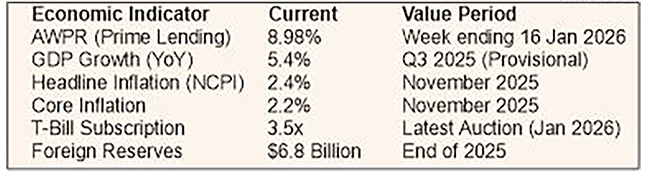
When asked about the instances where Treasury Bills are not fully subscribed by the investors, he replied,” Treasury Bill yields remained broadly stable, with only minimal movement across 91-day, 182-day, and 364-day tenors. Strong demand was clear, with the latest T-Bill auction oversubscribed by about 3.5 times. This sovereign-level stability creates room for the gradual easing of commercial lending rates, allowing the Central Bank to nurture a more growth-supportive monetary policy.”
Replying to a question on how he views the inflation numbers in this context, he said, “The year-on-year increase in the National Consumer Price Index stood at a manageable 2.4% in November, with core inflation at 2.2%. Such an environment should allow interest rates to fall without sparking a price spiral. For businesses, it means the real cost of borrowing adjusted for inflation, and it is becoming more favourable for them. While consumers still face weekly price shifts in vegetables and fish, the broader disinflation trend gives policymakers leeway to keep credit affordable.”
Referring to the growth trajectory, he mentioned, “With GDP growth provisionally at 5.4% in the third quarter of 2025 and Purchasing Managers’ Indices signalling expansion in both manufacturing and services, the economy is in a growth phase. However, to accelerate this momentum businesses need capital at lower cost to modernise machinery, boost export capacity, and spur innovation. Affordable credit is, therefore, not merely helpful, it is essential to shift growth into a higher gear.”
In conclusion , he said,” The coming months will be watched closely, because for Sri Lankan businesses, a sustained decline in borrowing costs isn’t just an indicator; it’s the foundation for growth. There’s hope that this easing in the cost of money will prevail through most of the year.”
By Sanath Nanayakkare ✍️

Mercantile Investments & Finance PLC has expanded its national footprint to 90 branches with a new opening in Tangalle, reinforcing its commitment to community accessibility. The trusted non-bank financial institution, with over 60 years of service, now supports diverse communities across Sri Lanka with leasing, deposits, gold loans, and tailored lending.
This physical expansion aligns with significant financial growth. The company recently surpassed an LKR 100 billion asset base, with its lending portfolio doubling to Rs. 75 billion and deposits growing to Rs. 51 billion, reflecting strong customer trust. It maintains a low NPL ratio of 4.65%.
Chief Operating Officer Laksanda Gunawardena stated the branch network is vital for building trust, complemented by ongoing digital investments. Managing Director Gerard Ondaatjie linked the growth to six decades of safeguarding depositor interests.
With strategic plans extending to 2027, Mercantile Investments aims to convert its scale into sustained competitive advantage, supporting both customers and Sri Lanka’s economic progress.

PM departs Sri Lanka to participate in the 56th World Economic Forum Annual Meeting in Davos-Klosters, Switzerland.

Several killed in Kabul blast, Afghan Interior Ministry says

Senegal beat hosts Morocco to win AFCON 2025 after farcical walk-off

At least six killed in Pakistan as fire rips through Karachi shopping mall

Chile declares ‘state of catastrophe’ as deadly wildfires menace cities

At least 21 killed in Spain after crash involving high-speed trains

‘Dates have the highest sugar content to fight Coronavirus’

Sunday Island 27 December – Headlines

#SundayIsland 17th December – Headlines

Sunday Island – 28th March

Sunday Island Headlines – 21 March

Sunday Island – 21st February – Headlines
-

 Editorial2 days ago
Illusory rule of law
-

 News3 days ago
UNDP’s assessment confirms widespread economic fallout from Cyclone Ditwah
-

 Business5 days ago
Koaloo.Fi and Stredge forge strategic partnership to offer businesses sustainable supply chain solutions
-

 Editorial3 days ago
Crime and cops
-

 Features2 days ago
Daydreams on a winter’s day
-

 Editorial4 days ago
The Chakka Clash
-
 Features2 days ago
Surprise move of both the Minister and myself from Agriculture to Education
-

 Features2 days ago
The Story of Furniture in Sri Lanka