
Latest News
Litton, Shamim lead Bangladesh’s rout of Sri Lanka


Bangladesh snapped their six-game losing streak in dominant fashion as they handed Sri Lanka a 83-run defeat in front of a packed house in Dambulla and with it levelled the three match series 1-1.
Litton Das’ 76 off 50 – he put to rest a 13-match run without a fifty – headlined Bangladesh’s innings, but it was Shamim Hossain’s destructive 48 off 27 that shifted the winds in Bangladesh’s favour.
Chasing 178, Sri Lanka’s top order failed to fire – unlike in Kandy – and an excellent Bangladesh effort with the ball and in the field ensured the Sri Lanka middle and lower order were not able to bail them out either.
To the crowd’s credit they hung around as wicket after wicket fell, but as early as the 12th over the droves began to filter out, as the last recognised batter – Dasun Shanaka – fell with just 73 runs on the board. Sri Lanka’s innings lasted just 15.2 overs.
It was the 12th over of the Bangladesh innings that shifted the game in the visitors’ favour, as it brought Shamim to the crease earlier than might have initially been planned. At the time though, the innings looked anything but redeemable.
The openers had thrown their wickets away in what might be described as cosplay efforts of aggression on a good batting surface, while Litton and Towhid Hridoy’s efforts at consolidation had helped their side avert a collapse.
However, when Towhid sliced one to short third and Mehidy Hasan Miraz scooped another to short fine leg, it looked as if all that consolidation had gone to waste. But Shamim’s entry changed the dynamics of the innings, and indeed the game.
Off just second ball he faced he cut one away from close to the stumps. A couple of deliveries later the pace was taken off, but Shamim responded with a bat swing that was even more rapid. Shamim’s next boundaries came against Sri Lanka’s death-bowling specialists – three off Nuwan Thushara, and one each off Maheesh Theekshana and Binura Fernando.
But the expert ball-striking and placement was only a small part of Shamim’s innings. Across his 27 deliveries faced, only five were dots. Shamim was then at the heart of disrupting Sri Lanka’s chase, effecting the run out of Kusal Mendis and holding on to running catch in the deep to remove Avishka Fernando.
His energy was infectious, and even if his eagerness for singles might have eventually led to his – and Jaker Ali’s – downfall in the final over as they sought to steal runs to the keeper, the momentum he had created would create the conditions for Bangladesh’s ultimate victory.
Litton hadn’t come into this game in any great form. He’d scored a pair of 40s this year, but his last 50-plus score in T20Is had come all the way back in June 2024. Even his coach had to acknowledge prior to the game that his skipper wasn’t in the best of form.
So, when Litton sauntered down the track and missed a wide one from Jeffrey Vandersay, it seemed inevitable that lean run was destined to continue. Kusal Mendis, however, was unable to gather this wide legbreak that spun even wider, and Litton survived. He was on 30 at the time.
Had he fallen then, perhaps Sri Lanka might have pressed home their advantage further. But in reality, the more painful missed chance came some six overs later, with Litton shanking an attempted sweep on 56, only to be dropped by Theekshana at mid-off in the 16th over.
By the time Theekshana had dismissed Litton three overs later, he had added a further 20 runs to his total and the momentum had decidedly shifted in Bangladesh’s favour.
Brief scores:
Bangladesh 177/7 in 20 overs [Litton Das 76, Towhid Hridoy 31, Shamim Hossain 48; Nuwan Thushara 1-30, Binura Fernando 3-31, Maheesh Theekshana 1-30] beat Sri Lanka 94 in 15.2 overs (Pathum Nissanka 32, Dasun Shanaka 20; Rishad Hossain 3-18, Shoriful Islam 2-12, Mohamad Saiffudin 2-21, Mustafizur Rahman 1-14, Mehidy Hasan Miraz 1-26) by 83 runs
[Cricinfo]

Latest News
Heat Index at Caution Level in the Sabaragamuwa, North-western and North-central provinces and in Colombo, Gampaha, Vavuniya, Mannar, Hambantota and Monaragala districts
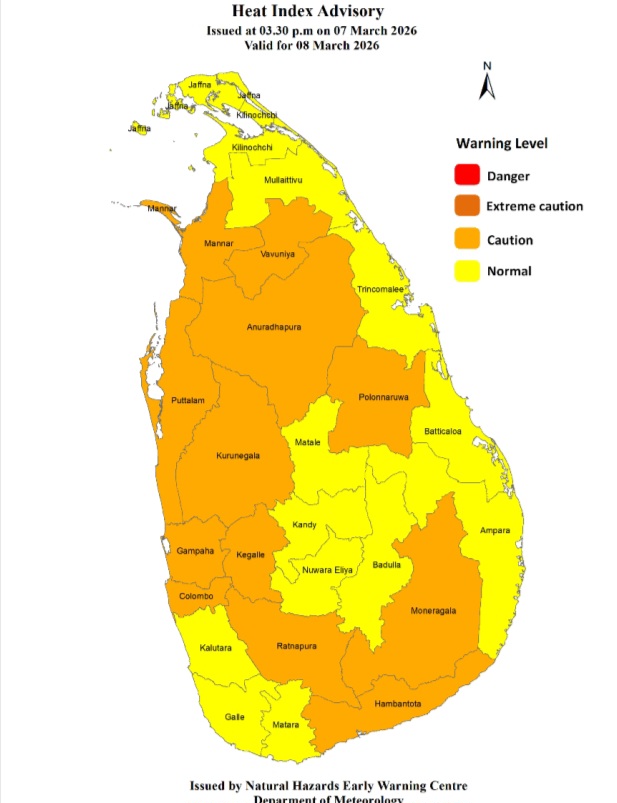
Warm Weather Advisory issued by the Natural Hazards Early Warning Centre of the Department of Meteorology at 3.30 p.m. on 07 March 2026, valid for 08 March 2026.
Heat index, the temperature felt on human body is likely to increase up to ‘Caution level’ at some places in the Sabaragamuwa, North-western and North-central provinces and in Colombo, Gampaha, Vavuniya, Mannar, Hambantota and Monaragala districts
The Heat Index Forecast is calculated by using relative humidity and maximum temperature and this is the condition that is felt on your body. This is not the forecast of maximum temperature. It is generated by the Department of Meteorology for the next day period and prepared by using global numerical weather prediction model data.

Effect of the heat index on human body is mentioned in the above table and it is prepared on the advice of the Ministry of Health and Indigenous Medical Services.
ACTION REQUIRED
Job sites: Stay hydrated and takes breaks in the shade as often as possible.
Indoors: Check up on the elderly and the sick.
Vehicles: Never leave children unattended.
Outdoors: Limit strenuous outdoor activities, find shade and stay hydrated.
Dress: Wear lightweight and white or light-colored clothing.
Note:
In addition, please refer to advisories issued by the Disaster Preparedness & Response Division, Ministry of Health in this regard as well. For further clarifications please contact 011-7446491.

An unprecedented wave of AI-generated misinformation about the US-Israel war with Iran is being monetized by online creators with growing access to generative AI technology, experts have told BBC Verify.
Our analysis has found numerous examples of AI-generated videos and fabricated satellite imagery being used to make false and misleading claims about the conflict which have collectively amassed hundreds of millions of views online.
“The scale is truly alarming and this war has made it impossible to ignore now,” says Timothy Graham, a digital media expert at the Queensland University of Technology.
“What used to require professional video production can now be done in minutes with AI tools. The barrier to creating convincing synthetic conflict footage has essentially collapsed,” he says.
The US and Israel began launching strikes on Iran on 28 February. In response, Iran has launched drone and missile attacks on Israel, as well as multiple Gulf nations and US military assets in the region.
Many have turned to social media to search for and share the latest information and to help make sense of a fast-moving week of conflict.
The platform X announced this week it will temporarily suspend creators from its monetization programme if they post AI-generated videos of armed conflict without a label.
The scheme rewards eligible users whose posts create large numbers of views, likes, shares and comments with payments from the platform.
“It’s a notable signal that they’ve noticed that this is a big problem,” says Mahsa Alimardani, a researcher specialising in Iran at the Oxford Internet Institute.
We asked TikTok and Meta, the company of Facebook and Instagram, if they intend to take similar action, but they did not respond to our requests for comment.
A typical example of an AI-generated video that BBC Verify has tracked appears to show missiles striking the city of Tel Aviv in Israel as the sound of explosions rings out in the background.

This video has been featured in more than 300 posts which have then been shared tens of thousands of times across social media platforms.
Some X users turned to the platform’s AI chatbot Grok to confirm the video’s veracity. But in many cases seen by BBC Verify, Grok wrongly insisted that the AI-generated video was real.
Another fake video, viewed tens of millions of times, claims to show Dubai’s Burj Khalifa skyscraper in flames, while a crowd of people seem to be running towards the building.
This AI-generated footage spread widely online at a time of considerable concern from residents and tourists about the drone and missile strikes on the city.
“Fake videos like these have a detrimental impact on people’s trust in the verified information they see online and make it much harder to document real evidence,” says Alimardani.

A new feature of this conflict analysed by BBC Verify is the emergence of AI-generated satellite imagery.
We verified multiple real videos showing Iranian drone and missile strikes on the US Navy’s Fifth Fleet headquarters in Bahrain on the first day of the conflict.
A fabricated photo, shared on X by the state-linked newspaper The Tehran Times, began to spread the following day and claimed to show extensive damage to the base.
The fake appears to be based on real satellite imagery of a US naval base in Bahrain taken in February 2025, which is publicly available online.
According to Google’s SynthID watermark detector, the fake image was generated or edited with a Google AI tool.

Three vehicles parked outside are also in the exact same spot in both the genuine satellite imagery and the AI picture – despite the photos allegedly having been taken a year apart.
Google’s AI tools, including its video generator Veo, are on the growing list of popular AI platforms, like OpenAI’s Sora model, Chinese AI app Seedance, and Grok which is built into X.
“The number of different tools that are now available to create a wide range of highly realistic AI manipulations is unprecedented,” says Henry Ajder, a generative AI expert.
“We have never seen these tools so available, so easy and so cheap to use,” he says.
This has led to a surge of AI-generated content online “because the pipeline onto social media can now be almost fully automated,” says Victoire Rio, executive director of the technology policy non-profit What To Fix.

X’s head of product said on Tuesday that “99%” of the accounts spreading AI-generated videos like these were trying to “game monetization” by posting content that will generate large amounts of engagement in return for payment through the app’s Creator Revenue Sharing programme.
The platform does not publish how many accounts are part of the programme, or how much money they can make.
But Graham estimates that X could pay about “eight to 12 dollars per million verified user impressions”.
“Creators have to hit five million organic impressions in three months, plus hold an X premium subscription, to be eligible,” he added.
“Once you’re in, viral AI-generated content is basically a money printer,” he says. “They’ve built the ultimate misinformation enterprise.”
X did not respond to our request for comment or our questions about the Creator Revenue Sharing programme.
Experts have told BBC Verify that while many social media companies say they are trying to change their moderation and detection systems to address the scale and speed at which AI-generated content spreads, there is no simple solution to the problem.
“The deeper issue is that engagement-driven monetisation and accurate information are fundamentally in tension, and no platform has fully resolved that tension or perhaps ever will,” says Graham.
[BBC]

Explosions have rocked one of Teheran’s main commercial airports, with eyewitnesses reporting a burning plane and large plumes of smoke at the Mehrabad airport – Iran’s busiest airport and main domestic hub – in footage shared on social media. Satellite imagery taken on Friday shows multiple aircraft were at the airport.
Israel earlier said it was launching a new wave of strikes on Iran
[BBC]

Dry weather will prevail except for a few showers in the Southern province and Rathnapura district

Heat Index at Caution Level in the Sabaragamuwa, North-western and North-central provinces and in Colombo, Gampaha, Vavuniya, Mannar, Hambantota and Monaragala districts

Lanka tea industry may lose $ 10-15 mn per week from ME war

Salary Commission this year to address public sector pay gaps

JP posts to be free of political influence: Minister

Emergency extension approved by 100-vote majority

‘Dates have the highest sugar content to fight Coronavirus’

Sunday Island 27 December – Headlines

#SundayIsland 17th December – Headlines

Sunday Island – 28th March

Sunday Island Headlines – 21 March

Sunday Island – 21st February – Headlines
-

 Features6 days ago
Brilliant Navy officer no more
-

 News2 days ago
University of Wolverhampton confirms Ranil was officially invited
-

 Opinion6 days ago
Sri Lanka – world’s worst facilities for cricket fans
-

 News3 days ago
Legal experts decry move to demolish STC dining hall
-

 Features6 days ago
A life in colour and song: Rajika Gamage’s new bird guide captures Sri Lanka’s avian soul
-

 News2 days ago
Female lawyer given 12 years RI for preparing forged deeds for Borella land
-

 Business3 days ago
Cabinet nod for the removal of Cess tax imposed on imported good
-

 Business4 days ago
War in Middle East sends shockwaves through Sri Lanka’s export sector