
News
LG Election System Review Committee wants number elected reduced

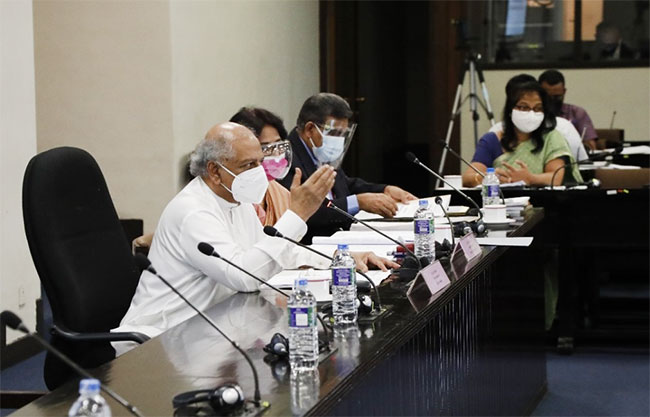
Well over 8,000 members heavy burden on taxpayer
The committee reviewing the Local Government electoral system has pointed out the need to reduce the number of elected local councillors.
During the previous administration the Parliament unanimously agreed to expand the LG system leading to an increase of members, from 4,000 to 8,600.
The expansion caused a massive increase in the expenditure, causing a tremendous burden on those bodies.
The following is the text of a statement issued by Parliament yesterday: “A report submitted by the three-member committee, appointed by the Minister of Public Services, Provincial Councils and Local Government to review the Local Government, Election system was taken into consideration at the Select Committee of Parliament to Identify Appropriate Reforms of the Election Laws and the Electoral System and to Recommend Necessary Amendments, on Thursday (02).
The summary of the review committee was presented by R.A.A.K. Ranawaka, Secretary to the Ministry of Lands and Land Development, in his capacity as the committee Chair.
Prof. Sudantha Liyanage, Vice Chancellor of the University of Sri Jayewardenepura, a member of the National Delimitation Committee, said that the unusual growth in the number of members in local government bodies should be reduced to a fixed number as decided by the committee.
He said that 70% of the members, in the local government bodies, should be elected on a divisional basis and the remaining 30% on a proportional basis.
Prof. Sudantha Liyanage stated that the review committee recommended that the proportional representation system used for choosing Members of Parliament should be used in calculating the number of members in Local Government Institutions and also stated that the bonus seat system applied should also be applicable.
One of the weaknesses the Committee observed in the current mixed proportional representation system was the failure to introduce any bonus seats for the winning parties. He added that the review committee hoped that the introduction of bonus seats will reduce the instability in local government bodies.
Members of the Review Committee was also of the view that in order for a political party or independent group to be eligible to represent local government bodies, such party or independent group must have 2.5% or more of the valid votes cast in the relevant local government area.
The Committee also pointed out that the manner in which members are to be elected for multi-member constituencies should be changed and the procedure prescribed in Act No. 22 of 2012 should be applied for that purpose. Former Secretary to the Ministry Jayalath Ravi Dissanayake has also been a member of this Review Committee.
The Leader of the House, Minister of Education Dinesh Gunawardena, Chairman of the Parliamentary Select Committee, said that the will of the people is to maintain local government bodies with a minimum number of seats. However, he pointed out that there must be a member responsible for a particular division.
The Attorney General’s Conclusive remarks regarding the Provincial Council Elections (Amendment) Act No. 17 of 2017 were also tabled at this Parliamentary Select Committee.
Also, the Report on Local Government Elections submitted to the Committee by the Sri Lanka Muslim Congress was tabled.
Ministers Nimal Siripala de Silva, G. L. Peiris, Douglas Devananda, M.U. M. Ali Sabry, Members of Parliament Kabir Hashim, Ranjith Madduma Bandara, M.A. Sumanthiran, Mano Ganesan, Madura Vithanage and Sagara Kariyawasam were present at this meeting, held in Parliament.
The next meeting of the Parliamentary Select Committee is scheduled to be held on Monday (06), said the Secretary to the Select Committee, Deputy Secretary General and Chief of Staff of Parliament Ms. Kushani Rohanadheera.

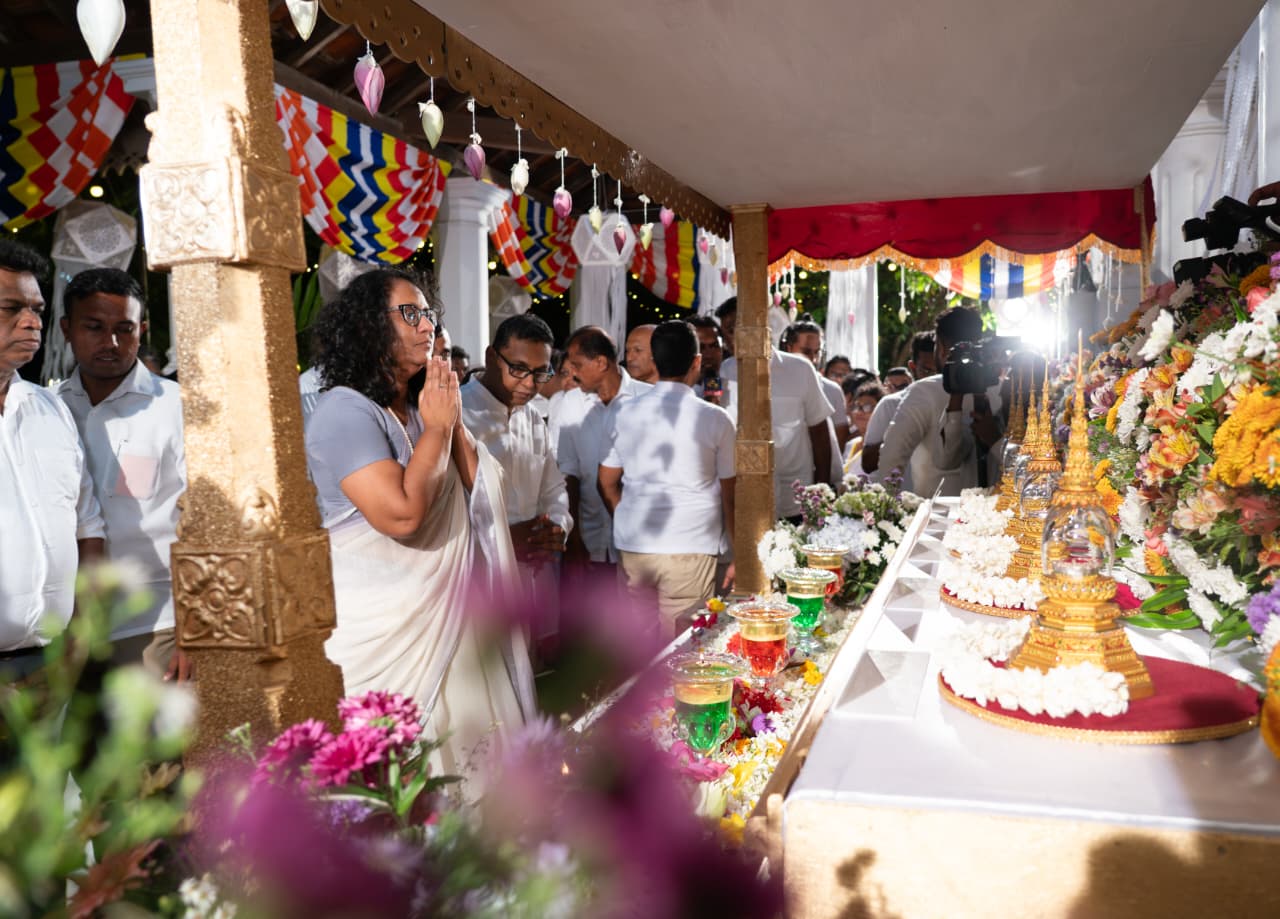
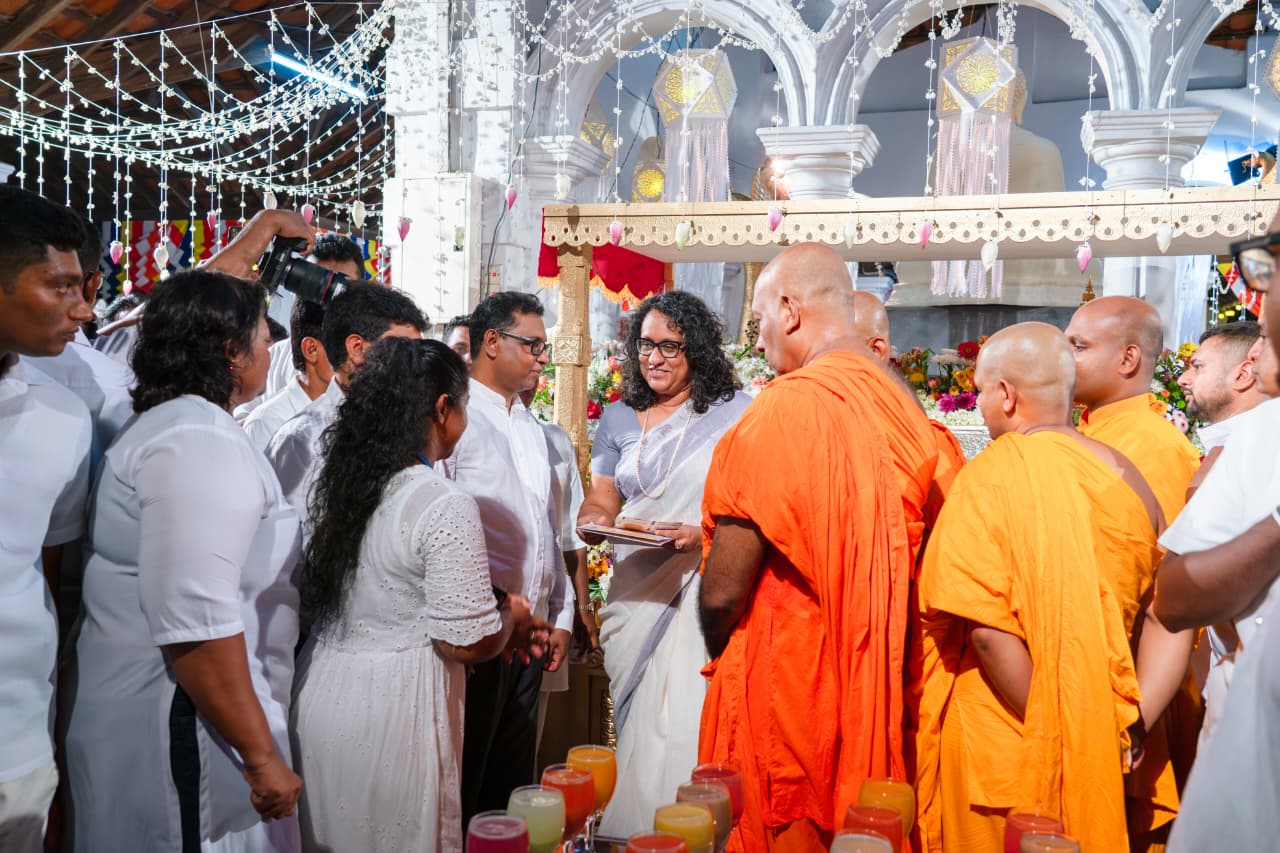
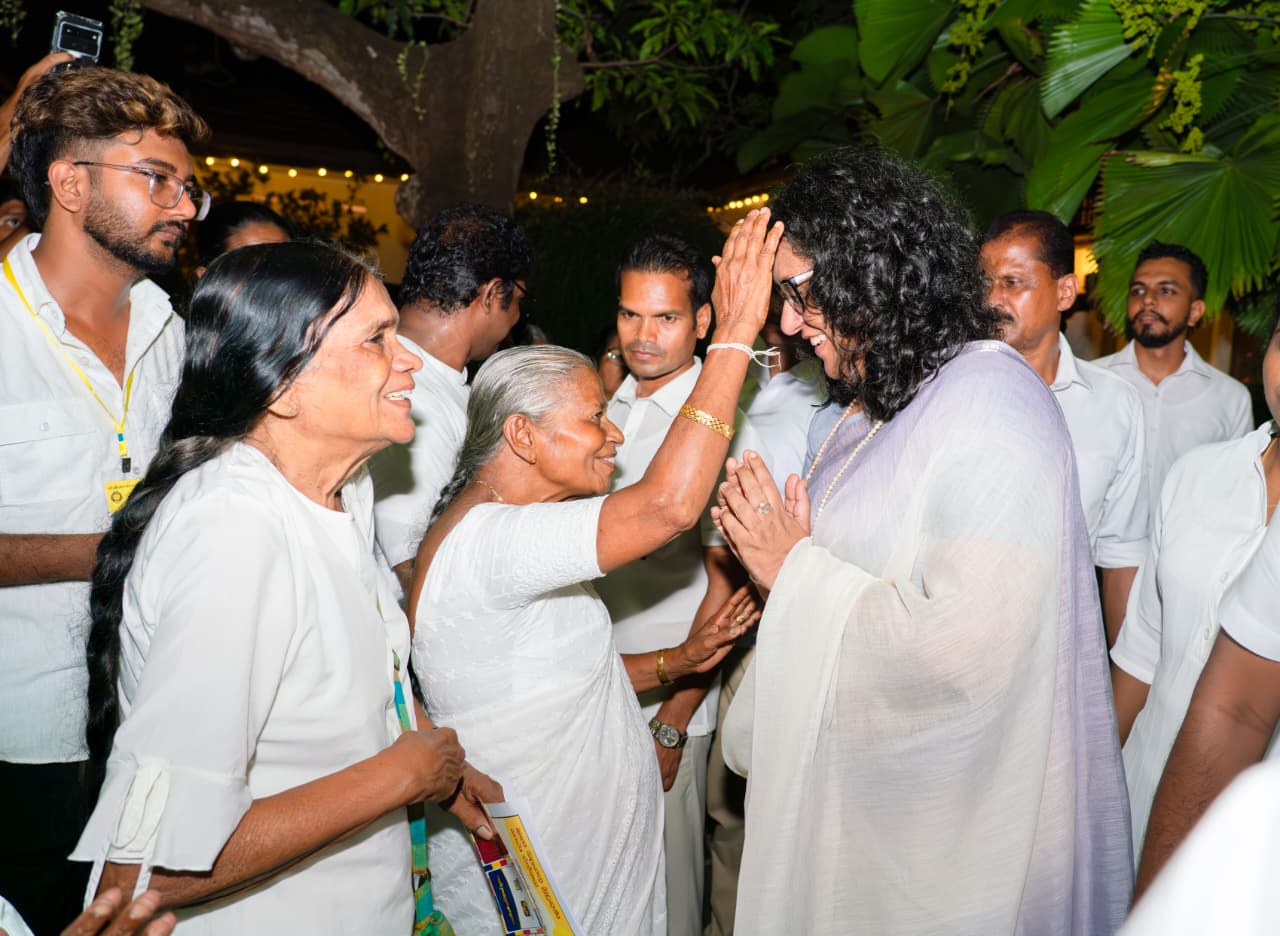
In line with the 2026 Vesak Poya Day, the ‘Swarnabhivandana 2026’ Sacred Relic Veneration ceremony, organized by the Sri Sudarshanarama Temple, Kiribathgoda under the guidance of the Chief incumbent of the temple, and the Head of the Department of Pali and Buddhist Studies at the University of Ruhuna and a Senior Lecturer Ven. Makola Mangala Nayaka was held on 3rd of May with the participation of Prime Minister Dr. Harini Amarasuriya.
The Prime Minister stated that it was a rare privilege to take part in such a noble religious event. She noted that devotees have been presented with a rare opportunity to venerate sacred relics, including those of the Supreme Buddha and Maha Arahants of Seewali, Angulimala, Anuruddha, and Mihindu Theros.
She further emphasized that such religious programmes contribute to the spiritual development of society and help invoke blessings upon the country.
The Prime Minister also expressed her sincere gratitude to the Chief Incumbent Thero for his guidance in successfully organizing this meritorious event, as well as to the Dayaka Sabha of the temple and all those who contributed with dedication.
[Prime Minister’s Media Division]
Latest News
Heat Index at Caution Level in the Northern, North-central, Eastern, Sabaragamuwa and North-western provinces and in Colombo, Gampaha, Hambantota and Monaragala districts during the day time

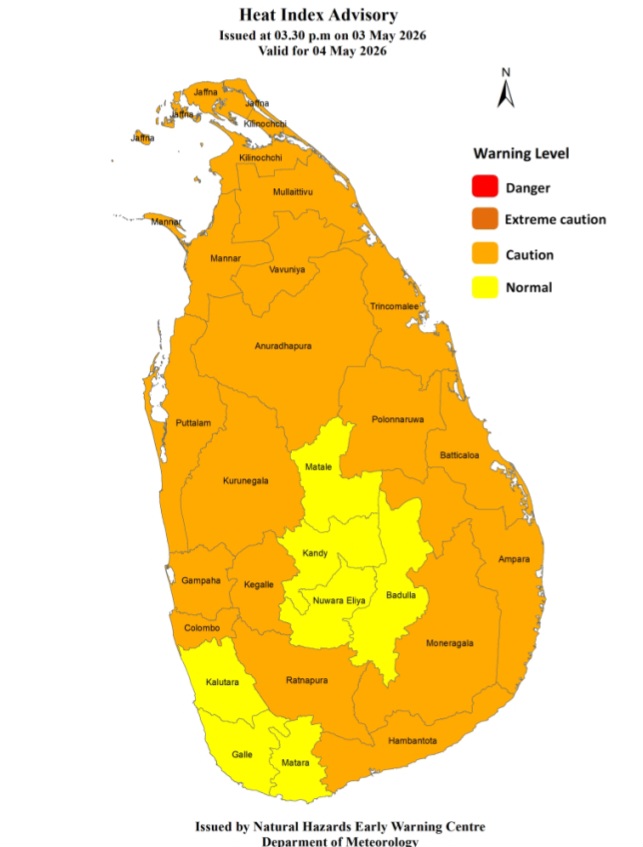
Warm Weather Advisory
Issued by the Natural Hazards Early Warning Centre
Issued at 3.30 p.m. on 03 May 2026, valid for 04 May 2026.
The Heat index, the temperature felt on human body is likely to increase up to ‘Caution level’ at some places in the Northern, North-central, Eastern, Sabaragamuwa and North-western provinces and in Colombo, Gampaha, Hambantota and Monaragala districts during the day time.
The Heat Index Forecast is calculated by using relative humidity and maximum temperature and this is the condition that is felt on your body. This is not the forecast of maximum temperature. It is generated by the Department of Meteorology for the next day period and prepared by using global numerical weather prediction model data.

Effect of the heat index on the human body is mentioned in the above table and it is prepared on the advice of the Ministry of Health and Indigenous Medical Services.
ACTION REQUIRED
Job sites: Stay hydrated and takes breaks in the shade as often as possible.
Indoors: Check up on the elderly and the sick.
Vehicles: Never leave children unattended.
Outdoors: Limit strenuous outdoor activities, find shade and stay hydrated.
Dress: Wear lightweight and white or light-colored clothing.
Note:
In addition, please refer to advisories issued by the Disaster Preparedness & Response Division, Ministry of Health in this regard as well. For further clarifications please contact 011-7446491.

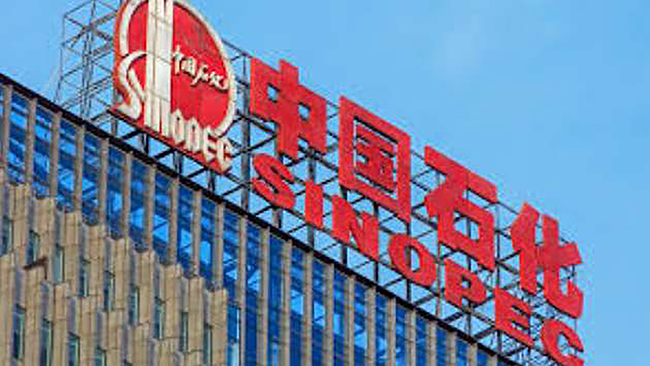
China has declared that China Petroleum and Chemical Corporation (SINOPEC) will not proceed with the USD 3.7 bn Hambantota oil refinery project unless a consensus could be reached on the percentage of the output that could be sold in the local market.
China has informed the NPP government that SINOPECwill not be able to sustain the project in terms of the original agreement that stipulated that 80% of the output be exported and 20 % sold in the Sri Lankan market, according to sources familiar with the issue.
Once fully operational, the strategic facility will be able to process 200,000 barrels of crude oil a day. The proposed facility, together with the Hambantota International port, which was taken over by China in 2017 on a 99-year lease, emphasise significant Chinese presence in the country.
SINOPEC with about 12% market share is among the foreign companies engaged in fuel distribution in Sri Lanka at the moment. Other foreign players are Lanka India Oil Company (LIOC) and joint venture by Shell Brands International AG (Shell) and RM Parks (Private) Limited, the latter being the latest entrant.
LIOC entered the market way back in 2003 during Ranil Wickremesinghe’s tenure as the Prime Minister. LIOC holds the second biggest market share with 211 fuel stations with SINOPEC being third and joint Shell Brands International AG (Shell) and RM Parks (Private) Limited in fourth place. CPC remains the market leader with some 800 odd fuel stations countrywide.
Sources said that whatever the Chinese and Sri Lankan government representatives said in public the launch of the project primarily would depend on a new formula. The Island learns that the Chinese expect to sell 30% of the output here. “The Chinese are of the view that 20% share is not sufficient to sustain the project,” sources said.
Sri Lanka and China in January 2025 announced plans for the SINOPEC project dubbed the largest single Chinese direct investment here following President Anura Kumara Dissanayake’s three-day state visit to Beijing. Dissanayake’s delegation included Minister of Foreign Affairs, Employment and Tourism Vijitha Herath, Minister of Transport, Highways, Ports and Civil Aviation Bimal Rathnayake, and Sri Lankan Ambassador to China, Majintha Jayesinghe. Outspoken Chinese Ambassador to Sri Lanka Qi Zhenhong was also present at all key meetings with representatives of China Petrochemical Corporation (SINOPEC Group), China Communications Construction Company Ltd (CCCC), China Merchants Group (CMG), Huawei, and BYD Auto, a leading company in the automobile manufacturing sector.
Pointing out that Sri Lanka and China hadn’t been able to resolve the knotty problem for about 15 months, sources said that Sri Lanka was also under pressure from India to expedite the Trincomalee oil tank farm development project. Sri Lanka finalized an agreement with India and United Arab Emirates (UAE) in early April 2025 to develop Trincomalee as an energy hub.
Sources said that in line with the overall plans involving China as well as India-UAE, Sri Lanka was required to enhance the fuel storage facilities as soon as possible. The ongoing West Asia conflict underscored the responsibility on the part of the incumbent dispensation to take tangible measures to enhance storage facilities.
The Trincomalee and Hambantota projects could be on a collision course, sources said. The likelihood of Indo-Lanka agreements in respect of WW two era oil tank farms in Trincomalee, particularly the one negotiated during Gotabaya Rajapaksa’s presidency having animpact on the Hambantota oil refinery couldn’t be ruled out, sources said.
President Dissanayake during his May Day address disclosed the crisis faced by his government in ensuring uninterrupted oil supplies. Dissanayake said that the government had no option but to increase fuel quotas given to various categories in view of the arrival of fuel ships in Colombo as Sri Lanka lacked storage facilities.
Sources said that energy insecurity was at stake due to the continuing instability in the global markets caused by US actions in Hormuz Strait.
Newly-appointed Energy Minister Anura Karunathilake is believed to be engaged in consultations with relevant parties. Earlier Punyakumara Dissanayake who resigned recently over the coal scam handled the Hambantota refinery matter.
by Shamindra Ferdinando

PM participated in ’Swarnabhivandana 2026,’ Sacred Relic Veneration Ceremony

Holder and Washington star in Gujarat Titans’ nervy last-over win

Varun and Narine push Sunrisers Hyderabad’s off switch

Aaron Hardie owns big stage to help Peshawar Zalmi lift second PSL title

Showers expected in the the Western, Sabaragamuwa, Central, North-western and Eastern provinces and in Polonnaruwa, Galle and Matara districts after 2.00 pm.

Heat Index at Caution Level in the Northern, North-central, Eastern, Sabaragamuwa and North-western provinces and in Colombo, Gampaha, Hambantota and Monaragala districts during the day time

‘Dates have the highest sugar content to fight Coronavirus’

Sunday Island 27 December – Headlines

#SundayIsland 17th December – Headlines

Sunday Island – 28th March

Sunday Island Headlines – 21 March

Sunday Island – 21st February – Headlines
-
 News5 days ago
Treasury chief’s citizenship details sought from Australia
-
 News4 days ago
Rooftop Solar at Crossroads as Sri Lanka Shifts to Distributed Energy Future
-
 News6 days ago
Govt. assures UN of readiness to introduce ‘vetting process’ for troops on overseas missions
-
 News3 days ago
“Three-in-one blood pressure pill can significantly reduce risk of recurrent strokes”
-
 Business6 days ago
ADB-backed grid upgrade tender signals next phase of Sri Lanka’s energy transition
-

 News5 days ago
Central Province one before last in AL results
-

 Sports5 days ago
Well done AKD!
-

 Business6 days ago
Update on independent forensic review