
Latest News
Lewis’ 61-ball century trumps Kusal’s 19-ball fifty in 23-over shootout


After a series in which they consistently failed to get the rub of the green, the stars finally aligned for West Indies as they ended their tour of Sri Lanka with a morale-boosting win. Evin Lewis, playing his first ODI since 2021, struck an unbeaten 102 off 61 balls, as West Indies chased down a DLS-adjusted target of 195 in a rain-reduced game of 23 overs with eight wickets to spare. In fact, they got the required runs with an over to spare. It was their first ODI win in Sri Lanka following ten straight defeats, and their first win on this tour since the first T20I.
Sri Lanka, for their part, had put up a valiant effort after their innings had been cut into less than half. The first 17.2 overs had come prior to the rain intervention, and upon resumption, they were given just a further 5.4 overs to set a competitive total.
Enter Kusal Mendis, who bludgeoned an unbeaten 56 off 22 deliveries – he got the half-century off 19 balls – as Sri Lanka themselves struck 75 runs in those final 5.4 overs to end on 156 for 3, and gave themselves a fighting chance. In the end, though, a combination of a wet outfield, wet ball and a laser-focused Lewis proved too much to overcome.
Brandon King (18 off 19 balls) and Shai Hope (22 off 27) had kept Lewis company for most of the chase, but it wasn’t until Sherfane Rutherford joined him in the middle that West Indies truly took control of proceedings.
Rutherford’s brisk cameo saw him plunder 50 off just 26 deliveries, including four fours and three sixes, with his partnership with Lewis amounting to an unbeaten 88 from just 45 deliveries. It was a pivotal stand in the context of the game, as it came just as Sri Lanka might have been harbouring thoughts of a late heist.
With the required run rate at roughly 8.5 an over from the outset, West Indies had done well to just about keep up with it over the opening ten overs – there was at least one boundary in seven of the first 11 overs. But in such a short chase, even a couple of quiet overs can heighten the pressure – and so it proved to be.
Between the 11th and 17th overs, Sri Lanka gave away just 40 runs as the required rate rose to above 11.50 runs an over. Skipper Charith Asalanka had done well in this period by shuffling his pack to sneak in some cheap overs from himself and Kamindu Mendis – both of whom made up the fifth-bowler quota after Wanindu Hasaranga had struggled with controlling a wet ball.
Where Asalanka erred was in bowling himself for one over too many, which allowed Rutherford and Lewis to go after him. That 14-run over set the tone, after which the pair never looked back. The miserly Maheesh Theekshana was rinsed for 18 in the next over, while even the excellent Asitha Fernando was hounded for 26 off his final two. Dilshan Madushanka, playing his first ODI since March, went for 50 in five.
Sri Lanka, though, will have positives to take away from this game, particularly in how aggressively they approached the post-rain period, knowing that they didn’t have much time to scrounge up a competitive total. The opening 17.2 overs had seen Sri Lanka stitch together a measured start, with openers Pathum Nissanka and Avishka Fernando putting on 81.
That, though, owed much to West Indies dropping three chances – two of Nissanka and one of Avishka – inside the opening ten overs. This poor catching did not get much better after the five-hour rain delay, with Kusal also dropped twice on the way to becoming the third-quickest Sri Lanka batter to 4000 ODI runs.
It all began with the four balls left in Roston Chase’s second over, as Kusal proceeded to clatter each of them for boundaries – two precise pulls, one stunning straight drive, and finally a fortunate inside edge down to fine leg. In all, Sri Lanka struck 12 boundaries in the final 34 deliveries they faced.
The shortened game also had some knock-on effects on West Indies’ bowling plans, as the new provisos meant three bowlers were given a quota of five overs each, while two others were handed four apiece. Once Chase’s over, in which Kusal had struck four consecutive boundaries, was belatedly completed, and with Sri Lanka in raucous mood, West Indies were suddenly faced with the proposition of figuring out how Gudakesh Motie, Jayden Seales, and Alzarri Joseph – who had bowled four, four and three overs, respectively – would split the remains.
And with the economical Matthew Forde already having bowled five overs prior to the rain break, it meant only two more bowlers could bowl five; so they needed to find one more over from somewhere.
With Chase having been dispatched upon the resumption of play, it was left to Rutherford to roll his arm over, and he was duly taken for 17 runs courtesy two fours and a six. And as Kusal’s carefree innings continued in earnest, Sri Lanka eventually managed to muster up a competitive total – though it proved to be just not good enough on the day.
Brief scores: (23 overs)
West Indies 196 for 2 in 22 overs (Evin Lewis 102*, Shai Hope 22, Sherfane Rutherford 50*, Dilshan Madushanka 1-50, Asitha Fernando 1-39) beat Sri Lanka 156 for 3 in 23 overs (Avishka Fernando 34, Kusal Mendis 56*, Pathum Nissanka 56; Roston Chase 1-20, Sherfane Rutherford 1-27) by eight wickets (DLS method)
[Cricinfo]







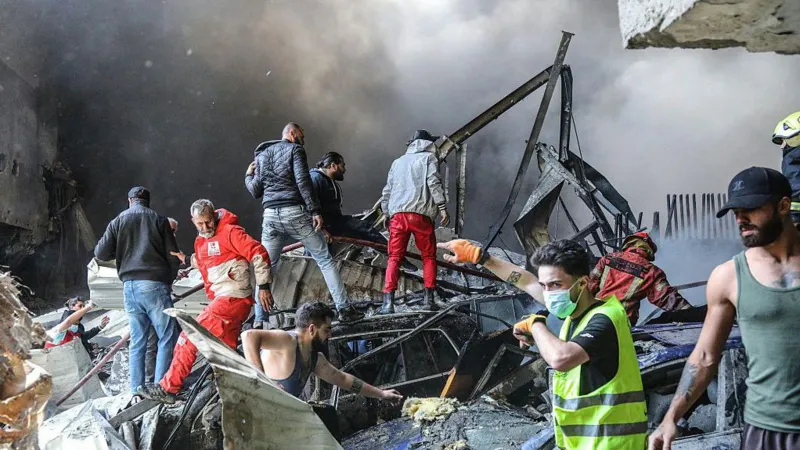
Israeli Prime Minister Benjamin Netanyahu has ordered his government to begin direct talks with Lebanon, he said in a statement on Thursday.
Netanyahu said the talks would focus on the disarmament of Hezbollah, the Iran-backed Lebanese political and militant group, and establishing peaceful relations.
A US State Department official confirmed it would host a meeting next week “to discuss ongoing ceasefire negotiations with Israel and Lebanon”.
Lebanese officials called for a ceasefire before the talks begin, but Netanyahu in a subsequent address to residents of northern Israel said: “There is no ceasefire in Lebanon.”
The Israeli military continued to strike Lebanon on Thursday – targeting what it described as Hezbollah rocket launch sites in the south. It also issued a new evacuation warning for residents in the southern suburbs of the capital, Beirut.
The head of the World Health Organization (WHO), Tedros Adhanom Ghebreyesus, said on X that this included the Jnah area, which includes two major hospitals.
“At this time, no alternative medical facilities are available to receive approximately 450 patients from the two hospitals (including 40 patients in the ICU), rendering their evacuation operationally unfeasible,” he said.
Among those being treated at the hospitals, Tedros added, were some of the 1,150 people that Lebanon’s health ministry said were wounded in Wednesday’s massive wave of Israeli strikes. At least 303 people were killed.
Tedros also said that the headquarters of the Ministry of Public Health, which “hosts five shelters accommodating more than 5,000 people”, is in the evacuation area.
That ceasefire began with confusion over whether Lebanon, Israel’s second front, was to be included. Iranian officials and mediators from Pakistan said it was, US and Israeli officials said clearly that it was not.
Amid the confusion, the wave of Israeli strikes on Lebanon – the heaviest since the conflict began six weeks ago – prompted Iran to declare that Israel was break8ng the terms of the ceasefire, once again halt passage of shipping through the Strait of Hormuz, and to threaten retaliatory strikes.
Israel’s military continues to occupy a large part of the south of Lebanon, where it has destroyed villages in recent days. Without a commitment to a temporary ceasefire at least, it is not clear how productive talks could proceed between the two sides.
(BBC)
Latest News
Sun directly overhead Nagawilluwa, Galgamuwa, Sigiriya, Palugasdamana and Mankerni about 12:11 noon today (10)

On the apparent northward relative motion of the sun, it is going to be directly over the latitudes of Sri Lanka from the 05th to 15th of April in this year.
The nearest areas of Sri Lanka over which the sun is overhead today (10th) are Nagawilluwa, Galgamuwa, Sigiriya, Palugasdamana and Mankerni about 12:11 noon.

Bangladesh advance match timings to save energy

PM on inspection tour of newly renovated Colombo Central Bus Stand

Israel to hold direct talks with Lebanon but no ceasefire, Netanyahu says

Sun directly overhead Nagawilluwa, Galgamuwa, Sigiriya, Palugasdamana and Mankerni about 12:11 noon today (10)

Showers expected in the Western, Sabaragamuwa, Southern and Uva provinces and in Kandy and Nuwara-Eliya districts after 2.00 p.m

Opposition tells Minister Kumara Jayakody to resign

‘Dates have the highest sugar content to fight Coronavirus’

Sunday Island 27 December – Headlines

#SundayIsland 17th December – Headlines

Sunday Island – 28th March

Sunday Island Headlines – 21 March

Sunday Island – 21st February – Headlines
-

 Features5 days ago
Ranjith Siyambalapitiya turns custodian of a rare living collection
-

 News5 days ago
Global ‘Walk for Peace’ to be held in Lanka
-

 News3 days ago
Lankan-origin actress Subashini found dead in India
-

 Features5 days ago
Beyond the Blue Skies: A Tribute to Captain Elmo Jayawardena
-

 Features5 days ago
Aspects of Ceylon/Sri Lanka Foreign Relations – 1948 to 1976
-

 News1 day ago
AG: Coal procurement full of irregularities
-

 Business1 day ago
Hayleys Mobility introduces Premium OMODA C9 PHEV
-

 Sports1 day ago
DS to face St. Anthony’s in ‘Bridges of Brotherhood’ cricket encounter