
Opinion
Last chance for Parliament

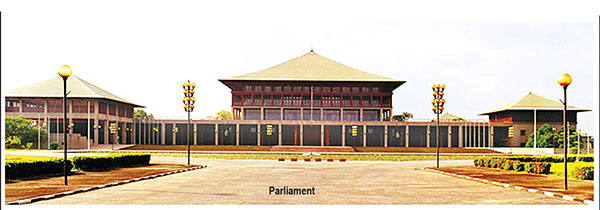
by Sanja de Silva Jayatilleka
The People have spoken. They no longer regard their Parliamentary representatives with any kind of trust and respect. Read their placards. Listen to what they say. No longer is Parliament a repository of hope and expectation. In their reckoning, you, their elected representatives in Parliament, have let them down and they are done forgiving and forgetting. Instead, now awakened by unprecedented economic hardships, they mean to hold you accountable.
Our country has gone from being the “Resplendent Isle” to being the Basket Case of South Asia. It’s in all sorts of trouble. People have died in fuel and gas queues. Basics are in short supply and now, for many, unaffordable. Essential medicines are unavailable. No one is looking forward to the Sinhala and Tamil New Year in a few days.
The people’s disgust at most of you who represented them for many years in Parliament, is clearly and unambiguously displayed for all to see at the on-going protests. They blame you for the manner in which they have been cheated, deceived and wrung out in every possible way. Corruption, mismanagement, nepotism have been rife amongst a large part of the ruling elite and the People believe that either you benefitted from it or didn’t have the courage to stand against it.
The People have seen through the “whitened sepulchers” inhabiting the temple of democracy in which they had placed their trust. You have treated that trust with contempt. Now the People have nothing but frustrated contempt for you!
The conduct of many of you in Parliament over the last few days, at such a decisive moment of this country’s history, with on-going agitations by every social group and community, was a shameful revelation of your total disregard for the people, their voices and their welfare. Instead, you displayed your supreme preoccupation with your own interests. You didn’t impress them and their desperation only increased.
The President, whom the people want gone, like yesterday, is not planning to do anything of the sort. He doesn’t hear them. That much was proudly announced in Parliament, so as to leave no one in doubt. While the ruined lives of the less fortunate and their livelihoods are steadily heading towards complete collapse, it looks like the rulers are carefully stepping around the remains and plotting the continuance of the rest of their terms of office.
The People, out on the streets, are in no mood to accommodate them. Added now to their cries for the President’s departure is the growing demand for the 225 to be gone as well, together with “the system” which they say has created and enabled this present situation where the people were clearly the losers and will continue to be so.
The government’s record, as revealed during the current debate in parliament has only confirmed the suspicions of the people of the ineptitude of the legislators: more than 18% of children today are malnourished. It also revealed that military spending as a percentage of government expenditure is only second to Israel! The people saw that the government chose to fatten the military and starve the children. Surely those responsible deserve all the insults they are getting on the streets today.
The people had heard the experts repeatedly warn that unless the government changed their path, the country would go bankrupt. But the government was beyond listening to experts. The unilateralism which started with the fertilizer ban continued through the international bond payments. Never mind the cost. There were always the downtrodden to pay the bill. They are no longer willing to pay quietly for the numerous mistakes of those they elected to make things better for them. They demand that the perpetrators pay for them, starting with those who have looted the treasury.
The people, together as one, are calling for the change that they see as necessary to save their country, and themselves. Waving constitutional and legal arguments at them, however valid, as to the unviability of their demands has only made them more determined in their agitation. They expect the Parliament to come up with a solution, and their unrelenting pressure has finally extracted a number of proposals from the legislators.
The Proposals
The proposals in themselves, don’t seem to have reassured the people. They have a basic demand which they don’t seem to want to give up, that of the President leaving. The government is clear that such a demand will not be accommodated in any shape or form. A gridlock replete with danger, given the mood on the street and the numbers gathering along them. One hopes it will be resolved in some peaceful form. It is hardly possible to comprehend the casual dismissal with which this unprecedented phenomenon is being regarded by the government. They do this at their own peril.
As for their second demand, the proposals offer options for an interim administration which goes some way towards addressing the crisis and the insistent chants of the people. It’s best if the Parliament acts quickly to make those proposals work inside the citadel before matters devolve entirely to the street. It is not unknown to have happened outside parliaments (and Constitutions) in other parts of the world.
Once the immediate crisis is addressed, and the economy is stabilized to the extent possible, the people demand a newly elected President and representatives in Parliament. Elected by a now ‘woke’ population, sick and tired of being pawns in an unsavory game that they had been unwittingly part of. I would say it’s no great prediction that at such a time, a change is certainly going to come.
It’s up to the legislators now to decide on how to deliver what the people demand. Their current concern with their own agendas is rapidly losing them the little respect that remains. The time is now, for those few legislators who actually care, to display courage and concern for the multitudes waving flags and placards, screaming their appeals for meaningful action to bring about real change.
The sooner those with the power to legislate get their act together, the better it is for them and any plans they have of continued participation in politics of this country. If they choose to do so, this is their chance to prove to the people of Sri Lanka that they are the exception to the broad-brush impression of an incompetent, uncaring and dishonest 225.
The Movement
A Movement was born out of the misery of the people. No curfew, no masked motorcyclists carrying automatic weapons, no threats and intimidation has been able to stop the Movement. It’s been swelling at the edges as every sector, every professional group has been inspired by the courage of the people who chose to protest. Lawyers protest outside the Attorney-General’s department, doctors and hospital workers protest lack of lifesaving medicines, priests and nuns, teachers and 5-star hotel employees, students and day workers, entrepreneurs and the super-rich are all part of the Movement, chanting the same slogans, simple enough to be understood, powerful enough to reflect their bitter anger.
And now, they have come to the city, in their thousands or tens of thousands, and have gathered opposite the Presidential Secretariat, filling the roads all around it to drive home their message. They have come to the heart of the city to confront their President and his power-structure in a show of unity and strength, unseen since the moment of Independence 74 years ago.
It is to this generation that another kind of struggle, one to free themselves and their country from their own elected rulers, has fallen. They are proving that they are equal to it.
Will those parliamentarians who assert that they are different, stand alongside and play their part? Are they equal to the challenge of navigating their constitutional space in Parliament to offer the change they demand? The opportunity to respond may be time-bound.



Walking through Pettah market in Colombo, I have noticed something both obvious and troubling. Shop after shop sells bags, shoes, electronics, even sarees, and yet all shops are owned and run by men. Even businesses catering exclusively to women, like jewelry stores and bridal boutiques, have men behind the counter. This is not just my observation but it’s a reality where most Sri Lankans have observed as normal. What makes this observation more important is when we examine the demographics where women population constitute approximately 52% of Sri Lanka’s population, but their representation as business owners remains significantly low. According to the Global Entrepreneurship Monitor 2023 report, Sri Lanka’s Total Early Stage Entrepreneurial Activity rate for women is just 8.2%, compared to 14.7% for men.
Despite of being the majority, women are clearly underrepresented in the entrepreneurial aspect. This mismatch between population size and economic participation create a question that why aren’t more women starting ventures? The answer is not about capability or intelligence. Rather, it’s deeply in social and cultural barriers that have been shaping women’s mindsets for generations. From childhood, many Sri Lankan girls are raised to believe that their primary role is as homemakers.
In families, schools, and even universities, the message has been same or slightly different, woman’s success is measured by how well she manages a household, not by her ability to generate income or lead a business. Financial independence is rarely taught as essential for women the way it has been for men. Over time, this messaging gets internalised. Many women grew up without ever being encouraged to think seriously about ownership, leadership, or earning their own money. These cultural influences eventually manifest as psychological barriers as well.
Years of conditioning have led many skilled women to develop what researchers call “imposter syndrome”, a persistent fear of failure and feel that they don’t deserve success kind of feeling. Even when they have the right skills and resources, self-doubt holds them back. They question whether they can run a business independently or not. Whether they will be taken seriously, whether they are making the right choice. This does not mean that women should leave their families or reject traditional roles. But lack of thinking in a confident way and make bold decisions has real consequences. Many talented women either never start a business or limit themselves to small, informal ventures that barely survive. This is not about men versus women. It’s about the economic cost of underutilising 52% of the population. If our country is genuinely serious about sustainable growth. we must build an inclusive entrepreneurial ecosystem through confidence building programs, better finance access to women, and a long term societal mindset shift. Until a young girl walking through Pettah can see herself as a future shop owner rather than just a customer, we will continue to waste our country’s greatest untapped resource.
Harinivasini Hariharasarma
Department of Entrepreneurship
University of Sri Jayewardenepura

Some essential points made to indicate its future in Power Generation
The hard facts are that:
1) Coal supplies cannot last for more than 70- 100 years more at most, with the price rising as demand exceeds supply.
2) Reactor grade Uranium is in short supply, also with the price rising. The cost is comparable to burning platinum as a fuel.
3) 440 standard Uranium reactors around the world are 25-30 years old – coming to the end of their working life and need to be replaced.
4) Climate Change is increasingly making itself felt and forecasts can only be for continuing deterioration due to existing levels of CO2 being continuously added to the atmosphere. It is important to mention the more serious problems associated with the release of methane gases – a more harmful gas than CO2 – arising from several sources.
5) Air pollution (ash, chemicals, etc.) of the atmosphere by coal-fired plants is highly dangerous for human health and should be eliminated for very good health reasons. Pollution created by India travels to Sri Lankans by the NE monsoon causing widespread lung irritations and Chinese pollution travels all around the world and affects everybody.
6) Many (thousands) of new sources of electric power generation need to be built to meet increasing demand. But the waste Plutonium 239 (the Satan Stuff) material has also to be moved around each country by lorry with police escort at each stage, as it is recovered, stored, processed and formed into blocks for long term storage. The problem of security of transport for Plutonium at each stage to prevent theft becomes an impossible nightmare.
The positive strengths to Thorium Power generation are:
1) Thorium is quite abundant on the planet – 100 times more than Uranium 238, therefore supplies will last thousands of years.
2) Cleaning or refining the Thorium is not a difficult process.
3) It is not highly radioactive having a very slow rate of isotope decay. There is little danger from radiation poisoning. It can be safely stored in the open, unaffected by rain. It is not harmful when ingested.
4) The processes involved with power generation are quite different and are a lot less complex.
5) Power units can be quite small, the size of a modern detached house. One of these can be located close to each town, thus eliminating high voltage cross-country transmission lines with their huge power losses (up to 20%).
6) Thorium is ‘fertile’ not fissile: therefore, the energy cycle has to be kick-started by a source of Neutrons, e.g., fissile material, to get it started. It is definitely not as dangerous as Uranium.
7) It is “Fail – Safe”. It has walk-away safety. If the reactor overheats, cooled drain plugs unfreeze and the liquid drains away to storage tanks below. There can be no “Chernobyl/ Fukoshima” type disasters.
8) It is not a pressurized system; it works at atmospheric pressure.
9) As long as reactor temperatures are kept around 600 oC there are little effects of corrosion in the Hastalloy metal tanks, vessels and pipe work. China, it appears, has overcome the corrosion problem at high temperatures.
10) At no stage in the whole chain of operations is there an opportunity for material to be stolen and converted and used as a weapon. The waste products have a half- life of 300 years, not the millions of years for Plutonium.
11) Production of MEDICAL ISOTOPE Bismuth 213 is available to be isolated and used to fight cancer. The nastiest cancers canbe cured with this Bismuth 213 as Targetted Alpha therapy.
12) A hydrogen generation unit can be added.
This information obtained from following YouTube film clips:
1) The Liquid Fluoride Thorium Reactor – what Fusion wanted to be…
2) An unbiased look at Molten Salt Reactors
3) LFTR Chemical Processing by Kirk Sorensen
Thorium! The Way Ahead!
Priyantha Hettige

There are three key issues regarding foreign degrees:
Recognition: Is the awarding university recognized by our UGC?
Authenticity: Is the degree genuine or bogus?
Quality: Is it a standard, credible qualification?
1. The Recognition Issue (UGC Role)
The UGC addresses the first issue. If a foreign university is listed in the Commonwealth Universities Yearbook or the International Handbook of Universities, the UGC issues a letter confirming that the university is recognized. However, it is crucial to understand that a recognized university does not automatically imply that every degree it issues is recognized.
2. The Authenticity Issue (Employer Role)
The second issue rests with the employer. It is the employer’s responsibility to send a copy of the foreign degree to the issuing university to get it authenticated. This is a straightforward verification process.
3. The Quality Assurance Gap
The third issue
—the standard and quality of the degree—has become a matter for no one. The UGC only certifies whether a foreign university is recognized; they do not assess the quality of the degree itself.
This creates a serious loophole. For example:
Does a one-year “top-up” degree meet standard criteria?
Is a degree obtained completely online considered equivalent?
Should we recognize institutions with weak invigilation, allowing students to cheat?
What about curricula that are heavy on “notional hours” but light on functional, practical knowledge?
What if the medium of instruction is English, but the graduates have no functional English proficiency?
Members of the UGC need to seriously rethink this approach. A rubber-stamp certification of a foreign university is insufficient. The current system ignores the need for strict quality assurance. When looking at the origins of some of these foreign institutions (Campuchia, Cambodia, Costa Rica, Sudan..) the intentions behind these “academic” offerings become very clear. Quality assurance is urgently needed. Foreign universities offering substandard degrees can be delisted.
M. A. Kaleel Mohammed
757@gmail.com
( Retired President of a National College of Education)

Coal ash surge at N’cholai power plant raises fresh environmental concerns

Akuregoda double murder: Suspected gunman in custody a duly discharged ex-soldier

Those who hid under beds fearing Gotabaya, now talking big: Justice Minister

Demand for accommodating Thimphu principles in promised Constitution: ITAK says it was not party to that move

Tamil politicians tell the UK NPP govt. not fulfilling its promises

Protection of Occupants Bill: Good, Bad and Ugly

‘Dates have the highest sugar content to fight Coronavirus’

Sunday Island 27 December – Headlines

#SundayIsland 17th December – Headlines

Sunday Island – 28th March

Sunday Island Headlines – 21 March

Sunday Island – 21st February – Headlines
-
 Features1 day ago
Why does the state threaten Its people with yet another anti-terror law?
-

 Features1 day ago
Victor Melder turns 90: Railwayman and bibliophile extraordinary
-

 Features1 day ago
Reconciliation, Mood of the Nation and the NPP Government
-
 Features1 day ago
Victor, the Friend of the Foreign Press
-

 Latest News2 days ago
New Zealand meet familiar opponents Pakistan at spin-friendly Premadasa
-

 Latest News2 days ago
Tariffs ruling is major blow to Trump’s second-term agenda
-

 Latest News3 days ago
ECB push back at Pakistan ‘shadow-ban’ reports ahead of Hundred auction
-
 Features1 day ago
Barking up the wrong tree