
News
Lanka’s Amb in Myanmar questions continuing Indian interference in Lanka’s domestic affairs

By Shamindra Ferdinando
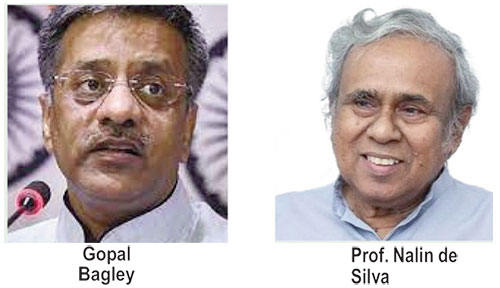
Sri Lanka’s Ambassador in Myanmar Prof. Nalin de Silva yesterday (18) questioned continuing Indian interference in domestic affairs in Sri Lanka.
Declaring Indian High Commissioner Gopal Bagley meeting with a TNA delegation to discuss what he called internal politics, Prof. De Silva alleged that the Indian envoy’s actions were contrary to Section 41 (A) of the Vienna Convention.
Ambassador de Silva was responding to Indian HC statement issued on Thursday (17) following a meeting with a delegation of TNA lawmakers led by R. Sampanthan. The statement quoted Bagley as having reiterated India’s support for devolution within the framework of a united Sri Lanka based on full implementation of the 13A which would be in line with Tamil aspirations for equality, justice, peace, and reconciliation and would strengthen Sri Lanka.
Outspoken Prof. de Silva asked whether India would allow such blatant interference there.
Prof de Silva emphasized that the TNA, having recognized the LTTE as the sole representative of the Tamil speaking people had no business to talk devolution with Indian HC. “It is an internal problem and what does the HC Bagley mean by full implementation of the 13A. It is up to Sri Lanka to implement the sections that need to be done,” Ambassador de Silva said. In the eyes of most of the people, the 13th A was nothing but a betrayal of the country, the blunt former Mathematics Don said.
Do not the Tamils enjoy equality, justice, and peace since the successful conclusion of the war? Those suspicious about Sri Lanka’s intentions should seek an explanation from new Attorney General Sanjay Rajaratnam, Ambassador de Silva said. He alleged that India and the UK prevented real reconciliation. Those who could not stomach the eradication of the LTTE relentlessly harassed Sri Lanka, Prof de Silva said, urging the world to recognize saving Tamil speaking children from forced conscription to be used as cannon fodder as one of the major achievements of the war winning government.
The TNA delegation for talks with HC Bagley at India House comprised R. Sampanthan, Leader of Ilangai Tamil Arasu Katchi (ITAK) Mavai Senathirajah Dharmalingam Siddharthan, Selvam Adaikalanathan and M.A. Sumanthiran were present during the meeting. Deputy High Commissioner Vinod K. Jacob and Political Counsellor Mrs. Banu Prakash have also been present.
Ambassador de Silva noted that several months ago, the Deputy HC discussed 13th A with former LTTE personnel, former UPFA lawmaker Karuna Amman and Sivanesathurai Chandrakanthan alias Pilleyan, a member of the current parliament.
Prof de Silva said that both President Gotabaya Rajapaksa and Foreign Minister Dinesh Gunawardena should be reminded of the Indian interference. According to him, even if he wanted to comment on Myanmar developments he could not do so for obvious reasons.
Referring to the late President Ranasinghe Premadasa declaring the then British High Commissioner in Colombo persona non grata and President Mahinda Rajapaksa taking a tough stand when French and British Foreign Secretaries attempted to intervene in 2009 on behalf of the LTTE, Amb. de Silva said that Sri Lanka had allowed foreign envoys the freedom to meddle with impunity. Prof. De Silva questioned the absurdity in various Colombo based envoys routinely commenting on domestic affairs, making suggestions and recommendations.
Referring to the Indian statement, Ambassador de Silva said it would be better if India explained about funding housing programmes implemented in areas outside the Northern and Eastern Provinces.
The tough talking ex-university don said that Sri Lanka had proved beyond any doubt that the country could do without electing members for Northern and Eastern Provincial Councils. Sri Lanka could not forget India forced the then President JRJ to establish Provincial Councils system in terms of the 13th A to the Constitution in contravention of a Supreme Court ruling, he noted.



A man and h is son allegedly linked to a drug trafficking network were arrested by the CID at the Bandaranaike International Airport, following their deportation from India, and handed over to the Western Province North Crimes Division on Saturday (28).
The arrests stem from an earlier detection on January 29, 2026, when a team of officers from the Western Province North Crimes Division apprehended a suspect in the Ganemulla Police area with 4.4 kilos of cocaine and 3,450 narcotic pills in her possession.
Subsequent investigations revealed that the suspect’s husband and son had aided and abetted the trafficking operation and had fled the country by sea to India.
The two suspects, aged 57 and 23, were later arrested by Indian security authorities, on Tuesday (24), while residing there illegally and were deported to Sri Lanka on Saturday (28).
Upon arrival at the airport, they were taken into custody by CID officers and subsequently handed over to the Western Province North Crimes Division for further investigations, which are continuing.
By Chaminda Silva

Andrey Rudenko, Russia’s Deputy Foreign Minister, is scheduled to visit Sri Lanka on Tuesday (31) to take part in the 11th round of bilateral political consultations between the two nations.
The Ministry of Foreign Affairs said the visit aimed to further strengthen longstanding diplomatic ties and broaden cooperation across multiple sectors.

The Police and the Special Task Force have called for applications to fill vacancies in the posts of Police Constable, Female Police Constable and Police Constable Driver, with nearly 7,500 openings countrywide, including in the Northern and Eastern Provinces.
Applications must be submitted online via the official Sri Lanka Police website (www.police.lk) under the “Join Us” section or by scanning the relevant QR code. The closing date for applications is May 8, 2026, the Police Media Division said on Saturday (28).
The Police Recruitment Division said further information could be obtained via 071-8591925, 011-2505202 or 011-2552953.

New arithmetic of conflict: How the drone revolution is inverting economics of war

SLT-MOBITEL turnaround signals new era for SOEs, says deputy minister

Father, son deported from India for drug dealing, arrested at BIA

Russian Deputy FM to hold bilateral talks in Sri Lanka tomorrow

Police to recruit 7,500 more personnel

Kia Tasman arrives in Sri Lanka: A pickup built for work and comfort

‘Dates have the highest sugar content to fight Coronavirus’

Sunday Island 27 December – Headlines

#SundayIsland 17th December – Headlines

Sunday Island – 28th March

Sunday Island Headlines – 21 March

Sunday Island – 21st February – Headlines
-

 News5 days ago
Senior citizens above 70 years to receive March allowances on Thursday (26)
-

 Features2 days ago
A World Order in Crisis: War, Power, and Resistance
-

 News3 days ago
Energy Minister indicted on corruption charges ahead of no-faith motion against him
-

 News4 days ago
US dodges question on AKD’s claim SL denied permission for military aircraft to land
-

 Business4 days ago
Dialog Unveils Dialog Play Mini with Netflix and Apple TV
-

 Sports3 days ago
SLC to hold EGM in April
-

 News5 days ago
CEB Engineers warn public to be prepared for power cuts after New Year
-
 Business6 days ago
Postponement of Sri Lanka Investment Forum 2026