
News
Lankans describe abuse as Russian captives in Ukraine

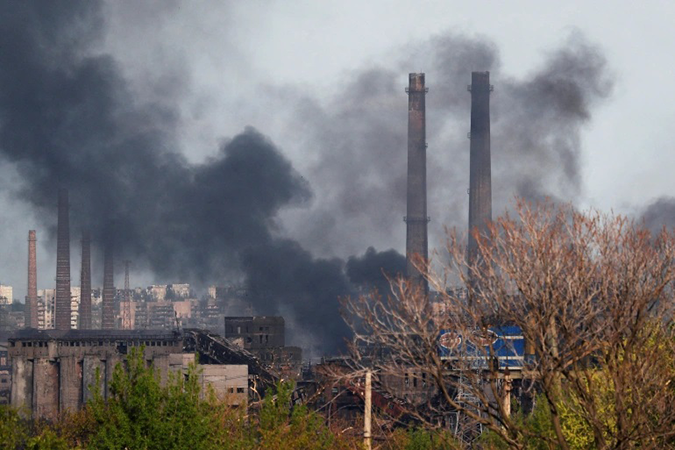
Group was captured at a checkpoint near Ukraine’s Kupiansk city and Russian troops shot one in the foot and beat them with rifle butts
(Al Jazeera) A group of Sri Lankans held captive by Russian forces in an agricultural factory in eastern Ukraine has alleged torture for months before escaping on foot as the Russians withdrew from the Kharkiv region.Recounting their ordeal to reporters in Kharkiv, Ukraine’s second-largest city, one of the seven Sri Lankans said he was shot in the foot. Another had his toenail ripped off and was slammed in the head with the butt of a rifle.Ukrainian officials described their treatment as torture.
“Every day we were cleaning toilets and bathrooms,” Dilukshan Robertclive, one of the former captives, said. “Some days Russians came and beat our people, our Sri Lanka people.”
Four of the seven were medical students in the city of Kupiansk and three were working there when Russian forces poured across the border in late February and occupied large swaths of eastern and southern Ukraine.
The group said they were captured at the first checkpoint out of Kupiansk and then taken to Vovchansk, near the border with Russia, where they were held in the factory with about 20 Ukrainians.
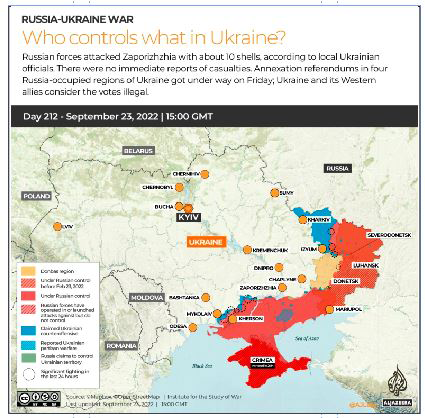
“They took our passports, other documents, phones, clothes, and locked us up in a room,” said Sharujan Gianeswaran. “There were also Ukrainian people with us, and they were questioned and sent away in 10 days, 15 days or one month. With us, they never spoke, because they could not understand our language.”
Ukraine police said the factory housed a Russian “torture centre” – one of 18 in the Kharkiv region.
“They were bound and blindfolded. After that they were captured and then taken to the city of Vovchansk,” said Serhiy Bolvinov, head of the investigative department of the National Police in Kharkiv.
Six among the group said they were held in a large upstairs room. The seventh, the only woman, was kept in a dark cell by herself, her companions said. The woman wept silently and did not speak as the group told their story on Saturday.One man said he was shot in the foot by his Russian captors. Another had a toenail ripped off after the soldiers repeatedly bashed it with the butt of a rifle. The men showed their injuries to journalists.
“Most of the time we could not understand what they told us and we were beaten for that,” Gianeswaran said.
It dawned upon the Sri Lankans that battle lines were shifting only when Russian soldiers ordered them to help load trucks with food and weapons.As the last trucks raced away, the group asked fruitlessly for their passports and documents back, knowing to move around without them would be impossible in a country filled with checkpoints.
Russian troops captured several cities and towns in northeastern Ukraine’s Kharkiv region early in the war. Ukrainian troops retook the area during a swift counteroffensive earlier this month.When the Sri Lankans realised the Russians were gone on September 10, the group left the factory and started walking towards the city of Kharkiv, having no real idea how to get to the regional capital that remained in Ukrainian hands.
“We walked on that road for two days and were exhausted and hungry. We had no food or money to buy food,” Gianeswaran said.
They slept on the side of the road and walked until they reached a river. But with so many bridges in the region destroyed by one side or the other in months of fighting, they could find no way to cross.Finally, someone noticed their plight, gave them shelter, and called for a ride from security forces.
Police said the group was picked up in the Chuhuiv area, 70km (40 miles) from where they started. They are in Kharkiv now with no idea of what the future holds. Robertclive said they are psychologically damaged by their months in captivity.But the men smiled when asked how they felt when they realised the worst of their ordeal was at an end.
“They [Ukrainians] have given us food and clothing,” Gianeswaran said. “We thought we were going to die but we are saved and are being well looked after.”










Latest News
Heat Index at Caution level’ in the Northern, North-central, North-western, Western and Southern provinces and in Trincomalee district.


Warm Weather Advisory
Issued by the Natural Hazards Early Warning Centre
Issued at 3.30 p.m. on 12 April 2026, valid for 13 April 2026.
Heat index, the temperature felt on human body is likely to increase up to ‘Caution level’ at some places in the Northern, North-central, North-western, Western and Southern provinces and in Trincomalee district.
The Heat Index Forecast is calculated by using relative humidity and maximum temperature and this is the condition that is felt on your body. This is not the forecast of maximum temperature. It is generated by the Department of Meteorology for the next day period and prepared by using global numerical weather prediction model data.

Effect of the heat index on human body is mentioned in the above table and it is prepared on the advice of the Ministry of Health and Indigenous Medical Services.
ACTION REQUIRED
Job sites: Stay hydrated and takes breaks in the shade as often as possible.
Indoors: Check up on the elderly and the sick.
Vehicles: Never leave children unattended.
Outdoors: Limit strenuous outdoor activities, find shade and stay hydrated.
Dress: Wear lightweight and white or light-colored clothing.
Note:
In addition, please refer to advisories issued by the Disaster Preparedness & Response Division, Ministry of Health in this regard as well. For further clarifications please contact 011-7446491.

On the apparent northward relative motion of the sun, it is going to be directly over the latitudes of Sri Lanka from 05th to 15th of April in this year.
The nearest areas of Sri Lanka over which the sun is overhead today (13th) are Pesalai, Mankulam and Nedunkerny about 12:11 noon.
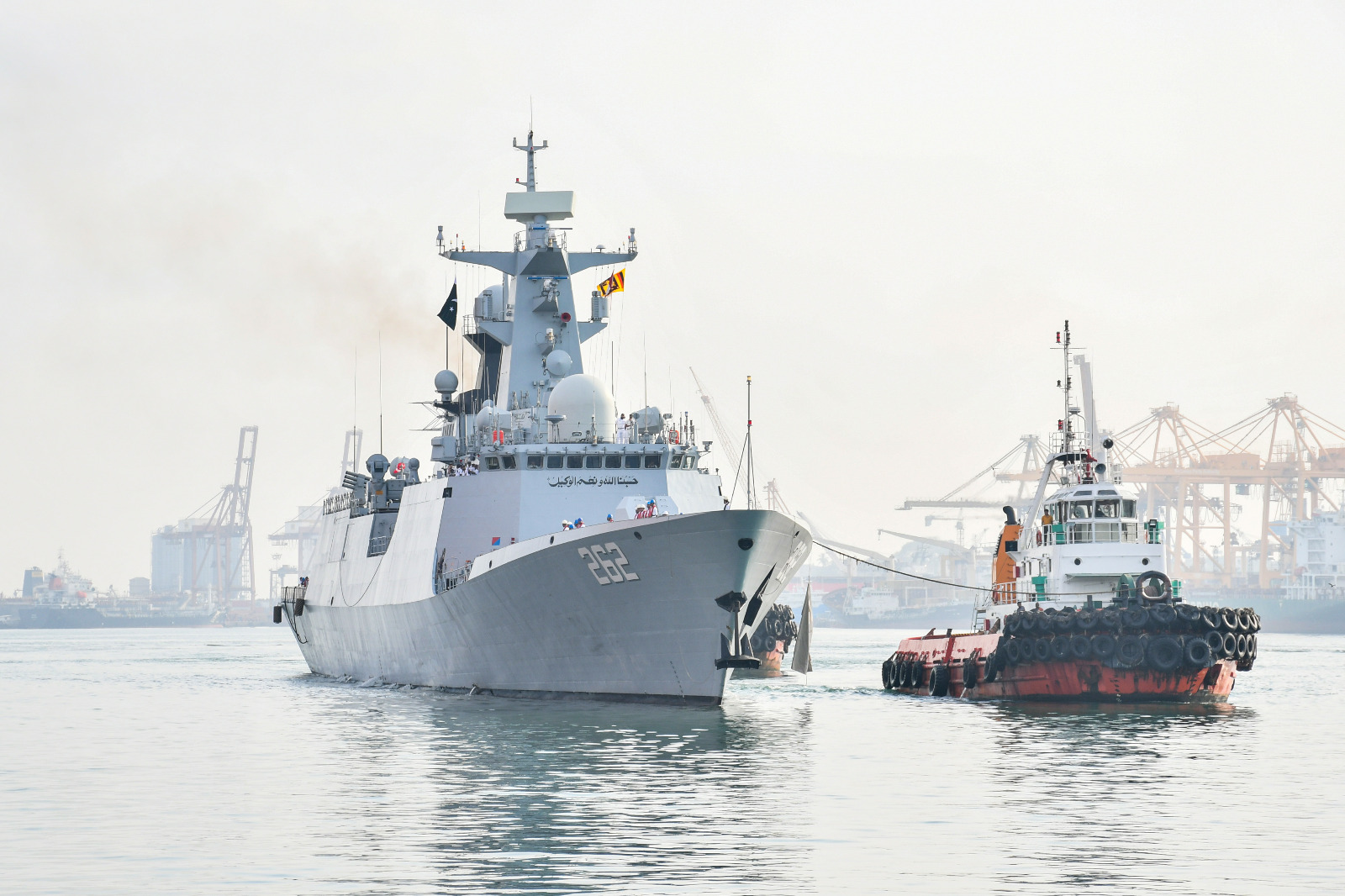
The Pakistan Navy Ship (PNS) TAIMUR and ASLAT arrived at the Port of Colombo on a goodwill visit on 12 Apr 26.
The visiting ships were welcomed by the Sri Lanka Navy in
compliance with naval traditions.
The duo of ships is commanded by Captain NIAMAT SAEED KHAN (PNS TAIMUR) and Captain NADIR MATEEN AFRIDI (PNS ASLAT).
Meanwhile, the ships are expected to conduct a Bilateral Naval Exercise LION STAR V with the Sri Lanka Navy in Colombo seas.

Salt and Patidar power RCB past Mumbai Indians

Prasidh, Buttler set up comfortable win for Gujarat Titans

Heat Index at Caution level’ in the Northern, North-central, North-western, Western and Southern provinces and in Trincomalee district.

Showers above 75 mm are likely at some places in the Western, Sabaragamuwa, Central, Southern and North-western provinces.

Sun directly overhead Pesalai, Mankulam and Nedunkerny about 12:11 noon

PNS TAIMUR & ASLAT arrive in Colombo

‘Dates have the highest sugar content to fight Coronavirus’

Sunday Island 27 December – Headlines

#SundayIsland 17th December – Headlines

Sunday Island – 28th March

Sunday Island Headlines – 21 March

Sunday Island – 21st February – Headlines
-

 News7 days ago
Lankan-origin actress Subashini found dead in India
-

 News2 days ago
CEB orders temporary shutdown of large rooftop solar systems
-

 News5 days ago
AG: Coal procurement full of irregularities
-

 Business4 days ago
Israeli attack on Lebanon triggers local stock market volatility
-

 Business5 days ago
Hayleys Mobility introduces Premium OMODA C9 PHEV
-

 News7 days ago
UN Regional Director launches SL’s first Country Gender Equality Profile during official visit
-

 Business4 days ago
HNB Assurance marks 25 years with strategic transformation to ‘HNB Life’
-

 News7 days ago
Dialog Launches ‘GanuDenu QR’, Making Cashless Transfers Free for All with eZ Cash and Dialog Finance