
News
Lankan workers in Middle East sending money, while more educated do not: Minister

By NESHELLA PERERA
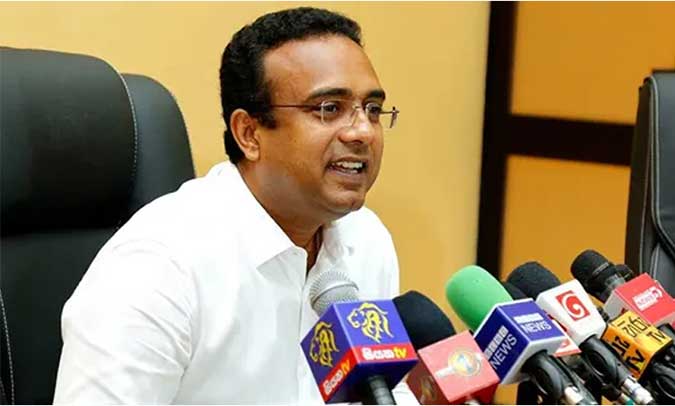
Millions of less affluent Sri Lankans works in the Middle East are sending money home to keep the economy afloat while the more educated who hold higher post in developed countries keep money stashed elsewhere, Labour Minister Manusha Nanayakkara said.
“The most amount of foreign exchange generated for Sri Lanka comes from the Middle Eastern region,” Nanayakkara said in Parliament.
“The ones who earn the least contribute to most of the remittances and those who hold bigger posts in developed countries, send very little money to the country because they are politically misled and will not send money.”
Many liberal developed nations give permanent resident status to foreign nationalized who can later become naturalized citizens, unlike nationalist nations like Sri Lanka critics say.As a result, they buy assets in those countries.
Middle Eastern nations also do not allow foreigners to settle permanently as a general rule.Sri Lanka is trying to raise salaries of workers in the Gulf, he said.
“We have discussed with Saudi Arabia, Oman, Kuwait and The United Arab Emirates to increase the salary earned by these women,” Nanayakkara said.
Many Sri Lankans are now leaving the country after the central bank printed money to maintain an artificially low policy rate and boost growth without working for it (output gap targeting or stimulus) under a discretionary flexible inflation targeting regime and collapsed the rupee.
Before the money printing central bank was set up in August 1950, Sri Lanka was a net importer of labour, like Dubai and Singapore.The weaker the currency the lower the salary that people will be prepare to migrate to countries with monetary stability.Sri Lanka has printed money for 73 years creating forex shortages, and with the support of economists in many cases have laid the blame on importers.In this crisis, the worst in the history of the central bank exporters were blamed and public money was used to track their transactions.
Minister Nanayakkara’s praise comes a few months after expat workers were themselves were scapegoated for sending money through unofficial gross settlement system which had been used for long distance maritime trade for centuries.
Remittances shifted to Undiyal/Hundi or Hawala settlement system from the formal banking system after the central bank printed money to artificially lower interest rates and maintain a fixed policy rate.Undiyal funds kept the country fed through open account trade, with the formal banking system was unable to prioritize as the newly printed money struggled to go out of the country through the credit system.
Sri Lanka’s remittances through official channels rose to 568 million US dollars in March 2023, up 78 percent from a year earlier, as parallel premiums declined as the central bank put brakes on money printing.( ECONOMYNEXT)







The Ministry of Industries and Entrepreneurship Development has recommended the establishment of Sri Lankan Standards, i.e. the import testing methodology for imported tires used for passenger cars and pneumatic tires for three-wheelers with the aim of ensuring a fair competitive environment for local
manufactures and ensuring consumer safety and security.
Taking into the said recommendations, “Import and Export (control regulations N0.08 of the 2026)” has been enacted to amend the existing regulations by means of the Extraordinary Gazette Notification No. 2508/27 dated 2026-10-01, prescribing Sri Lanka standard 1212 for the import of passenger types (HS Code 4011.10.90) and Sri Lanka standard 1347 for the import of
pneumatic tires for three – wheeled vehicles (HS Code 4011.90.10).
Accordingly, the Cabinet of Ministers has approved the resolution furnished by the President in his capacity as the Minister of Finance, Planning, and Economic Development to submit the aforementioned regulations to Parliament for approval.
Approval of the Cabinet of Ministers was granted at their meeting held on 02.06.2025 to introduce a new act to promote and providing legal provisions for facilitating the Public Private Joint Enterprises within Sri Lanka as well as the establishment of the National Agency for Public Private Partnership Joint Enterprises.
Accordingly, the Legal Draftsman has formulated the relevant draft bill and the Attorney General has given his clearance to the said draft bill.
The Cabinet of Ministers approved the resolution furnished by the President in his capacity as the Minister of Finance, Planning and Economic Development to publish the said
draft bill in the government gazette notification and thereby submit it to the Parliament for its concurrence.
Regulation, development and control of indigenous medical sector in Sri Lanka comprised of Ayurvedha, Sidhdha, Unani, Local Therapies are carried out under the provisions of Ayurvedha Act No. 31 of 1961.
Although amendments were made to the act from time to time as per the requirements, the necessity of further amending the Ayurvedha Act has been identified to enable efficiently maintaining all activities of local medical field productively, further formalizing the regulation of the sector, taking actions to providing licenses applicable to export of local medicines, and achieving the progress and sustainable development goals in the local medical sector.
Based on the said factors, the Cabinet of Ministers granted approval to the resolution furnished by the Minister of Health and Mass Media to direct the Legal Draftsman to formulate a draft bill to amend the Ayurvedha Act No. 31 of 1961.

Import and Export (Control) Regulations No. 08 of 2026
Draft Bill of the Public Private Partnership Enterprises Act to be gazzetted
Amendment of the Ayurvedha Act No. 31 of 1961

Cabinet nod to amend the Sri Lanka Development Administration Institute Act No. 9 of 1982
Establishment of the National Higher Performance Centre
State patronage for the cremation ceremony of the late deputy prelate (Anu Nayaka Thero) of the Sri Laka Ramangya Maha Nikaya, Gatambe Rajopawanramadhipatha, Siri Chandawimala Wanshalankara, Chandrakeerthi Sri Amarawansha, Sadhdharmawageeshwara, Shasanashobhanna Most Venerable Keppetiyagoda Siriwimalabhidhana Thero

‘Dates have the highest sugar content to fight Coronavirus’

Sunday Island 27 December – Headlines

#SundayIsland 17th December – Headlines

Sunday Island – 28th March

Sunday Island Headlines – 21 March

Sunday Island – 21st February – Headlines
-

 Features3 days ago
Kotahena:A Small Enclave, An Extraordinary Legacy
-

 News7 days ago
Sri Lanka, India caught in US-Iran ship crisis
-
 News4 days ago
Asgiri Mahanayake calls for immediate release of Gnanasara Thera
-

 Latest News7 days ago
Missiles intercepted near Riyadh after Saudi coalition hits Yemen fuel depot
-

 Latest News7 days ago
Kusal Mendis’ unbeaten 87 hands Sri Lanka consolation win
-

 News2 days ago
Record 1,600 students take Russian Classical Ballet examination in Sri Lanka
-
 News6 days ago
AC President recuses himself from hearing prison attire case pertaining to Gnanasara Thera
-
 News5 days ago
Naval officer testifies Yoshitha received Rs. 5.15 mn in salaries during SLN service