
News
Lanka signs agreement with UN

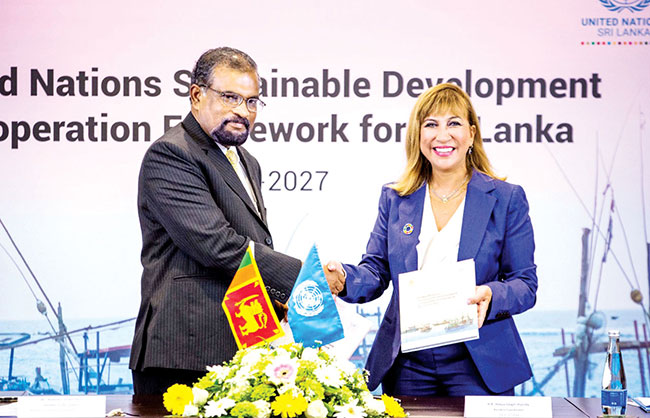
The United Nations Sustainable Development Cooperation Framework (UNSDCF) 2023-2027 was launched by the Government of Sri Lanka and the United Nations in Sri Lanka, on Thursday.
The UNSDCF is the Framework that guides the work of all the UN Agencies in Sri Lanka and articulates the collective vision and contribution of the United Nations to support Sri Lanka to accelerate actions towards the achievement of the 2030 Agenda for Sustainable Development. The Cooperation Framework gives primacy to accelerating actions to ensure a rapid recovery from the economic crisis, along with the impact of COVID-19, prioritising support to revitalise the economy and economic activities, social services, decent employment, social cohesion, and health and wellbeing for all people in Sri Lanka.
The UNSDCF was co-signed by the Secretary to the Treasury, Mahinda Siriwardana, on behalf of the Government of Sri Lanka, and UN Resident Coordinator in Sri Lanka, Hanaa Singer-Hamdy, on behalf of the United Nations. Heads of UN Agencies, Funds and Programmes, in Sri Lanka, also signed the Cooperation Framework. The signing ceremony, hosted at the Ministry of Finance, was also attended by the Secretary to the Ministry of Foreign Affairs, Aruni Wijewardane, and the Regional Director for Asia and the Pacific of the UN Development Coordination Office, David McLachlanKarr. Speaking at the event, Secretary to the Treasury, Mahinda Siriwardana, noted that “the current global challenges demonstrate the continued importance for multilateral solutions that bring together the international community around shared priorities. This Cooperation Framework, with the United Nations in Sri Lanka, will be the key as we pursue sustainable and inclusive development for the people of Sri Lanka.”
Elaborating further, the UN Resident Coordinator in Sri Lanka. Singer-Hamdy said, “this Cooperation Framework is mutually owned and anchored in national development priorities, the 2030 Agenda and the principles of the UN Charter. The UNSDCF is structured around four interrelated and mutually reinforcing Strategic Priorities where the UN system will concentrate its expertise to support Sri Lanka to make transformational and accelerated progress. These Strategic Priorities cover Inclusive and Equitable Human Development and Well-being; Resilient and Green Recovery and Growth for Shared Prosperity and Environmental Sustainability; Social Cohesion and Inclusive Governance & Justice; and 2022 – 08 – 17 Gender Equality. Of course, our work will be underpinned by a crosscutting commitment to support rapid recovery from the economic crisis and the impact of COVID-19”. She further noted that programmes by the UN System will be anchored in the principles of human rights and nondiscrimination and ensuring that “no one is left behind”.
“The 2023-2027 Development Cooperation Framework reflects Sri Lanka’s national development priorities while working towards the 2030 Agenda for Sustainable Development. It was concluded at a very significant moment for the country, when transformational changes are being operationalized in the economic, political and social fronts. It is supportive of the Government’s efforts to “leave no one behind” in progressing towards the SDGs in partnership with the UN Development System in “Delivering as One”, Secretary to the Ministry of Foreign Affairs Aruni Wijewardane said. The UNSDCF will be funded through core budget allocations of an estimated USD 60 Million, in addition to approx. USD 325 Million through other resources – spread across the five-year period of implementation.

Latest News
Landslide Early Warnings issued to the Districts of Badulla, Kandy, Matale, Monaragala and Nuwara Eliya


The Landslide Early Warning Center of the the National Building Research Organaisation [NBRO] has issued landslide early warnings to the districts of Badulla, Kandy, Matale, Monaragala and Nuwara Eliya for a period of 24 hours effective from 1200 noon today [07th January].
Accordingly,
LEVEL III RED landslide early warnings have been issued to the divisional secretaries divisions and surrounding areas of Udadumbara in the Kandy district, and Nildandahinna and Walapane in the Nuwara Eliya district.
LEVEL II AMBER landslide early warnings have been issued to the divisional secretaries divisions and surrounding areas of Kandaketiya in the Badulla district, Wilgamuwa in the Matale district, and Mathurata and Hanguranketha in the Nuwara Eliya district.
LEVEL I YELLOW landslide early warnings have been issued to the divisional secretaries divisions and surrounding areas of Meegahakiwula, Lunugala, Welimada, Passara, Badulla and Hali_Ela in the Badulla district, Doluwa in the Kandy district,Ambanganga Korale in the Matale district, and Bibile in the Monaragala district


Chairman of the Committee on Public Finance (CoPF), MP Dr. Harsha de Silva, told Parliament yesterday that President Anura Kumara Dissanayake had personally telephoned him in response to a letter highlighting the prolonged delay in appointing an Auditor General, a vacancy that has remained unfilled since 07 December.
Addressing the House, Dr. de Silva said the President had contacted him following the letter he sent, in his capacity as CoPF Chairman, regarding the urgent need to appoint the constitutionally mandated head of the National Audit Office. During the conversation, the President had sought his intervention to inform the Constitutional Council (CC) about approving the names already forwarded by the President for consideration.
Dr. de Silva said the President had inquired whether he could convey the matter to the Constitutional Council after their discussion. He stressed that both the President and the CC must act in cooperation and in strict accordance with the Constitution, warning that institutional deadlock should not undermine constitutional governance.
He also raised concerns over the Speaker’s decision to prevent the letter he sent to the President from being shared with members of the Constitutional Council, stating that this had been done without any valid basis. Dr. de Silva subsequently tabled the letter in Parliament.
Last week, Dr. de Silva formally urged President Dissanayake to immediately fill the Auditor General’s post, warning that the continued vacancy was disrupting key constitutional functions. In his letter, dated 22 December, he pointed out that the absence of an Auditor General undermines Articles 148 and 154 of the Constitution, which vest Parliament with control over public finance.
He said that the vacancy has severely hampered the work of oversight bodies such as the Committee on Public Accounts (COPA) and the Committee on Public Enterprises (COPE), particularly at a time when the country is grappling with a major flood disaster.
As Chair of the Committee responsible for overseeing the National Audit Office, Dr. de Silva stressed that a swift appointment was essential to safeguard transparency, accountability and financial oversight.
In a separate public statement, he warned that Sri Lanka was operating without its constitutionally mandated Chief Auditor at a critical juncture. In a six-point appeal to the President, Dr. de Silva emphasised that an Auditor General must be appointed urgently in the context of ongoing disaster response and reconstruction efforts.
“Given the large number of transactions taking place now with Cyclone Ditwah reconstruction and the yet-to-be-legally-established Rebuilding Sri Lanka Fund, an Auditor General must be appointed urgently,” he said in a post on X.
By Saman Indrajith

The NPP government was exploring the feasibility of introducing a regular pension, or annuity scheme, for Employees’ Provident Fund (EPF) contributors, Deputy Minister of Labour Mahinda Jayasinghe told Parliament yesterday.
Responding to a question raised by NPP Kalutara District MP Oshani Umanga in the House, Jayasinghe said the government was examining whether EPF benefits, which are currently paid as a lump sum at retirement, could instead be converted into a system that provides regular payments throughout a retiree’s lifetime.
“We are looking at whether it is possible to provide a pension,” Jayasinghe said, stressing that there was no immediate plan to abolish the existing lump-sum payment. “But we are paying greater attention to whether a regular payment can be provided throughout their retired life.”
Jayasinghe noted that the EPF was established as a social security mechanism for private sector employees after retirement and warned that receiving the entire fund in a single installment could place retirees at financial risk, particularly as life expectancy increases.
He also cautioned that interim withdrawals from the EPF undermined its long-term sustainability. “Even the interim payments that are given from time to time undermine the ability to give security at the time of retirement,” he said, distinguishing the EPF from the Employees’ Trust Fund, which provides more frequent interim benefits.
Addressing concerns over early withdrawals, the Deputy Minister explained that contributors have been allowed to withdraw up to 30 percent of their EPF balance since 2015, with a further 20 percent permitted after 10 years, subject to specific conditions and documentary proof.
Of 744 applications received for such withdrawals, 702 had been approved, he said.
The proposed shift towards an annuity-based system comes amid broader concerns over Sri Lanka’s ageing population and pressures on retirement financing. While state sector employees receive pensions funded by taxpayers, including EPF contributors, the EPF itself has been facing growing strain as it is also used to finance budget deficits.
Jayasinghe said the government’s focus was to formulate a mechanism that would ensure long-term income security for private sector employees, placing them on a footing closer to a pension scheme rather than a one-time retirement payout.

Shadab, Mirza, Abrar set up Pakistan’s easy win in first T20I

Shadab, Dhananjaya back as Pakistan chase in first T20I

Russia sends navy to guard oil tanker being pursued by US forces

Landslide Early Warnings issued to the Districts of Badulla, Kandy, Matale, Monaragala and Nuwara Eliya

Indian gang rape survivor back home after a week in hospital

Brilliant Bethell hundred pushes SCG Test to fifth day but Australia on target for 4-1

‘Dates have the highest sugar content to fight Coronavirus’

Sunday Island 27 December – Headlines

#SundayIsland 17th December – Headlines

Sunday Island – 28th March

Sunday Island Headlines – 21 March

Sunday Island – 21st February – Headlines
-
 News2 days ago
Broad support emerges for Faiszer’s sweeping proposals on long- delayed divorce and personal law reforms
-

 News2 days ago
Interception of SL fishing craft by Seychelles: Trawler owners demand international investigation
-

 News3 days ago
Private airline crew member nabbed with contraband gold
-

 News5 days ago
Health Minister sends letter of demand for one billion rupees in damages
-

 News18 hours ago
Govt. exploring possibility of converting EPF benefits into private sector pensions
-

 Opinion7 days ago
Remembering Douglas Devananda on New Year’s Day 2026
-

 Features2 days ago
Educational reforms under the NPP government
-

 Features3 days ago
Pharmaceuticals, deaths, and work ethics