
News
Lanka can overcome its problems while avoiding foreign debt traps Prof.TISSA VITARANA

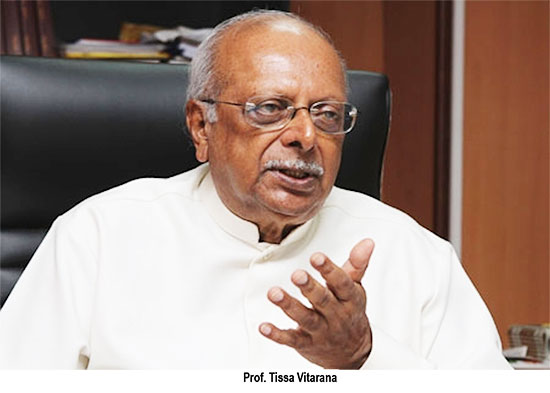
Sri Lanka faces a severe economic, social and political crisis. More than sixty per cent of families have incomes below the poverty line and manage on one or at most two meals per day, many going to bed hungry. The level of malnutrition is 18.4%, close to twenty per cent. That is one out of five children are malnourished, and both mental and physical development will be retarded, with grave consequences to our future generation. The floating of the Rupee and the widening budget deficit has made matters worse. The present SLPP government has aggravated this situation by publicly stating that there will be no price control and traders are free to charge whatever they like. The trader middle men are making enormous profits and prices , specially of food, are going sky high. The massive printing of currency notes, without a commensurate increase in production, has led to very high inflation. Incomes have remained static or even dropped due to staff cuts or closures affecting the private sector. On this May Day, international Labour Day, one is sad to see that the trade union movement is too weak to fight back. The horrible contract labour system has undermined the strength of the unions. On this May Day the LSSP and the socialist Left state that we are categorically opposed to the above policies and are ready to support the workers to rebuild the Trade Union movement to what it was in the 1970s. Dr.NM Perera as Finance Minister in the 1970 Coalition Government overcame the severe economic crisis (when there was little or no local industry and the country depended on imports, and the price of a ton of sugar rose from 40 pounds to 600 pounds), not only balancing the budget but even showing a surplus. Through a dual value for the Rupee, locally and in relation to the dollar, the rupee and the country remained stable, and exports were promoted.
Besides the above rupee crisis, there is a massive dollar crisis. Most governments, whether green or blue, have resorted to loans from foreign sources to bridge the adverse foreign trade gap. As a result we have a massive foreign debt burden of US$ 52 Billion and the cost of debt servicing alone is about US $ 6 Billion per year. But our foreign reserve which averaged around US $ 7 to 8 Billion is now down to well below US $ 1 Billion, nearer 500 million. Internationally accepted rating agencies like Fitch and Moody have dropped us down to the bottom value of a single C in their scale. This means that our importers cannot get their requirements quickly for the market by sending letters of credit (LCs) through our major banks. They have to send dollars. But if there are no dollars available in the banks in the country the inevitable result is an acute shortage of medicines that endanger the lives of people. The import of essential food items, of fuel, of LP gas etc. is the result. More and more queues to torture the people, the middle class as well. Galle Face and “Gota go home” is the inevitable outcome. Is it that we in Sri Lanka cannot produce these items.
Development of the national economy can make us self- sufficient in food, and healthier through a gradual shift to proper organic farming ( Eco- Agriculture). The Medicinal Drug policy of Prof.Senaka Bibile ( a member of the LSSP) enabled every Government Hospital to provide every medicine to practically every disease free of charge in the 1970 – 1975 Coalition Government period. More than 100 Third world countries have adopted his policy under WHO leadership. Some like Bangladesh have become leading exporters. Senaka created the State Pharmaceutical Corporation (SPC)for the bulk purchase of all Sri Lanka’s entire needs at rock bottom prices under the pharmaceutical name. An off-shoot, the SPMC, manufactured over 50 essential and much used drugs. A good pharmaceutical industry will prevent patients’ lives being put at risk as at present, and also give many jobs for our youth and earn dollars abroad.
The import of LP Gas, can be replaced by popularizing the Bio-gas cookers developed by the Government owned NERD institution in Jaela. The team of engineers and technicians led by Sunil Weliwita have developed this so that the energy is obtained from kitchen waste and trees and plants in the garden. There is no need to pay nearly Rs 5,000 for imported LP gas as at present. We only need some Sri Lankan entrepreneurs to invest in setting up some factories to mass produce them. Under the theme ” Smart Home Garden” it not only achieves waste disposal, but also helps to produce water.
One of the major factors provoking the peoples’ protest is the cut in electricity supply, often at unexpected times, not according to the published time schedules. This can be better organized. The shift to renewable energy ( solar, wind, and water has been extremely slow. This must be speeded up. The anaerobic fermentation of all types of waste collected in towns can be used to produce good organic fertilizer and also bio-gas. We tried to introduce this to Colombo but it failed, but I am happy that it has worked in Yatiyantota and Balangoda and a few other towns.
There is no need to go begging to the IMF for dollar loans. These take over 3 months to arrive and the amounts are small e.g. US $ 300 to 600 million. The conditions are harmful to us e.g. the insistence that Sri Lanka permits uncontrolled imports, the major cause of our present problem. We get into more debt. Instead what should be done is to negotiate a Moratorium on our debt with our creditors. This is common practice when countries are faced with crises like ours. I am told that Uruguay and Argentina have done so this time. The principle is to delay our annual debt servicing payments, which was US $ 6 Billion last year, for about 5 years. This would mean that we save about US $ 30 Billion , which can ensure our peoples’ needs as well as be used for productive development. Why has the SLPP Government not done this yet?
Why are we sending out valuable raw material at rock bottom prices, as was done during British rule. We have the best graphite in the world in Bogala and other places which is being converted into the wonder material, Graphine, which is being used to produce a whole range of goods in UK and Europe. The latter is spending over one billion Euro on related research. Why are we sending the mineral rich earth from Pulmoodai in ship loads abroad. The Ilmenite alone is a source of Titanium dioxide, a base for all paints. From the latter is obtained Titanium , a highly priced substance essential for the aeronautics industry. What about the Phosphate deposits in Eppawela that the McMorran Co. of USA tried to steal from us for a pittance. But the LSSP stopped with our former General Secretary, Batty Weerakone, defeating the move in the Supreme Court.
We have so many raw materials as the basis for industry. As the Minister of Science and Technology I targeted setting up one technology transfer centre in in each Administrative Division. I succeeded in 263 out of the 341 ( LTTE was a obstacle). In the 5 years I was Minister 12,643 entrepreneurs emerged, all SMEs, a majority also providing jobs. I am glad to learn that more than a thousand of them are exporting their products. Hi Tech is important for large industry. I planned and developed SLINTEC as the only Nanotechnology Centre in South Asia, the 18th in the world. One benefit is that Dr. Kottegoda and her team have produced in a pilot plant, nanoparticles with 43% nitrogen. But our SLPP Government chooses to buy from India Nanoparticles with only 4.7% Nitrogen at a huge cost.
When are we going to think of developing our country, and not to line certain peoples’ pockets. It is also high time that the tax policy is changed and the upper limit raised from 14% to 75%.

Latest News
Heat Index likely to increase up to ‘Caution level’ at some places in the Western, Sabaragamuwa, Southern and North-western provinces and in Monaragala and Mannar districts

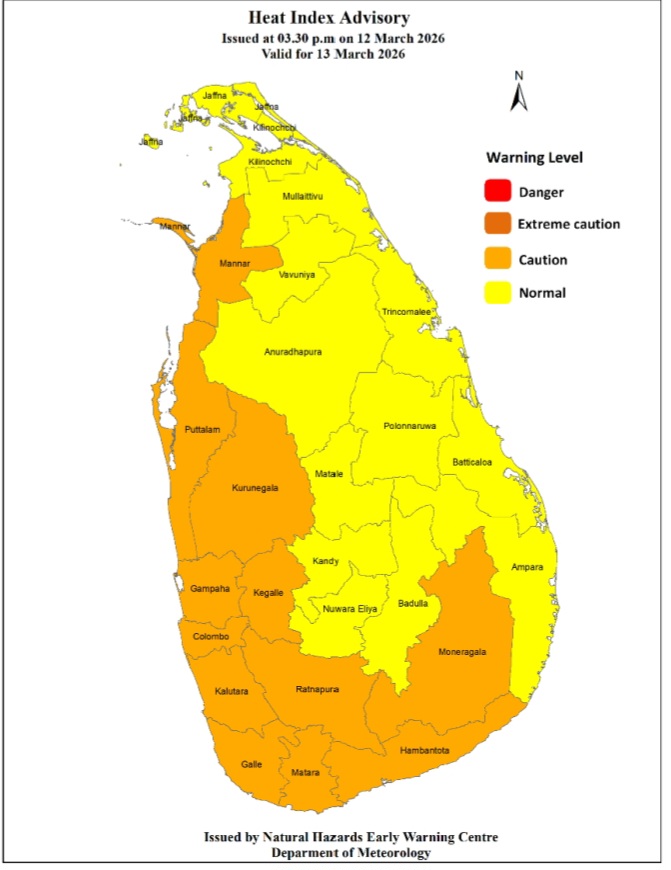
Warm Weather Advisory
Issued by the Natural Hazards Early Warning Centre of the Department of Meteorology at 3.30 p.m. on 12 March 2026, valid for 13 March 2026.
Heat index, the temperature felt on human body is likely to increase up to ‘Caution level’ at some places in Western, Sabaragamuwa, Southern and North-western provinces and in
Monaragala and Mannar districts.
The Heat Index Forecast is calculated by using relative humidity and maximum temperature and this is the condition that is felt on your body. This is not the forecast of maximum temperature. It is generated by the Department of Meteorology for the next day period and prepared by using global numerical weather prediction model data.
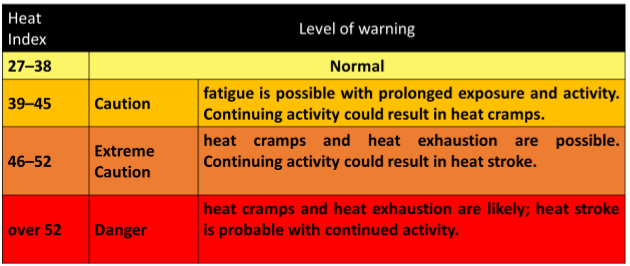
Effect of the heat index on human body is mentioned in the above table and it is prepared on
the advice of the Ministry of Health and Indigenous Medical Services.
ACTION REQUIRED
Job sites: Stay hydrated and takes breaks in the shade as often as possible.
Indoors: Check up on the elderly and the sick.
Vehicles: Never leave children unattended.
Outdoors: Limit strenuous outdoor activities, find shade and stay hydrated.
Dress: Wear lightweight and white or light-colored clothing.
Note:
In addition, please refer to advisories issued by the Disaster Preparedness & Response Division, Ministry of Health in this regard as well. For further clarifications please contact 011-7446491.


The Frontline Socialist Party (FSP) yesterday accused the government of trying to award another tender to the Indian company that supplied low-grade coal to the Norochcholai Power Plant and failed to deliver the stipulated amount of coal according to schedule.
The allegation was made by the Education Secretary of the Progressive Socialist Party, Pubudu Jayagoda, during media briefing at the party office in Nugegoda last afternoon.
Jayagoda said that in September 2025, the government had awarded a tender to the Indian company Trident Chemphar to supply 25 coal shipments for electricity generation in 2026.
In August 2025, it was confirmed that the coal delivered by the company was substandard. The company also failed to supply coal on schedule. Although the first shipment was expected in the second week of December 2025, it arrived at the end of the month. By mid-March, only 12 ships had arrived, and biweekly deliveries have been disrupted, putting Sri Lanka at risk of a severe energy shortage.
On 11 March, the government called a sudden spot tender for five coal shipments. Four companies submitted bids, and they include Trident Chemphar. FSP criticiced awarding the tender to the same discredited company, saying it was unethical and could trigger a major national crisis, as the company had failed to supply quality coal reliably in the past.
Previously, coal quality was strictly measured, with a “Reject Value”. But now to help the errant supplier the term of Reject Value has now been omitted altogether and replaced with a new term ‘Minimum Value’ setting it as the minimum calorific threshold—coal producing less than 5,900 kilocalories per kilogram was rejected, and coal with ash content above 16% was also discarded.
However, the government is now reportedly lowering these standards, accepting substandard coal, and changing tender specifications to accommodate the company.
Jayagoda castigated the latest stunt coming especially at a time when the world faces war and oil shortages. Diesel meant for electricity generation is being diverted to school buses, public transport, and emergency vehicles, leaving households at risk of prolonged blackouts. Even if diesel is imported, electricity tariffs could skyrocket.

The Indian Ministry of External Affairs has said it is considering requests for diesel supplies from neighbouring countries, including Sri Lanka, Bangladesh and the Maldives.
Speaking to the Press Trust of India, Ministry Spokesperson Randhir Jaiswal noted that India was a major exporter of refined petroleum products in the region. He confirmed that Bangladesh had formally requested a diesel supply, which is currently under review.
He said that diesel exports to Bangladesh had largely continued since 2017, but any new allocations would take into account India’s refining capacity, domestic demand, and overall fuel availability.
Jaiswal added that similar requests from Sri Lanka and the Maldives were also being considered, with India’s own energy requirements forming a key part of the decision-making process.

Heat Index likely to increase up to ‘Caution level’ at some places in the Western, Sabaragamuwa, Southern and North-western provinces and in Monaragala and Mannar districts

Showers above 50 mm can be expected at some places in the Western and Sabaragamuwa provinces and in the Galle and Matara districts

Govt. bends rules, lowers coal standards in favour of errant company: FSP

Lanka requests diesel from India

Gas shortage pushes up electricity demand, night peak rises: CEB

Navy seizes narcotics haul, lethal weapons in two vessels, arrests 10 suspects

‘Dates have the highest sugar content to fight Coronavirus’

Sunday Island 27 December – Headlines

#SundayIsland 17th December – Headlines

Sunday Island – 28th March

Sunday Island Headlines – 21 March

Sunday Island – 21st February – Headlines
-

 News6 days ago
Peradeniya Uni issues alert over leopards in its premises
-
 News4 days ago
Repatriation of Iranian naval personnel Sri Lanka’s call: Washington
-

 News6 days ago
Wife raises alarm over Sallay’s detention under PTA
-
 Features4 days ago
Winds of Change:Geopolitics at the crossroads of South and Southeast Asia
-

 News3 days ago
Prof. Dunusinghe warns Lanka at serious risk due to ME war
-

 Latest News6 days ago
Heat Index at ‘Caution Level’ in the Sabaragamuwa province and, Colombo, Gampaha, Kurunegala, Anuradhapura, Vavuniya, Hambanthota and Monaragala districts
-

 Sports2 days ago
Royal start favourites in historic Battle of the Blues
-

 Features6 days ago
The final voyage of the Iranian warship sunk by the US