
News
Lanka busts US$664mn in ‘reserves for imports’ in two months


ECONOMYNEXT – Sri Lanka has spent 664 million US dollars in providing ‘reserves for imports’ in November and December 2021, as the central bank tried to implement a 200 to the US dollar peg while printing money to sterilize the same dollar sales at fixed interest rate of 6.0 percent.
The central bank bought 61.7 million US dollars from forex markets where compulsory surrender rules have been imposed, creating money, and spent 372.35 million US dollars for imports in November.
In December the central bank bought 71.16 million US dollars from banks and spent 424.7 million US dollars to enforce a peg at 200 and provide ‘reserves for imports’.
A pegged central bank which tries to implement a fixed interest rate has to print money to offset such interventions, injecting new rupee reserves to the banking system as dollar sales from reserves sucks out liquidity from the banking system reflecting the transfer of real wealth out of the country.
Such an ‘unsterilized sale’ will reduce the ability of banks to give new credit and shrink reserve money driving up rates and keeping the exchange rate fixed.
However a soft-pegged central bank re-injects the money into the banking system to ‘sterilize’ the intervention, perpetuating the currency crisis by keeping both interest rate and reserve money fixed.
Central bank data showed that 113 billion rupees had been printed in November.
Sri Lanka’s foreign reserves fell in November. In December reserves were boosted with a swap.
In a remarkable development, Mercantilists and some members of the business community last week called on the central bank to continue to sell reserves which will keep the exchange rate at 200 to the US dollar and default on debt.
The call for reserve sales to enforce the peg came after many businessmen had previously said the 200 to the US dollar peg was not realistic or not market determined.
Due to continued liquidity injections at 6.0 percent and earlier at around 5.2 percent by placing price controls on Treasury bill auctions the credibility of the 200 to the US dollar peg has been lost and people are willing to pay as much as 250 rupees to get the printed money out of the country leading to the emergency of parallel markets.
A float will end the ‘reserve sales’ for imports and consequently also end the need to sterilize the intervention, restore the interbank spot market and balance total inflows with outflows.
As long as reserve sales continue, the liquidity injections also continue (the central bank sells both dollars and rupees to the banking system simultaneously) preventing the credit system from adjusting to the reserve outflow.
However a float also leads to a fall of the currency to a lower level.
Analysts have said that the Mercantilist myth involving sterilized interventions were propagated by John Henry Williams an advocate of the the US dollars as ‘key currency’ in a post-World War II monetary system and others like Arthur Bloomfield, who found instances when gold standard central banks supposedly engaged in sterilized interventions and lived to tell the tale.
Such ideas were rejected in East Asian countries like Singapore, which do not have a fixed policy rate.
“..[W]e wanted to indicated to academics, both local and foreign; that what is fashionable in the West is not necessarily good for Singapore,” Singapore’s economic architect and former Finance Minister Goh Keng Swee said in a landmark speech.
“A perceptive mind is needed to distinguish the peripheral form the fundamental, transient fads from permanent values.”
The entire ‘Sterling Area’ of which Sri Lanka was a member until a US money doctor set up a sterilizing Latin America style central bank was based on this ‘permanent value’.
The US Fed in 1971 under then Chairman Arthur Burns broke a 300 year old gold standard, sterilizing interventions in 1971, after earlier printing money to target an output gap.

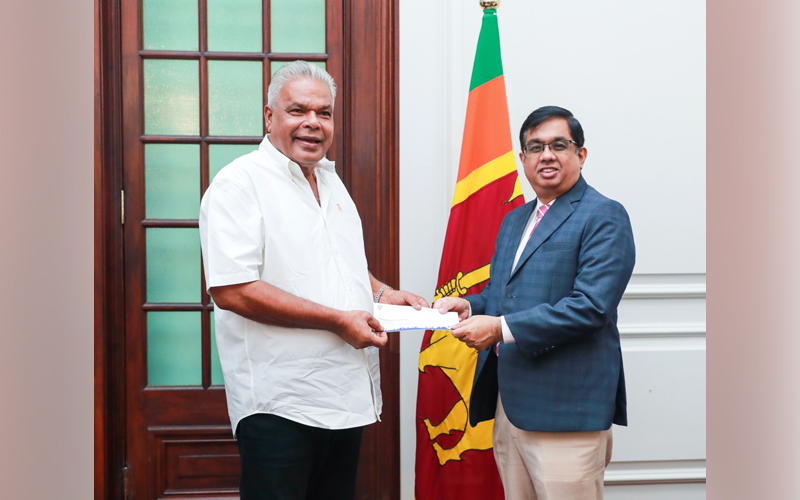
Lakbima Rice Mills (Pvt) Ltd, based in Polonnaruwa, has contributed Rs. 100 million to the Government’s ‘Rebuilding Sri Lanka’ Fund, established to provide relief to communities affected by Cyclone Ditwa.
The donation cheque was handed over this morning (13) at the Presidential Secretariat to Dr. Nandika Sanath Kumanayake, Secretary to the President, by Dudley Sirisena, Chairman of the Araliya Group of Companies.
Latest News
Advisory for severe lightning issued to the Districts of Kaluthara, Rathnapura, Galle and Matara

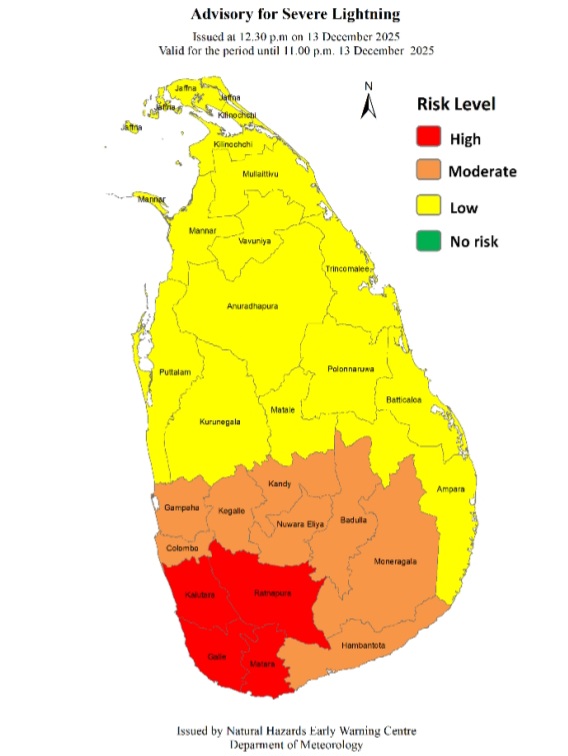
Advisory for Severe Lightning
Issued by the Natural Hazards Early Warning Centre
at 12.30 p.m. 13 December 2025 valid for the period until 11.00 p.m. 13 December 2025 for Kaluthara, Rathnapura, Galle and Matara Districts
The public are warned that thundershowers accompanied with severe lightning are likely to occur at some places in the Kaluthara, Rathnapura, Galle and Matara Districts.
There may be temporary localized strong winds during thundershowers.
General public is kindly requested to take adequate precautions to minimize damages caused by lightning activity.
ACTION REQUIRED:
The Department of Meteorology advises that people should:
Seek shelter, preferably indoors and never under trees.
Avoid open areas such as paddy fields, tea plantations and open water bodies during thunderstorms.
Avoid using wired telephones and connected electric appliances during thunderstorms.
Avoid using open vehicles, such as bicycles, tractors and boats etc.
Beware of fallen trees and power lines.
For emergency assistance contact the local disaster management authorities.

Based on the prevailing disaster situation and the upcoming festive season, arrangements have been made to provide a nutrition allowance worth Rs. 5,000 to pregnant mothers.
This allowance, which will be provided only once, will be given to pregnant mothers who were registered at maternal clinics on or before 30 November 2025.
The distribution will take place through the Divisional Secretariat offices from 16 December, as a program of the National Secretariat for Early Childhood Development, which is affiliated with the Ministry of Women and Child Affairs.

Lakbima Rice Mills (Pvt) Ltd donates Rs 100 million to the ‘Rebuilding Sri Lanka’ Fund

England security in airport clash with camera operator

Sethmika stars as Sri Lanka under 19s crush Nepal by 8 wickets

Advisory for severe lightning issued to the Districts of Kaluthara, Rathnapura, Galle and Matara

Pregnant Mothers to receive Rs 5000 Nutrition Allowance in December

640 deaths, 211 missing as at 6:00AM today (13)

‘Dates have the highest sugar content to fight Coronavirus’

Sunday Island 27 December – Headlines

#SundayIsland 17th December – Headlines

Sunday Island – 28th March

Sunday Island Headlines – 21 March

Sunday Island – 21st February – Headlines
-

 Features4 days ago
Finally, Mahinda Yapa sets the record straight
-

 News6 days ago
Over 35,000 drug offenders nabbed in 36 days
-

 News5 days ago
Cyclone Ditwah leaves Sri Lanka’s biodiversity in ruins: Top scientist warns of unseen ecological disaster
-
 Features7 days ago
The Catastrophic Impact of Tropical Cyclone Ditwah on Sri Lanka:
-

 News6 days ago
Rising water level in Malwathu Oya triggers alert in Thanthirimale
-
 Features4 days ago
Handunnetti and Colonial Shackles of English in Sri Lanka
-

 Business2 days ago
Cabinet approves establishment of two 50 MW wind power stations in Mullikulum, Mannar region
-

 Business6 days ago
Sri Lanka betting its tourism future on cold, hard numbers