
News
Lanka again abstains from voting on resolution against Russia

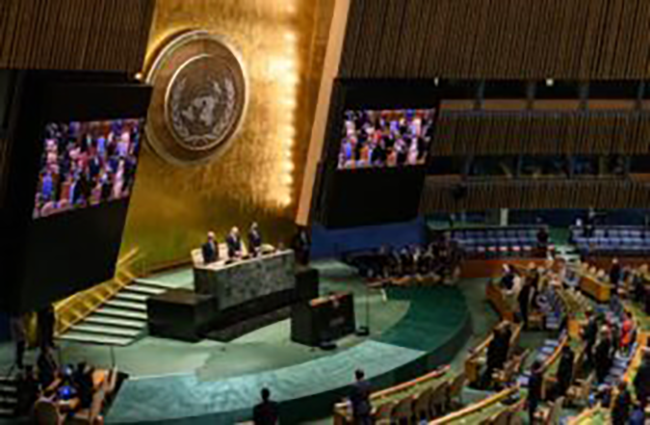
Sri Lanka once again abstained from voting on a resolution against Russia at the UN General Assembly, despite appeals made last week to back the new document.The UN General Assembly called for ending the war in Ukraine and demanded Russia’s immediate withdrawal from the country, in line with the UN Charter.
At its resumed eleventh emergency special session on Thursday, the world body adopted a new resolution calling for an end to the war, only hours before the conflict enters its second year on Friday.
The results were 141 Member States in favour and seven against – Belarus, the Democratic People’s Republic of Korea, Eritrea, Mali, Nicaragua, Russia and Syria. Among the 32 abstentions were Sri Lanka, China, India and Pakistan.
Sri Lanka has so far abstained from voting on successive resolutions presented against Russia’s invasion of Ukraine.
By the terms of the new 11-paragraph resolution, the Assembly reiterated its demand that Russia “immediately, completely and unconditionally withdraw all of its military forces from the territory of Ukraine and called for a cessation of hostilities”.
The Assembly, through the resolution, urged Member States to cooperate in the spirit of solidarity to address the global impacts of the war on food security, energy, finance, the environment and nuclear security and safety. Underscoring that arrangements for a lasting peace should consider these factors, the Assembly also called upon all nations to support the Secretary-General in his efforts to address these impacts.
The resumed session had met on Wednesday to begin debating the resolution, with the General Assembly President, Csaba Korosi, saying that for a full year, the 193-member Assembly, the Secretary-General, and the international community “have been consistent and vocal in our calls to end this war, and to adhere to the UN Charter and international law”.
The Assembly also reaffirmed its commitment to the sovereignty, independence, unity, and territorial integrity of Ukraine within its internationally recognized borders, extending to its territorial waters.
The resolution also emphasized the need to ensure accountability for the most serious crimes under international law committed in Ukraine through independent national or international investigations and prosecutions to ensure justice for all victims and the prevention of future crimes.
The world body on Thursday also rejected two amendments proposed by Belarus. The first proposal would have altered several of the resolution’s provisions, and the second would have had the Assembly call on Member States to, among other things, refrain from sending weapons to the zone of conflict.
At the outset of the resumed session on Wednesday, the Assembly President said that in this “new chapter of history”, the world is facing “stark choices about who we are as an international community. These choices will either set us on a path of solidarity and collective resolve to uphold the tenets of the UN Charter,” he said, “or a path of aggression, war, normalized violations of international law and collapsed global action.”
Days after the 24 February 2022 invasion, UN Security Council members had voted to allow the General Assembly to convene the eleventh emergency special session after Russia had vetoed a resolution that would have condemned the invasion of Ukraine.In line with resolution?377A(V), adopted in 1950, the Assembly is able to take up international peace and security matters when the Council fails to do.



More than 1,600 students sat this year’s Russian Classical Ballet Examination, the largest number ever to take part in the examination in Sri Lanka. Exams were held in Colombo from 5, to 18, October and in Galle on 10 October.
Students aged four and above came from across the island, including Colombo, Galle, Gampaha, Negombo, Matara, Kelaniya, Panadura, Wattala, Kiribathgoda, Ratnapura, Kandy, Kurunegala, Bandarawela and Badulla. They are taught by 15 dedicated teachers trained in the Vaganova method, the renowned Russian system of classical ballet training.
They were examined by Dr. Oxana Karnovich of the Moscow State Academy of Choreography, a distinguished academic and curator.
The Russian School of Ballet and Dancing was established in 2001 by Michael Ustinov, Buddhapriya Ramanayake and Mrs Chandi Aluvihare, with Mrs Galina Pleshakova as its founding instructor. Today the School is led by Director Madam Maria Popova, Counsellor of the Embassy of the Russian Federation in Sri Lanka.

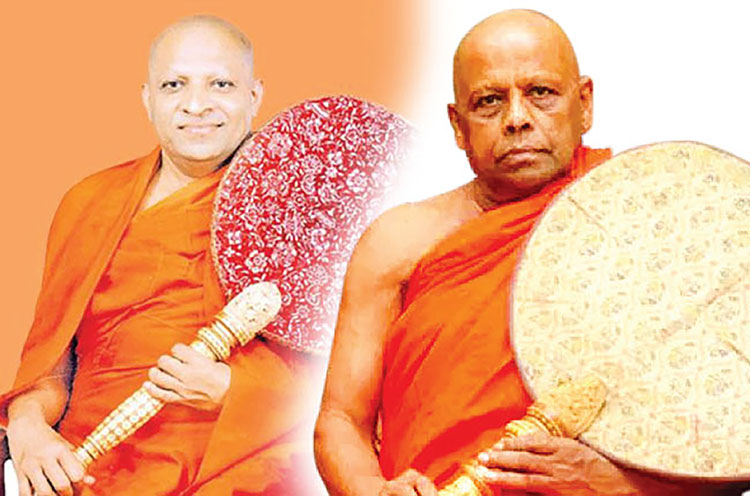
MONETABRIEF– Sri Lanka’s two most senior Buddhist chapters, Malwatte and Asgiriya, demanded special concessions for monks serving prison sentences, following the disrobing of convicted monk Ven. Galagodaatte Gnanasara in line with established procedures.
The chief prelate of the Asgiriya chapter, Most Venerable Warakagoda Sri Gnanarathana, told Prisons Commissioner Senaka Palletenna that Ven. Gnanasara, who is serving a six-year sentence for contempt of court, must be released immediately.
Prison authorities have no power to release or pardon convicts, but Palletenna told the monk in Kandy on Friday that he would convey his request to the relevant government authorities.
“There is no point in talking about this and that… The entire country has been shaken (??????? ) . He must be released,” the Asgiriya chief prelate said.
The Malwatte chief prelate, Most Venerable Thibbatuwawe Sri Siddhartha Sumangala, appeared to accept the court verdict against Ven. Gnanasara, but asked the prisons chief whether a separate section could be established for convicted monks.
Palletenna noted that a special ward for the clergy already existed at Welikada Prison.
At least 63 convicted Buddhist monks are currently incarcerated within Sri Lanka’s criminal justice system.
Meanwhile, a group of 34 Buddhist monks named in a Colombo Fort Magistrate’s Court order to vacate the vicinity of the Presidential Secretariat ended their protest and dispersed after lunch on Friday.The monks are demanding an unconditional pardon for Ven. Gnanasara, who has previously been imprisoned, making him a reconvicted prisoner.
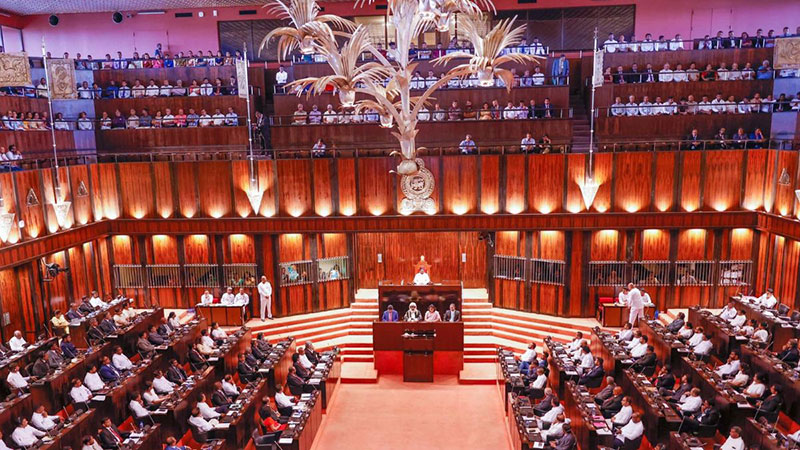
The debate on the no-confidence motion against Speaker Dr. Jagath Wickramaratne, submitted by the Samagi Jana Balawegaya (SJB), has been postponed indefinitely pending the Attorney General’s opinion on certain technical issues in the motion.
Government representatives raised the matter at a meeting of the Committee on Parliamentary Business, pointing out that several provisions of the motion required clarification and that the Attorney General’s advice should be obtained.
As obtaining the opinion would take time, the debate could not be scheduled for the next parliamentary week, parliamentary sources said.
Chief Opposition Whip Gayantha Karunatilaka said a date for the debate would be decided after the Attorney General’s advice was received.
Meanwhile, Parliament is scheduled to meet from October 20 to 23, Secretary General of Parliament Kushani Rohanadeera announced.
The parliamentary business for the week was finalised at a meeting of the Committee on Parliamentary Business held on Friday (16) under the chairmanship of Deputy Speaker Dr. Rizvie Salih.
On each sitting day, the period from 9.30 a.m. to 10 a.m. will be allocated for parliamentary business under Items 1 to 6 of Standing Order 22. Questions for Oral Answers will be taken up from 10 a.m. to 11 a.m., followed by questions under Standing Order 27(2) from 11 a.m. to 11.30 a.m.
On Tuesday, October 20, an Opposition-sponsored Adjournment Motion will be debated from 11.30 a.m. to 5.30 p.m.
On Wednesday, October 21, a resolution under the Public Debt Management Act and a Supplementary Estimate will be taken up for debate and approval from 11.30 a.m. to 5 p.m. The annual reports of five statutory institutions will subsequently be presented for approval without debate, while questions at the Adjournment Time will be taken up from 5 p.m. to 5.30 p.m.
On Thursday, October 22, the Second Reading debates on two Bills to amend the Poisons, Opium and Dangerous Drugs Ordinance (Bills Nos. 79 and 80) will be held from 11.30 a.m. to 5 p.m.
The annual reports of five statutory institutions will then be taken up for approval without debate, followed by an Opposition-sponsored Adjournment Motion from 5 p.m. to 5.30 p.m.
On Friday, October 23, the Second Reading debate on the Elimination of Rabies and Registration of Dogs Bill will be held from 11.30 a.m. to 5 p.m. A Government-sponsored Adjournment Motion will be debated during the final half-hour of the sitting.

Pakistan quicks seal win after Salman Agha ton sets tone

Record 1,600 students take Russian Classical Ballet examination in Sri Lanka

Half a million people join protests in France, but some turn violent

Deadly fire breaks out at Canada military base

Showers or thundershowers will occur in most parts of the island after 1.00 p.m.

Buddhist hierarchy demands prison perks for monk convicts

‘Dates have the highest sugar content to fight Coronavirus’

Sunday Island 27 December – Headlines

#SundayIsland 17th December – Headlines

Sunday Island – 28th March

Sunday Island Headlines – 21 March

Sunday Island – 21st February – Headlines
-

 Latest News6 days ago
Nissanka’s return headlines Sri Lanka’s Test squad against Pakistan
-
 Features7 days ago
Intake 16: 45 years of duty and honour
-
 News7 days ago
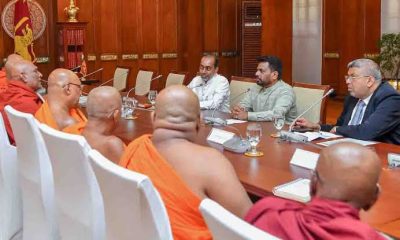
Malwathu Chapter issues statement on talks with President over Gnanasara Thera’s robes
-
 News7 days ago
CP alleges NPP has taken the blame for illegal US sanctions on Iranian vessels
-

 News5 days ago
Sri Lanka, India caught in US-Iran ship crisis
-

 Opinion7 days ago
How long can Sri Lanka remain silent on its demographic crisis?
-

 Latest News5 days ago
Kusal Mendis’ unbeaten 87 hands Sri Lanka consolation win
-
 Latest News6 days ago
Imran Khan’s PTI braces to fight federal takeover of Khyber Pakhtunkhwa