
Opinion
Land rackets and legal fraternity


On joining the prestigious legal profession, in Sri Lanka, an attorney-at-law has certain obligations and responsibilities to their clients and the country. As Dr A. R. B. Amarasinghe in his book, “Professional Ethics and Responsibilities of Lawyers”, points out, “a lawyer has many obligations. He has a duty to the client, to the court and to other tribunals and bodies. As an officer of the court, he must act with honesty, integrity and candour. Any duties or directions made by the court must be fulfilled, including any matter regarding which he has given an undertaking to the court. His foremost duties to his clients require him to act with due skill and diligence and reasonable swiftness and courtesy while maintaining his clients’ confidence and avoiding conflict of interests. A lawyer has an obligation to demonstrate ethical practice to the public, including his peers.”
In 1979, I designed a house for Prof. Ediriweera Sarachchandra at Epitamulla Road, Pita Kotte. During this process, he informed me that there was land available for sale on the opposite side of the road. As I had been looking for suitable land, I ventured to buy it. I could not afford to build at the time but constructed a retaining wall and fence along the boundary to secure it. Even though I visited the place off and on, nothing was built on the land. Neighbours are excellent and kind enough to take care of the property. All these years, we did not have any problem.
In 2016, my daughter was interested in constructing a house and was looking for land. I offered her the land at Epitamulla Road. As she was interested, I proceeded to install a proper gate and redid the boundary fence that had deteriorated. I gifted the land to my daughter. A young, efficient attorney prepared the deeds on behalf of my daughter with life interest on the property retained in my name as a precautionary measure. It also helped to maintain the pedigree of the land from the original purchase. I proceeded to the Land Registry at Battaramulla, interviewed the lady in charge, and inquired about registering the land. There was a delay, and subsequently, the process was completed.
A false deed registration, registered from Matara, claiming ownership to the land appeared within a week of going to the Land Registry. The claimant said that the land belonged to him, a case was filed against him. He is currently absconding. But judgement has been issued.
In the meantime, it seems that the land was sold many times in quick succession. One person who allegedly bought it cut the two jack trees and the kitul tree, while another buyer brought in heavy equipment and filled the land that sloped to the water edge of the lake. In the process, he broke the gate post and the gate. While this was going on, I placed nine police entries recording what was happening in sequential order. These complaints were made to the Mirihana Police Station, as Epitamulla Road comes under its jurisdiction. The gate post and gate were hurriedly repaired in one night.
The land was being hawked around and offered to different Finance companies and possible genuine buyers. Many to whom the land was offered to, through friends, contacted me, and on being informed that the deeds were fraudulent and that we had not sold the land and they should not get caught in the fraud, they quickly withdrew. Some still ring me, thanking me for saving them.
In the meanwhile, others were busy preparing the second set of false deeds and documents. This time the documents included a false deed prepared and attested by Attorneys, a National Identity Card issued in my daughter’s name with a photograph of some strange woman, a death certificate issued in Kuruvita, Ratnapura District, in my name and a signed affidavit that the life interest holder was dead. The documentation looked authentic. The seller was pushing for the conclusion of the sale. The sale had been almost concluded on this false deed. However, a family member of the buyer and his lawyer were suspicious and informed the Mirihana Police. All involved, that is, all the players who were getting a share from the proceeds of the sale, were arrested. We were called to the Mirihana Police Station and requested to make statements. We stated that we had not sold the land, and this was recorded. There was a lull for some time.
A couple of months later, two new false deeds appeared. This was more serious. One false deed stated that my daughter had sold the land to one Mr Perera, and another false deed was issued in the new owner’s name. As there was a life interest on the property, there was also a second death certificate, which this time was issued in Colombo, stating that I had died and was buried at the Galkissa Cemetery.
With this documentation, the land was sold to a finance company. Within a week, the owner of the finance company, who had met me previously through his family contacts, enquired if I had sold the land when informed that I was still alive. On being informed that I had not sold the land, he immediately informed the CID. He was hell-bent on getting his money back.
The CID was on the ball. They quickly collected copies of all four false deeds and the names of the Attorneys who had signed the deeds, copies of the two death certificates and the false Identity card. The CID also collected copies of all the five original deeds lodged with us. They also recorded statements from all involved with the original deeds. The heat was such that the owner of the finance company got his money back.
Subsequently, the property, with the false deed and documentation was sold again to an insurance company that placed their name on the gate. The insurance company has since offered the property for sale in the usual manner. Many who were offered it informed us, and after they heard our story, they withdrew. But the insurance company continued to push for its sale. We were informed that some individual had brought in heavy equipment and cleaned the property. I lodged a complaint at the Mirihana Police that an unknown individual was cleaning my property.
At the end of August 2021, we received an anonymous letter with information giving the names of persons, one Mr. Perera, who is involved in the possible preparation of another fraudulent deed. This letter as well has been handed over to our lawyers.
It is difficult to comprehend how members of the legal profession, members who are duty bound to protect the rights of the citizens of this country, are so easily convinced and willing to compromise and demean themselves and their ethics to indulge in the initiation and preparation of false deeds and support the falsification of legal documents, which I understand is a serious offence. It is disconcerting that these individuals are willing to compromise themselves, their responsibility and professional ethics to stoop to such low levels to cheat the general public and be so desperate to earn a fee.
It is also unfortunate that members of the legal brotherhood are willing to certify the forged documents as authentic without proper research into the pedigree of the deeds. They seem to be ever ready to take the documents at face value and even recommend them to potential buyers, their innocent clients who have placed their trust and faith in their better judgement that the documents are in order.
It is also a bad reflection on the officers in different important government departments which may be willing to issue collaborative documents, like death certificates, on false requests, and even going as far as issuing false national Identity cards to different persons for a fee. Surely, the Sri Lanka administrative service has not reached down to such a low level. However, these documents may also be forgeries. The officers in the land registry, covering the Epitamulla area and the Kotte Municipal Council, should not register false documents, at face value. They should insist on some authenticated documentation of the real ownership of the property.
We have been notified that brokers are going around trying to sell this property. We have not engaged any brokers. We are informing the general public to please note that we have not sold the above-mentioned property to anyone. We still hold the original title. There have been many efforts to change the status by using numerous forged deeds and false supporting documents to pressure the authorising authorities to collaborate.
Let the general public be warned against the purchase of this property at 48/57, Epitamulla Road currently 128/5, Ediriweera Sarachchandra Mawatha
, Kotte as all the documentation used to sell the property is fraudulent. The deeds shown and paraded around are all false deeds and documents. Please do not get caught. The Criminal Investigation Department may be busy, but they have all the information needed. The CID has the names of all the people involved and the names of all the members of the legal brotherhood involved in preparing these false deeds. They have already interviewed several people. We are confident that the CID will soon do their job in the usual efficient manner. All the original deeds and copies of the false deeds and related documentation are lodged with Romesh de Silva, PC.
This land adjacent to the Diyawanna Oya is not for sale. We are still interested in developing it for our use. We recommend that all parents who give property to their children introduce a life interest clause, making it more complicated for unscrupulous individuals to intrude on your privacy, as two persons have to agree to sell this land.
Ashley de Vos

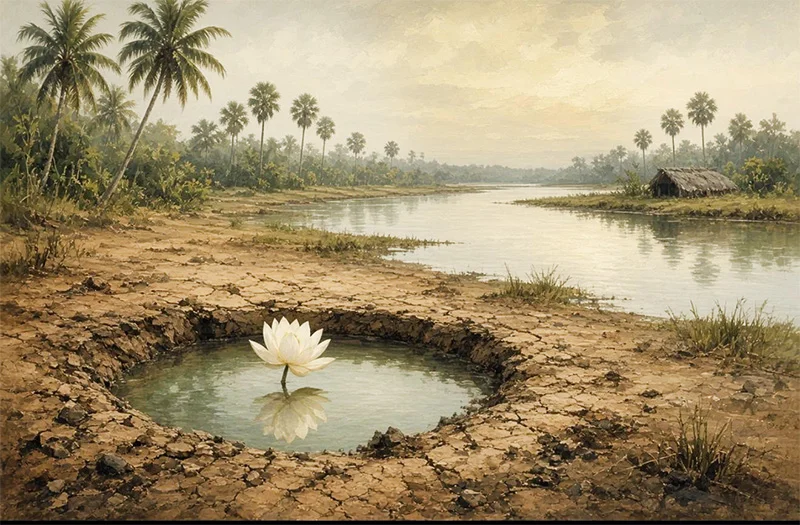
A monk’s four days in Jaffna, another monk’s restored prison term, and a party visit to Delhi are one argument: trust follows conduct, and the North will not be healed by a file.
By Mahil Dole
Senior Superintendent of Police (Retd.)
The sea, the monk writes, brings us all sorts of things. One slipper arrived five days after the other, and he was wearing the pair. It is a small opening for a large account, and it is the right one. What Ven. Dhammananda Thero brought back from four days at Thapovanam, an ashram beside a lagoon in Allaippiddi, is not a matched set of slogans. It is two things that arrived separately and only make sense together: an extraordinary welcome, and a street that would not smile.
I write this as a Muslim, and I write it as a citizen. I served this country in law enforcement and in intelligence, with the duty of keeping the peace, the security and the sovereignty of the republic. For service in the operational districts I was awarded the Purna Bhumi Padakkama. I do not mention the medal to decorate a paragraph. I mention it so that what follows is not mistaken for a petition from outside the state. The North and East are not a foreign file to me. They are districts in which I served, and people among whom the peace of this country is either kept or lost.
I know the difference between a communiqué and a witness. The piece published by the Walpola Rahula Institute on 20 September 2026 is a witness. From dawn on 22 August until the night of 25 August, a Buddhist monk stayed with Professor Daya Somasundaram, formerly Professor of Psychiatry at the University of Jaffna, in a fishing village the war emptied more than once. He peeled onions. He sat mindfulness with Sinhala, Tamil and Muslim medical students. He chanted the Karaniya Metta Sutta while a former combatant’s lotus seeds went into a pond. On the last day, at Tellippalai, he met faces of unease, dislike and rejection, and was told why. That sequence is what we need today. Not another resolution. The action, and the moral sense, of the prelate.
What he showcased was not Buddhism as a heritage claim. It was Buddha Dhamma as conduct, and ahimsa as a method rather than a motto. He left Wellawatte late on 21 August, reached Jaffna at dawn, and was taken by Mariyadas of Batticaloa, who speaks Sinhala, through Mandaitivu and Kayts. The man who opened the gate, bare-chested, in a short sarong, about seventy-five, was the professor. He sleeps on a concrete terrace under a palmyrah slope too small for a night of rain, eats one meal a day, wakes to yoga, and swims in the lagoon for about two hours each afternoon. None of this is theatre. It is the opposite of possession.
Policy makers should not skip what the place actually does. Allaippiddi was forced out more than once. Many lived in the Vanni before they returned. Almost all the men, the monk was told, are heavily addicted to alcohol. Crystal methamphetamine, the drug our streets call ice, is widespread. Domestic violence is extremely high. Some children do not sleep at home. They go to their grandparents to escape the fighting. Surroundings of that kind teach a child that drunkenness is normal, and that a man who does not beat his wife is weak. In the holidays the children come to Thapovanam for drama, dance, music, drawing, karate, swimming and sand sculpture. The characters are animals. The stories are the real problems of the families. Nothing is aimed at an examination. Each child is fed. On 22 August about fifty came. The monk joined the kitchen and chopped some forty onions for a tomato sambol, beside Mariyadas, his wife Tamil Selvi of Mannar, and women of the village. Selvi’s father supported a separate state, and began each child’s name with the word Tamil. On the evening of 25 August, she still knelt, and so did her husband. No communiqué I have sat through has produced a moment of that weight.
A second classroom answers who a Sri Lankan is more honestly than any clause we have drafted. Dr S. Sivadas, once Somasundaram’s student and now a consultant psychiatrist at Jaffna Teaching Hospital, brought medical students to the ashram — Sinhala, Tamil and Muslim, curious about mindfulness. The next day, at the hospital, the monk guided twenty minutes of anapanasati for first-year students of all three communities. They issued no statement. They breathed in the same room. That is a wider definition than the one announced from Colombo: not a bloodline, not a language, not a monument on a contested coast, but a person willing to sit with the other long enough to become real.
The lotus planting carries the lesson onto scorched ground. The seeds were brought by a former combatant living with post-traumatic stress, who on some nights wakes on the battlefield again. From the bank the monk recited the Karaniya Metta Sutta. He adds what commemorations omit. Former soldiers carry the same nights, known mostly to their families. Ahimsa that cannot see both is not ahimsa.
Then Tellippalai, and the account refuses to flatter us. The town lies about fifteen kilometres from Jaffna, on the road to Kankesanthurai. At midday on 25 August the monk went alone to meet a group of the Chelvanayakam Memorial Trust. At the junction the faces showed unease, dislike and rejection. Not a single smile. Inside, they did not console him. After he left, they said, they too would have to answer the questions people asked. The reason they named was Tissa Raja Maha Vihara, about four kilometres away. Because of that temple, people there have come to see Buddhist monks as persons who arrive to seize land. His sentence belongs in every secretariat and every chapter house. What a terrible misfortune. He asks that it be read by the officers who built the temple, by the monks who live there, and by the lay devotees who travel from Colombo for sil on poya days. The more we try to possess, the more we lose. When we let go, a whole world becomes ours.
The same weeks have given us the opposite conduct, and the country should be made to look at both robes together. Ven. Galagoda Aththe Gnanasara Thero was sentenced in 2018 to an effective six years for contempt of court, over his conduct at the Homagama Magistrate’s Court in 2016 during proceedings on the disappearance of Prageeth Ekneligoda. In May 2019 a presidential pardon released him. On 10 September 2026 the Supreme Court held that pardon unlawful. He did not appear when called on 29 September. An open warrant and a travel ban followed. Police arrested him on 3 October at an aranya in Thiniyawala, Kalutara. Today, 5 October, the Court of Appeal ordered the remaining period of that sentence enforced. A separate warrant had already been issued after he failed to appear in a case concerning an alleged statement insulting Islam.
I am not interested in a further quarrel with the man. I am interested in the robe. The Buddha’s instruction on who may wear it is not obscure. The robe is for a life of restraint, of truthfulness, of harmlessness, and of respect for the discipline that keeps a community from fear. It is not a costume in which to storm a courthouse, to be pardoned out of a sentence, and then to stay away when the highest court restores the sentence. Dhammananda Thero took the night bus to Jaffna, chopped onions, chanted metta over a former fighter’s seeds, and wrote down the street that would not smile. Gnanasara Thero’s recent path was the avoidance of a warrant. One conduct leads human beings towards a peaceful path. The other teaches every community, mine included, to distrust the cloth. Religious leaders who still share a platform with that second example should ask which of the two they are prepared to defend.
This contrast is not a private matter for the Sangha. It lands in the same week in which the North has again become a diplomatic file. Tilvin Silva, general secretary of the Janatha Vimukthi Peramuna and a powerful figure in the ruling National People’s Power, has just concluded a five-day visit to India, from 27 September to 1 October, at the invitation of the Bharatiya Janata Party under its Know BJP programme. He met senior party figures, among them B. L. Santhosh and the BJP’s national president, and on the last morning he met External Affairs Minister S. Jaishankar, who described India as a trusted partner in Sri Lanka’s progress. The shift is real. The JVP was for years sharply critical of India’s stance on devolution. In 2008 Vijitha Herath, now our foreign minister, called Indian ideas on devolution an indirect support to the LTTE ideology, and said no country had a right to interfere in our problem. New Delhi is now courting the party it once found obstructive.
The hope in Delhi, as set out by those watching the visit, is that JVP leaders can be brought to see devolution not as a stepping stone to separation but as a counter to it, and as necessary to the economic progress of the Northern and Eastern provinces. India has pressed for early Provincial Council elections and for the constitutional provisions that meet Tamil aspirations to be made real. Its interest in the North is not sentimental.
It is geopolitical and practical: connectivity, projects such as the Jaffna airport expansion, a shipping link towards Kankesanthurai, and a stable Tamil-majority littoral that does not become anyone else’s lever. That interest is legitimate for a neighbour. It is not a substitute for our own policy.
The stance of our government is the unfinished half of this story. The party that once treated Indian devolution as a foreign design is now the dominant partner in office, and its general secretary has gone to Delhi as a guest of the ruling party there. Cordiality is not a policy.
Colombo has yet to say, in language a villager in Allaippiddi or Tellippalai can test, whether the North and East are to be governed as equal parts of the republic, with elections and a share of development, or managed as a sensitive file between two capitals. Devolution sold only as an answer to separatism will be heard, in the North, as a security device. Devolution refused because a foreign capital favours it will be heard, in Delhi and in Jaffna, as the old refusal. Neither reading builds the confidence the monk found only when he arrived without a claim.
I say this as an officer who spent his service against separatism in arms, and who does not confuse a provincial council with a separate state. The armed challenge to the sovereignty of this country was defeated. What was not defeated was the inference a street draws from conduct. Tellippalai did not close its face because a constitution was incomplete. It closed its face because a temple was read as seizure. Allaippiddi did not open its kitchen because a delegation had been to Delhi. It opened its kitchen because a monk chopped onions and left. India’s diplomatic approach can support ports, power and elections. It cannot supply the trust. That remains a Sri Lankan task, and it will not be performed by a government that is eloquent in New Delhi and silent on the robe that frightens its own citizens.
The eye-opener is therefore for more than one audience. It is for the Buddhist clergy and laity, who have been shown two paths in the same season and must choose which one the robe will mean. It is for the imam, the priest and the Hindu leader who still announce coexistence and rarely cross the village they have stereotyped. It is for a government that can sit with Jaishankar and has not yet sat, in policy, with the meaning of Tellippalai. And it is for Delhi, which is entitled to its interests and not entitled to mistake a party visit for the healing of a province. Trust is an inference from conduct. People who never enter the room can revoke it.
What is required is a team, in little steps, not a new ministry and not a new patron. Somasundaram has made that team for years. Dr Sivadas carried it into a hospital classroom. Mariyadas and Selvi carried it onto a doorstep. A Muslim leader can take students and stay long enough to work. Trustees of a contested site can say plainly what is worshipped and what is not being taken. A government can enforce a court order without selectivity, and can say what it will and will not devolve without waiting to be asked in Delhi. None of this is a giant leap. Giant leaps here have never been legislated. They are the late result of people who refused, in small rooms, to behave as the stereotype predicted.
The hope is real, and conditional. A lotus pond does not cancel a war, and one cold junction is not the North. The space remains large. It closes where we possess, where a robe is worn against the discipline of the robe, and where the North is discussed over our heads. It opens where someone arrives without a claim. Who a Sri Lankan is will not be settled by a gazette, or by a photograph in New Delhi. It will be settled by whether the next visitor to Tellippalai meets a question or a closed face. Little steps of that nature make the leaps of tomorrow. When we let go, a whole world becomes ours. It was true on a pond bank in Allaippiddi. It remains the only terms on which this island will hold.
( This analysis is offered in the interest of national security, institutional reform, and public safety)
Notes
Dhammananda Thero. (2026, September 20). A lotus pond on scorched earth: A few days of healing at Thapovanam. Walpola Rahula Institute.
Court of Appeal order of 5 October 2026 enforcing the remainder of the sentence on Galagoda Aththe Gnanasara Thero, following the Supreme Court ruling of 10 September 2026 that the pardon of 23 May 2019 was unlawful. Arrest reported on 3 October 2026 at Thiniyawala, Kalutara.
Tilvin Silva led a JVP delegation to India from 27 September to 1 October 2026 at the BJP’s invitation under the Know BJP programme, and met External Affairs Minister S. Jaishankar on 1 October. The reading of New Delhi’s hope on devolution follows M. R. Narayan Swamy, “Why India is wooing Sri Lanka’s JVP,” Rediff, 5 October 2026.
The Purna Bhumi Padakkama was awarded to police and service personnel for qualifying service in designated operational districts between 1977 and 2010.
The writer is a retired Senior Superintendent of Police, former head of the counter terrorism desk at the state intelligence service, a former member of the Sri Lanka Wakfs Board, and the author of Security Beyond Enforcement: Practical Approaches for a Safer Nation (2026).

by Prof Ranjith Bandara,
PhD (Qld)
Emeritus Professor of Economics, University of Colombo
The Department of Census and Statistics (CS Department) reports that Sri Lanka’s real GDP grew by 4.2 per cent in the second quarter of 2026, compared with 5.1 per cent in the first quarter. Although the economy continued to grow, the reported rate was lower in the second quarter. The figures have prompted differing views about what this means for the country’s economic and political future.
In this article, I share my views on the Department’s figures and the comments they have prompted. I consider whether slower economic growth can lead to an economic crisis or political instability. Drawing on Sri Lanka’s latest economic indicators and examples from other countries, I examine how economic difficulties can affect public confidence and, in turn, political stability.
Economic analyst Dhananath Fernando has warned that political leaders may seek to consolidate control over the judiciary, state institutions and other centres of political power. But if they fail to ensure economic growth and improve people’s lives, they may eventually lose power. This is an important warning. Yet the relationship between economic growth, people’s wellbeing and political power is not automatic. These factors influence one another in complex ways.
What the growth figures tell us
According to the CS Department, Sri Lanka’s real GDP grew by 4.2 per cent in the second quarter of 2026 compared with the same period in 2025. In the first quarter, growth was 5.1 per cent compared with the same quarter a year earlier. The reported rate was therefore 0.9 percentage points lower in the second quarter. This indicates that the pace of year-on-year growth eased and deserves attention. It does not mean that the economy contracted or is collapsing. Since both figures compare a quarter with the same quarter of the previous year, they cannot, on their own, show whether the economy shrank from one quarter to the next.
The IMF’s forecast also needs to be considered. In May 2026, the IMF said Sri Lanka’s economy had grown by 5 per cent in 2025 and projected growth of 3 per cent for 2026. It identified higher oil prices, conflict in the Middle East and lower tourism receipts as risks to growth and the country’s external finances. The IMF also projected public debt at about 100.1 per cent of GDP in 2026.
The IMF’s 3 per cent figure and the Department’s 4.2 per cent figure measure different things. The IMF figure is a forecast for the whole of 2026; the Department’s figure measures the change in economic output in the second quarter compared with the same quarter a year earlier. The IMF forecast was also issued before the second-quarter results were published. The two figures should not be treated as directly comparable, or as if one disproves the other. Read together, however, they point to a central challenge: keeping growth on track while protecting the economy from external shocks.
Growth also varied across sectors. In the second quarter, industrial activity expanded by 7.3 per cent, while services grew by 2.7 per cent. Agricultural activity, by contrast, contracted by 2.3 per cent. Growth in construction and mining supported industry, while information technology, financial services and telecommunications contributed to growth in services. However, the Department reported slower growth in some services, including tourism-related activities, than in the same period a year earlier.
The decline in agriculture deserves particular attention. According to the Department’s figures, value added in rice cultivation fell by 15.1 per cent, while freshwater fishing and aquaculture fell by 61 per cent. Agriculture’s importance cannot be judged only by its share of GDP. A decline in agricultural activity can affect food supplies, farmers’ incomes, rural employment, food prices and the need for imports. It is therefore more than a figure in the national accounts: it can affect rural household incomes and the cost of food for consumers.
The key question is not only whether GDP is growing. We must also ask whether that growth creates secure, good-quality jobs; raises household incomes after allowing for price increases; and gives small businesses the confidence to invest and expand. If the cost of living remains high, or if the gains from growth reach only a small part of society, people may not feel the improvement shown in the official figures. Public confidence depends not only on the growth rate, but also on whether people experience the benefits of growth in their daily lives.
Lessons from other countries
Sri Lanka’s 2022 crisis is the clearest example of how severe economic hardship can affect political stability. It was not simply a period of slower growth. Foreign exchange shortages, the suspension of debt payments, shortages of fuel and other essential goods, and rising living costs reinforced one another. The World Bank reported that jobs were lost, while food insecurity and poverty increased during the crisis. Shortages and the hardships of daily life contributed to mass protests, and the President resigned. The crisis showed how economic distress can shake political power. But it was a far deeper breakdown than a modest decline in the growth rate: the country faced a debt crisis and a collapse in its ability to pay for imports.
Argentina’s crisis in 2001 offers another example. As the country’s financial and debt problems worsened, public protests grew. The President resigned, the government defaulted on its debt, and the exchange-rate system was abandoned. Argentina’s experience shows how an economic crisis can become a crisis of public confidence when people’s incomes, savings and jobs are all under pressure.
Greece offers a different lesson. A prolonged recession, high unemployment and painful economic adjustment weakened public support for established political parties, while new political forces gained ground. This shows that the way people experience economic policies—and whether they believe the costs are being shared fairly—can shape their political response. Difficult reforms may be necessary, but carrying them out without public trust and support for those most affected can deepen political instability.
Zimbabwe, however, shows that economic decline does not always remove a government from power. The country experienced prolonged periods of high inflation, currency instability and falling production. Yet restrictions on opposition activity and the concentration of state power helped the ruling party remain in office. Economic failure can increase the risk that a government will lose power, but it does not guarantee that outcome. Electoral rules, independent institutions, media freedom, the strength of the opposition and people’s ability to organise also matter.
Debt, growth and public confidence
Slower growth can increase debt risks, but debt sustainability depends on more than the growth rate. Interest costs, government revenue, the budget balance, the maturity of debt, and whether it is owed locally or abroad all matter. The IMF’s 2026 estimate puts public debt at about 100.1 per cent of GDP. Reducing that burden will require growth, stronger public revenue and careful spending to work together.
Sri Lanka therefore needs more than a higher growth rate. It needs a stronger economic base that can sustain growth over time. This means expanding exports and competitive production, creating a stable environment for private investment, improving agricultural productivity, providing young people with good jobs, and protecting those most affected by economic reforms. If growth is not broad enough to benefit many people, it may appear in the statistics without restoring public confidence.
The claim that political leaders will inevitably lose power if the economy fails to grow should be treated as a serious warning, not an unbreakable rule. Long periods of economic weakness can increase public dissatisfaction, strengthen political opposition and raise the risk of a crisis of government. Whether this leads to a change in power also depends on the country’s political and institutional conditions.
In the end, leaders must answer a simple question: do people feel the recovery in their incomes, jobs and daily lives, or do they see it only in the statistics? If the answer is no, it will become harder for any government to retain public confidence—and harder to remain in power.
Opinion
Monument to H.C.P. Bell and Bell Party: Unsung Labour Force of Early Archaeological Surveys – II
by Lokubanda Tillakaratne
Nature of Bell Party work
Villagers and the headmen mostly provided information about these potential digging sites. Since the start of the archaeological projects, the Bell Party was probably the first to see our ancient monuments there, by the mileposts of history, frozen before disappearing, holding their last breath beneath the earth, for reasons known and unknown.
Sinhala Bell Party members often passed up digging out a Buddha statue for superstitious reasons and fear of yakkas believed to haunt (guard?) Buddhist ruins, statues, and ancient artifacts. But Bell found Tamil workers showed no such traits.
Often, a village muladeni, usually the arachchirala, joined a traveling Bell Party and came to the vadiya to help with excavations. Once, Korala of Kahatagasdigiliya came to the Bell’s vadiya at Konwewa to help. Muladeniya usually provided accouterments and food for the Bell Party at excavation sites within his weikkiya, jurisdiction.
Although they were no Archaeologists, Bell’s guidance led the Party men to push forward with sheer determination to rebuild and restore these ancient structures on stone stylobates, piece by piece, connecting them to the present.
Bell wrote that the Party’s work involved exploring “backwoods in the wildest and most inaccessible nooks and corners of Ceylon.” After thinning trees and brush, and general weeding and digging, they looked for evidence of statues, sculptured stone pillars, engravings, relief carvings, and inscriptions on rocks covering areas as big as Melville’s whale, paintings, ceramic material, coins, gems, seals, jewels, arms, tools, ornaments, lamps, and any item of antiquarian interest. The Party also helped Bell with archaeological conservation and epigraphical work.
Seeing a buried Buddha statue, restoring it to its former luster, and probably hearing its hummingbird heartbeat must have been like seeing the Buddha alive. How satisfying for the Party to see remnants of stone pillars they raised back to life as grand temples, in a lovely and telling shape?
But when sarong- and amuda-clad men dug up a serene Buddha statue or an ornamental moonstone, sandakadapahana, with relief figures of animals parading from horizon to horizon, Disney illustrators or Old Masters at the Louvre would have envied the chance to see such superb artistry.
The bulk of the work was done while Bell and other contractors stood around and directed. During rainy days, soggy earth made the Bell Party’s work difficult. They dug ditches to drain water from the swampy site and reach the submerged ruins. At Sigiriya, when they restored the pond, they first used a yotta, a long scoop hung on a crossbar, to remove water.
Drowned in a furry forest, unfrequented and alone, often weeks away from the civilisation, Bell, his assistants, and the Bell Party enjoyed untainted freedom. Bell once chimed to a friend about his independence. He wrote, “After all it is good to be Head Man, even in Hell!”
In a letter Bell wrote to the Colonial Secretary in the annexure to the Third Progress Report in 1890, he stressed the Bell Party’s struggles to excavate Buddhist Railings near Abhayagiriya. To begin excavations, the Party had to remove about 50 large weera trees, which took 10 days. The excavation then reached 10 ft wide and 3-4 ft deep to expose the base and recover scattered railing plinths, posts, and coping.
Raising the 7 ft. tall, sedentary Buddha statue at Pankuliya required 50 Bell Party members and 6 Europeans in 1892. Another Buddha statue, which Bell described as having “soft expression, symmetry and repose of the body,” … and “finest brought to light” at Toluwila between Anuradhapura Railway Station and the Nuwara Wewa bund, was 7.6 ft tall and 7 ft across, weighing like a large CAT excavator at a construction site.
Bell Party did all the lifting of this statue using wood beams the size of street lamp-posts and deer-skin ropes, waramadhu, and pulleys. It now adorns the entrance to the Colombo Museum. We must thank the Bell Party for this stunning representation of Sri Lankan history, literally at the doorstep of its repository.
When Bell had to read an inscription on a rock face 20ft above ground, the Party members climbed up the rock and built a hanging platform. One writer saw them crawling like cats on a sloping rock. At Ritigala, the Bell Party managed to get a rope across a deep crevice between two rocks for Bell to cross the chasm.
Some statues escaped Bell’s eye. I know one instance when villagers and the area arachchirala did not notify the authorities about archaeological items in their neighborhood. An example is the little-known 4 ft tall seated Buddha at Rame (රරාමේ) near Kahapathwilagama, my father’s village, described in Echoes of the Millstone (Lokubanda Tillakaratne, 2013). After a villager leading a herd of buffaloes stumbled upon it, the elders decided to keep it a secret for fear that Bell Mahattaya would take it as a museum piece. Meanwhile Toluwila villagers lost their Buddha statue which connected them to their long and proud history.
Travelling
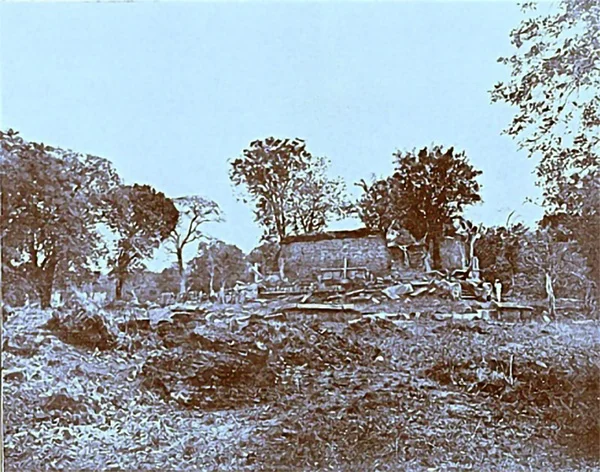
Watada Ge, Polonnaruwa (1907) before restoration (H.C.P. Bell)
The mode of transport of the Bell Party was unlike that of some storied migrants who crossed the North American continent in covered wagons in the 19th century. In their treks through scrub and thorn jungle, the Party had no street signs to follow. Mostly, the sun, moon, stars, and large and aging trees that witnessed the ruins in their better days fueled the men with a collective instinct to keep moving. While walking through the trackless forest, they often got lost. Then a Party member climbed a tree to retrace their route. Some days they walked 20 miles to reach a site.
Bell Party walked while Bell Mahattaya usually rode on a horse or a bullock cart on hastily cleared paths just enough for the yoke to proceed. When convenient, bullock carts owned by the Archaeological Department or loaned by a arachchirala transported supplies and equipment on these trips. On some days, an advance party of men carried supplies ahead on pack animals, while others followed a day later. Usually, a muladeni in the area was always there to help with logistics.
The Party carried tools, camping equipment like tarpaulin, cameras, pickaxes, mamoties, cooking supplies and utensils, and drinking water. In some instances, they were lucky to get water from a Pin-thaliya, a roadside pot of drinking water on a waist-high pedestal conveniently set up by villagers for travellers. These drinking pots also appeared on major roadways, reflecting the caring and sharing character of Sri Lankan people. In Remembered Yesterdays (1927), Maha Mudaliyar Solomon Dias Bandaranayake writes about the Pin-thaliya he set up on Kandy Road in front of his Horagolla residence in 1887 to commemorate the Queen Victoria Jubilee celebrations.
On long treks, when night fell, Bell slept on his tarpaulin shed, a gaman vadiya, erected by the Party on site or at a nearby village. Others in the Party just slept under the stars watching celestial streaming shows – shooting stars spilling out into the night sky. Often the dreary cry of Ula Lena, the mysterious nocturnal animal believed to be a lizard or a bird, woke them up sweating. There were times when Bell slept on an altar slab unearthed during the day.
Mosquitoes and other night critters serenaded the tired group. Walking through the rank forest involved encounters with caterpillars and other poison-skinned creatures swinging from silvery strands. One or two party members stood guard against quadruped thieves – bears, boars, and porcupines who would follow the smell of dry food men carried from a mile away. When they had to cross a swollen creek, they often felled a tree across the water to pass through. Finally, emerging from the dense woods, they reached an open villu, where a deafening hush stretched across its entire span. With a drying slough, which probably was an ancient river bed in the middle of the villu, it mimicked a half-ripen papaya half.
For comparison, let me describe how His Excellency the Governor Henry Ward went on circuits. In 1856, a little over three decades before the creation of the Bell Party, he took an extensive circuit covering nearly every big town from Polonnaruwa to Jaffna. His party consisted of 120 coolies, five elephants, 13 horses, and five tents. He stopped at Mihintale to telegraph Colombo to get his watch recalibrated.
Decades later, Bell out in Komarkiwala, in a large swath of uninhabited forest between Kahatagasdigiliya and Huruluwewa, had no such convenience keeping his chronograph in shape. He probably used his own sundial – his midday shadow – to adjust his watch as most did at the time.
Bell Party, accompanying their boss without the luxury of the governor, carried basic accouterments enough for weeks in the jungle to conduct excavations. It was quite a sight – Bell on a horse leading the Party along a tank bund overgrown with brush or crossing its bed as it too seemed to have been emaciated years ago.
A native leader led the way in the forest. The sight of bare-bodied men walking in a line through close-set jungle or along a footpath as shadows moved between dimmed forest patches on either side is easier to imagine than describe. Often they used buffalo tracks, or pushed forward in trackless wilderness, hanging twigs as markers to guide them back. They waded across swollen creeks and rivulets to these sites, passing areas of forest separating villages by leagues. These men are used to such walks. They have seen it all while on honey-collecting excursions in their spare time in miles of forest.
Writing in the The Island newspaper in 1987, A.T.G.A. Wickramasuriya revealed the hardship his father, P. Don Ambrose, based in Anuradhapura, endured in the early decades of the 20th century carrying the salaries of the Bell Party workers in Polonnaruwa, 100 km southeast. With a trunk full of money, Ambrose takes the morning train from Anuradhapura and transfers to the Kandy-Matale train at Polgahawela. From Matale he rode a Trincomalee-bound horse-drawn Mail Coach to Habarana. It is already midnight. From there, he hops on a bullock cart and arrives at Polonnaruwa at dawn, covering a cool 306 km, 24 hours after he started.
Sights and Scenes
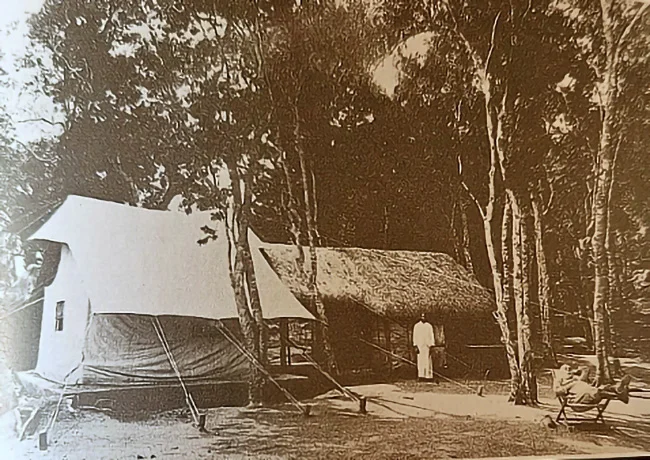
Bell camped out in a village (Bethia N, and Heather M Bell)
In every outing, the eyes of the Bell Party feasted on sights others see only decades later or never. They were the first to feel the touch of heavenly ladies marooned on a cave wall in Sigiriya, the most dangerous and demanding site the Bell Party worked. In contrast to this perilous adventure, Bell once wrote how Kaludiya Pokuna, a large black-water pool by the Mihintale hill, came into view before their eyes taking up a “delightful glen, as it suddenly bursts on the charmed gaze, entrancing in its quiet picturesqueness. A perfect sanctuary could not be found anywhere throughout the length and breadth of Ceylon. … Fringed by umbrageous trees, which dip their boughs in its placid depths, as hills offered inviting shade.” Bell then tweaked the 13th-century Indo-Persian poet Amir Kushrau: “Oh! If there be an Elysium on earth, it is this, it is this.”
But nothing matches an incident the Bell Party saw at Sigiriya in 1906, involving the Governor – the king’s representative and his Royal entourage. While the Governor and the Royal Duchess, sister-in-law of His Majesty, climbed down to the base of the Sigiriya rock ahead of others, the Bell Party was still on the top working on the ruins. Suddenly, the Governor’s daughter and the Bell Party workers saw over the precipice a bald man chasing and beating the princess with his hat. They were confused and alarmed.
Only later would they learn that the Governor was trying to protect the princess from an angry swarm of giant bees (bambaru) that descended and circled over her head. Probably, the workers at Sigiriya did a bad job of sedating the beehive with vedi dodan – a ball of leaves with various aromatic characteristics set on fire to burn slowly, generating smoke to sedate the bees.
A Monument for the Bell Party
A short essay like this does not do justice to memorialize the workers of the Bell Party. Far out where evidence of ancient settlements and structures existed, the work of this Party is a fond memory. In my village, it is not just a sobriquet, probably public knowledge of a valued tradition conferred from kings’ times.
Their story did not cross the pen of history and literary apostles in 19th- and 20th-century Sri Lanka because the Bell Party consisted of a bunch of coolies from distant villages. But they were the luckiest to find and raise the ancient monuments Sri Lankan kings fought wars to build and protect. Sadly, there isn’t even a lifeless fresco or a sign depicting their work beside the granite paneling near an ancient temple they reconstructed. The peaceful Toluwila Buddha sits at a museum entrance in Colombo over a hundred kilometers away from home, waiting to hear the names of the men and women of the Bell Party who helped it back to sit in its meditative state.
Although the collective pulsation of these men and women as they raised stone pillars and serene sages has become a welcoming breeze in the old city of Anuradhapura, kings standing arrayed in coronation ornaments, granite paneling reconnecting royal guard houses, and inscriptions on stone surfaces whispering elegancies of our past all thank the Bell Party for making all that a reality.
They worked with mechanics that would raise eyebrows among the Romans. Even with his passion, curiosity, and persistence, Bell would not have completed half of his pioneering work without Bell Party help.
We hardly find kings etching their names on these ancient structures they supervised building. In those days, they must have thought, rightly so, that it was a weird practice to engrave on a structure the name of the king, who I bet never got down to a mud pit to make a single brick. That’s probably why we don’t see King Kasyapa’s name anywhere near Sigiriya today.
The Bell Party stood by this ancient practice and did not scratch something as small as an initial on a brick they placed in mortar to reify an ancient wall. Until the Bell Party came around, history looked on as these great works fell into decay and those who built them remained nameless.
And yet.
The times have changed. The faddish trend now is to etch the names of the prominent few on a stone slab by a people- funded structure, rather than the actual workers who mixed concrete and set stones in place. Let it be known that none of this prominent few dropped something as a fistful of sand into the cement bucket to build it or offered a can of cold soda to a worker whenever they happened to pass by the site.
Therefore, to celebrate the group of exceptional Nuwarakalaviya villagers in the Bell Party, known on record as coolies, earth men, earth party, basket men, and warriors, and their headman, the incomparable H.C.P. Bell himself, I now request that the Archaeological Commissioner erect a 2 ft x 2 ft monument with appropriate wording celebrating their gracious contribution. It is the right thing to do, and not a bridge too far to cross.
Walk of Fame of Archaeological Survey
I cannot think of a better spot for this monument to go up than on what I call Sri Lanka’s Walk of Fame of Archaeological Survey – the cobblestone path connecting the Sri Maha Bodhi and the Ruwanweli Seya in the old city of Anuradhapura. Then present and future generations will know that a spirited group of labourers called the Bell Party worked to bring back the brilliance of our lost past. (Concluded).
The writer is the author of Pulse of the Jungle (Dayawansa Jayakody, 2000) and Ratashabhawa of Nuwarakalviya, grew up among several Bell Party members in Nuwarakalaviya.

Showers above 100 mm are likely at some places in the Western, Sabaragamuwa, Central, Uva and Southern provinces and in Anuradhapura district

PSTA worse than PTA: FSP

Shiranthi R remanded until 13 Oct.

Former NSB Chairman Kariyawasam granted bail

Katchatheevu row: India SC urges fishermen to avoid Sri Lankan waters

Remembering Juvenal, Coke, Acton and Machiavelli

‘Dates have the highest sugar content to fight Coronavirus’

Sunday Island 27 December – Headlines

#SundayIsland 17th December – Headlines

Sunday Island – 28th March

Sunday Island Headlines – 21 March

Sunday Island – 21st February – Headlines
-

 Editorial7 days ago
Colombo Port drug bust: The plot thickens
-

 Features5 days ago
The first woman in the foreign service or Ceylon Overseas Service it was then called
-

 Editorial6 days ago
Fuelling discontent and protest
-

 News4 days ago
Geneva takes up Sallay’s case and govt. ignores opportunity to answer accusations
-
 Foreign News5 days ago
Ten injured after car crashes into rugby supporters in Australia
-

 Latest News6 days ago
Tharindu Rathnayake, bowlers secure Asian Games Bronze for Sri Lanka
-
 News5 days ago
Nearly 20 Iranian tankers stranded off Lanka amid US sanctions
-

 Features4 days ago
Sri Lanka Cricket Bill: Governance reform is not yet a cricket strategy