
News
Lakpahana – Keeping the Traditions alive.

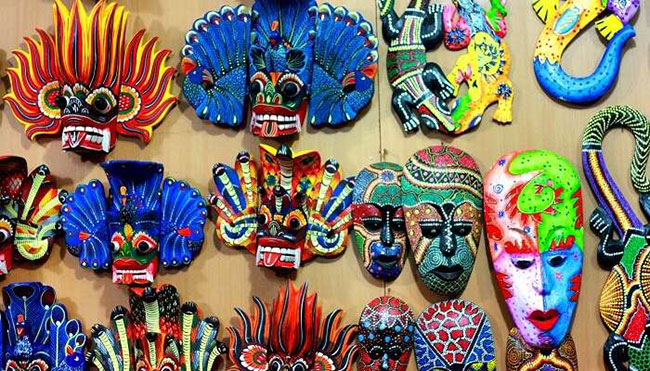
Lakpahana the undisputed leader of the Sri Lankan handicraft gifts and souvenir market retails only Sri Lankan made craft. It is a private sector organization started by Desamanya Mrs. Siva Obeyesekere in 1973. Lakpahana has for 46 years been helping local artisans for many decades. Mrs. Obeyesekere has passed all these traditions in craft to her grandson Dhevan de Saram just as the traditional artisans pass on their crafts and skills. Lakpahana is a keeper of these traditions. Many artisans depend on Lakpahana to keep the crafts and traditions alive. The simple motto which Lakpahana functions on is giving joy, by keeping traditions alive.
Lakpahana connects the discerning customer with many extraordinary Sri Lankan master artisans. Creative artisans have the freedom to make beautiful original crafts. Discerning customers have the unique opportunity of purchasing hand made products of quality at affordable prices. They have the joy of helping to nurture and elevate the crafts of Sri Lankan artisans. Lakpahana safeguards the artisans. Each product bought by a customer will give the artisan financial and motivational strength to carry on these age old crafts.
The artisans keep alive the traditional skills whilst infusing modern designs created by the designers involved at Lakpahana. Lakpahana therefore showcases local skills and talents through innovative products that appeal to international requirements. In the coming years we are looking forward to increase our satisfied customer base and increase and improve the sustainability of Sri Lankan crafts people.
Lakpahana is situated in Colombo 07, across from the Colombo Race Course. It has quickly gained popularity amongst customers for its wide array of Sri Lankan Handicrafts, offering an extensive range of choices for local and foreign customers.
Sri Lankan handicrafts production has been traditionally handed from generation to generation. It has strong linkage to the environment to the way of life, to the history, culture of the island and ceremonial ritual and daily life. It consists of many different products made out many different raw materials.
Folk crafts of a country also reveal a historical process of evolution in relations to the concept quality, techniques and material used. Craftsman attached to Lakpahana have earned an international reputation for quality, originality, variety of designs and motifs. Most of the finished products are fascinating expression of local concepts. The organization has won many UNESCO excellence awards for its products.
Basically the handicrafts products made in Sri Lanka are produced and patterned based on natural resources that are easily available in the country. In addition, due to the multi-racial composition of its citizens various types of craft products can be found and produced simultaneously. One of the main objectives of the Lakpahana is diversity and preservation of Sri Lankan’s handicrafts. It contributes in nurturing the heart, mind and soul of the craftspeople, artisans and artists in their pursuit of making traditional and contemporary crafts. Crafts are the symbols of a particular culture, because of that Lakpahana works to promote crafts and nurture craftsmen.
Lakpahana is a store which has exquisite silverware, silver jewellery, elegant brassware and pewter ware, beautifully patterned dumbara weaving mats, ladies handbags, etc. delicate lacquer ware ,intricate wood carvings, reed & rush ware, handloom items, embroidery, lace work, batik, educational toys, painted wooden wall hangings are some of the better known handicrafts.
Mat weaving is a craft, which is an old craft and exemplifies the cultural aspect. The origins, traditions and present form of the art of mat weaving using rush and reed dates back many centuries. In the early Stone Age people utilized the natural resources around them in order to meet the requirements of their day to day lives, be it hides for clothing, branches for roofing, reed for production of mats to sleep on.
Reed can be classified as a grass and is found growing amongst wetlands and marshy areas. In bygone days, paddy farmers would always have a plot of reed plants amidst their paddy field. A crop of this reed was used to produce baskets, sacks, mats, food covers and a host of other everyday items. Another aspect is that reed is long lasting and durable. Reed is the sole raw material in the production of mats in Sri Lanka. The growth of reed covers all directions in Sri Lanka, from Jaffna in the north to Hambanthota in the Deep South. The health benefits of sleeping on a reed mat are many. Firstly, reed mat placed on a flat surface, offers, critical support and comfort that is needed by the spine. The combination of using both hands and brain in weaving is said to be of immense therapeutic benefit.
The mat is not only a household utility item. It is an artifact. The Sri Lankan handmade mat has been decorated with various motifs from immemorial times. The motifs are called “Rata” in Sinhala and the mat woven with the motifs are called “Rata Pedura” (Decorated Mat). Among the traditional motifs there are floral motifs, animal motifs, geometrical motifs and also several miscellaneous motifs. Some of these Traditional motifs are “Samadaramal ratawa, Nelummal ratawa, Atapethimal ratawa, Mirismal ratawa, Hansaputtuwa, Makuluwa ratawa, Muwa ratawa, Vankagiriya ratawa, Diyarali ratawa, Katuru ratawa, Alli ratawa, Wellawehum ratawa, Kathira ratawa and Panimal ratawa, etc.” There also mat decorated with the letters of Sinhala alphabet and the English alphabet as well as numerals. What is significant in the weaving of these intricate motifs are that they are woven without using any tool or an instrument. These “Rata pedura” mats are available at Lakpahana.
Culture also includes traditional island sweetmeats. When searching for the most delicious and freshly made traditional treats. Head over to Lakpahana and indulge. Choosing from a variety of items such as stuffed veralu, coconut toffee, kalu dodol, narang kavum and unduwel. The items are made fresh on a daily basis. Everyday favourites such as murukku, marshmallows, aasmi, kokis, kavum and mung kavum are available in addition to neatly wrapped packages of love cake, bibikkan and jaggery cake.
Lunu dehi as is a popularly known is an integral part of Sri Lankan cuisine and even culture. These are just perfect for the festive season or even as a gift. Cake orders can be placed too. Tala bola, jiggery, coconut and milk toffees stock the shelves in addition to the other yummy treats. Lakpahana also has freshly prepared lamprais on orders. Other items available at Lakpahana include jars of bees’ honey (50ml/100ml), kithul jaggery, kithul treacle, lime pickle, seeni sambol and chutneys.
Lakpahana is open every day. From 9.30 a.m. – 6.30 p.m. Monday to Saturday. 10 a.m. – 6 p.m. on Sundays and holidays.

Latest News
Landslide RED warnings issued to the Divisional Secretaries Divisions of Ududumbara, Nildadndahinna and Walapane


The landslide early warning center of the National Building Research Organisation [NBRO] has issued RED warnings to the districts of Kandy and Nuwara Eliya for the next 24 hours effective from 0900 hrs today [09th January].
Accordingly,
LEVEL III RED landslide early warnings have been issued to the Divisional Secretaries Divisions and surrounding areas of Ududumbara in the Kandy district, and Nildandahinna and Walapane in the Nuwara Eliya district.
LEVEL II AMBER landslide early warnings have been issued to the Divisional Secretaries Divisions and surrounding areas of Wilgamuwa in the Matale district, and Mathurata and Hanguranketha in the Nuwara Eliya district.
LEVEL I YELLOW landslide early warnings have been issued to the Divisional Secretaries Divisions and surrounding areas of Uva Paranagama, Welimada, Kandaketiya, Badulla, Meegahakiwula, Hali_Ela, Passara and Lunugala in the Badulla district, Minipe in the Kandy district, Ambanganga Korale, Ukuwela, Rattota, Naula and Laggala_Pallegama in the Matale district, and Nuwara Eliya in the Nuwara Eliya district.
Latest News
A Policy is being formulated to ensure Child Protection in the use of Technology — Prime Minister

Prime Minister Dr. Harini Amarasuriya stated that a policy is currently being formulated to ensure child protection in the use of technology.
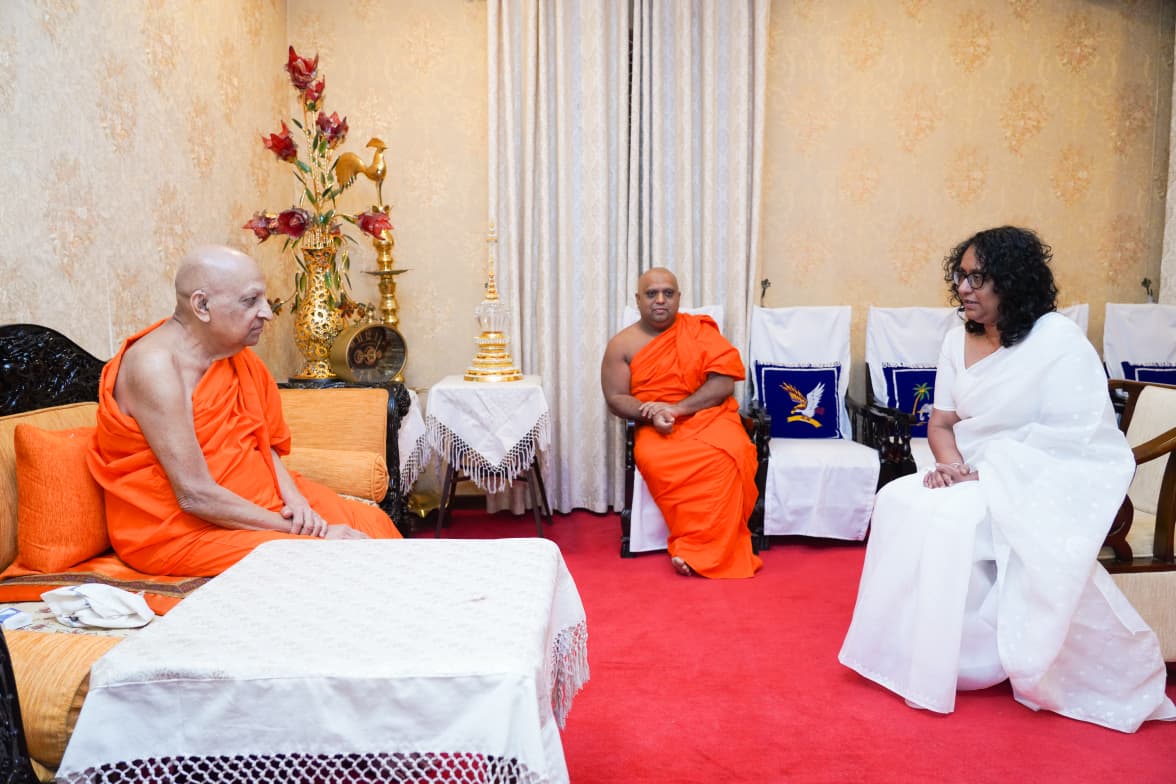
The Prime Minister made this statement on Thursday (08) in Kandy while briefing the Most Venerable Mahanayake Theros of the Asgiriya and Malwathu Chapters on the issue that has arisen regarding the Grade 6 English module. Thereafter, printed copies of all modules were presented to the Mahanayake Theros.
Earlier on Thursday (08), the Prime Minister visited the Malwathu Viharaya in Kandy and met the Most Venerable Thibbatuwawe Sri Siddhartha Sumangala Nayaka Thero, the Mahanayake of the Malwathu Chapter, where she explained the error that had occurred in the first print run of the English module for Grade 6 .
The Mahanayake Theros emphasized that education is a sensitive subject and that such matters should be handled with greater sensitivity and proper oversight. They further advised that a formal investigation should be conducted and that education reforms should be carried forward in a systematic manner.
Subsequently, the Prime Minister visited the Asgiriya Maha Viharaya and met the Most Venerable Warakagoda Sri Gnanarathana Mahanayaka Thero of the Asgiriya Chapter, where she clarified the error related to the English module.
The Mahanayake Thero noted that education reforms are a timely necessity and should be implemented with due oversight and careful review and also pointed out that there are broader issues in Sri Lanka regarding the use of technology, which are evident in the manner in which modern tools such as AI technologies are being used on social media.
Clarifying the issue Prime Minister Dr. Harini Amarasuriya further stated,
“We have appointed a committee to look into this issue, and based on the recommendations of the National Institute of Education (NIE), steps were taken to remove the relevant lesson. In addition, all printed copies of the relevant module have been stamped, and no module has been distributed to schoolchildren. A formal investigation into this matter has been initiated by the Ministry, and a complaint has also been lodged with the Criminal Investigation Department.
At the same time, we are in the process of formulating a policy on child protection in the use of technology”.
Thereafter, addressing the media and responding to the’ questions raised by journalists, the Prime Minister stated:
“The Opposition is attempting to use this national task for their own political advantage. However, many in society have expressed their views on the issues that have arisen in a positive manner, with the objective of identifying and correcting mistakes. The government has decided to move forward with education reforms by recognizing the error that have occurred and rectifying them. We will take the no-confidence motion brought by the Opposition as an opportunity to further advance dialogue on education reforms”
The occasion was graced by the Most Venerable Anunayaka Thero of the Asgiriya Chapter, Venerable Narampanawe Ananda Nayaka Thero; Deputy Registrar of the Asgiriya Chapter, Venerable Muruddeniye Dhammarakkhita Thero; Deputy Registrar of the Malwathu Chapter, Venerable Mahawela Rathanapala Thero; Members of Parliament Thushari Jayasinghe and Thanura Dissanayake; Mayor of Kandy Chandrasiri Wijenayake; Secretary to the Ministry of Education Nalaka Kaluwewa; and Secretary to the Ceylon Teachers’ Union in Central Province D. D. Wimalaweera.
[Prime Minister’s Media Division]
Latest News
The deep depression to the South-east of Sri Lanka is likely to intensify in to a cyclonic storm during the next 24 hours

A RED warning for a deep depression to the South-east of Sri Lanka has been issued at 01.00 a.m. on 09 January 2026 for the period until 01.00 a.m. 10 January 2026 by the Natural Hazards Early Warning Centre, of the Department of Meteorology.
The deep depression in the Bay of Bengal to the southeast of Sri Lanka (At 01:00 a.m. on Jan 9th, 2026 located about 200 km East of Pottuvil) is very likely to intensify further and move west-northwestwards towards the coast of Sri Lanka between Pottuvil and Trincomalee in the evening today (9th January 2026.) The system is likely to intensify in to a cyclonic storm
during the next 24 hours.
Hence, showery, and windy condition over the island, particularly in the Northern, North-Central, Eastern, Uva and Central provinces is expected to enhance.

Landslide RED warnings issued to the Divisional Secretaries Divisions of Ududumbara, Nildadndahinna and Walapane

Harmanpreet, Mandhana return to DY Patil, on opposite sides this time

Huge anti-government protests in Tehran and other Iranian cities, videos show

Clinical Pakistan look to keep momentum going and wrap up series

Astronaut’s ‘serious medical condition’ forces Nasa to end space station mission early

Six whales die after mass stranding on remote New Zealand beach

‘Dates have the highest sugar content to fight Coronavirus’

Sunday Island 27 December – Headlines

#SundayIsland 17th December – Headlines

Sunday Island – 28th March

Sunday Island Headlines – 21 March

Sunday Island – 21st February – Headlines
-

 News3 days ago
Interception of SL fishing craft by Seychelles: Trawler owners demand international investigation
-
 News3 days ago
Broad support emerges for Faiszer’s sweeping proposals on long- delayed divorce and personal law reforms
-
 News4 days ago
Private airline crew member nabbed with contraband gold
-

 News2 days ago
Prez seeks Harsha’s help to address CC’s concerns over appointment of AG
-

 Opinion7 hours ago
The minstrel monk and Rafiki, the old mandrill in The Lion King – II
-

 Latest News1 day ago
Warning for deep depression over South-east Bay of Bengal Sea area
-

 News2 days ago
Govt. exploring possibility of converting EPF benefits into private sector pensions
-

 Features3 days ago
Educational reforms under the NPP government