
Editorial
Lajja!


Friday 23rd May, 2025
The Constitutional Council (CC) has rejected President Anura Kumara Dissanayake’s nominee for the post of the Auditor General. The Opposition has torn into President Dissanayake—and quite rightly so—for his attempt to have one of his cronies elected to the post of Auditor General at the expense of a highly deserving officer with 30 years of experience in the Auditor General’s Department. The rejected nominee has only five years of experience in the Ceylon Petroleum Corporation, the Opposition has alleged.
Various professional associations, such as the Sri Lanka Audit Services Union, the Association of State Assistant Auditors Union, and State Auditors Union, have demanded to know why President Dissanayake overlooked the most deserving candidate for the post of Auditor General. But the government has chosen to remain silent.
The JVP-led NPP based its election campaigns on promises of good governance, etc., and flayed its political opponents for cronyism, which, it said, had ruined the public service. Now, the NPP is drawing criticism for cronyism.
The manipulation of the CC process yields adverse consequences. The incumbent government is all out to oust IGP Deshabandu Tennakoon. The controversy over his conduct would not have arisen if the Rajapaksa-Wickremesinghe government had not undermined the CC process to have him appointed IGP in early 2024. The CC was divided over his appointment; four members voted in favour of it, and two against it, with two others abstaining. The CC consists of 10 members, but it had only nine members at the time. The previous regime engineered a tie in the CC vote by interpreting abstentions as opposition to the appointment at issue and had Speaker Mahinda Yapa Abeywardenea cast what was made out to be a tie-breaking vote!
One of the main reasons why President Ranil Wickremesinghe became unpopular in spite of his courageous political leadership for breaking the back of the country’s worst-ever economic crisis was that he succumbed to the arrogance of power, defended the corrupt and other undesirables, and enabled his cronies to secure sinecures and top posts in the public service. He blatantly undermined the CC and even sought to make the judiciary bend to his will, but in vain. No surprise that he came a poor third in the 2024 presidential race.
Are we to conclude that some of his predecessors’ sordid practices have rubbed off on President Dissanayake?
Politicians intoxicated with power cannot bring themselves to stomach defeat, and therefore the government will do everything in its power to have an NPP loyalist appointed as the Auditor General to ensure that its interests will be served in state audits. They know more than one way to shoe a horse or skin a cat. Hence the need for robust constitutional safeguards to prevent governments from undermining the CC process to achieve their political ends.
The CC deserves praise for having intrepidly torpedoed President Dissanayake’s move to appoint a fellow university alumnus as the Auditor General. Such bold decisions will go a long way towards safeguarding the integrity of the key institution tasked with depoliticising the public service. However, the CC has not stipulated selection criteria for the nominees for the high posts. If they had been in place, President Dissanayake or his predecessors would not have been able to nominate their cronies for the top positions in the state institutions, according to their whims and fancies. The CC stands accused of either rejecting or endorsing nominees in an ad hoc manner. Parliament and the CC must take up this issue and introduce selection criteria so that not even a government capable of mustering a majority in the CC will be able to have officials appointed to top posts on the basis of their political affiliations.
The NPP is rapidly forfeiting its good governance credentials. Out of its sheer desperation to seize control of the hung local councils, it has unashamedly opted for a political honeymoon with the very councillors it condemned as crooks before the 06 May local government elections. In power politics, expediency takes precedence over scruples. Horse-trading over the hung local councils as well as the President’s attempt to elevate a crony to the post of Auditor General has proved that the current dispensation is not capable of resisting the corrupting influence of power. It’s the NPP government’s moment of shame or lajja!



Wednesday 13th May, 2026
Former President Mahinda Rajapaksa yesterday visited the Commission to Investigate Allegations of Bribery or Corruption (CIABOC), made a statement on the Airbus bribery scandal and returned home. A large number of his supporters flocked to Colombo to pledge solidarity with him. Speaking at a District Coordination Committee meeting at the Matale District Secretariat yesterday, President Anura Kumara Dissanayake stated that nobody was above the law, and anyone could be questioned in an investigation. He claimed that his predecessors had violated the Constitution and committed other offences, with impunity. His reference was obviously to President Rajapaksa making a statement to the CIABOC. By making that claim, President Dissanayake left room for allegations that he has a vested interest in the ongoing Airbus scandal investigation and defends the CIABOC action against Rajapaksa.
Yesterday’s show of strength near the CIABOC was organised by the SLPP. It is an affront to the intelligence of the public for anyone to claim that it was the result of a spontaneous outburst of public anger at an alleged move to frame former President Rajapaksa. Such protests are tantamount to attempts to intimidate the CIABOC. It is the organisers of such events who were responsible for Rajapaksa’s defeat in the 2015 presidential election and his ouster as Prime Minister in 2022, when they acted like the proverbial monkey that killed his sleeping royal master by striking a mosquito with the king’s own sword. They attacked the peaceful Aragalaya protesters at Galle Face, triggering widespread retaliatory attacks. The rest is history.
President Dissanayake yesterday said in Matale that his government had ensured that nobody was above the law and urged the public to bring instances of selective law enforcement, if any, to his attention. Is he unaware that the NPP politicians are more equal than others before the law? Kumara Jayakody was not arrested over the coal procurement scam, which is believed to have caused a loss of more than Rs. 10 billion to the state coffers, and led to a situation where a colossal amount of diesel has to be burnt daily to produce power to meet a generation shortfall at Norochcholai due to the use of low-grade coal imported by a company favoured by the government while Jayakody was the Minister of Energy. Power tariffs have been increased to recover the losses caused by the substandard coal imports. It may be recalled that Keheliya Rambukwella was arrested and prosecuted during the previous government for procuring substandard medicines while he was the Health Minister. That administration initially defended Rambukwella but did not stoop so low as to prevent his arrest and make a cover-up attempt by setting up a presidential commission of inquiry to probe all drug procurement issues in the Health Ministry under successive governments. President Dissanayake has appointed a presidential commission to investigate alleged irregularities in coal procurement since 2009! They must be probed, but the allegations against Jayakody are so serious that they should have been investigated separately on a priority basis.
Ironically, while President Dissanayake was waxing eloquent about his government’s commitment to upholding the rule of law, bashing his predecessors for having violated the Constitution, and claiming that his government had ended the culture of impunity, the Joint Opposition levelled a very serious allegation against him. Former Minister of Justice and Constitutional Affairs Prof. G. L. Peiris, addressing the media in Colombo, said that at a recent May Day rally, President Dissanayake had committed a serious offence by asking the public to get ready to hail the judgement to be delivered in a court case on 25 May. Pointing out that only the judge who heard a case was privy to the judgement therein before it was delivered and could not inform a third party of it or have any discussion thereon, Prof. Peiris said interference with the judiciary was a very serious offence, according to the Constitution, and a person who committed it was liable to one-year imprisonment and the suspension of civic disabilities for five years. He said the Joint Opposition had brought the President’s statement at issue to the attention of the Chief Justice and would take it up with international professional associations.
The public may not have a high opinion of the Opposition, which has quite a few tainted politicians among its ranks, but shouldn’t the JVP-NPP government and their leaders turn the searchlight inwards and put their own house in order before preaching to others about the virtues of good governance?
Tuesday 12th May, 2026
US President Donald Trump yesterday rejected Iran’s response to his peace proposal. He wants the conflict ended on his own terms, but Iran is not amenable to that idea. Oil prices have gone up again.
The economic cost of the US-Israeli war on Iran is incalculable, as is obvious. There has been a welcome pause in the conflict, thanks to a fragile ceasefire, but economies across the world are still reeling due to a global energy crisis. CEO of Saudi Aramco Amin Nasser is of the view that the world has lost about one billion barrels of oil over the past two months, and it will take energy markets a considerable time to stabilise even if the oil supplies resume via the Hormuz Strait, the closure of which has curtailed shipping and sent energy prices through the roof. It is not only energy supplies that have suffered due to the US-Israel military campaign; many countries are experiencing crippling fertiliser shortages as well, so much so that the Food and Agriculture Organization of the UN has warned of a possible decline in global agricultural output. Most of all, the human cost of the war has been enormous for Iran.
Israeli Prime Minister Benjamin Netanyahu, who considers the war on Iran a dream come true for him, and is trying to turn his country’s military might into political gain, has reportedly said that there is still “work to be done” in Iran. He says Iran has retained many of the capabilities it had at the start of the war. Iran has not given up its enriched uranium or dismantled its nuclear sites, he has said. This claim is at variance with President Trump’s statement that the US military has “beaten and completely decimated” Iran. Netanyahu himself has also bragged that Iran has been militarily weakened as never before.
Netanyahu wants enriched uranium in Iran removed urgently. He says that can be done as part of an agreement to be reached. He has stopped short of mentioning any timeline for the proposed task. Trump has expressed a similar view. An Iranian news outlet linked to the country’s armed forces has denied reports that Tehran agreed to allow its enriched uranium stocks to be removed as part of talks with the United States. Thus, the uranium issue is sure to stand in the way of finding a lasting solution to the West Asia conflict, saving lives and properties and facilitating uninterrupted energy and fertiliser supplies via the Hormuz chokepint.
The US-Israeli military campaign has apparently strengthened Iran’s resolve to acquire nuclear capability. In a world where nuclear weapons are the currency of power, Tehran is not likely to give up its nuclear programme. Any country with nukes is a danger to the world, but only the US has so far carried out nuclear attacks. Not even North Korea has done so. Those who got a head start in the nuclear race decades ago have built huge nuke stockpiles, which are believed to be sufficient to blow up this planet several times over. The new world order based on the law of the jungle has left many countries struggling to safeguard their independence, and some of them are pursuing their nuclear ambitions in keeping with what can be described as the de Gaulle doctrine.
Charles de Gaulle rightly argued that no country without the atomic bomb could properly consider itself independent. He maintained that national sovereignty required an autonomous nuclear force, which he called the force de frappe, which alone, in his opinion, was the ultimate guarantee of political independence and great-power status. So, it is only natural that countries that feel threatened and have the wherewithal are trying either to shore up their nuclear stockpiles or to arm themselves with nukes.
While Trump is devising ways and means of grabbing Iran’s enriched uranium, in a dramatic turn of events, the FBI and other federal agencies have launched investigations into the deaths or disappearances of about 10 top US nuclear and space scientists, according to international media reports. US House Oversight Committee Chairman James Comer has suggested, in an interview with Fox News, that there has been a foreign involvement in these deaths and disappearances. Republican Congressman Eric Burlison has claimed they have “all the hallmarks of a foreign operation” and cited China, Russia and Iran as potential lines of inquiry.
Self-righteous powerful nations’ calls for nuclear non-proliferation to make the world safe ring hollow. If the much-peddled argument that no more countries should acquire nuclear capability to ensure global safety is to gain credibility and wider acceptance, the proponents of it must accelerate nuclear disarmament, decommission their arsenals and lead by example. Most of all, they ought to take cognisance of what US President Dwight D. Eisenhower said in his famous “Cross of Iron speech” on war in 1953, highlighting the opportunity cost of military spending and stressing that resources used on weapons are stolen from the people struggling to meet their basic needs: “Every gun that is made, every warship launched, every rocket fired signifies, in the final sense, a theft from those who hunger and are not fed.” How true!
Monday 11th May, 2026
Tamilaga Vettri Kazhagam (TVK) leader Chandrasekar Joseph Vijay has achieved his chief ministerial dream in Tamil Nadu, with the help of some other parties, including the Congress. His meteoric rise to power was possible mostly due to his popularity as a film star, his unrealistic promises and a massive protest vote fuelled by anti-politics. Winning elections is one thing, but living up to people’s expectations by fulfilling campaign promises is quite another. In politics, a beginner’s luck rarely lasts long. If implemented, the freebies promised by Vijay to garner favour with voters, are estimated to account for more than 50% of Tamil Nadu’s tax revenue. Thus, Vijay has his work cut out to prevent his first chief ministerial term from facing the same fate as his first film, which reportedly became a box office bomb.
The paradigm shift in Tamil Nadu politics has sent the Colombo commentariat into overdrive, with divergent assessments of its implications for Sri Lanka and Indo-Lanka relations. Some commentators are of the view that Vijay’s anti-Sri Lanka utterances were mere campaign rhetoric; Vijay himself will forget them with the passage of time, and even if he wants to pursue his pledges, especially the one to retrieve Katchatheevu, there will be nothing he cannot do, as New Delhi considers the issue long settled. The proponents of this argument have apparently ignored the fact that the Indian Centre is swayed by Tamil Nadu, and New Delhi has even resorted to extreme measures to appease the Tamil Nadu politicians and further its own interests at the expense of Sri Lanka. India trained, armed and funded pro-Eelam terror groups, and rammed the Indo-Lanka Accord down President J. R. Jayewardene’s throat in 1987, paving the way of devolution. India was hoist with its own petard, with the LTTE turning against it, a few years later, and the situation changed.
The current world order is anything but “rules based”. International pacts, accords, covenants, treaties, charters, etc., become worthless when the powerful signatories thereto feel like violating them. The US has violated the UN Charter, perhaps for the umpteenth time, by abducting President of Venezuela Nicolás Maduro and his wife. It has also carried out unprovoked air strikes on Iran, killing its Spiritual Leader and thousands of civilians besides destroying assets worth billions, if not trillions, of dollars.
It has been alleged that at the height of the 2022 uprising here, following the forced resignation of President Gotabaya Rajapaksa, Indian High Commissioner Gopal Baglay pressured Speaker Mahinda Yapa Abeywardene to take over the presidency in violation of the Constitution. Abeywardene told Parliament subsequently that the goal of those who tried to force him to appoint himself the Acting President was to plunge this country into anarchy. Baglay allegedly acted in violation of the Vienna Convention on Diplomatic Relations, which requires diplomats to refrain from interfering with the internal affairs or politics of the host countries. Curiously, this very serious allegation remains unprobed though the grandees of the JVP-NPP government and the SJB-led Opposition wrap themselves in the flag and often declare their commitment to protecting the national interest.
The possibility of the new Tamil Nadu administration escalating the issue of illegal fishing in Sri Lankan waters to such an extent that New Delhi may feel compelled to intervene more assertively, if not aggressively, cannot be ruled out. In 2013, the then Minister of Fisheries and Aquatic Resources Development Dr. Rajitha Senaratne disclosed that certain Tamil Nadu politicians owned trawlers and rented them out on the strict condition that they be used for poaching in Sri Lankan waters. These troublemakers are likely to step up their illegal fishing operations to belittle Sri Lanka’s sovereignty and bring New Delhi and Colombo on a collision course.
Responses to vital bilateral issues should not be grounded solely in suspicions and perceptions if they are to be workable. Tamil Nadu politicians’ hostility towards Sri Lanka is a problem to be managed diplomatically. Foreign relations are layered and dynamic, and diplomacy requires calibrated responses to contentious issues. It is, however, prudent to be cautious.

Complete all projects funded under the LKR. 500 bllion allocation for Ditwah within this year – President

Development projects should be carried out in line with the practical needs of the people – PM

Ayesha Zafar’s rapid ton crushes Zimbabwe

Donald Trump lands in China for high-stakes meeting with Xi Jinping

Gujarat Titans go No.1 after Rabada and Holder rout Sunrisers Hyderabad

Showers will occur in the Western, Sabaragamuwa, Central, North-western and Northern provinces and in Anuradhapura, Trincomalee, Galle and Matara districts

‘Dates have the highest sugar content to fight Coronavirus’

Sunday Island 27 December – Headlines

#SundayIsland 17th December – Headlines

Sunday Island – 28th March

Sunday Island Headlines – 21 March

Sunday Island – 21st February – Headlines
-

 News7 days ago
MIT expert warns of catastrophic consequences of USD 2.5 mn Treasury heist
-
 News4 days ago
Lanka Port City officials to meet investors in Dubai
-
 News20 hours ago
Ex-SriLankan CEO’s death: Controversy surrounds execution of bail bond
-

 Editorial7 days ago
Clean Sri Lanka and dirty politics
-
 News5 days ago
SLPP expresses concern over death of former SriLankan CEO
-

 Editorial6 days ago
The Vijay factor
-
 News5 days ago
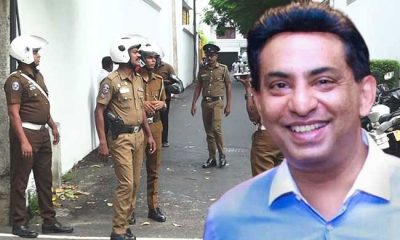
Police inform Fort Magistrate’s Court of finding ex-CEO of SriLankan dead under suspicious circumstances
-
Features2 days ago
High Stakes in Pursuing corruption cases