
Sports
Knight leads from the front as England take opening T20I

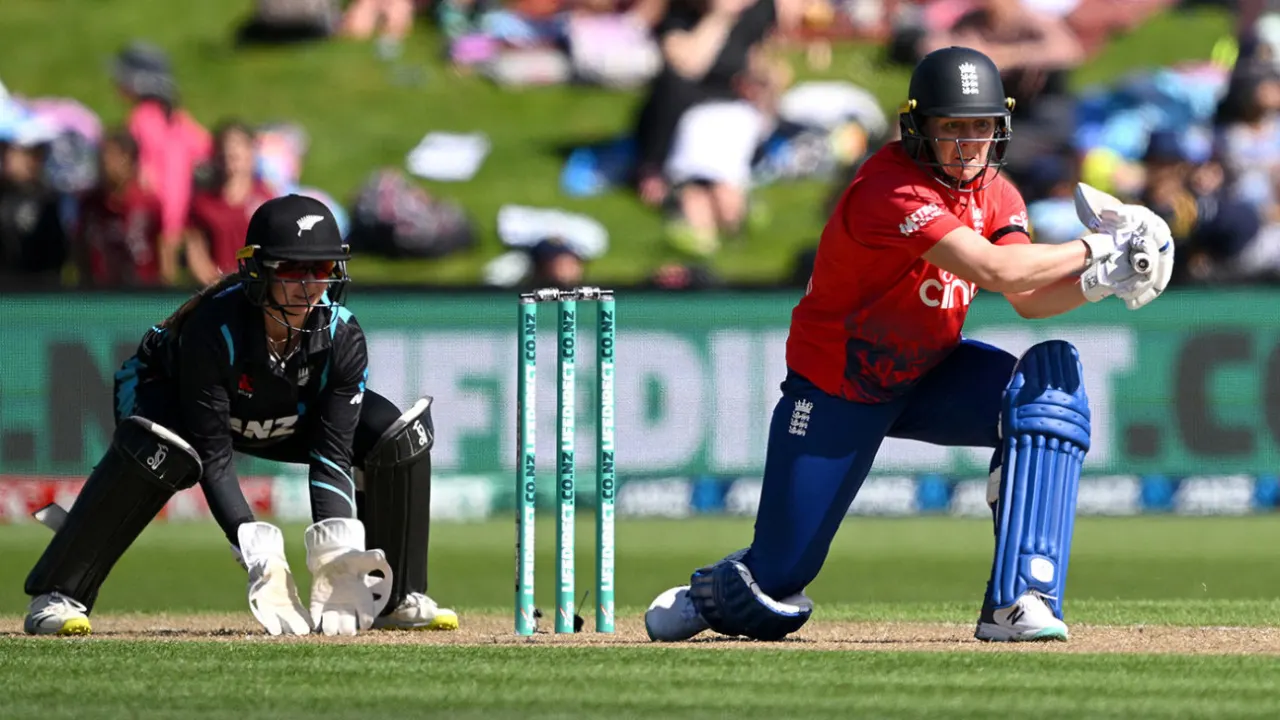
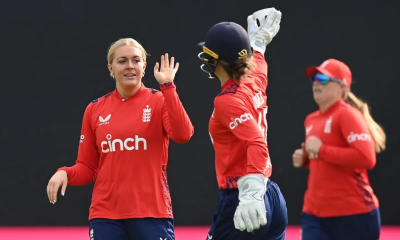
In a game of two captains’ innings, it was Heather Knight who came out victorious as England took the opening T20I of the five-match series in Dunedin by 27 runs.
Knight, who opted out of the WPL to lead England from the start of this tour, put together a superbly-paced 63 off 39 balls to steer the visitors to 160 for 4 with handy contributions from Sophia Dunkley and Maia Boucher.
Suzie Bates, standing in for Sophie Devine as she returns from the WPL where she won the title with Royal Challengers Bangalore, did her best to carry the chase with 65 off 51 balls but a batting line-up without Devine and Amelia Kerr couldn’t provide enough support at a high enough tempo.
New Zealand should be boosted by the return of the two stars for the next match in Nelson while England’s WPL players – Alice Capsey, Sophie Ecclestone, Nat Sciver-Brunt, and Danni Wyatt – won’t enter the series until after the third game.
Tammy Beaumont returned at the top of the order for her first T20I in more than two years and the 100th of her career. She was given an early life on 1 when Hannah Rowe couldn’t hold onto a chance above her head at mid-on and then there were some positive signs for Beaumont before she found mid-off against the left-arm spin of Fran Jonas.
Either side of the powerplay ending, Dunkley hit her stride having initially reached 11 off 14 balls. She twice found the boundary in the sixth and seventh overs against Rowe and Rosemary Mair as 27 runs came to give England’s innings a shot in the arm. Dunkley was starting to motor when she picked up her sixth boundary, but Lea Tahuhu struck back the next ball with a short delivery that was top-edged behind.
At the midway point, England were 72 for 2 with Knight and Bouchier working to give themselves a platform. It took Knight a little time to get going and she was 8 off 10 balls before collecting her first boundary with a thumping straight drive off Jess Kerr. Then she was up and running.
The England captain needed just another 23 deliveries to bring up her half-century from 33 balls which included taking Tahuhu over wide long-on for six in the 18th over that cost 18 runs. At that point, 170 was well within sight for England but New Zealand clawed the innings back well in the last two overs, leaking just 11 runs.
The third-wicket stand of 91 off 64 balls ended when Knight walked past a full delivery from Jess. Bouchier, who had been dropped on 26 and 37, the first a sitter by Maddy Green at mid-on, ended with a career-best in T20Is but, unlike Knight, couldn’t elevate her scoring rate in the same way.
Lauren Bell struck in the first over of the chase to have Izzy Gaze caught at cover second ball (she could have been run out off her first) but stand-in captain Bates ensured New Zealand remained level-pegging to what England have achieved in the powerplay – 44 for 1 compared to 41 for 1.
Bates took on the opening over of debutant quick Lauren Filer with three boundaries – a strong clip, a big top edge to third and a bludgeon over the on side – to lay down the gauntlet. But England’s spinners, including Knight, proved harder work and there wasn’t the required scoring rate from the other batters.
George Plimmer showed glimpses before skying Sarah Glenn to short fine leg then Green was becalmed early in her innings as the asking rate grew. Green’s stay was ended in somewhat unfortunate circumstances when Bates crunched a straight drive into Charlie Dean which ricocheted onto the non-striker’s stumps with Green well short.
Bates just about kept New Zealand alive before picking out deep square leg for 65 off 51 balls at which point 52 were needed off the last three overs. The trio of Plimmer, Green and Brooke Halliday managed 56 off 61 balls between them.
Scores:
England Women 160 for 4 in 20 overs (Sophie Dunkley 32, Heather Knight 63, Maia Bouchier 43; Jess Kerr 1-26, Fran Jonas 1-30, Lea Tahuhu 1-36) beat New Zealand Women 133 for 5 in 20 overs (Suzie Bates 65, Georgia Plimmer 21, Brooke Halliday 27*; Lauren Bell 2-29, Sarah Glenn 1-17) by 27 runs









Hurdler Kaveesha Dilshan of Kularathna MV, Godakawela and sprinter Risansa Hirupama of Lyceum International, Wattala were named best athletes for their outstanding performances at the All Island Schools Games Athletics Championships, which concluded at Diyagama on Tuesday.
Dilshan earned the title with a 14.02-second run in the Under 20 boys’ 110m hurdles. Kishal Oshada, the best athlete in the Under 18 category, also comes from his school. Both hurdlers are trained by Thiron Gamage, and both outclassed their opponents in the sprint hurdles.
Hirupama excelled in the Under 20 girls’ 200m. Her time of 24.23 seconds earned the highest score in the girls’ events (1,026 points).
St. Joseph Vaz’s College, Wennappuwa, and Lyceum International, Wattala, claimed the overall boys’ and girls’ championships respectively.

Kaveesha Dilshan and sprinter Risansa Hirupama with
their best athlete awards. (Pix by Kamal Wanniarachchi
St. Joseph Vaz’s amassed 118 points to finish ahead of Maris Stella College, Thimbirigaskatuwa (95). Rahula College, Matara, took third place with 82 points. Former track and field powerhouses St. Benedict’s, Kotahena (54), and Maris Stella, Negombo (54), missed out on the top three.
Lyceum dominated the girls’ category with 215 points. Dharmapala College, Pannipitiya (70), and Ave Maria Convent, Negombo (62), finished second and third respectively.
For the first time in more than two decades, Ratnayake Central were not among the leading teams in the girls’ category. Most of their athletes struggled after an outbreak of flu, but late performances over the last two days helped them secure fourth place. (RF)

Mahanma College, Colombo and Nalanda College Colombo registeted convincing victories in the quarter finals while dark horses Wesley ended Richmond’s unbeaten run with a win according to the DLS method to seal the semi-final spots of the Under 19 Division I Tier A tournament on Tuesday.
Mahanama rattled St. Joseph’s for meagre 84 runs before cruising to a seven-wicket win at Mattegoda. Kaushika Thilakarathne and Sanuka Ganepola shared seven wickets between them to trouble the Joes.
Thilakarathne spearheaded the bowling attack, claiming four wickets for 13 runs in nine overs, while Sanuka Ganepola supported him with an impressive spell of three for nine in nine overs. Sanul Weerarathne captured two wickets for 12 runs.
Mahanama reached 85 for three wickets as Sineth Veerarathne top scored with 52 runs (53 balls).
Nalanda College defeated St. Anthony’s College, Katugastota by 77 runs at Campbell Place.
Nalanda posted a competitive 234 for six in their allotted 50 overs, with Ranmith Senarath top-scoring with 52 off 79 balls. Nemindu Akmeemana contributed 47, while Lithum Wijekumara made 32. Mihin Zoysa added 29 before Santhul Wijeyarathne provided a late boost with an unbeaten 30 off just 13 deliveries.
In their essay St. Anthony’s were dismissed for 157 in 44 overs. Sadew Amarakoon fought hard with 47 off 94 balls, while Kaushika Kumarasinghe scored 38 off 41 deliveries. However, Nalanda’s bowlers maintained control, with Rusandu Silva taking four wickets for 22 runs. Osanda Pamuditha supported him with two wickets for 22 runs to seal a convincing victory for the hosts.
After posting 141 for six in 30 overs, Wesley did well to restrict Richmond to 109 for eight in 23 overs to stay ahead according to DLS method at Weeraketiya.
Adhyaan Zain and Senura Lakshan bowled controlled spells taking three wickets each to seal the semi-final place. Wesley are set to meet Nalanda in the semis. (RF)

by Reemus Fernando
Heshara Jayasinghe, Shashen Rajapaksha and Dilini Rajapaksha were among the athletes who excelled creating meet records during the morning session of the final day of the All Island Schools Games Athletics Championship at Diyagama on Tuesday.
Shashen Ravihansa Rajapaksha of Ratnayake Central Walala set the tone on the track, clocking an impressive 8:58.50 to win the Under 18 boys’ 3000 metres. The time established a new meet record and made the school’s presence felt to a great extent. Many Ratnayake Central athletes had fallen ill recently denying them their usual top positions in the overall points table.

Dilini Rajapaksha in action in the Under 18 girls’ triple jump (L) / K.K. Baalasooriya of Sumana Balika Vidyalaya Ratnapura in action in the Under 20 girls’ discuss throw (R)
In field events, Heshara Jayasinghe of St. Joseph Vaz’s College Wennappuwa produced a landmark performance in the Under 20 boys’ shot put. His effort of 17.30 metres made him the first athlete in the event’s history to clear the 17 metre mark, and it also broke the meet record previously held by Jayavi Ranhinda Alwis.
Abhimani Kodituwakku of Dharmapala College Pannipitiya delivered a remarkable run in the Under 20 girls’ 400 metres hurdles. Her time of 1:01.57 erased the nine-year-old record held by Yamani Dulanjali of Ambagamuwa Central.
K.K. Baalasooriya of Sumana Balika Vidyalaya Ratnapura joined the record-breakers with a throw of 41.82 metres in the Under 20 girls’ discus throw.
Lyceum International Wattala’s Dilini Rajapaksha then created a new meet record in the Under 18 girls’ triple jump, clearing 12.73 metres.

Shashen Ravihansa Rajapaksha of Ratnayake Central Walala
won the Under 18 boys’ 3000 metres with a new record mark. (L) / Gimhani Pulle of St. Andrew’s MV won the Under 18 girls’ 3,000 metres. (R)

Low-quality coal causes power cuts: Ex-LECO Chief

Power cuts continue

GL stresses importance of post-war Shangri-La investment after CIABOC questions him

Coal inquiry gets extension until 16 December

Dilshan, Hirupama named best athletes at All Island Schools Games Athletics Championships

Saudi Vision 2030 offers new economic opportunities for Sri Lanka

‘Dates have the highest sugar content to fight Coronavirus’

Sunday Island 27 December – Headlines

#SundayIsland 17th December – Headlines

Sunday Island – 28th March

Sunday Island Headlines – 21 March

Sunday Island – 21st February – Headlines
-

 Features3 days ago
Kotahena:A Small Enclave, An Extraordinary Legacy
-

 News4 days ago
Asgiri Mahanayake calls for immediate release of Gnanasara Thera
-

 News3 days ago
Record 1,600 students take Russian Classical Ballet examination in Sri Lanka
-

 News6 days ago
AC President recuses himself from hearing prison attire case pertaining to Gnanasara Thera
-

 Latest News7 days ago
Heavy showers above 100 mm are likely at some places in the Western, Sabaragamuwa, Southern, Central, and North-western provinces and in Anuradhapura district.
-

 News5 days ago
Naval officer testifies Yoshitha received Rs. 5.15 mn in salaries during SLN service
-

 News3 days ago
Karannagoda pushed for £24,536 for Yoshitha’s UK training, Court told
-

 News6 days ago
CID informs Fort Magistrate’s Court investigation into money laundering case against Namal completed