
Sports
Kipchoge ‘fulfills legacy’ winning second consecutive Olympic marathon

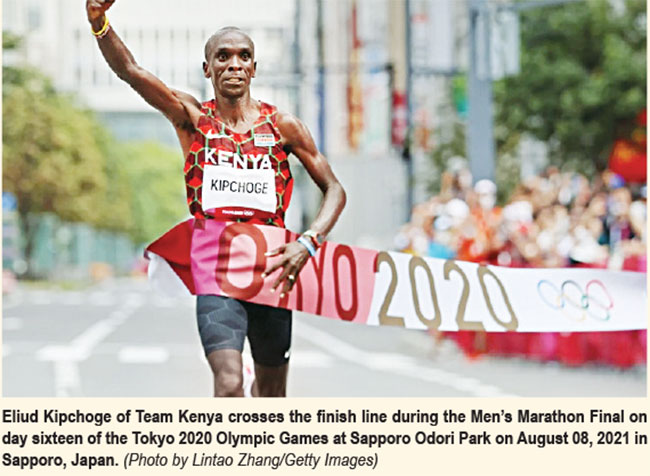
World record-holder Eliud Kipchoge became the third man in history to successfully defend the Olympic marathon title as he delivered a masterclass in running to win the men’s marathon at the Tokyo Olympic Games on Sunday.
The Kenyan runner, competing in his fourth Olympics, crossed the finish line in Sapporo Odori Park in a time of two hours eight minutes and 38 seconds. His winning margin of 1:20 was the widest in an Olympic marathon since Frank Shorter’s win in 1972.
“In Rio, he waited until the 36th kilometre to break away. Yesterday, his decisive move came in the 31st. By the 38th, the Kenyan more closely resembled a solitary figure out on a morning training run than a man leading the Olympic marathon,” the World Athletics described the Kenyan’s feat in its new report. He’d built a lead of more than one minute by that point, with no other runner within view.
“I think I have fulfilled the legacy by winning the marathon for the second time, back-to-back. I hope now to help inspire the next generation,” said Kipchoge, who joined 1960 and 1964 champion Abebe Bikila of Ethiopia and East German Waldemar Cierpinski, the winner in Montreal in 1976 and Moscow in 1980, as a back-to-back winner.
“It means a lot for me, especially at this time. It was really hard last year, with the Olympic Games postponed. I am happy for the local organising committee who made this race happen. It is a sign that shows the world we are heading in the right direction – we are on the right transition to a normal life.”
Kipchoge, won bronze in Athens in 2004 and silver in Beijing 2008 in the 5000m before his marathon gold in Rio in 2016.
But this addition to his collection is Kenya’s fifth medal in the men’s Olympic marathon since the Games in Beijing in 2008.
Like Saturday’s women’s race, the pace was conservative and cautious throughout, with a large group of nearly 50 runners going through the opening five kilometres in 15:17 and ten in 30:53, on pace for a modest 2:10:19 finish. Kipchoge was at or near the front throughout, taking turns in the lead with Colombian Jeison Alexander Suarez and Daniel do Nascimento of Brazil who seemed to enjoy the opportunity of leading a pack that included the greatest marathoner of all-time.
Little changed at 15 kilometres (46:03) where 2016 bronze medallist Galen Rupp of the US and Kipchoge’s teammate Lawrence Cherono were also chipping in with the pacing duties.
The field was beginning to spread out by the time Stephen Mokoka of South Africa reached the halfway point in 1:05:13, with 23 runners still within three seconds of the lead. At the head of the pack, Kipchoge was the picture of calm and cool, and was playful too, as he exchanged a fist bump with Brazil’s Daniel do Nascimento as they continued to take turns at the front.
The first big break came in the 27th kilometre when the lead pack was reduced to 12, but with Kipchoge still firmly dictating the proceedings. Rupp was still there, along with Belgian Bashir Abdi and Dutchman Abdi Nageeye, Kipchoge’s teammates Cherono and Kipruto, and Alphonce Felix Simbu of Tanzania.
By 30km (1:32:31) the pack further dwindled to eight, but that apparently wasn’t to Kipchoge’s liking. Less than a kilometre later, he injected a surge that quickly created considerable daylight between him and the remaining chase pack. He then began to pour it on, building a 27-second lead through 35 kilometres (1:46:59). He extended it to more than a minute five kilometres later. The only company he had in the waning moments were the substantial crowds that turned out to watch the race.
Behind him, Cherono, Ayad Lamdassem of Spain, and training partners Abdi and Nageeye battled it out for the remaining two podium spots. Nageeye won that battle, crossing the line in 2:09:58, two seconds clear of Abdi.
“I said so many times I wanted a top three, but I never made it. So today I was just focusing. Focus, focus, focus,” said Nageeye, who finished 11th in Rio. “When I reached 39km I just knew (I would win a medal). I was feeling really easy with three kilometres to go. I knew I had just nine minutes to run. It is unbelievable.”
“I always believed in myself,” he continued. “I was a nomad, I packed my bags and trained in France, America, Ethiopia, Kenya. To stand on the podium with Eliud Kipchoge, the greatest of all time – It is amazing.”
Abdi too was a believer. Without Nageeye, he said, it would be unlikely that he’d finish on the podium.
Of the 106 runners who started, 76 finished.



Georgia Wareham towered over the rest with an impressive all-round show to lead Gujarat Giants to an impressive opening match win over UP Warriorz.
Wareham’s unbeaten 10-ball 27 gave Giants the finishing kick they needed to nudge past 200, after a half-century from Ashleigh Gardner had laid the perfect platform. Then Wareham picked up the massive wickets of Meg Lanning and Harleen Deol to scupper Warriorz’s chase.
Phoebe Litchfield’s 40-ball 78 kept Warriorz in the hunt, but her dismissal proved decisive. Warriorz, however, managed to stem some net-run-rate damage courtesy a neat cameo from Asha Sobhana.
Sophie Devine briefly wrested the initiative in the powerplay, taking down Deepti Sharma in the fourth over, but a double-strike kept Giants in check. Beth Mooney was undone by a Sophie Ecclestone arm-ball in the fifth over, while Devine holed out to deep midwicket off Shikha Pandey for a 20-ball 38 in the sixth.
She exhibited this best when she danced down the track and got leg-side of the ball before lofting Ecclestone inside-out between cover and point for four. Gardner, initially measured, shifted gears decisively in the 13th over, carving Kranti Gaud for three boundaries.
She turned up the heat further, launching three sixes, off Asha and Ecclestone, across the 14th and 15th overs. Giants plundered 49 runs from overs 13 to 15, a burst that carried Gardner to her half-century off just 30 balls.Wareham walked in halfway through the 17th over, and had stamped her mark on the innings by the end of Giants’ innings. The highlight was her onslaught against Deandra Dottin, the former Giants allrounder, hitting for three sixes in the 19th over.
Wareham could have been dismissed on 13, though, had Gaud held on to a simple chance at cover point in the same over. Bharti Fulmali then showcased her hitting prowess, muscling Deepti for two sixes in the final over to take Giants past 200.
Warriorz lost Kiran Navgire in the first over, to Renuka Singh, but Litchfield looked in sparkling form from the outset. Her exhilarating strokeplay somewhat consigned Mrg Lanning to the background for much of their 70-run second-wicket stand before the floodgates opened, with Warriorz losing three wickets in four deliveries to go into a full-blown collapse.
At 74 for 4, Warriorz held back Dottin and promoted their lone retention, Shweta Sehrawat. And she made everyone go wow first ball, launching Renuka down the ground for six. If that was audacious, two consecutive sixes off Gardner in the following over were truly exhilarating.
Litchfield’s progress to her half-century in 29 balls was no less entertaining. She swept, reverse-swept, paddled, and moved across the stumps to mow length deliveries into the leg side.
Warriorz’s hopes rose through the course of a fifth-wicket stand of 69, but Litchfield’s dismissal, coming soon after that of Sehrawat who was bowled missing a slog-sweep off Rajeshwari Gayakwad, proved to be the clincher.
Asha’s cameo from there on merely reduced the margin of defeat.
Brief scores:
Gujarat Giants Women 207 for 4 in 20 overs (Beth Mooney 13, Sophia Devine 38, Ashleigh Gardner 65, Anushka Sharma 44, Georgia Wareham 27*, Bharati Fulmali 14*; Shikha Pandey 1-29, Deandra Dottin 1-47, Sophie Ecclestone 2-32) beat UP Warriorz Women 197 for 8 in 20 overs (Meg Lanning 30, Phoebe Litchfield 78, Shweta Sehrawat 25, Deandra Dottin 12, Sophie Ecclestone 11, Asha Sobhana 27*; Renuka Singh 2-25, Sophie Devine 2-55, Ashleigh Gardner 1-37, Georgia Wareham 2-30, Rajeshwari Gayakwad 1-07) by 10 runs
[Cricinfo]

After a nail-biter slipped through their hands in the last over of the opening night of WPL 2026, defending champions Mumbai Indians bounced back with style and thrashed three-time table-toppers Delhi Capitals with bruising half-centuries from their experienced duo of Nat Sciver-Brunt and Harmanpreet Kaur, and a three-for from their fresh recruit Nicola Carey, Chasing an imposing 196, DC slipped to 33 for 4 in the sixth over and hardly ever looked like bouncing back, eventually falling short by 50 runs.
As is often the case for MI, the heavy lifting with the bat was done by Sciver-Brunt and Harmanpreet, especially in the absence of the injured allrounder Hayley Matthews. After the boundary-laden half-century from Sciver-Brunt and some late sixes from Harmanpreet powered MI close to 200, Carey’s early seam movement knocked over the off stumps of Shafali Verma and Laura Wolvaardt, before also accounting for Marizanne Kapp. From 33 for 4, DC stuttered to 86 for 6 as Amelia Kerr also chipped in with an economical spell and three wickets that rolled over DC for 145.
For the second game in a row, MI’s openers failed: Kerr fell for a duck while Gunalan Kamalini struggled to 16 off 19. After a scratchy 4 off 15 on Friday night in the season opener, Kerr edged her first legal delivery – an outswinger from Chinelle Henry – behind, as Lizelle Lee completed a diving catch on her second attempt. Kamalini also handed a diving catch to Lee, soon after she smashed Nandani Sharma for consecutive fours down the ground, but the debutant’s riposte earned her a maiden WPL wicket with Kamalini’s thick outside edge.
Sciver-Brunt then led MI’s innings and looked in top form, smashing three fours in her first four balls to different corners of the ground. She collected another pair of consecutive fours, again going after Henry, and took MI to 43 for 1 in the powerplay. While Sciver-Brunt went about finding the boundaries against the spinners too for a 32-ball fifty, Harmanpreet took her time to reach 15 off 17 before taking off.
The Harmanpreet act started when she dispatched Henry for six over long-on. She followed it with her trademark loft over the covers for four, to take MI past 100 at the end of the 13th over. Sciver-Brunt then outfoxed Minnu Mani with late adjustments for three fours in the next over, which went for 14, and even though the England batter was soon caught for 70 at cover, MI were set for a strong finish on 127 for 3 after 15.
Harmanpreet was not going after the bowlers by herself, however. She found a hard-hitting partner in Carey, who reverse-pulled for one of her four fours during her 21 off 12. But it was Harmanpreet’s clean striking that left the new DC captain Jemimah Rodrigues sweating, as the experienced MI leader played with the field, especially in the last over off Shree Charani. She hit four back-to-back fours to help MI collect 53 runs in the last four overs.
With Meg Lanning – the WPL’s second-highest scorer – released before the auction, DC had big shoes to fill at the top of the order. It didn’t happen on Saturday, at least, as Lee fell for 10 on her WPL debut.
Shafali and Wolvaardt then saw their off stumps pegged back as Carey seamed the ball into them, in the space of three balls in the fifth over. When Rodrigues fell to a one-handed stunner from Kamalini behind the stumps off Shabnim Ismail, DC had lost four wickets in the powerplay for the first time in the WPL.
DC still had hope with depth in their line-up, but when Kapp was also sent back by Carey, DC needed a stiff 150 runs from 78 balls. Chinelle Henry’s hitting from No. 7 was the only silver lining for DC. Her penchant for boundaries belied DC’s score as she went after the inexperienced Triveni Vasishta – on WPL debut – and even the experienced Kerr. While she collected boundaries, wickets fell at the other end, and the asking rate climbed from over 12 after the halfway mark to nearly 20 by the time four overs were left.
Henry brought up her second WPL fifty in eight innings with a big six over long-on, but once she fell for 56 with the score 133, DC lasted just 11 more balls for 12 runs, before going down in their season opener.
Brief scores:
Mumbai Indians Women 195 for 4 in 20 overs (GunalanKamalini 16, Harmanpreet Kaur 74*, Nat Sciver-Brunt 70, Nicola Carey 21; Chinelle Henry 1-32, Shree Charani 1-45, Nandani Sharma 2-26) beat Delhi Capitals Women 145 in 19 overs (Lizelle Lee 10, Marizanne Kapp 10, Niki Prasad 12, Chinelle Henry 56, Sneh Rana 11, Shree Charani 10*; Shabnim Ismail 1-14, Nat Sciver Brunt 2-29, Amelia Kerr 3-24, Nicola Carey 3-37, Sanskriti Gupta 1-09) by 50 runs
[Cricinfo]


The upcoming T20 World Cup, featuring 20 teams across a frenetic three-week carnival, has whetted appetites among fans, players and administrators alike. Scratch beneath the surface and the contenders fall neatly into three baskets. There are the heavyweights; Australia, England and India, with South Africa firmly in that front rank. Then come the dark horses: Pakistan, New Zealand and Afghanistan, sides capable of blowing hot and cold but dangerous on their day. And finally, the also-rans, teams largely battle-hardened through the qualifying grind.
As co-hosts, Sri Lanka would like to believe they belong in the second bracket, coming into the tournament as dark horses rather than merely making up numbers. But form, that most unforgiving of judges, tells a harsher story. Six months out from the World Cup, the former champions have looked closer to the third category than the second. In an era where 200 has become par for the course in T20Is, Sri Lanka are struggling to bat out their 20 overs, a red flag if ever there was one. Their opening skirmish against Pakistan in the ongoing series did little to lift the mood or the belief.
The obvious question is: what have Pakistan done right that Sri Lanka haven’t?
No one expects Sri Lanka to suddenly roll out a production line of express quicks to rival Pakistan’s fearsome fast-bowling arsenal. That cupboard is well stocked in Pakistan and admired by all and sundry. But their batting depth and spin options have not materialised overnight. They are the dividends of continuity and clarity, commodities Sri Lanka have been short of.
Take Kamindu Mendis. Across formats, he has been a reliable all-rounder, even if he hasn’t always set the world on fire. Yet the evidence is there: his skill set is good enough to win you games. Once you identify such a player, you give him a long rope. You don’t pull the plug after a couple of low scores.
Then there is the curious case of Kusal Janith Perera. It is hard to fathom how a player deemed good enough for the squad struggles to crack the playing XI. KJP is a destructive batter, a high-risk, high-reward operator. His methods won’t always win him admirers, but impatience with a proven match-winner smacks of short-term thinking.
Continuity, after all, is the bedrock of a successful cricket team. There was little logic in stripping Charith Asalanka of the T20 captaincy. Now low on confidence, he risks sliding out of World Cup contention altogether.
Selectors have also dusted off an old playbook by turning again to Dhananjaya de Silva. Before and during the last World Cup, he was tasked with batting through the innings to arrest collapses. The experiment failed and he was axed. Now, on the eve of another World Cup, he is back in the saddle. It feels less like strategy and more like musical chairs.
The other burning issue is the gaping hole in the lower order. Too many bowlers are passengers with the bat, leaving the tail exposed. Dunith Wellalage offers a partial solution, yet he has failed to cement his place. Yes, his bowling can be a weak link, but if he was identified as a future star, the onus was on the management to back him, build his confidence and tell him he belongs in the big league.
With the World Cup at home and conditions tailor-made for spin, an operator like Wellalage should have been banked on long ago.
Rex Clementine
in Dambulla ✍️

National Communication Programme for Child Health Promotion (SBCC) has been launched. – PM

Level I landslide early warnings issued to the Districts of Badulla, Kandy, Matale and Nuwara-Eliya extended

Rescuers race to find dozens missing in deadly Philippines landfill collapse

Trump seeks $100bn for Venezuela oil, but Exxon boss says country ‘uninvestable’

US military strikes Islamic State group targets in Syria, officials say

Gardner and Wareham lead Giants to opening-game victory

‘Dates have the highest sugar content to fight Coronavirus’

Sunday Island 27 December – Headlines

#SundayIsland 17th December – Headlines

Sunday Island – 28th March

Sunday Island Headlines – 21 March

Sunday Island – 21st February – Headlines
-

 News5 days ago
Interception of SL fishing craft by Seychelles: Trawler owners demand international investigation
-

 News9 hours ago
Sajith: Ashoka Chakra replaces Dharmachakra in Buddhism textbook
-
 News5 days ago
Broad support emerges for Faiszer’s sweeping proposals on long- delayed divorce and personal law reforms
-

 Opinion2 days ago
The minstrel monk and Rafiki, the old mandrill in The Lion King – II
-

 Features2 days ago
The Venezuela Model:The new ugly and dangerous world order
-

 Latest News2 days ago
Rain washes out 2nd T20I in Dambulla
-

 Business1 day ago
Sevalanka Foundation and The Coca-Cola Foundation support flood-affected communities in Biyagama, Sri Lanka
-

 News4 days ago
Prez seeks Harsha’s help to address CC’s concerns over appointment of AG