
Features
KEY TO DEVELOPMENT IS COMMITTED AND ETHICAL LEADERSHIP


BY OMAR KAMIL
The Presidential Election of 1988 was held amid fear of disruption and death threats to campaigners. During the election period, a curfew was in force from 11 pm to 5 am throughout the month from Nomination to Polling Day while the forces of disruption were also enforcing fear psychosis, causing shops, government institutions, offices, and even court houses to close regularly.
From Nomination Day, the candidates Prime Minister Ranasinghe Premadasa, Mrs. Sirima Bandaranaike and Mr. Ossie Abeygunasekara were conducting their election campaigns under heavy security. People were fearful of attending meetings, and attendance at most meetings was limited. The JVP did not run at this election.
Traveling to ‘Sirikotha’ in Battaramulla in the evening hours was a nightmare due to fear of being stopped by violent mobs who opposed the elections. Prime Minister Premadasa’s campaign headed by Mr. Sirisena Cooray held its meetings at the Colombo at Mayor’s residence while the General Secretary of the UNP, Mr. Ranjan Wijeratne, operated from Sirikotha in Battaramulla. Those present at the Mayor’s residence were, Messrs Sirisena Cooray, Jehan Cassim, Imran Markar, F. A. Yaseen, A. H. M. Azwer, Siridharan, myself, and a few others.
As a Municipal Councilor in Colombo, I was appointed co-ordinator of the Northern and Eastern Provinces while others were assigned to co-ordinate the other 25 districts. Due to the curfew, public meetings were held in the mornings and would end around 8.00 p.m. to enable people to get back to their homes before the curfew came into force.
Under these trying circumstances, Prime Minister Ranasinghe Premadasa launched his election campaign in Kandy at a meeting chaired by Hon, E.L. Senanayake MP. In view of the local people being unable to get involved in stage arrangements etc due to reprisals, party workers and supporters from Colombo decorated the stage and surroundings and participated at the meeting.
Election meetings were held throughout the country by the candidates, but under a cloud of uncertainty of disruption by those who opposed the elections. Despite all these threats and obstacles created by the JVP to discourage polling or casting of votes, the people braved the threats and voted in numbers for Mr. Premadasa, giving him over 50% of the total vote cast in the first count.
The economy of the country during this period was in dire straits as the JVP called for a boycott of Indian products and imports from India, disrupting the of Colombo Port with wildcat strikes and many shipping lines bypassed Colombo calling at neighboring ports instead. The conflict in the north and east of Sri Lanka was a further burden on the economy.
President Ranasinghe Premadasa assumed office on December 20, 1988, at a time when Treasury reserves had dwindled to a very low ebb and was barely sufficient to service three to four weeks of imports. Oil imports too could not be made as the establishment of Letters of Credit required at least two months requirement of foreign exchange to be held in the Treasury.
Upon assuming office, one of the first acts of the new president was to appoint Retired Deputy Governor of the Central Bank, Dr. H. N. S. Karunathilaka, as the Governor of the Central Bank of Sri Lanka, He was immediately sent off to Washington to finalize a Standby Agreement with the IMF (International Monetary Fund).
Although stringent conditions were laid by lending agencies such as the World Bank and International Monetary Fund, the president confidently renegotiated the terms and conditions of the agreement without burdening the people with additional taxes.
The Privatization Program of the IMF was effectively transformed to a people friendly “Peoplization” (a new word coined by the president) with the ownership of plantation lands being retained by the government in respect of the estates vested under the Land Reform Commission (LRC), Janatha Estate Development Board (JEDB) and Sri Lanka State Plantation Corporation (SLSPC). Nine Regional Transport Boards were established in all the Provinces and each Province was called upon to manage the transport services without seeking funds from the Treasury.
The requirement of the IMF to prune the numbers employed in the Government sector led to a Voluntary Retirement Scheme (VRS) being introduced through Treasury Circular 44/90, whereby those above 50-years of age could retire on pension.
The management of estates vested in the LRC were leased for 30 years to quoted Regional Plantation Companies with previous plantation management experience and this arrangement reduced the burden of the Treasury paying workers’ and staff wages and salaries hitherto funded by it.
All these innovative measures helped to reduce the burden on the Treasury and the economy began to pick up slowly. In order to increase Foreign Direct Investment (FDI), the President introduced a 200-garment factory program expanding the Free Trade Zone (FTZ) concept enabling factories located throughout the country to enjoy benefits previously restricted to areas under the Greater Colombo Economic Commission (GCEC) which was replaced by the Board of Investment (BOI).
This helped to locate factories even in the remotest parts of the country to provide employment to workers near their homes so that the wages they earned would be circulated in the village.
All these steps brought prosperity throughout the country and within a short period of two years, the foreign reserves which were barely sufficient for three weeks imports increased to five and a half months. In addition, incentives were given to the tourist industry to build hotels and resorts all over the country.
President Premadasa identified the best men for the jobs that needed to be done. Among them were Finance Secretary R. Paskaralingam, Secretary to the President K.H.J. Wijayadasa, Chairman BOI Lakshman Watawala, and retired civil servant Baku Mahadeva appointed to chair the National Development Bank among others.
Mr. Karu Jayasuriya, a successful businessman, was appointed to head the Government Owned Business Undertaking (GOBU) of United Motors Ltd which was vested in the state by the previous government. This institution was privatized and within a short period its shares were sold through the stock market. This innovation was a resounding success with the share prices trebling in the first month.
All these and many other innovative measures introduced by President Premadasa resuscitated the local economy despite of the conflict in in the North and East. In 1991, the JVP leaders and their cadres were arrested and peace was restored in the South of the country.
While the country was returning to normalcy and the economy being stabilized, foreign investors came here to be a part of developing Sri Lanka. Among them was the developers of the high-rise Twin Towers in the Colombo Fort.
With the JVP conflict brought under control, the President appointed a committee headed by Prof GL Pieris, Vice Chancellor of the University of Colombo, to submit a report on the youth unrest in the country. This report revealed that wherever poverty was at the highest, the insurrection was the most intense proving that one of the prime reasons for youth unrest was unemployment and poverty.
The US Quota for manufactured garments was distributed among factories countrywide and higher incentives granted to those located in the most remote areas as well as where the youth unrest was at its worst. Within a period of 18 months over 150 garments factories were in operation in many parts of the country including the Northern and Eastern Provinces.
Each factory was required to employ 500 female workers giving youth an opportunity to be employed in their own villages without trekking to the city. Prosperity started spreading throughout the country even to the remotest villages affected by both JVP and LTTE insurrections. The country was on the road to recovery, villages began to reawaken and progress and development was visible all around.
The president’s initiatives in other areas of development too were noteworthy. All projects commenced were monitored by officials specially assigned for the task. The president and his team ensured that they were completed and implemented within the stipulated time frame. President Premadasa brought about a total transformation in Sri Lanka. He was successful as he identified the right team of capable public officers to undertake a daunting task and ensure timely implementation.
The economic situation of Sri Lanka in 1988 with an ongoing North and East conflict coupled with JVP insurgency in other parts of the country was much worse than the economic crisis Sri Lanka faced in 2022/2023. Fortunately, astute leadership along with persons of integrity being appointed in the right place were the reasons that the country was able to come out of the crisis by 1990.
President Premadasa was not only able to win the hearts and minds of people of different communities but also won the confidence of the international community and funding agencies. This made top world business leaders and conglomerates come to Sri Lanka and invest here helping to rejuvenate the economy.
In today’s context, there’s much to learn from the recent history of Sri Lanka. It’s evident that even organizations like the IMF and other funding agencies are willing to engage in renegotiation of credit terms with leaders who can win their trust and confidence. This is crucial as it prevents the imposition of huge burdens on the people through increased taxes in various forms. It’s important to remember that the success of state-owned enterprises at that time was largely attributable to the appointment of professionals and skilled personnel assigned to manage various Institutions.
What the country lacks today is strong leadership with vision and determination to ensure that targets are met within set periods. President Premadasa had a commendable track record of identifying the right person for the job and constantly monitoring progress which ensured that projects were completed as planned.
Sri Lanka awaits a dynamic leader of vision to set the country right and develop its true potential. Hopefully, the necessary qualities will be available among those aspiring for the presidency later this year. Fortunately, Sri Lanka is not lacking in such talent; it’s just a matter of identifying and empowering them to lead effectively. The people now have the opportunity of electing leaders of the calibre of H.E. Ranasinghe Premadasa, a man of determination with a vision to develop the country, providing equal opportunities to all the people of the North, East, South and West.
(The writer was a senior local politician in Colombo who served both as Deputy Mayor and Mayor of Colombo in the nineties and a term as Ambassador to Iran)


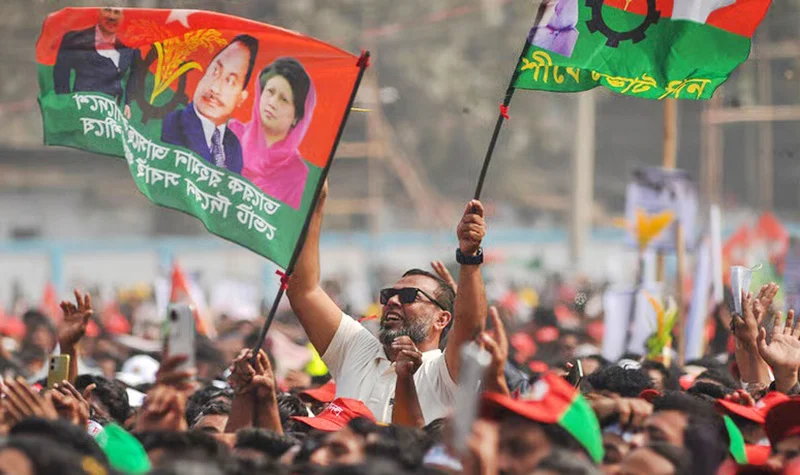
 Will the Bangladesh parliamentary election bring into being a government that will ensure ethnic and religious harmony in the country? This is the poser on the lips of peace-loving sections in Bangladesh and a principal concern of those outside who mean the country well.
The apprehensions are mainly on the part of religious and ethnic minorities. The parliamentary poll of February 12th is expected to bring into existence a government headed by the Bangladesh Nationalist Party (BNP) and the Islamist oriented Jamaat-e-Islami party and this is where the rub is. If these parties win, will it be a case of Bangladesh sliding in the direction of a theocracy or a state where majoritarian chauvinism thrives?
Chief of the Jamaat, Shafiqur Rahman, who was interviewed by sections of the international media recently said that there is no need for minority groups in Bangladesh to have the above fears. He assured, essentially, that the state that will come into being will be equable and inclusive. May it be so, is likely to be the wish of those who cherish a tension-free Bangladesh.
The party that could have posed a challenge to the above parties, the Awami League Party of former Prime Minister Hasina Wased, is out of the running on account of a suspension that was imposed on it by the authorities and the mentioned majoritarian-oriented parties are expected to have it easy at the polls.
A positive that has emerged against the backdrop of the poll is that most ordinary people in Bangladesh, be they Muslim or Hindu, are for communal and religious harmony and it is hoped that this sentiment will strongly prevail, going ahead. Interestingly, most of them were of the view, when interviewed, that it was the politicians who sowed the seeds of discord in the country and this viewpoint is widely shared by publics all over the region in respect of the politicians of their countries.
Some sections of the Jamaat party were of the view that matters with regard to the orientation of governance are best left to the incoming parliament to decide on but such opinions will be cold comfort for minority groups. If the parliamentary majority comes to consist of hard line Islamists, for instance, there is nothing to prevent the country from going in for theocratic governance. Consequently, minority group fears over their safety and protection cannot be prevented from spreading.
Therefore, we come back to the question of just and fair governance and whether Bangladesh’s future rulers could ensure these essential conditions of democratic rule. The latter, it is hoped, will be sufficiently perceptive to ascertain that a Bangladesh rife with religious and ethnic tensions, and therefore unstable, would not be in the interests of Bangladesh and those of the region’s countries.
Unfortunately, politicians region-wide fall for the lure of ethnic, religious and linguistic chauvinism. This happens even in the case of politicians who claim to be democratic in orientation. This fate even befell Bangladesh’s Awami League Party, which claims to be democratic and socialist in general outlook.
We have it on the authority of Taslima Nasrin in her ground-breaking novel, ‘Lajja’, that the Awami Party was not of any substantial help to Bangladesh’s Hindus, for example, when violence was unleashed on them by sections of the majority community. In fact some elements in the Awami Party were found to be siding with the Hindus’ murderous persecutors. Such are the temptations of hard line majoritarianism.
In Sri Lanka’s past numerous have been the occasions when even self-professed Leftists and their parties have conveniently fallen in line with Southern nationalist groups with self-interest in mind. The present NPP government in Sri Lanka has been waxing lyrical about fostering national reconciliation and harmony but it is yet to prove its worthiness on this score in practice. The NPP government remains untested material.
As a first step towards national reconciliation it is hoped that Sri Lanka’s present rulers would learn the Tamil language and address the people of the North and East of the country in Tamil and not Sinhala, which most Tamil-speaking people do not understand. We earnestly await official language reforms which afford to Tamil the dignity it deserves.
An acid test awaits Bangladesh as well on the nation-building front. Not only must all forms of chauvinism be shunned by the incoming rulers but a secular, truly democratic Bangladesh awaits being licked into shape. All identity barriers among people need to be abolished and it is this process that is referred to as nation-building.
On the foreign policy frontier, a task of foremost importance for Bangladesh is the need to build bridges of amity with India. If pragmatism is to rule the roost in foreign policy formulation, Bangladesh would place priority to the overcoming of this challenge. The repatriation to Bangladesh of ex-Prime Minister Hasina could emerge as a steep hurdle to bilateral accord but sagacious diplomacy must be used by Bangladesh to get over the problem.
A reply to N.A. de S. Amaratunga
A response has been penned by N.A. de S. Amaratunga (please see p5 of ‘The Island’ of February 6th) to a previous column by me on ‘ India shaping-up as a Swing State’, published in this newspaper on January 29th , but I remain firmly convinced that India remains a foremost democracy and a Swing State in the making.
If the countries of South Asia are to effectively manage ‘murderous terrorism’, particularly of the separatist kind, then they would do well to adopt to the best of their ability a system of government that provides for power decentralization from the centre to the provinces or periphery, as the case may be. This system has stood India in good stead and ought to prove effective in all other states that have fears of disintegration.
Moreover, power decentralization ensures that all communities within a country enjoy some self-governing rights within an overall unitary governance framework. Such power-sharing is a hallmark of democratic governance.
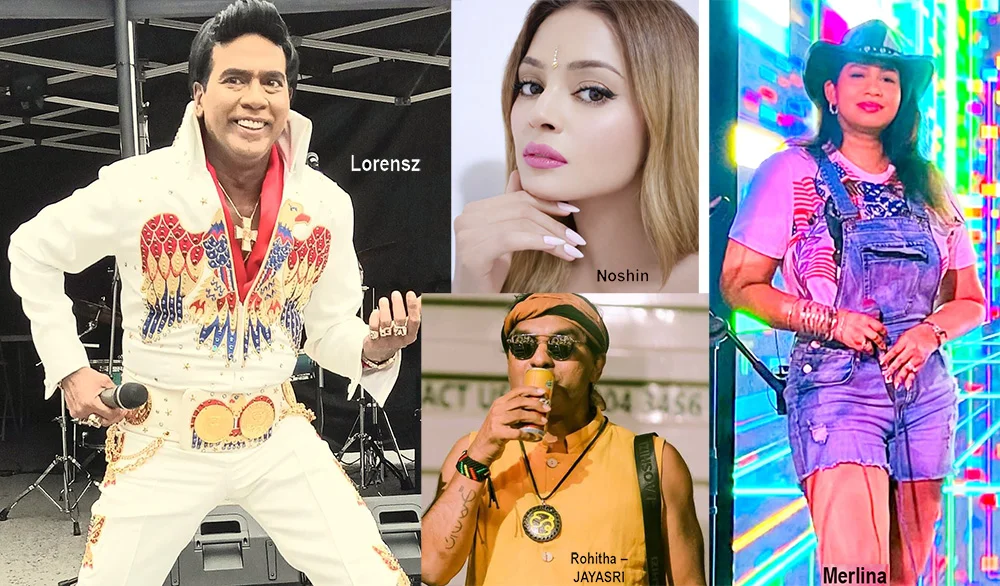
 Valentine’s Day is all about celebrating love, romance, and affection, and this is how some of our well-known personalities plan to celebrate Valentine’s Day – 14th February:
Merlina Fernando (Singer)
Yes, it’s a special day for lovers all over the world and it’s even more special to me because 14th February is the birthday of my husband Suresh, who’s the lead guitarist of my band Mission.
We have planned to celebrate Valentine’s Day and his Birthday together and it will be a wonderful night as always.
We will be having our fans and close friends, on that night, with their loved ones at Highso – City Max hotel Dubai, from 9.00 pm onwards.
Lorensz Francke (Elvis Tribute Artiste)
On Valentine’s Day I will be performing a live concert at a Wealthy Senior Home for Men and Women, and their families will be attending, as well.
I will be performing live with romantic, iconic love songs and my song list would include ‘Can’t Help falling in Love’, ‘Love Me Tender’, ‘Burning Love’, ‘Are You Lonesome Tonight’, ‘The Wonder of You’ and ‘’It’s Now or Never’ to name a few.
To make Valentine’s Day extra special I will give the Home folks red satin scarfs.
Emma Shanaya (Singer)
I plan on spending the day of love with my girls, especially my best friend. I don’t have a romantic Valentine this year but I am thrilled to spend it with the girl that loves me through and through. I’ll be in Colombo and look forward to go to a cute cafe and spend some quality time with my childhood best friend Zulha.
JAYASRI
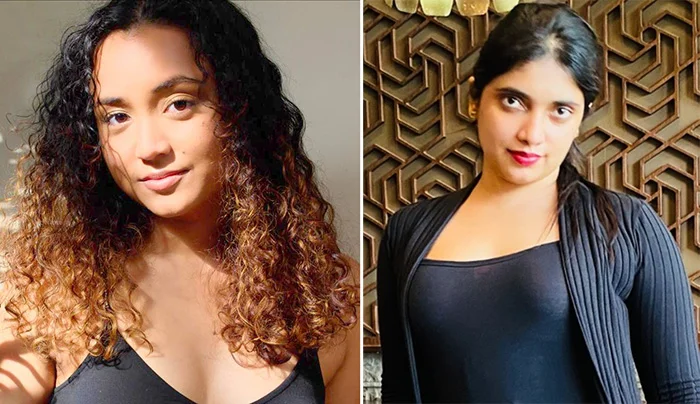
Emma-and-Maneeka
This Valentine’s Day the band JAYASRI we will be really busy; in the morning we will be landing in Sri Lanka, after our Oman Tour; then in the afternoon we are invited as Chief Guests at our Maris Stella College Sports Meet, Negombo, and late night we will be with LineOne band live in Karandeniya Open Air Down South. Everywhere we will be sharing LOVE with the mass crowds.
Kay Jay (Singer)
I will stay at home and cook a lovely meal for lunch, watch some movies, together with Sanjaya, and, maybe we go out for dinner and have a lovely time. Come to think of it, every day is Valentine’s Day for me with Sanjaya Alles.
Maneka Liyanage (Beauty Tips)
On this special day, I celebrate love by spending meaningful time with the people I cherish. I prepare food with love and share meals together, because food made with love brings hearts closer. I enjoy my leisure time with them — talking, laughing, sharing stories, understanding each other, and creating beautiful memories. My wish for this Valentine’s Day is a world without fighting — a world where we love one another like our own beloved, where we do not hurt others, even through a single word or action. Let us choose kindness, patience, and understanding in everything we do.
Janaka Palapathwala (Singer)
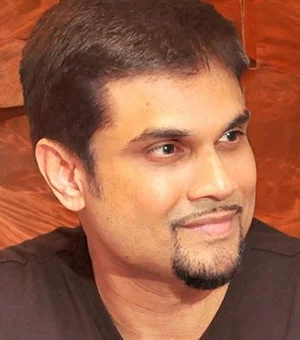
Janaka
Valentine’s Day should not be the only day we speak about love.
From the moment we are born into this world, we seek love, first through the very drop of our mother’s milk, then through the boundless care of our Mother and Father, and the embrace of family.
Love is everywhere. All living beings, even plants, respond in affection when they are loved.
As we grow, we learn to love, and to be loved. One day, that love inspires us to build a new family of our own.
Love has no beginning and no end. It flows through every stage of life, timeless, endless, and eternal.
Natasha Rathnayake (Singer)
We don’t have any special plans for Valentine’s Day. When you’ve been in love with the same person for over 25 years, you realise that love isn’t a performance reserved for one calendar date. My husband and I have never been big on public displays, or grand gestures, on 14th February. Our love is expressed quietly and consistently, in ordinary, uncelebrated moments.
With time, you learn that love isn’t about proving anything to the world or buying into a commercialised idea of romance—flowers that wilt, sweets that spike blood sugar, and gifts that impress briefly but add little real value. In today’s society, marketing often pushes the idea that love is proven by how much money you spend, and that buying things is treated as a sign of commitment.
Real love doesn’t need reminders or price tags. It lives in showing up every day, choosing each other on unromantic days, and nurturing the relationship intentionally and without an audience.
This isn’t a judgment on those who enjoy celebrating Valentine’s Day. It’s simply a personal choice.
Melloney Dassanayake (Miss Universe Sri Lanka 2024)
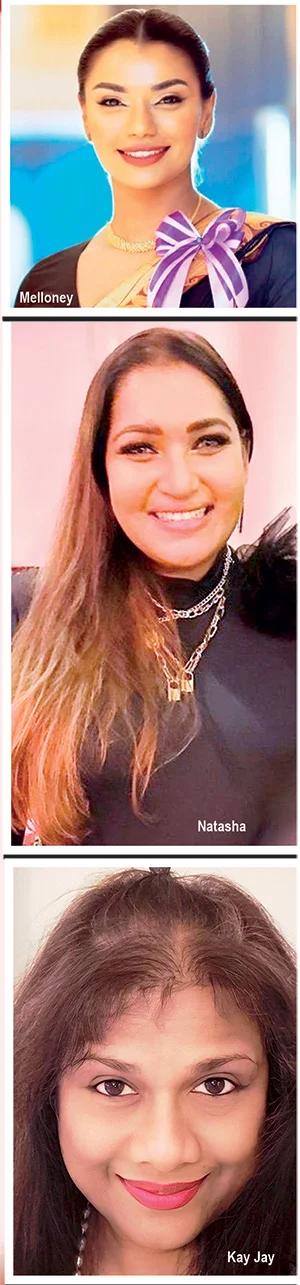 I truly believe it’s beautiful to have a day specially dedicated to love. But, for me, Valentine’s Day goes far beyond romantic love alone. It celebrates every form of love we hold close to our hearts: the love for family, friends, and that one special person who makes life brighter. While 14th February gives us a moment to pause and celebrate, I always remind myself that love should never be limited to just one day. Every single day should feel like Valentine’s Day – constant reminder to the people we love that they are never alone, that they are valued, and that they matter.
I’m incredibly blessed because, for me, every day feels like Valentine’s Day. My special person makes sure of that through the smallest gestures, the quiet moments, and the simple reminders that love lives in the details. He shows me that it’s the little things that count, and that love doesn’t need grand stages to feel extraordinary. This Valentine’s Day, perfection would be something intimate and meaningful: a cozy picnic in our home garden, surrounded by nature, laughter, and warmth, followed by an abstract drawing session where we let our creativity flow freely. To me, that’s what love is – simple, soulful, expressive, and deeply personal. When love is real, every ordinary moment becomes magical.
Noshin De Silva (Actress)
Valentine’s Day is one of my favourite holidays! I love the décor, the hearts everywhere, the pinks and reds, heart-shaped chocolates, and roses all around. But honestly, I believe every day can be Valentine’s Day.
It doesn’t have to be just about romantic love. It’s a chance to celebrate love in all its forms with friends, family, or even by taking a little time for yourself.
Whether you’re spending the day with someone special or enjoying your own company, it’s a reminder to appreciate meaningful connections, show kindness, and lead with love every day.
And yes, I’m fully on theme this year with heart nail art and heart mehendi design!
Wishing everyone a very happy Valentine’s Day, but, remember, love yourself first, and don’t forget to treat yourself.
Sending my love to all of you.

 To create a powerful, natural, and hydrating beauty mask that soothes inflammation, fights acne, and boosts skin radiance, mix a mashed banana with fresh aloe vera gel.
This nutrient-rich blend acts as an antioxidant-packed anti-ageing treatment that also doubles as a nourishing, shiny hair mask.
* Face Masks for Glowing Skin:
Mix 01 ripe banana with 01 tablespoon of fresh aloe vera gel and apply this mixture to the face. Massage for a few minutes, leave for 15-20 minutes, and then rinse off for a glowing complexion.
* Acne and Soothing Mask:
Mix 01 tablespoon of fresh aloe vera gel with 1/2 a mashed banana and 01 teaspoon of honey. Apply this mixture to clean skin to calm inflammation, reduce redness, and hydrate dry, sensitive skin. Leave for 15-20 minutes, and rinse with warm water.
* Hair Treatment for Shine:
Mix 01 fresh ripe banana with 03 tablespoons of fresh aloe vera gel and 01 teaspoon of honey. Apply from scalp to ends, massage for 10-15 minutes and then let it dry for maximum absorption. Rinse thoroughly with cool water for soft, shiny, and frizz-free hair.

Prime Minister meets delegation from the European External Action Service

Moscas star as Italy dismantle Nepal for first World Cup win

Kim Jong Un chooses teen daughter as heir, says Seoul

Newly appointed ADB Country Director to Sri Lanka and delegation meet PM

School student transport services are being regulated

Shanaka and Rathnayake blow Oman away with frenetic half-centuries

‘Dates have the highest sugar content to fight Coronavirus’

Sunday Island 27 December – Headlines

#SundayIsland 17th December – Headlines

Sunday Island – 28th March

Sunday Island Headlines – 21 March

Sunday Island – 21st February – Headlines
-
 Features5 days ago
My experience in turning around the Merchant Bank of Sri Lanka (MBSL) – Episode 3
-
 Business6 days ago
Zone24x7 enters 2026 with strong momentum, reinforcing its role as an enterprise AI and automation partner
-
 Business5 days ago
Remotely conducted Business Forum in Paris attracts reputed French companies
-
 Business5 days ago
Four runs, a thousand dreams: How a small-town school bowled its way into the record books
-
 Business5 days ago
ComBank and Hayleys Mobility redefine sustainable mobility with flexible leasing solutions
-
 Business2 days ago
Autodoc 360 relocates to reinforce commitment to premium auto care
-
 Business6 days ago
HNB recognized among Top 10 Best Employers of 2025 at the EFC National Best Employer Awards
-
 Midweek Review2 days ago
A question of national pride