
Latest News
Karun Nair fifty resists England on rain-hit day


After four Tests on flat pitches that took bowlers from both teams to the brink and counted among its casualties – Ben Stokes, Jofra Archer and Jasprit Bumrah – The Oval which has been profoundly seam-friendly in recent times provided a margin of error. England played like they needed it; there were 30 extras but also six wickets and just 204 runs.
India came to the ground facing humongous odds. But they beat them. The probability of losing a 15th toss in a row was 32728 to 1. There’s a chance unicorns are easier to find than a coin that will fall the way Shubman Gill wants it to.
England got first use of a pitch with 8mm of grass on it and their fast bowlers benefited from the weather in more than one way. Rain through most of the afternoon helped keep their legs fresh and the threat of it, hanging over the entire day, created overhead conditions that were perfect for swing and seam. Only 64 overs were possible but there was enough help to bowl a team out. England’s lack of discipline is the reason why India are still standing. That and Karun Nair scoring a Test fifty after 3149 days dreaming of it. His hopes of becoming a permanent fixture in this batting line-up are still alive, with his opponents lending him a helping hand.
Josh Tongue could only create 13 false shots in 13 overs. Watching him bowl raised the suspicion that the stumps aren’t inanimate; that they can get up and move wherever they please. Otherwise why would a Test match bowler stray so far and so often. His first over produced 11 runs in wides. And yet this was the same man who eventually made England feel comfortable about their decision to bowl first when he found his radar – briefly – to dismiss B Sai Sudharsan and Ravindra Jadeja in the space of four overs. India went from a respectable 101 for 3 to 123 for 5 and it was because Tongue wasn’t bowling line and length. He was bowling filth and jaffas.
Gill will take a portion of the blame as well. He was looking good in testing conditions, rendering England’s most experienced bowler – Chris Woakes – toothless by batting a foot and a half in front of his crease and exploiting the mistakes from the rest of the attack – who have 18 caps between them – by cutting and pulling handsomely. In doing so, he went past Sunil Gavaskar’s tally of 732, against West Indies in 1978-79, to become the Indian captain with the most runs in a Test series.
No batter who reaps such a big bounty does so without something special about him. In Gill’s case, it is the sound of bat hitting ball. Often times, it is deafening, a sign of shots well-chosen and perfectly executed. Ironically though, his dismissal here was the result of a ball he middled. He thought he could get a run off a front-foot block but he hadn’t placed it wide enough of the bowler. Gus Atkinson had a head start thanks to his followthrough, he picked the ball up comfortably, took aim at the keeper’s end and broke the stumps. Gill wasn’t even in the frame. Five minutes later, rain swept the players off the field. It was as untimely as a wicket could be.
Sai Sudharsan enhanced his reputation while he was out there on the ground he calls home in county cricket. He didn’t look quite so susceptible to being caught down the leg side, even though England kept targeting him there. There was a moment where a pigeon flew right across the pitch just as Atkinson let go of the ball. It was an inswinger. Nicely pitched up. Searching for lbw and bowled. But Sai Sudharsan, on instinct, prevented his front leg from going too far across and was able to bring down a lovely straight bat. That was the kind of delivery that was taking him out early on in the series. It raised the question that maybe this is the real him and that in Leeds and Manchester, he was just a mess of nerves because he was playing his first few Tests. It took an unplayable delivery from an unlikely source – Tongue – to dislodge him for 38 off 108.
Nair took over from there, playing some gorgeous drives, particularly through cover. He still appears vulnerable to the ball in the channel because his bat comes down in an angle and his front foot doesn’t move too far but England didn’t test him there enough. Atkinson was their most reliable bowler. He only had a second XIs game to prove his readiness for Test cricket again after a hamstring injury and apparently that’s enough of a testing ground. His first spell was pristine 6-1-7-1, where he took down Yashasvi Jaiswal early and caused problems throughout. But the rest of the attack only got their act together in the final session.
Tongue and Jamie Overton did point to some extenuating circumstances for their rhythm being awry. They kept slipping as they powered their weight through their bowling action because the landing spot for their front foot kept giving away. Saw dust came to the rescue but it still wasn’t ideal. When you’re running in worried you could twist your leg, you run in less hard.
Nair and Washington Sundar saw India through to the close of a strange day’s play. Neither team will be disappointed with their efforts, though England will be mulling the injury that Woakes sustained. His efforts to stop a boundary late in the day might have led to a dislocated left shoulder.
Brief scores [Day 1 stumps]
India 204 for 6 in 64 overs (Sai Sudharsan 38, Karun Nair 52*, Washington Sundar 19*; Gus Atkinson 2-31, Josh Tongue 2-47) vs England
[Cricinfo]


Russia has launched the largest aerial attack on Ukraine over a 24-hour period since the war began, hitting cities across the country with 948 drones.
Ukraine’s Air Force said 556 drones had been fired since 09:00 local time (07:00 GMT) on Tuesday, in an unusual daytime attack which killed at least three people and injured dozens.
In the western city of Lviv, the 16th century Bernardine monastery – part of a Unesco World Heritage site in the city centre – was damaged, local officials said.
In the neighbouring Ivano-Frankivsk region, a maternity hospital was hit.
Those strikes came after an overnight Russian attack left five people dead. Ukraine said 392 drones and 34 missiles were fired.
In his video address on Tuesday evening, Ukrainian President Volodymyr Zelensky said the scale of the latest attacks “clearly shows that Russia has no intention of really ending this war”.
Russia’s military has not publicly commented on the attacks.
A video posted earlier on Tuesday by Lviv authorities showed a fire burning through the roof of a residential building near the Bernardine monastery.
Separate footage posted on social media showed a drone flying lower over the city and hitting the residential building.
Lviv regional head Maksym Kozytskyi said 32 people were injured in the Russian attack.
In the city of Ivano-Frankivsk, two people were killed and another four – including a six-year-old child – were injured, local officials said.
Various buildings – including a maternity hospital – were damaged in the regional capital.
Ternopil – another western Ukrainian city – was also targeted on Tuesday. A number of direct hits were reported by regional authorities, but no casualties.
In the central Ukrainian city of Vinnytsia, one person was killed and 13 injured, regional head Nataliya Zabolotna said.
In the overnight Russian attacks, five people were killed when Russia targeted 11 Ukrainian regions.
Ukraine’s Air Force said it had managed to shoot down most of the Russian drones and missiles – but admitted that there were multiple direct hits across the country.
Yurii Ihnat, spokesman of the Ukrainian Air Force, said late on Tuesday that a “large number of drones” had entered Ukrainian airspace from the north of the country, “effectively moving in columns”.
“The geography of the strikes during the daytime was broader than at night… It can be said this was one of the largest attacks within a 24-hour period,” he said.
While more than four years of war have left virtually no corner of Ukraine untouched, the west of the country has been hit comparatively less intensely and frequently than other areas nearer the Russian border in the east.
Russia launched a full-scale invasion of Ukraine in February 2022, and the war continues unabated, with Moscow launching near-daily attacks on cities across the country.
Also on Tuesday, the governor of Russia’s western Kursk region said one man was killed and 13 people were injured in a Ukrainian drone attack on an agricultural enterprise.
Talks brokered by the US and aimed at reaching at a peace settlement have stalled since the start of the US-Israeli war with Iran in late February.
“Amid the news the world is drowning in every day, we will not let Ukrainian grief get lost, become just another statistic, a headline that will be casually skipped over,” wrote Ukraine’s First Lady Olena Zelenska on social media.
(BBC)

If the price of oil hits $150 a barrel it will trigger a global recession, the boss of US financial giant BlackRock has told the BBC.
Larry Fink, who leads the world’s largest asset manager, said if Iran “remains a threat” and oil prices stay high it will have “profound implications” for the world economy.
In a wide-ranging exclusive interview, he also denied there was an AI bubble, although he said the new technology meant too many people were pursuing university degrees and not enough doing technical training.
BlackRock is a financial colossus, controlling assets worth $14 trillion (£10.5tn), and is one of the biggest investors in many of the world’s largest companies.
Its size and spread gives Fink – who is one of the eight co-founders of the business, which started in 1988 – a unique insight into the health of the global economy.
The conflict in the Middle East has triggered wild moves on financial markets as people try to assess what will happen to energy costs.
For Fink, it is too early to determine the ultimate scale and outcome of the conflict, but he believes it will be one of two extreme scenarios.
In one, if the conflict is settled and Iran becomes a country that can be accepted again by the international community then the price of oil could fall back to below where it stood before the war.
But if not, he says, then there could be “years of above $100, closer to $150 oil, which has profound implications in the economy” and an outcome of “a probably stark and steep recession”.
The surge in energy costs has led to some in the UK to argue that it should be focusing more on producing its own oil and gas.
On Tuesday, industry body Offshore Energies UK said that without more domestic production, the country risks becoming reliant on imports “at a time of rising global instability”.
Fink says countries need to be pragmatic about their energy mix by using all sources available to them, but providing cheap energy is key to driving growth and raising living standards.
“Rising energy prices is a very regressive tax. It affects the poor more than the wealthy.”
While the UK already has some solar and wind power and hydrocarbons, if oil prices were to rise to $150 for three or four years, “you would have so many countries moving so rapidly towards solar and maybe even wind”.
Countries should not depend on just one source, he says.
“Use what you have unquestionably, but also aggressively move towards alternative sources too.”
Some analysts have suggested that there are some echoes of the run-up to the 2007-08 financial crisis in the markets at the moment.
Energy prices are surging and some have flagged signs of cracks in the financial system. BlackRock itself is one of several firms to have limited withdrawals by nervous investors from private credit funds.
But Fink is adamant there is no chance of a repeat of the financial trauma seen in 2007-08, when several banks around the world collapsed or had to be rescued, as he believes financial institutions today are more secure.
“I don’t see any similarities at all,” he says. “Zero.”
The issues affecting some funds account for a small fraction of the overall market and investment from institutions remains strong, he says.
Fink also rejects suggestions that the surge in investment in AI, which has seen billions of dollars invested in the new technology, has been overblown.
“I do not believe we have a bubble at all,” he says.
“Could we have one or two failures in AI? Sure, that I’m fine with.”
Last year, BlackRock was part of a consortium that bought one of the world’s largest data centre providers, Aligned Data Centres, in a $40bn deal.
“I believe there’s a race for technology dominance. I believe that if we do not invest more, China wins. I believe it’s mandatory that we are aggressively building out our AI capabilities.”
The biggest issue he feels that is hindering the expansion of AI in the US and Europe is the cost of energy.
While China is investing hugely in solar and nuclear power, in Europe “I just see a lot of talk and no action”, he says, while in the US “as much as we are energy independent, we better start focusing on solar… because we need to have cheap, inexpensive power to move into AI”.
Earlier this week, in his annual letter to shareholders, Fink said the boom in artificial intelligence risked widening inequality, with only a small number of firms and investors seeing the benefits.
However, speaking to the BBC, he emphasised AI was going to create an “enormous amount of jobs”.
He said that in his letter he had written about how many jobs would be created “related to electricians and welders and plumbers”.
In contrast, there might not be as much demand for some office jobs as AI evolves and this could lead to a rethink about what roles are needed as “society is changing and evolving”.
“We really put judgement on so many jobs and so many people who probably should not have gone into banking or media or law, [who] probably should have been a great worker with their hands, and we need to now rebalance that approach,” he says.
In the US, he says, after World War Two “we built the foundation of education, and we said to all the young people, go to college, go to college, go to college. And we probably overdid it”.
“We need to balance that out, and we need to be proud that… a career can be just as strong in these fields of plumbing and electricians.”
(BBC)
Latest News
Heat Index is likely to increase up to ‘Caution level’ at some places in the Western, Sabaragamuwa, Southern and North-western provinces and in Anuradhapura, Mannar and Vavuniya districts.
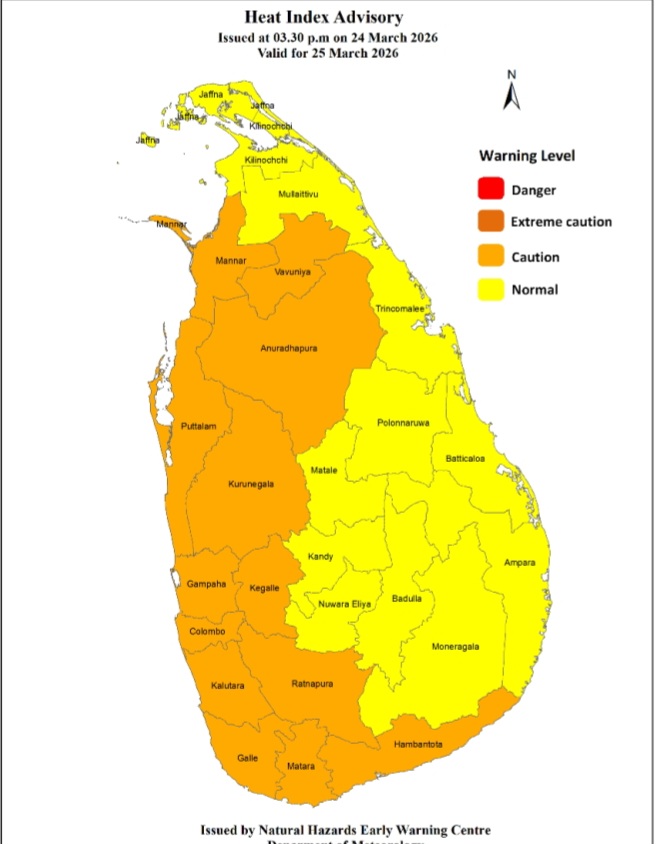
Warm Weather Advisory
Issued by the Natural Hazards Early Warning Centre of the Department of Meteorology
at 3.30 p.m. on 24 March 2026, valid for 25 March 2026.
The Heat index, the temperature felt on human body is likely to increase up to ‘Caution level’ at some places in the Western, Sabaragamuwa, Southern and North-western provinces and in
Anuradhapura, Mannar and Vavuniya districts.
The Heat Index Forecast is calculated by using relative humidity and maximum temperature and this is the condition that is felt on your body. This is not the forecast of maximum temperature. It is generated by the Department of Meteorology for the next day period and prepared by using global numerical weather prediction model data.
Effect of the heat index on human body is mentioned in the above table and it is prepared on the advice of the Ministry of Health and Indigenous Medical Services.
ACTION REQUIRED
Job sites: Stay hydrated and takes breaks in the shade as often as possible.
Indoors: Check up on the elderly and the sick.
Vehicles: Never leave children unattended.
Outdoors: Limit strenuous outdoor activities, find shade and stay hydrated.
Dress: Wear lightweight and white or light-colored clothing.
Note:
In addition, please refer to advisories issued by the Disaster Preparedness & Response Division, Ministry of Health in this regard as well. For further clarifications please contact 011-7446491.

Russia launches 948 drones at Ukraine in largest attack over 24-hour period

Oil at $150 will trigger global recession, says boss of financial giant BlackRock

Showers will occur at several places in the Western and Sabaragamuwa provinces and in Galle and Matara districts after 2.00 pm

Senior citizens above 70 years to receive March allowances on Thursday (26)

CEB Engineers warn public to be prepared for power cuts after New Year

Japanese boost to Sri J’pura Hospital, an outright gift from Tokyo during JRJ rule

‘Dates have the highest sugar content to fight Coronavirus’

Sunday Island 27 December – Headlines

#SundayIsland 17th December – Headlines

Sunday Island – 28th March

Sunday Island Headlines – 21 March

Sunday Island – 21st February – Headlines
-

 Features2 days ago
Trincomalee oil tank farm: An engineering marvel
-

 News6 days ago
Bailey Bridge inaugurated at Chilaw
-

 News5 days ago
CIABOC tells court Kapila gave Rs 60 mn to MR and Rs. 20 mn to Priyankara
-

 News6 days ago
Pay hike demand: CEB workers climb down from 40 % to 15–20%
-

 Features5 days ago
Science and diplomacy in a changing world
-

 News4 days ago
Colombo, Oslo steps up efforts to strengthen bilateral cooperation in key environmental priority areas
-

 News2 days ago
Substandard coal deepens energy crisis, warns former CEB Chief
-

 Features2 days ago
The scientist who was finally heard