
News
Jim Brown Nagar model village built with Indian grant support handed over to beneficiaries

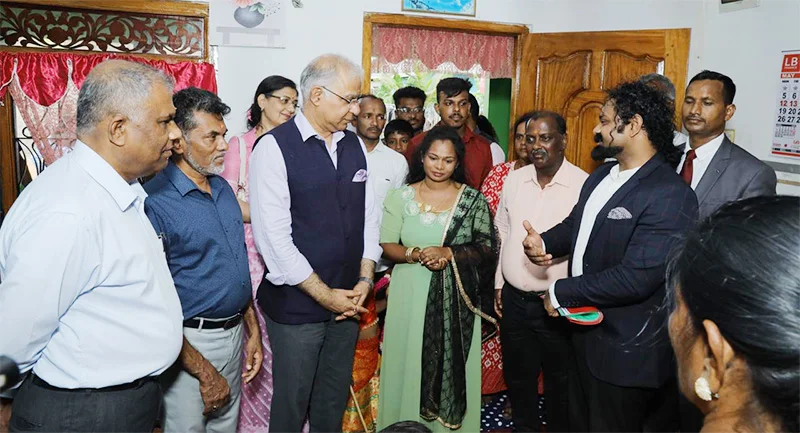
Indian High Commissioner Santosh Jha and Deputy Minister of Urban Development, Construction and Housing T. B. Sarath on May 26 jointly inaugurated and handed over Jim Brown Nagar Model Village in Mannar to the 24 beneficiary families.
The event was also attended by MP Mayilvaganam Jegatheeswaran, Secretary, Ministry of Urban Development, Construction and Housing Ranjith Ariyarathne; District Secretary, Mannar; Chairman and senior officials from National Housing Development Authority, and senior officials from the Ministry of Urban Development, Construction and Housing of Sri Lanka; Northern Provincial Council and Mannar District Administration.
The Model Village Housing Project is being implemented in all 25 districts in the country jointly with the Ministry of Urban Development, Construction and Housing of Sri Lanka with grant support from the Government of India. A Memorandum of Understanding between the Government of India and the Government of Sri Lanka was signed for the project in October 2017. The project encompasses housing facilities for 600 low-income families of Sri Lanka, with a model village each consisting of 24 houses per district for families selected by the District Housing Committees.
Model villages under the project have earlier been inaugurated and handed over in 13 districts: Batticaloa, Vavuniya, Jaffna, Kandy, Gampaha, Anuradhapura, Badulla, Matale, Puttalam, Colombo, Trincomalee, Monaragala and Kilinochchi. The project progress is over 97% and the remaining model villages too are expected to be inaugurated and handed over to the beneficiaries soon.




Latest News
Advisory for Heavy Rain issued for the Central, Uva, Sabaragamuwa, Eastern and North-central provinces and in Galle and Matara districts

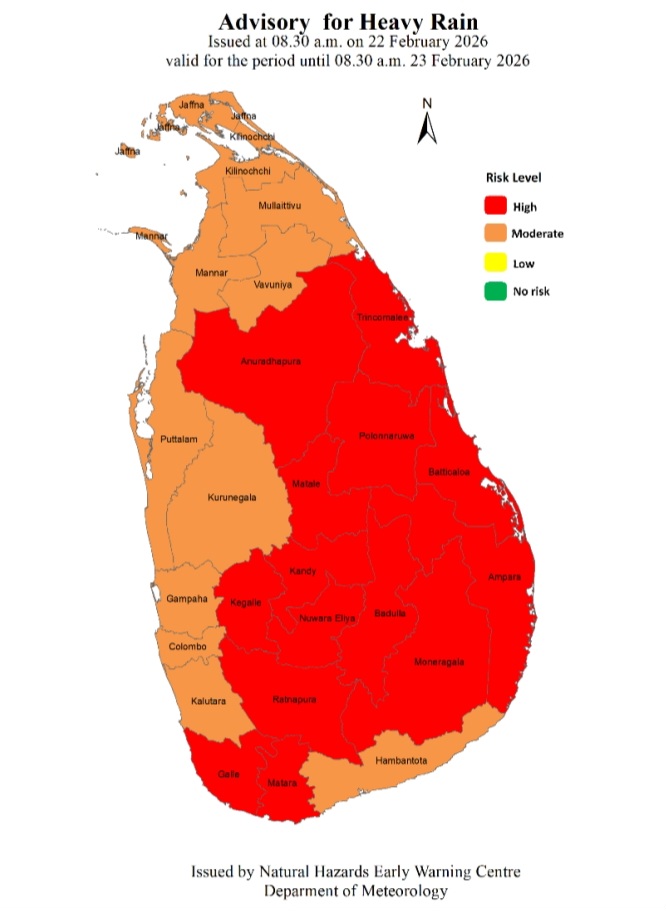
Advisory for Heavy Rain Issued by the Natural Hazards Early Warning Centre at 08.30 a.m. on 22 February 2026 valid for the period until 08.30 a.m. 23 February 2026
Due to the influence of the low level atmospheric disturbance in the vicinity of Sri Lanka, Heavy showers above 100 mm are likely at some places in Central, Uva, Sabaragamuwa, Eastern and North-central provinces and in Galle and Matara districts.
Therefore, general public is advised to take adequate precautions to minimize damages caused by heavy rain, strong winds and lightning during thundershowers
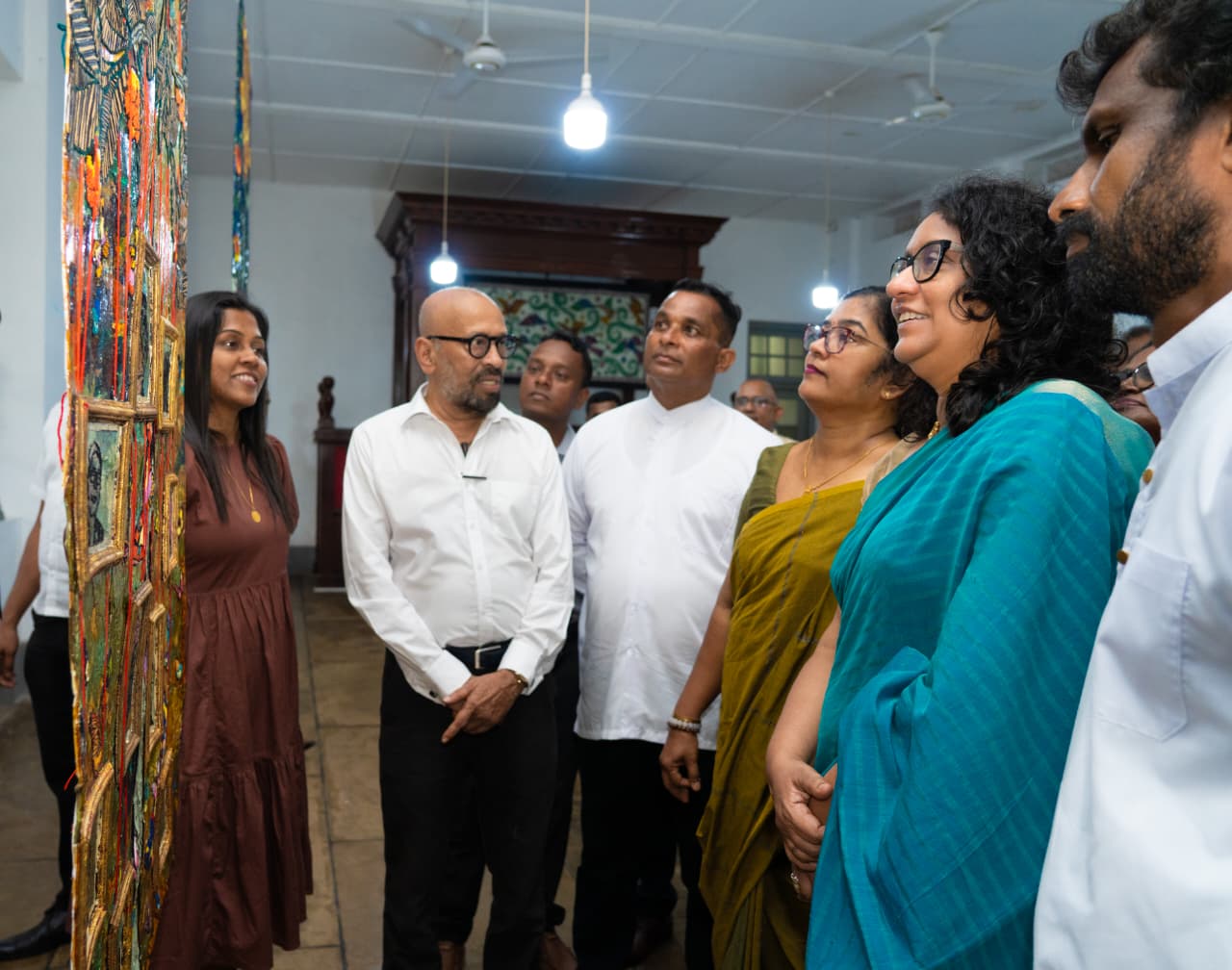
The inaugural ceremony of the Matara Festival for the Arts, featuring a wide range of creations by local and international artists, was held on February 19 at the Old High Court premises of the Matara Fort, under the patronage of Prime Minister Dr. Harini Amarasuriya.
The festival, centred around the Old High Court premises in Matara and the auditorium of the Matara District Secretariat, will be open to the public from 20 to 23 of February. The festival will be featured by visual art exhibitions, short film screenings, Kala Pola, and a series of workshops conducted by experts.
The inaugural event was attended by the Minister of Women and Child Affairs, Ms. Saroja Paulraj, along with artists, guests, and a large number of schoolchildren.
(Prime Minister’s Media Division)

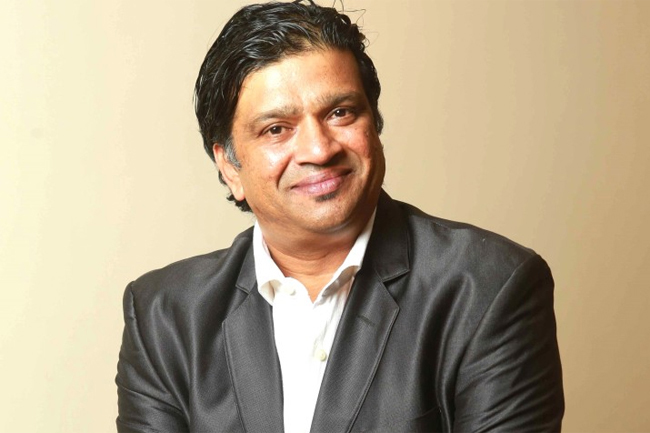
Only one Member of Parliament has chosen not to receive the salaries and allowances entitled to MPs, Prime Minister Dr. Harini Amarasuriya revealed in Parliament last Thursday, shedding light on the financial perks enjoyed by members of the Tenth Parliament.
Speaking on Thursday (Feb. 19) in response to a question from SJB Badulla District MP Chaminda Wijesiri, the Prime Minister outlined the full range of pay and allowances provided to parliamentarians.
According to Dr. Amarasuriya, MPs receive a monthly allowance of Rs. 54,285, an entertainment allowance of Rs. 1,000, and a driver’s allowance of Rs. 3,500—though MPs provided with a driver through the Ministry of Public Security and Parliamentary Affairs are not eligible for the driver’s allowance.
Additional benefits include a telephone allowance of Rs. 50,000, a transport allowance of Rs. 15,000, and an office allowance of Rs. 100,000. MPs are also paid a daily sitting allowance of Rs. 2,500 for attending parliamentary sessions, with an additional Rs. 2,500 per day for participation in parliamentary sittings and Rs. 2,500 per day as a committee allowance.
Committee meetings held on non-parliament sitting days also attract Rs. 2,500 per day.
Fuel allowances are provided based on the distance between an MP’s electoral district and Parliament. National List MPs are entitled to a monthly allocation equivalent to 419.76 litres of diesel at the market price on the first day of each month.
Despite the comprehensive benefits, only SJB Badulla District MP Nayana Wasalathilaka has opted not to draw a salary or allowances. Dr. Amarasuriya said that in accordance with a written notification submitted by MP Wasalathilaka on August 20, 2025, payments have been suspended since that date.
The Prime Minister also confirmed that she, along with the Speaker, Deputy Speaker, committee chairs, ministers, deputy ministers, the Opposition Leader, and senior opposition whips, have all informed the Secretary-General of Parliament in writing that they will not claim the fuel allowance.
Challenging the ruling party’s voluntary pledge to forgo salaries, MP Wijesiri pointed out that all MPs except Wasalathilaka continue to receive their salaries and allowances. “On one hand you speak about the people’s mandate, which is good. But the mandate also included people who said they would voluntarily serve in this Parliament without salaries. Today we have been able to prove, Hon. Speaker, that except for one SJB MP, the other 224 Members are drawing parliamentary salaries,” he said.
The Prime Minister responded by defending the political culture and practice of allocating portions of MPs’ salaries to party funds. Referring to previous practices by the JVP and NPP, she said: “It is no secret to the country that the JVP has for a long time not personally taken MPs’ salaries or any allowances. I think the entire country knows that these go to a party fund. That is not new, nor is it something special to mention. The NPP operates in the same way. That too is not new; it is the culture of our political movement.”
When MP Wijesiri posed a supplementary question asking whether diverting salaries to party funds was an indirect method of taking care of MPs, Dr. Amarasuriya said: “There is no issue there. No question was raised; the Member made a statement. What we have seen throughout this week is an inability to understand our political culture and practice, and a clash with decisions taken by political movements that misused public funds. What is coming out is a certain mindset. That is why there is such an effort to find fault with the 159. None of these facts are new to people. He did not ask a question, so I have nothing to answer.”
The disclosures come days after the Government moved to abolish the parliamentary pension, a measure that has sparked renewed debate over MP compensation and the transparency of funds allocation.

High stakes for a rare West Indies-Zimbabwe clash

Mexico’s most wanted drug lord ‘El Mencho’ killed in military operation

Zelensky tells BBC Putin has started World War 3 and must be stopped

All-round South Africa hammer India in Ahmedabad

Will Jacks stars again as England dismantle Sri Lanka

England limp to 146-9 against Sri Lanka

‘Dates have the highest sugar content to fight Coronavirus’

Sunday Island 27 December – Headlines

#SundayIsland 17th December – Headlines

Sunday Island – 28th March

Sunday Island Headlines – 21 March

Sunday Island – 21st February – Headlines
-
 Features23 hours ago
Why does the state threaten Its people with yet another anti-terror law?
-

 Business7 days ago
Ministry of Brands to launch Sri Lanka’s first off-price retail destination
-

 Features23 hours ago
Victor Melder turns 90: Railwayman and bibliophile extraordinary
-
 Features23 hours ago
Reconciliation, Mood of the Nation and the NPP Government
-
 Latest News2 days ago
New Zealand meet familiar opponents Pakistan at spin-friendly Premadasa
-
 Features23 hours ago
Victor, the Friend of the Foreign Press
-
 Latest News2 days ago
Tariffs ruling is major blow to Trump’s second-term agenda
-

 Latest News2 days ago
ECB push back at Pakistan ‘shadow-ban’ reports ahead of Hundred auction