
News
Japan’s baby hatch hospital offers mothers ‘last resort’


By Tomohiro Osaki
AFP-When the alarm sounds at Jikei hospital in southern Japan, nurses race down a spiral staircase. Their mission: to rescue an infant left in the country’s only baby hatch.For 15 years, the clinic has been the only place in Japan a child can be anonymously and safely abandoned.The pioneering hospital in the Kumamoto region also offers a 24/7 pregnancy support hotline and the country’s only “confidential birth” programme.
These have made it the target of criticism, but head doctor Takeshi Hasuda sees the facility as a vital safety net.
“There are women out there who are ashamed that they did something horrible (by getting pregnant) and are so scared,” he told AFP.
“For these women, a place like ours that bars no one and makes them think ‘even I will be welcome’ counts a lot, I think.”
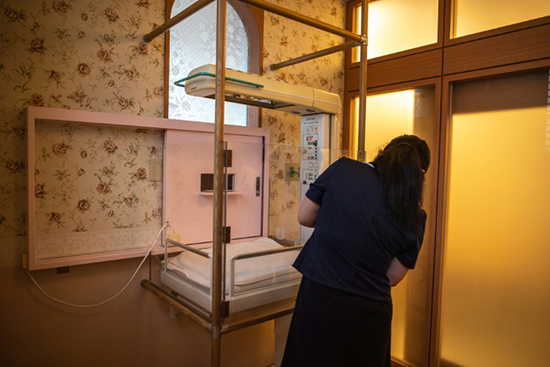
Nurses try to arrive at the hatch, with its stork illustrations and meticulously tended baby bed, within a minute of the alarm sounding.
“If we find mothers lingering nearby, we ask if they’re comfortable sharing their stories with us,” said hospital staffer Saori Taminaga.
They offer to check the health of mothers, providing support and encouraging them to leave information that could help a child learn their origins later.
“If they try to go, we persist and keep pushing until just before they leave the grounds. Once that happens, it’s time for us to give up.”
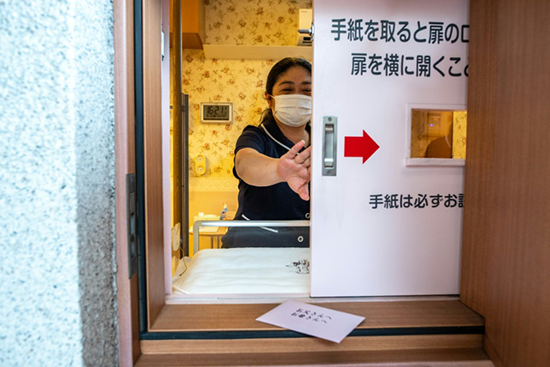
The Catholic-run hospital opened its baby hatch in 2007, modelled on a German scheme.Baby hatches have existed globally for centuries and are used today in places including South Korea, Pakistan and the United States.But they have been banned in some countries, such as Britain, and criticized by the UN for violating a child’s right to know their parents and identity.
– ‘Alienated by society’ –
Jikei hospital sees the hatch as a way to prevent child abuse and deaths in Japan, where police recorded 27 child abandonments in 2020 and at least 57 children died from abuse the year before.Hasuda says children abandoned at the hospital include those who were “the result of prostitution, rape and incest”, with mothers finding nowhere else to turn.
“I think the most important role our baby hatch system has played so far is to provide a sort of last resort for women left alienated by society,” he said.
In all, 161 babies and toddlers have been dropped at the hospital — with some coming from the Tokyo region, about 1,000 kilometres (621 miles) away, and beyond.
But the hatch has also faced scepticism in Japan, partly because of traditional ideas about what constitutes a family, according to Chiaki Shirai, an expert on reproduction and adoption studies at Shizuoka University.The country uses a registration system that lists births, deaths and marriages in a family going back generations. The crucial piece of administrative data also shapes views on family structure.It has “entrenched the idea in Japanese society that whoever gave birth to a child must raise the child,” to the point where children are almost considered “the property” of parents, Shirai told AFP.
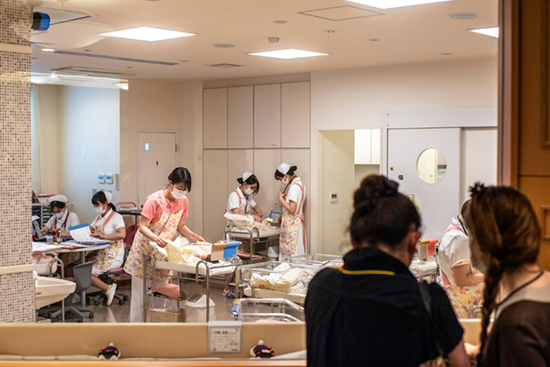
“Children who are abandoned and shown as having no family in the registry are heavily stigmatised.”
Despite the anonymity offered by the hatch, child welfare officials typically try to trace the family of infants abandoned at the hospital.
As a result, around 80 percent later learned their family’s identity, and 20 percent have returned to parents or relatives.
– ‘It’s all your fault’ –
Jikei hospital has expanded the services it offers marginalised women, adding a “confidential birth” programme to a pregnancy hotline that fields thousands of calls a year.Two babies have been delivered under the programme, which the hospital says is intended to discourage risky, solitary deliveries at home.
Both mothers told the Jikei they had been abused by their parents and wanted their children to be put up for adoption, Hasuda said.Under the scheme, a mother’s identity is revealed to a single staffer and kept confidential for possible disclosure to the child later on. The programme has also faced opposition — and while the government has not declared it illegal, it has baulked at legislation to formalise it.Shirai said women who resort to confidential births or the baby hatch face judgement for not choosing other options, including abortion.
“‘You could have chosen an abortion but didn’t. Now it’s all your fault’ is the kind of sentiment,” she said.Abortion has been legal in Japan since 1948 and is available up until 22 weeks, but consent is required from a male partner. Exceptions are granted only in cases of rape or domestic abuse, or if the partner is dead or missing.Hasuda, too, feels society often prefers to blame women rather than help them.
“Society’s motivation to sympathise with them or help them out seems to be low, if not completely non-existent,” he said.

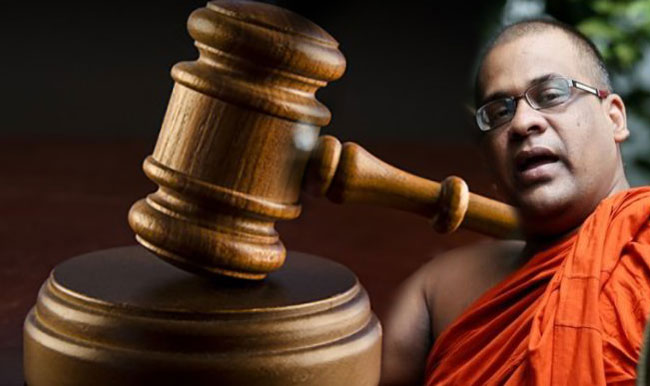
Ven. Galagoda Aththe Gnanasara Thero was not at his temple in Rajagiriya when prison officials visited the premises yesterday to take steps following the Supreme Court ruling that nullified the presidential pardon granted to him, police sources said.
Prison officials who visited the temple on Nawala Road, Rajagiriya, were reportedly informed by those present that the Thero’s whereabouts were unknown. The development comes a day after the Supreme Court declared former President Maithripala Sirisena’s 2019 pardon of Gnanasara Thero null and void.
The three-member Supreme Court bench comprising Justices Janak De Silva, Dr. Sobhitha Rajakaruna and Sampath B. Abayakoon held that the pardon was arbitrary, violated the public trust and principles of natural justice, and was made beyond the proper exercise of the President’s constitutional discretion.
The case arose from Gnanasara Thero’s conduct at the Homagama Magistrate’s Court in January 2016 during proceedings relating to the disappearance of journalist and political cartoonist Prageeth Eknaligoda.
The Court of Appeal convicted him on four counts of contempt of court in 2018 and imposed concurrent prison terms amounting to six years. He had served about nine months when Sirisena granted him a presidential pardon on May 23, 2019.
The Supreme Court found that although Article 34 empowers the President to grant pardons, that power is held in trust for the people and is subject to constitutional limitations and judicial review. The Court concluded that Sirisena had effectively acted on the recommendation of the Additional Secretary (Legal) without demonstrating that he had independently considered the relevant material.
Justice De Silva held that the pardon was “arbitrary”, violated public trust and the rules of natural justice, and was ultra vires the President’s powers. The Court consequently found that the decision violated the fundamental right to equality guaranteed by Article 12(1) of the Constitution.
The ruling effectively restores the legal position under the original conviction, leaving Gnanasara Thero without the benefit of the 2019 pardon. The Supreme Court also clarified that a pardon does not erase a conviction or sentence, but merely relieves an offender from serving the sentence to the extent specified in the pardon.
Gnanasara Thero, the General Secretary of the Bodu Bala Sena, had been convicted over his conduct during proceedings concerning the disappearance of Eknaligoda, who went missing in January 2010 and has not been located.
Sandhya Eknaligoda, Prageeth Eknaligoda’s wife, was among those who challenged the presidential pardon before the Supreme Court, alongside the Centre for Policy Alternatives and its Executive Director Dr. Paikiasothy Saravanamuttu.
The detailed account of the judgment indicates that the Court’s ruling primarily nullified the pardon and restored the legal effect of the original sentence, with the implementation of the sentence falling to the relevant authorities.
Police sources said that the Supreme Court, however, did not permanently close the door on executive clemency. It held that a future President could grant Gnanasara Thero another pardon, provided the power is exercised lawfully and after proper consideration of all relevant material.
The Supreme Court has so far overturned three presidential pardons granted to two former Presidents. In January 2024, the Court declared former President Gotabaya Rajapaksa’s pardon of former MP Duminda Silva unlawful and invalid. In June 2024, it invalidated two pardons granted by former President Maithripala Sirisena to Royal Park murder convict Jude Shramantha Anthony Jayamaha — the first in May 2016, which commuted his death sentence to life imprisonment, and the second in October 2019, which released him from prison. Jayamaha, who was convicted of the murder of 19-year-old Yvonne Johnson, remains at large. Most recently, on September 10, 2026, the Supreme Court declared Sirisena’s 2019 pardon of Ven. Galagoda Aththe Gnanasara Thero null and void, ruling that it was arbitrary and inconsistent with the Constitution.

Parliament is scheduled to debate the Twenty-Second Amendment to the Constitution Bill and the Judicature (Amendment) Bill on September 24 and 25, subject to the Speaker’s announcement following the delivery of the Supreme Court determination on petitions filed against the Bills.
The programme for the Parliamentary Week from September 22 to 25 was decided at a meeting of the Committee on Parliamentary Business held on Thursday (10) under the chairmanship of Speaker Dr. Jagath Wickramaratne.
On each sitting day, Parliamentary Business under Standing Orders 22(1) to 22(6) will be taken up from 9.30 am to 10 am, followed by Questions for Oral Answers from 10 am to 11 am Questions under Standing Order 27(2) will be taken up from 11 am to 11.30 am.
On Tuesday (22), the Orders published in Extraordinary Gazette No. 2497/37 under the Petroleum Resources Act and the Promotion of Export Agriculture (Amendment) Bill will be debated from 11.30 am to 5 pm.
The Tredso Development Foundation (Incorporation) Bill, a Private Member’s Bill, will then be taken up for Second Reading before being referred to the Legislative Standing Committee.
An Opposition motion at the Adjournment Time will follow.
On Wednesday (23), the Chartered Institute of Media Professionals of Sri Lanka Bill will be debated from 11.30 am to 5 pm, followed by Questions at the Adjournment Time.
The Second Reading debate on the 22nd Amendment Bill and the Judicature (Amendment) Bill is scheduled for 11.30 am to 7 pm on Thursday (24) and Friday (25).

Two children aged 11 and 17 were mistakenly killed and their 55-year-old father injured in an early morning hand grenade attack on Sirisangabo Mawatha on Friday. Police investigations later revealed that the attackers targeted the wrong house during an ongoing underworld clash.
Three police teams have been deployed to investigate the attack, which occurred at around 3 am.
According to police, a man who arrived near the house in a three-wheeler knocked on the front door before throwing a grenade into the premises and fleeing.
The victims were identified as 17-year-old Kasun Rashmika and 11-year-old Duminda Gihan. Their 56-year-old father, Nalin Thusantha Perera, was seriously injured and admitted to the Kalubowila Teaching Hospital.
Police said the injured man’s brother was allegedly a close associate of a drug trafficker known as ‘Sando’ and had also been accused of involvement in drug trafficking.
The brother lives in a house adjoining the one targeted in the attack, and police suspect the grenade may have been thrown at the wrong house.
Police are also investigating information that the attack was allegedly carried out at the direction of several overseas-based drug traffickers, identified as Pandithage Shantha Kumara alias ‘Kos Malli’, Samantha Perera alias ‘Chuwa Samantha’, ‘Kudu Avishka’ and ‘I.D.’
Police said the attack was believed to be linked to an ongoing conflict between two underworld factions, which have targeted each other’s associates in shootings and grenade attacks. More than 20 people have reportedly been killed in such attacks.
Security agencies are also investigating alleged links between one faction and overseas-based criminals including Kanjipani Imran, Unakuruwe Shantha, Dubai Gagana and Handaya.
Security agencies have also received information that overseas-based criminals identified as Kanjipani Imran, Unakuruwe Shantha, Dubai Gagana and Handaya are allegedly behind the supply of firearms and drugs to the faction associated with Kos Malli and Chuwa Samantha.

Death toll from Philippines ferry fire rises to 76, with more still missing

Anthropic boss Dario Amodei calls for AI development to slow down

It’s spin vs spin as India and Sri Lanka battle for Asia Cup title

Atmospheric conditions are favorable for afternoon thundershowers in most parts of the Island today [13]

Gnanasara Thero absconding after SC ruling

House to debate 22A, Judicature Bill next week

‘Dates have the highest sugar content to fight Coronavirus’

Sunday Island 27 December – Headlines

#SundayIsland 17th December – Headlines

Sunday Island – 28th March

Sunday Island Headlines – 21 March

Sunday Island – 21st February – Headlines
-

 Sports2 days ago
DDS set to lose Test captaincy
-

 Features6 days ago
After the parade: What a traffic OIC’s walk-out tells us
-

 Editorial6 days ago
Arrests as theatre
-
 News5 days ago
Thailand shuts door on undesirables from Sri Lanka
-

 Latest News6 days ago
Harshitha’s composed knock seals Sri Lanka’s semi-final berth
-

 News2 days ago
Sri Lanka faces new grid challenge as rooftop solar surges: former CEB GM
-
 Business5 days ago
CEB successor company breaks into top three in competitive BESS tender
-

 News6 days ago
‘Choka Malli’ slips out of country before travel ban