Connect with us

Latest News

Italy make history by qualifying for 2026 T20 World Cup

Published

on

File photo - Italy finished second on the points table, just ahead of third-placed Jersey, to secure qualification [Cricinfo]

Italy have secured qualification for the 2026 men’s T20 World Cup in India and Sri Lanka, despite losing to Netherlands at The Hague. Next year’s tournament will mark Italy’s first appearance at a cricket World Cup. Netherlands also qualified for the event after comfortably chasing 135.

Scotland, who have featured in the last four editions of the T20 World Cup, were knocked out after suffering a last ball defeat against Jersey earlier in the day. Despite pulling off a one-wicket heist, Jersey were also knocked out after Netherlands beat Italy. Both Italy and Jersey were level with five points, but Italy ended up progressing to the 2026 T20 World Cup, by virtue of a superior net run rate.

Italy only needed to avoid a heavy defeat, which they did by stretching Netherlands’ chase to 16.2 overs. They confirmed their place in next year’s T20 World Cup in the 15th over before Netherlands completed their job and joined Italy in the event.

After having opted to bat, Italy lost both their openers, Justin Mosca and Emilio Gay, within three overs and when their captain Joe Burns (22) fell in the seventh over, they were 41 for 3. Wicketkeeper-batter Marcus Campopiano also fell cheaply, leaving Italy at 46 for 4 in the ninth over. Ben Manenti then rallied along with the lower order to help Italy post a relatively competitive 134 for 7. Left-arm spinner Roleof van der Merwe was the pick of the bowlers for Netherlands, returning 3 for 15 in four overs, including the key wicket of Burns.

Manenti found support from No. 7 Grant Stewart (25 off 16) and No. 8 Anthony Mosca (13* off 14). Italy took 33 off the last three overs, including 15 off the penultimate over bowled by allrounder Bas de Leede.

Netherlands then dashed out of the blocks, hitting 66 for no loss in the powerplay in their chase. Max O’Dowd and Michael Levitt extended their opening stand to 71 before Crishan Kalugamage struck in the eighth over to dismiss Levitt for 34 off 25 balls, an innings which included five fours and a six. O’Dowd and captain Scott Edwards then put on an unbroken 64-run partnership for the second wicket to see Netherlands home.

Kalugamage finished with figures of 1 for 25 in his four overs and though Harry Manetti  didn’t strike on the day, he ended the Europe regional final as its top wicket taker. He took eight wickets at an average of 9.62 and economy rate of 7.70 in three matches.

As for Jersey, they sealed their first-ever win against Scotland, but their joy was short-lived with the result of the Italy-Netherlands fixture not going in their favour. In pursuit of 134, Jersey were cruising at 81 for 1 in the 12th over, but the wicket of Nick Greenwood triggered a collapse. Jersey lost 8 for 48 and were left needing five off four balls. Captain Charles Perchard and No. 11 Jake Dunford picked off 2,1,1,1 to keep Jersey in the race before Netherlands and Italy qualified at their expense.

Fifteen teams have qualified for the men’s T20 World Cup 2026 so far. The East-Asia Pacific qualifier will see three more sides qualify from the competition while two further teams will make it through from the Africa qualifier.

[Cricinfo]



Continue Reading
Click to comment

Leave a Reply

Your email address will not be published. Required fields are marked *

Foreign News

Deadly border fighting breaks out between Pakistan and Afghanistan

Published

on

By

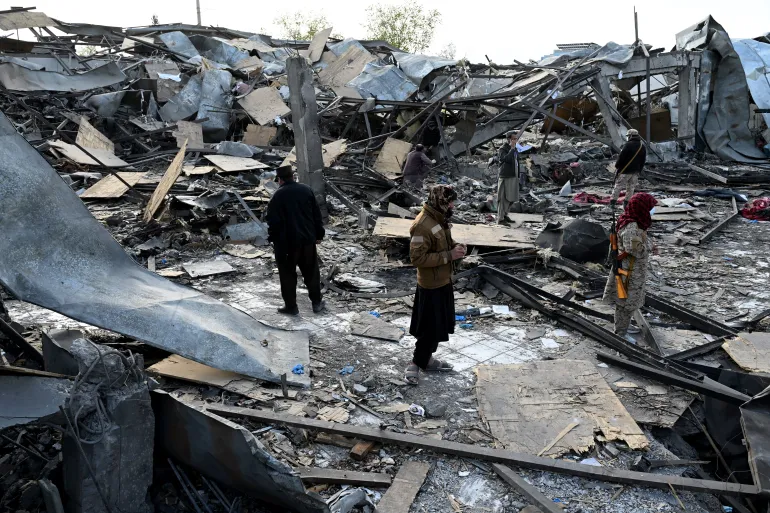
Fighting broke out close to the Afghan border city of Spin Boldak, which has seen deadly clashes in recent months (pictured October 2025) [BBC]

Border clashes have erupted again between Pakistan and Afghanistan’s Taliban forces, with each sides accusing the other of breaking a fragile ceasefire.

Residents fled the Afghan city of Spin Boldak overnight, which lies along the 1,600-mile (2,600 km) border between the two countries.

A medical worker in the nearby city of Kandahar told BBC Pashto that four bodies had been brought to a local hospital. Four other people were wounded. Three were reportedly wounded in Pakistan.

There has been sporadic fighting between the two countries in recent months, while Afghanistan’s Taliban government has also accused Pakistan of carrying out air strikes inside the country.

Both sides have confirmed they exchanged fire overnight but each blamed the other for initiating the four hours of fighting.

Mosharraf Zaidi, a spokesperson for Pakistan’s Prime Minister Shehbaz Sharif, accused the Taliban of “unprovoked firing”.

The statement continued: “An immediate, befitting & intense response has been given by our armed forces. Pakistan remains fully alert & committed to ensuring its territorial integrity & the safety our citizens.”

Meanwhile, a Taliban spokesperson said Pakistan had “once again initiated attacks” and said it was “forced to respond”.

Residents on the Afghan side of the border said the exchange of fire started at around 22:30 (18:00 GMT) on Friday.

Footage from the area showed a large number of Afghans fleeing on foot and in vehicles.

Ali Mohammed Haqmal, head of Kandahar’s information department, said Pakistan’s forces had attacked with “light and heavy artillery” and civilian homes had been hit by mortar fire.

The latest clashes came less than two months after both sides agreed to a ceasefire mediated by Qatar and Turkey.

It ended more than a week of fighting in which dozens were killed – the worst clashes between Pakistan and the Taliban since the group returned to power in 2021 – though tensions have remained high.

The government in Islamabad has long accused Afghanistan’s ruling Taliban of giving shelter to armed groups which carry out attacks in Pakistan.

The Taliban government denies the accusation and has accused Pakistan of blaming others for their “own security failures”.

The Pakistan Taliban have carried out at least 600 attacks on Pakistani forces over the past year, according to the Armed Conflict Location & Event Data Project.

Last week delegations from both sides met in Saudi Arabia for a fourth round of negotiations on a wider peace settlement, but did not reach an agreement.

Sources familiar with the talks told BBC News that both sides had agreed to continue with the ceasefire.

[BBC]

Continue Reading

Latest News

Advisory for severe lightning for the Western and Sabaragamuwa provinces and Galle and Matara districts

Published

on

By

Advisory for Severe Lightning Issued by the Natural Hazards Early Warning Centre at 12.15 p.m. 06 December 2025 valid for the period until 11.00 p.m. 06 December 2025.

The public are being cautioned that thundershowers accompanied with severe lightning are likely to occur at some places in the Western and Sabaragamuwa provinces and in Galle and Matara districts.

There may be temporary localized strong winds during thundershowers.

The General public is kindly requested to take adequate precautions to minimize damages caused by lightning activity.

ACTION REQUIRED:

The Department of Meteorology advises that people should:

 Seek shelter, preferably indoors and never under trees.

 Avoid open areas such as paddy fields, tea plantations and open water bodies during thunderstorms.

 Avoid using wired telephones and connected electric appliances during thunderstorms.

 Avoid using open vehicles, such as bicycles, tractors and boats etc.

 Beware of fallen trees and power lines.

 For emergency assistance contact the local disaster management authorities.

Continue Reading

Latest News

Justin Greaves 202*, Kemar Roach 58* anchor West Indies to epic draw

Published

on

By

An epic stonewall from Justin Greaves had him face more than half the deliveries of his 12-Test career in this one innings alone, as West Indies pocketed their first points in their sixth Test of the 2025-27 World Test Championship cycle in Christchurch. The 163.3 overs they eventually faced is the longest fourth-innings in Tests for West Indies in 95 years.

Having played the supporting role to Shai Hope through their 196-run stand that rescued West Indies from 92 for 4 on Day 3, Greaves became the heartbeat of the innings once Hope (140) and Tevin Imlach fell in quick succession.

He brought up a stunning maiden Test double ton in the penultimate over when he sliced Jacob Duffy over backward point to pocket what was to be only his second boundary in all of the final session as his colleagues stood up to give him a standing ovation.

He finished 202 not out, having faced 388 deliveries, turning an innings that began with the typical artistic flair and flamboyance into a steely knock full of purpose and grit. Greaves wore more blows on the body than he could count, batted more deliveries than he had in his career, and reined in his natural instincts with single-minded purpose and determination.

His effort led to an astonishing turnaround from the first hour of the day, when West Indies stumbled to 277 for 6 in a mammoth chase of 531. A depleted New Zealand attack down to two weary frontline pacers in Zak Foulkes and Jacob Duffy, fancied their chances. But Greaves found an able ally in Kemar Roach, the 37-year-old veteran, who batted like his life depended on it in his comeback Test.

Roach made 58 not out – his highest first-class score – while facing 233 deliveries himself. Astonishingly, he made just 5 off the last 104 deliveries he faced during a dramatic final two hours of play even as the sun baked down hard on an increasingly docile Hagley Oval surface. Yet that should not take away from the epic rearguard from Hope, Greaves, and Roach.

The frustration of not being able to separate Greaves and Roach during the second and third sessions was evident, as New Zealand’s bowlers were ground into the dust. They would also have felt robbed when Roach appeared to have nicked Michael Bracewell to Tom Latham behind the stumps – though perhaps only having themselves to blame for burning all their reviews.

Even so, it was the thinnest of spikes that made it all the more challenging for Alex Wharf, the on-field umpire, who only a few minutes earlier made a cracking decision by turning down what everyone believed was an obvious inside-edge onto the pad to the slips, again off Bracewell. Replays showed Wharf had made a terrific call.

As admirably as Roach played, he also maximised his opportunities. On 30, he was put down by Foulkes at backward square leg when he attempted an expansive sweep off Bracewell. On 35, Blair Tickner, subbing for Matt Henry, missed a direct hit at the bowler’s end from a few yards away at short mid-on as Roach was misjudging a run.

Then on 47 came the most obvious chance, when Roach attempted to loft Bracewell had him nearly hole out to mid-on. Except, Glenn Phillips, the other sub, saw Tickner looking to intercept the ball from mid-off and palm it away.

With those three chances firmly behind him, Roach buckled down and offered a dead bat to anything that came his way against Bracewell. Foulkes and Duffy tried to ruffle him with the short ball from around the wicket, only for him to duck and weave.

Going into the final session, it became increasingly evident West Indies weren’t going to be enticed by the prospect of chasing down the 132 runs they needed in 31 possible overs. This clarity allowed them to approach the session with dead defence being the sole primary aim, even as Greaves began to tire and suffer cramps that needed medical attention at different times.

Not even the possibility of an impending double century enticed Greaves into attempting anything loose, even if Tom Latham gave him the open invitation to drive Bracewell against the turn through the covers. This wasn’t perhaps a risk not worth taking given how easily West Indies’ lower order collapsed in the first innings.

But long before a draw became the only possibility, even as New Zealand tried to attack with six fielders around the bat in the final session, Hope and Greaves pocketed runs at every available opportunity as the hosts rushed through their first six overs with part-time spin in a bid to take the second new ball quickly.

But even after they took it, there was hardly any assistance for the bowlers. Hope defended comfortably off a length with neither Foulkes nor Duffy consistently able to challenge the outside edge consistently. The occasional misfields, like – Rachin Ravindra letting one through his legs for four, or Will Young overrunning a throw while backing up – added to the sense of raggedness New Zealand had begun to feel.

A breakthrough lifted them shortly after drinks when Duffy dug in a short ball down leg, which Hope gloved behind, only for Latham to throw himself to his left and pluck a stunner from his webbing to end a marathon. Then came a second when Imlach was trapped by a nip-backer.

They may have thought then it was just a matter of time. It could’ve been had they not reprieved Roach, but those reprieves proved even more costly given they only had two fast bowlers and two part-timers available – all of them going full throttle to the limit – despite not getting much out of the surface.

In the end, the manner in which West Indies earned the draw may prove far more valuable. Above all, it was a day that reminded everyone of the slow-burn magic only Test cricket could deliver.

Brief scores:
West Indies 167 (Shai Hope 56, Tagenarine  Chanderpaul 5; Matt Henry 3-43, Zak Foulkes 2-32, Jacob Duffy 5-34)  and  457 for 6 (Justin Greaves 202*, Shai Hope 140, Kemar Roach 58*; Jacob Duffy 3-122) drew with New Zealand 231 (Kane Williamson 52, Michaell Bracewell 47, Jayden Seales 2-44, Kemar  Roach 2-47, Ojay Shields 2-34, Justin Graves 2-35) and 466 for 8 dec (Ravindra 176, Tom Latham 145; Kemar Roach 5-78, Ojay Shields 2-74)

[Cricinfo]

Continue Reading

Trending