
Latest News
It is crucial to uphold respect for the diverse cultural traditions across the world as we strive to build a global community founded on sustainable values- President

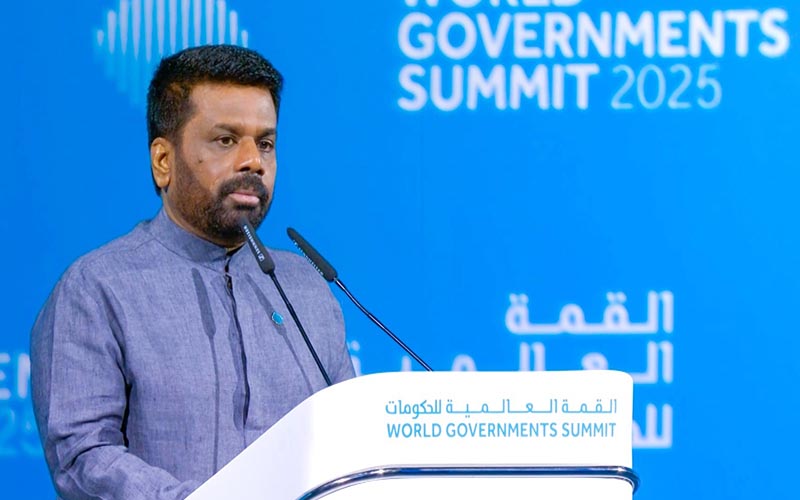
President Anura Kumara Disanayake addressing the World Governments Summit 2025 in UAE on 12th February 2025 said that it was, crucial to uphold respect for the diverse cultural traditions across the world as we strive to build a global community founded on sustainable values.
Full text of the President’s speech:
“Esteemed state leaders, distinguished delegates representing various organisations, honoured guests, members of the media and all those present, I seek your permission to address this extraordinary summit.
It is a great privilege to speak at this significant gathering, held at a crucial juncture in human history, at a time when the world calls for unprecedented global cooperation.
My country is a beautiful island nation with a unique history, a present filled with optimistic dreams for the future and a citizenry that possesses broad political and social awareness. The people of my country have a deep sense of empathy for events occurring anywhere in the world. While they cherish their traditions, they also demonstrate the wisdom and openness necessary to embrace change when required.
Moreover, if you were to search the internet at this very moment with your mobile phone and ask, “Which country has the highest number of eye donations in the world?” the answer would be the nation I represent, located at the edge of the Indian subcontinent: ‘Sri Lanka’.
It is a great honour and privilege for me to represent a nation of such altruistic and warm-hearted citizens, I take immense pride in addressing you on their behalf.
I believe that this summit, which focuses on developing future strategies and policies concerning critical aspects of human progress, will contribute positively to global well-being at some point.
Today, the challenges we face at national, regional and global levels are vast and complex.
Some choose to ignore these issues, embarking on self-cantered journeys. However, isolated problems of today soon evolve into global concerns of tomorrow, knocking on everyone’s doors ultimately bringing an end to solitary pursuits.
Therefore, I reiterate the importance of uniting as global citizens to confront cross-border challenges together. Addressing these crises requires collective global action and a unified front.
Effective Governance and Accountability
Enhancing governance accountability and efficiency is essential for the future world. Citizens must be encouraged to transition from individual efforts to collective initiatives.
The structure of state institutions and bureaucratic systems must prioritize accountability and responsibility, as these are crucial for the future of governance.
Social justice and the rule of law are not only vital for a regulated state but also for a well-functioning professional world. Proper implementation of agreements and laws, systematic support for low-income and vulnerable communities and ensuring accountability through an independent media and social activism are all of paramount importance.
The emergence of digital access rights, environmental rights and other new rights—along with evolving political systems—highlights the need for an updated universal declaration on human rights, which was not envisioned in the 1948 declaration. This moment serves as a reminder of the importance of awareness and proactive engagement in addressing these pressing issues.
As we strive to build a global community founded on sustainable values, it is crucial to uphold respect for the diverse cultural traditions across the world.
Financing the Future and the Global Economy
Nearly 60% of the poorest countries are either in a debt crisis or at high risk of one, raising serious concerns about the future of the global economy. With tightening global financial conditions, the prospect of massive debt repayments and a poorly prepared international financial structure, the global economic outlook appears increasingly precarious. Transforming into a fair and equitable financial system is of critical importance.
Climate, Crisis Mitigation and Resilient Cities
The world is heading toward the devastating consequences of uncontrolled industrial growth, including climate change, loss of biodiversity, and severe corruption. These issues are more frightening than a catastrophic celestial event that could impact Earth in a matter of years. While many developed countries have historically contributed to three-quarters of carbon dioxide emissions, their exposure to the impacts of climate change remains relatively low. Despite significant advancements in development, many naturally beautiful low-income countries are being ravaged by the harmful actions of others. These countries and islands, once known for their pristine coastlines, are now plagued by these disasters. If you ever visit our country, you will be astonished by the breath-taking coastal areas surrounding us. We are committed to making enormous efforts to protect our coastlines and preserve their beauty.
Human-Cantered Future and Sustainable Growth
The digital revolution has already transformed the way people live, work, and communicates. While these technologies have the potential to help billions of people lead happier, healthier, and more productive lives, they also create new challenges for citizens and governments around the world. It is important not to forget that the very technologies that empower individuals can also present significant risks. Take a computer virus, for example—though it doesn’t attack with a bullet or a nuclear bomb, it can wreak havoc in ways that are far more dangerous than traditional warfare, as evidenced by the increasing threat of cyber-attacks in recent years.
Global Health Transformation
Over the next two decades, population growth, urbanization, and the rise of antimicrobial resistance will likely contribute to the continuation and expansion of several health challenges.
As humans, we are inevitably interconnected. For over a year, a virus caused much of the global population to conceal their faces behind masks, creating significant pressure in both wealthy and impoverished nations.
In 2024, the world saw an increase or resurgence of several infectious diseases. Among non-communicable diseases, cancer has had an extraordinary impact on people’s lives. At this moment, millions of cancer patients are fighting for survival. Heart disease, regardless of national borders, continues to devastate lives, and it has become a major global crisis. Health experts predict that by 2030, the economic cost of mental health disorders worldwide could exceed $16 trillion.
The climate crisis is expected to result in an additional 14.5 million deaths by 2050, according to predictions.
In this context, it is crucial to focus on digital health, new technologies, and modern health tools, as well as the relationship between environmental health, sustainability, and health financial cooperation for economically vulnerable countries.
At times, you may represent the Middle East, Africa, Asia, Europe, or the West. However, the problems we all face and the call for unity, as expressed through the “lub dub” sound in our hearts, urge us to build the world together.
As Martin Luther King Jr. once said, “We must learn to live together as brothers.” If we don’t, he also foresaw the consequences.
We have united with a purpose to provide our people with “a thriving nation, a beautiful life,” a goal that has been historically endorsed.
At this historic summit, I urge you to join us in building a beautiful life and a beautiful world.”
[PMD]

Latest News
Landslide Early Warnings issued to the Districts of Kandy, Kegalle, Matale and Ratnapura

The Hational Building Research Institute (NBRI) has issued landslide early warnings to the Districts of Kandy, Kegalle, Matale and Ratnapura valid from 2200 hrs on 03rd October upto 2200 hrs on 04th October 2026.
Accordingly,
LEVEL II (AMBER) landslide early warnings have been issued to the Divisional Secretaries Divisions and surrounding areas of Udu Dumbara and Minipe 8n the Kandy district, Dehiowita in the Kegalle district, and Ambanganga Korale and Matale in the Matale district.
LEVEL I (YELLOW) landslide early warnings have been issued to the Divisional Secretaries Divisions and surrounding areas of Rambukkana in the Kegalle district, Rattota in the Matale district, and Eheliyagoda in the Ratnapura district.

The head of Turkiye’s football refereeing body and four other officials have been placed in pretrial detention by a court as part of a corruption investigation, the state news agency Anadolu reports.
Ferhat Gundogdu, head of the Central Referees Committee, and six others appeared before a judge over allegations of manipulation of the referee administration process, Anadolu said on Saturday.
They appeared on Friday before a judge at Istanbul’s Caglayan courthouse on several charges, including forgery of official documents, breach of trust and illegal acquisition of personal data, the report said.
The judge remanded five people in custody and granted the other two conditional release, Anadolu said.
It was the latest scandal to shake football in Turkiye, coming exactly a year after the Turkish Football Federation (TFF) suspended 149 referees on charges of illegal betting.
On Thursday night, police from the illegal betting and sports crime unit also detained Yasin Kol, a referee from Turkiye’s top-flight Super Lig, as well as an assistant referee, media reports said.
Justice Minister Akin Gurlek said prosecutors are examining claims about “interference in the processes of referee classification, assignments, scoring and appointments as well as the exams on rules”.
During raids on Tuesday, police searched the VAR room at TFF’s headquarters in Istanbul. Observers said the investigation was likely linked to last year’s betting scandal and would have implications for the federation.
“It does seem to be a continuation of 2025, and it looks like it will continue further,” sports journalist Ayhan Sensoy told the AFP news agency.
Sensoy, who wrote a 2024 book on the issue called The Gambling Pit, said it was unlikely that federation bosses “have any chance of staying in office”.
So far, the TFF has not directly addressed the arrests as its top officials are due to fly home on Saturday after attending Friday night’s Belgium-Turkiye UEFA Nations League clash in Liege, which Turkiye lost 3-0.
[Aljazeera]
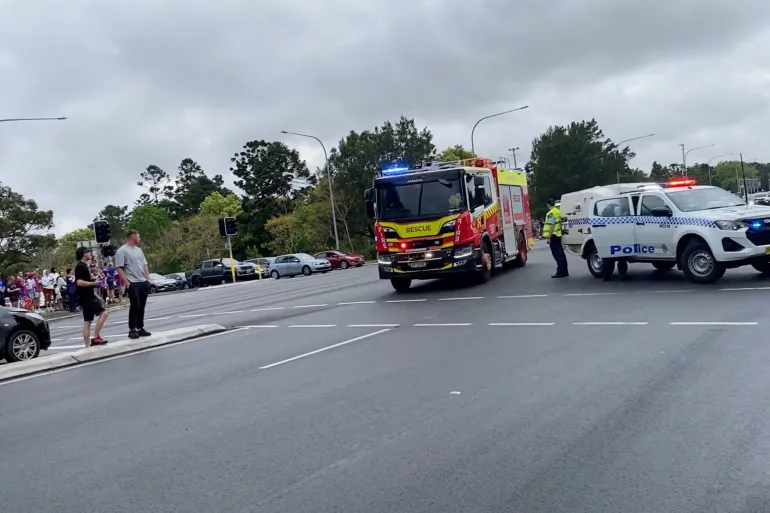
A car has crashed into a crowd of rugby league supporters in the eastern Australian city of Newcastle, injuring 10 people, including three children.
New South Wales police said on Saturday that two of the injured – a five-year-old girl and a 67-year-old man – were in a critical condition and the other eight were in stable condition in hospital.
Police said they had arrested the 18-year-old man driving the vehicle and were investigating what happened. They said the crash was not believed to be related to “terrorism”.
The crowd had gathered to farewell the local rugby league side, the Newcastle Knights, ahead of their grand final against the Sydney Roosters on Sunday.
Newcastle Lord Mayor Gavin Morris said the driver, a rugby league fan, had lost control of his vehicle and had been taken into custody.
“He was revving the car, he was excited, he was a supporter, he was there for the joy of the moment,” Morris told the national broadcaster ABC.
“Somehow he lost control of the car … and he’s gone into the crowd,” he added.
Prime Minister Anthony Albanese said: “My thoughts are with everyone injured or involved in the horrible incident this morning in Newcastle.”
“Rugby league brings people together, and this should have been a weekend of excitement and pride for Newcastle fans,” he wrote in a social media post.
[Aljazeera]

Showers above 75 mm are likely at some places in the Western, Sabaragamuwa, Central, and Southern provinces after 1.00 pm

Govt. urged to halt ‘illegal’ presidential pardons

GL urges cautious handling of Saudi death row case, blasts govt. over BRICS affair

Shiranthi files anticipatory bail application

Sri Lanka renews Honorary Consul appointment in Mombasa

Govt. plans to amalgamate NDF and ‘Api Wenuwen Api’ Fund

‘Dates have the highest sugar content to fight Coronavirus’

Sunday Island 27 December – Headlines

#SundayIsland 17th December – Headlines

Sunday Island – 28th March

Sunday Island Headlines – 21 March

Sunday Island – 21st February – Headlines
-

 Latest News6 days ago
Gold winner Tharanga gets brand-new Honda Vezel from SLAAJ
-

 News5 days ago
US-assisted ‘Ice’ detection: NPC to examine IGP’s move to transfer drug-busting team
-

 Features6 days ago
Why Sri Lanka needs an Inclusive Civic Nationalism – urgently
-

 Editorial4 days ago
Colombo Port drug bust: The plot thickens
-

 News6 days ago
Civil society activist accuses govt. of favouring Ven. Gnanasara
-

 Editorial6 days ago
When crime bosses rise above law and shrines
-
 Midweek Review6 days ago
Dappula’s Easter Sunday ‘grand conspiracy’ claim demolished
-
Editorial5 days ago
Drug busting, transfers and trust deficit