
Latest News
It is crucial to uphold respect for the diverse cultural traditions across the world as we strive to build a global community founded on sustainable values- President

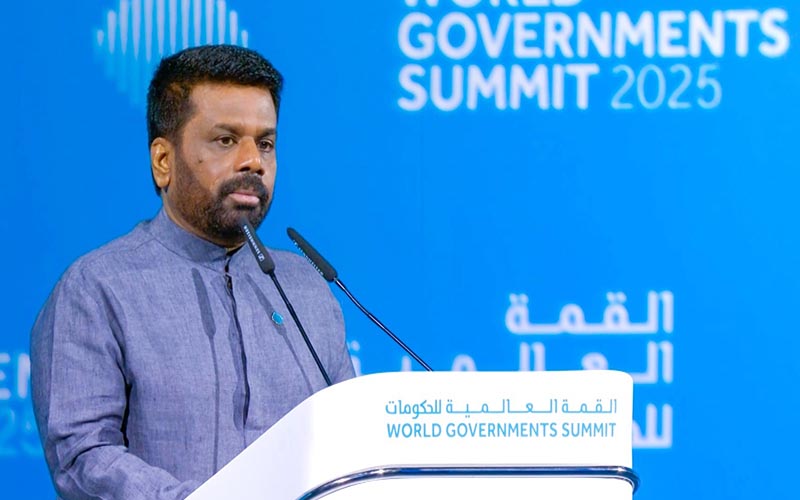
President Anura Kumara Disanayake addressing the World Governments Summit 2025 in UAE on 12th February 2025 said that it was, crucial to uphold respect for the diverse cultural traditions across the world as we strive to build a global community founded on sustainable values.
Full text of the President’s speech:
“Esteemed state leaders, distinguished delegates representing various organisations, honoured guests, members of the media and all those present, I seek your permission to address this extraordinary summit.
It is a great privilege to speak at this significant gathering, held at a crucial juncture in human history, at a time when the world calls for unprecedented global cooperation.
My country is a beautiful island nation with a unique history, a present filled with optimistic dreams for the future and a citizenry that possesses broad political and social awareness. The people of my country have a deep sense of empathy for events occurring anywhere in the world. While they cherish their traditions, they also demonstrate the wisdom and openness necessary to embrace change when required.
Moreover, if you were to search the internet at this very moment with your mobile phone and ask, “Which country has the highest number of eye donations in the world?” the answer would be the nation I represent, located at the edge of the Indian subcontinent: ‘Sri Lanka’.
It is a great honour and privilege for me to represent a nation of such altruistic and warm-hearted citizens, I take immense pride in addressing you on their behalf.
I believe that this summit, which focuses on developing future strategies and policies concerning critical aspects of human progress, will contribute positively to global well-being at some point.
Today, the challenges we face at national, regional and global levels are vast and complex.
Some choose to ignore these issues, embarking on self-cantered journeys. However, isolated problems of today soon evolve into global concerns of tomorrow, knocking on everyone’s doors ultimately bringing an end to solitary pursuits.
Therefore, I reiterate the importance of uniting as global citizens to confront cross-border challenges together. Addressing these crises requires collective global action and a unified front.
Effective Governance and Accountability
Enhancing governance accountability and efficiency is essential for the future world. Citizens must be encouraged to transition from individual efforts to collective initiatives.
The structure of state institutions and bureaucratic systems must prioritize accountability and responsibility, as these are crucial for the future of governance.
Social justice and the rule of law are not only vital for a regulated state but also for a well-functioning professional world. Proper implementation of agreements and laws, systematic support for low-income and vulnerable communities and ensuring accountability through an independent media and social activism are all of paramount importance.
The emergence of digital access rights, environmental rights and other new rights—along with evolving political systems—highlights the need for an updated universal declaration on human rights, which was not envisioned in the 1948 declaration. This moment serves as a reminder of the importance of awareness and proactive engagement in addressing these pressing issues.
As we strive to build a global community founded on sustainable values, it is crucial to uphold respect for the diverse cultural traditions across the world.
Financing the Future and the Global Economy
Nearly 60% of the poorest countries are either in a debt crisis or at high risk of one, raising serious concerns about the future of the global economy. With tightening global financial conditions, the prospect of massive debt repayments and a poorly prepared international financial structure, the global economic outlook appears increasingly precarious. Transforming into a fair and equitable financial system is of critical importance.
Climate, Crisis Mitigation and Resilient Cities
The world is heading toward the devastating consequences of uncontrolled industrial growth, including climate change, loss of biodiversity, and severe corruption. These issues are more frightening than a catastrophic celestial event that could impact Earth in a matter of years. While many developed countries have historically contributed to three-quarters of carbon dioxide emissions, their exposure to the impacts of climate change remains relatively low. Despite significant advancements in development, many naturally beautiful low-income countries are being ravaged by the harmful actions of others. These countries and islands, once known for their pristine coastlines, are now plagued by these disasters. If you ever visit our country, you will be astonished by the breath-taking coastal areas surrounding us. We are committed to making enormous efforts to protect our coastlines and preserve their beauty.
Human-Cantered Future and Sustainable Growth
The digital revolution has already transformed the way people live, work, and communicates. While these technologies have the potential to help billions of people lead happier, healthier, and more productive lives, they also create new challenges for citizens and governments around the world. It is important not to forget that the very technologies that empower individuals can also present significant risks. Take a computer virus, for example—though it doesn’t attack with a bullet or a nuclear bomb, it can wreak havoc in ways that are far more dangerous than traditional warfare, as evidenced by the increasing threat of cyber-attacks in recent years.
Global Health Transformation
Over the next two decades, population growth, urbanization, and the rise of antimicrobial resistance will likely contribute to the continuation and expansion of several health challenges.
As humans, we are inevitably interconnected. For over a year, a virus caused much of the global population to conceal their faces behind masks, creating significant pressure in both wealthy and impoverished nations.
In 2024, the world saw an increase or resurgence of several infectious diseases. Among non-communicable diseases, cancer has had an extraordinary impact on people’s lives. At this moment, millions of cancer patients are fighting for survival. Heart disease, regardless of national borders, continues to devastate lives, and it has become a major global crisis. Health experts predict that by 2030, the economic cost of mental health disorders worldwide could exceed $16 trillion.
The climate crisis is expected to result in an additional 14.5 million deaths by 2050, according to predictions.
In this context, it is crucial to focus on digital health, new technologies, and modern health tools, as well as the relationship between environmental health, sustainability, and health financial cooperation for economically vulnerable countries.
At times, you may represent the Middle East, Africa, Asia, Europe, or the West. However, the problems we all face and the call for unity, as expressed through the “lub dub” sound in our hearts, urge us to build the world together.
As Martin Luther King Jr. once said, “We must learn to live together as brothers.” If we don’t, he also foresaw the consequences.
We have united with a purpose to provide our people with “a thriving nation, a beautiful life,” a goal that has been historically endorsed.
At this historic summit, I urge you to join us in building a beautiful life and a beautiful world.”
[PMD]



Nahid Rana’s five-wicket haul followed by Tanzid Hasan’s fiery half-century got Bangladesh a six-wicket win against New Zealand. The home side leveled the ODI series, setting up the decider in Chattogram on Thursday.
It was a much-needed contribution from the Bangladesh batters, who were criticised for losing the first game by 26 runs. This time, the bowlers blew a hole through New Zealand’s top and middle orders, with Rana taking 5 for 32, his second five-for in ODIs, before the batters got them home in 35.3 overs.
Bangladesh’s chase, however, began with uncertainty once again. Nathan Smith burst through Saif Hassan with an excellent inswinger in the first over. Soumya Sarkar, drafted into the playing XI to replace Afif Hossain, fell after making eight runs. He struck Will O’Rourke for a six but New Zealand captain Tom Latham kept the three slips as he urged O’Rourke to keep bowling bouncers.
Soumya fell into the trap, when his attempted glide with a vertical bat, only reached Dean Foxcroft at third slip. Tanzid retaliated almost immediately, hitting Smith for two sixes in the fifth over. The first was over long-on, the next over midwicket with a lovely flick.
Tanzid reached his fifty with his third six, slog sweeping Foxcroft over midwicket in the 15th over. He took just 33 balls to reach his sixth half-century in ODIs.
Najimul Hossain Shanto, who made a golden duck in the first game, was more of his dominant self, complementing Tanzid’s efforts in their third-wicket partnership. Shanto struck Foxcroft’s half-tracker for six in the 17th over, before launching Jayden Lennox over long-off for a similar result.
Tanzid was racing towards a big score, hammering Lennox for his fourth six in the 23rd over. But the left-arm spinner had the last laugh the very next ball as Tanzid top-edged a hoick across the line for Henry Nicholls to take a steepling catch tracking back at cover. It ended a 120-run third wicket stand.
Litton Das, playing his 100th ODI, couldn’t add much to the total, when Lennox had him caught off a slog in his next over. Shanto hobbled off the field after completing his fifty due to cramps.
Towhid Hridoy and Mehidy Hasan Miraz added 32 to complete the chase. Hridoy made an unbeaten 30 off 31 balls with five fours, while Mehidy struck the winning run in the 36th over.
Rana had earlier dominated the New Zealand batting line-up whenever captain Mehidy handed him the ball. He took the first two wickets: Henry Nicholls, New Zealand’s top scorer from the first game, trapped lbw, before a 146kph bouncer got Will Young. Rana got the ball to rear into the No 3 batter, who could only guide it to gully where Soumya took an easy catch.
Nick Kelly found Muhammad Abbas as a willing ally, as the pair rebuild the New Zealand innings in the middle overs. Abbas broke the boundary drought of 33 balls, when he edged Soumya to deep third in the 20th over. Kelly struck another bookended the over with another four before driving Mehidy Hasan Miraz through cover in the following over.
Kelly then laid into Taskin Ahmed, driving him down the ground and clipping him over midwicket among his three fours in the 25th over. Kelly soon reached his fifty in the 27th over, before Rana, brought back into the attack, removed Abbas. Wicketkeeper Litton ran quite a distance towards fine-leg, where he dived to complete a brilliant catch. Litton had earlier taken a fine tumbling catch to remove Tom Latham, the New Zealand captain, off Soumya’s bowling
Kelly started to apply himself as a more aggressive batter. He moved a lot around the crease, even getting hit on his visor when he tried to hook Shoriful Islam’s length ball in the 35th over. He fell to the same bowler in his next over, caught at midwicket for 83.
Bangladesh’s fielders contributed to their good showing. Towhid Hridoy took three catches including a superb effort at long-on to end the New Zealand innings.
Rana added two more to his kitty in the death overs, removing Dean Foxcroft for 15, before yorking Jayden Lennox for a duck. Rana’s five wickets apart, Shoriful Islam took two wickets while Rishad Hossain, Taskin Ahmed and Soumya took a wicket each.
Brief scores:
Bangladesh 199 for 4 in 35.3 overs (Tanzid Hasan 76, Najmul Hossain Shanto 50 retd, Towhid Hridoy 30*; Jayden Lennox 2-36) beat New Zealand 198 in 48.4 overs (Nick Kelly 83; Nahid Rana 5-32, Shoriful Islam 2-32) by six wickets
[Cricinfo]

Sharmin Akhter’s 86 helped Bangladesh beat Sri Lanka by three wickets in the first Women’s ODI in Rajshahi, which was hosting its first international match. It is also Bangladesh’s first ever WODI win against Sri Lanka, though it wasn’t without a hiccup.
Bangladesh lost four wickets for just one run when they were just seven runs away from victory. This happened after Sharmin was out stumped in the 45th over for 86, having struck 13 fours in her 127-ball effort. This was her highest score against Sri Lanka, beating her previous best 64 not out at the DY Patil Stadium in the World Cup last year.
Sharmin added 78 runs for the fourth wicket with Shorna Akter before Sri Lanka finally took a wicket after 36 overs. Then came the string of wickets. Offpsinner Dewmi Vihanga took two wickets in the 46th over when both Shorna (35) and Ritu Moni (0) were caught going for big hits. Rabeya Khan also holed out in the deep playing a poor shot, as Bangladesh were 200 for 7 in the 47th over.
Nahida Akter and Sultana Khatun then added the final six runs in nervy fashion. Sri Lanka were poor at that point as Malki Madara conceded a wide followed by a misfield in the covers to concede the winning runs.
Bangladesh’s 206-run chase started poorly when they lost Sarmin Sultana in the first over. Sultana was clean bowled by Madara for a duck with a full ball on her leg-stump. Nimasha Meepage had debutant Juairiya Ferdous caught at mid-on in the next over, having made just five runs.
When captain Nigar Sultana was given out lbw against Vihanga, Bangladesh were in trouble at 34 for 3 in the ninth over. Sharmin and Sobhana Mostary then took charge of the situation, adding 87 runs for the fourth wicket. They were only separated when Mostary suffered severe cramps on her legs in the 28th over. She had to be stretchered off, having made 41 off 56 balls with six fours.
Sharmin then had the company of Shorna Akter to further the chase, as they dominated the Sri Lanka attack from that point.
When they batted first, Sri Lanka got off to a strong start with Hasini Perera – their stand-in captain with Chamari Athapaththu missing due to a finger injury – and Imesha Dulani adding 68 runs for the opening stand.
Seamer Ritu Moni, coming around the wicket, broke the partnership in the 14th over when her inswinger wrapped Perera on the pads.
Moni removed Harshitha Samarawickrama in her next over, when the batter couldn’t get her away with a flick shot, ending up giving a simple caught and bowled chance.
Dulani and Hansima Karunaratne then took stock of the situation, adding another 52 runs for the third wicket. Dulani made 54 with six fours, before getting caught at mid-off off Sultana Khatun. Part-timer Mostary then got fortunate when Karunaratne drilled her high full-toss to Rabeya at cover. Karunaratne was dumbstruck by the dismissal, as Rabeya held on to the tough chance, after she made 54 off 71 balls.
Sri Lanka lost their way around this point, with Nilakshika Silva and Kavisha Dilhari being caught at mid-off in quick succession, to Marufa Akter and Moni, respectively.
Moni finished with 3 for 36 while left-arm spinner Nahida picked up two wickets.
Brief scores:
Bangladesh Women 206 for 7 in 48.3 overs (Sharmin Akhter 86, Nigar Sultana 13, Sobhana Mostary 41, Shorna Akter 35; Malki Madara 2-37, Dewmi Vihanga 3-43) beat Sri Lanka Women 205 for 9 in 50 overs (Hasini Perera 27, Hansima Karunaratne 54, Imesha Dulani 52, Kavisha Dilhari 30, Kaushini Nuthyangana 18; Nahida Akter 2-38, Ritu Moni 3-36) by three wickets
[Cricinfo]

Dasun Shanaka handed one-year PSL ban

Nahid, Tanzid help Bangladesh level New Zealand series

Five UAE cricketers given citizenship through naturalisation

Moni, Sharmin help Bangladesh register maiden ODI win against Sri Lanka

Advisory for Severe Lightning issued for all provinces of Sri Lanka

Oil prices rise after Trump says Iranian ship seized

‘Dates have the highest sugar content to fight Coronavirus’

Sunday Island 27 December – Headlines

#SundayIsland 17th December – Headlines

Sunday Island – 28th March

Sunday Island Headlines – 21 March

Sunday Island – 21st February – Headlines
-

 News5 days ago
PNS TAIMUR & ASLAT set sail from Colombo
-

 Business3 days ago
Harnessing nature’s wisdom: Experts highlight “Resist–Align” path to resilience
-

 News3 days ago
Gratiaen Trust announces longlist for the 33rd Annual Gratiaen Prize
-

 Latest News7 days ago
“I extend my heartfelt wishes to all Sri Lankans for a peaceful and joyous Sinhala and Tamil New Year!” – President
-

 News2 days ago
From Nuwara Eliya to Dubai: Isha Holdings markets Agri products abroad
-

 News3 days ago
Heroin haul transported on 50-million-rupee contract
-

 Latest News4 days ago
Singapore Zoo’s first Sri Lankan leopard cubs make their public debut
-

 Latest News7 days ago
US blockade of Iran would worsen global energy crisis, analysts say