
Latest News
Israel delays vote to approve Gaza ceasefire deal

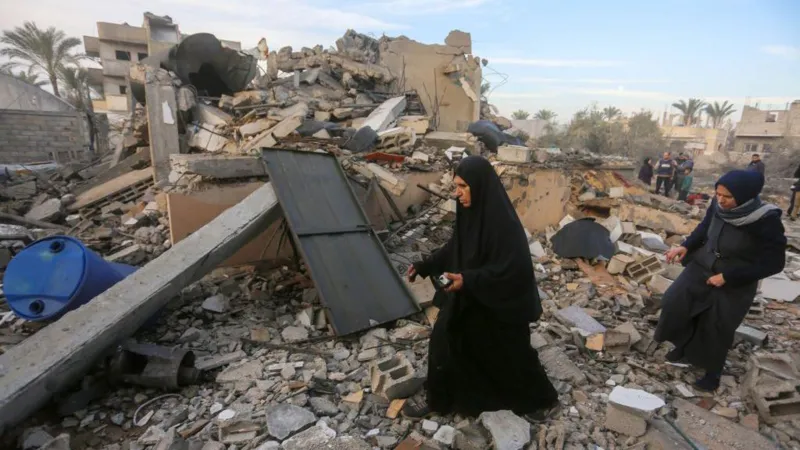
Israeli Prime Minister Benjamin Netanyahu has delayed a cabinet vote to approve the Gaza ceasefire deal, due on Thursday, accusing Hamas of seeking last-minute changes to the agreement.
US Secretary of State Antony Blinken said a “loose end” was being tied up and that he was confident the ceasefire would still begin on Sunday as planned.
Although Israeli negotiators agreed to the deal after months of talks, it cannot be implemented until it is approved by the security cabinet and government.
Hamas said it was committed to the deal, but the BBC understands it was trying to add some of its members to the list of Palestinian prisoners that would be released under the deal.
The delay came after Israeli strikes in Gaza following Wednesday’s announcement of a deal killed more than 80 people, according to the Hamas-run health ministry.
A few hours before the Thursday morning meeting was due, Netanyahu accused Hamas of trying to “extort last minute concessions”.
The cabinet would not convene until Hamas accepted “all elements of the agreement,” a statement from his office read.
Blinken said such a delay was to be expected in such a “challenging” situation. “It’s not exactly surprising that in a process and negotiation that has been this challenging and this fraught, you may get a loose end,” he told a press conference in Washington. “We’re tying up that loose end as we speak.”
He said the US was “confident” the deal would come into force on Sunday as planned, and that the ceasefire would then persist.
Israeli media reported that the cabinet was expected to meet on Friday to approve the deal and that the alleged issue had been resolved, although this was not officially confirmed.
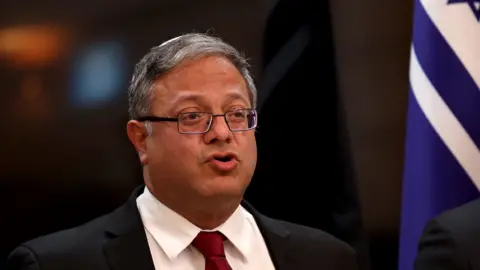
A majority of Israeli ministers are expected to back the deal, but late on Thursday Security Minister Itamar Ben-Gvir said his right-wing party would quit Netanyahu’s government if it was approved.
“The deal that is taking shape is a reckless deal,” Ben-Gvir told a news conference, adding it would “erase the achievements of the war”.
However, he said his Otzma Yehudit (Jewish Power) party would not seek to topple the government should the deal be ratified.
He urged the leader of the other far-right party in government, Finance Minister Bezalel Smotrich of the Religious Zionist party, to join him in resigning.
Ohad Tal, the party’s chair in Israel’s parliament, told BBC that it was “debating” whether to leave Netanyahu’s government over the deal.
Meanwhile, a senior Hamas official told the BBC that the group was committed to the agreement announced by the mediators.
The head of Hamas’s delegation, Khalil al-Hayya, officially informed Qatar and Egypt of its approval of all the terms of the agreement, the official told the BBC.
But BBC Gaza correspondent Rushdi Abualouf understands that Hamas was attempting to add the names of one or two symbolic members to the list of prisoners that would be released under the deal.
The first six-week phase of the deal would see 33 hostages – including women, children and elderly people – exchanged for Palestinian prisoners in Israeli jails.
Israeli troops would also withdraw to the east, away from densely populated areas of Gaza.
Displaced Palestinians would be able to start returning to their homes and hundreds of aid lorries would be allowed entry to the territory each day.
Negotiations for the second phase – which should see the remaining hostages released, a full Israeli troop withdrawal and a return to “sustainable calm” – would start on the 16th day.
The third and final stage would involve the return of any remaining hostages’ bodies and the reconstruction of Gaza – something which could take years.
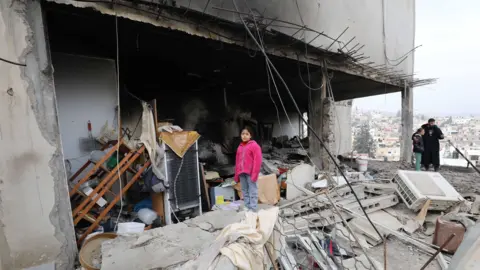
Israeli air strikes continued after the deal was announced on Wednesday. At least 12 people were killed in Gaza City, where a doctor told the BBC staff “did not rest for one minute” during the “bloody night”.
Strikes were carried out on 50 targets in Gaza since the deal’s announcement, the Israel Defense Forces and the Israeli Security Agency said in a statement.
The prime minister of Qatar – which mediated negotiations – called for “calm” on both sides before the start of the first six-week phase of the ceasefire deal.
Israel launched a campaign to destroy Hamas – which is proscribed as a terrorist organisation by Israel, the US and others – in response to an unprecedented cross-border attack on Israel on 7 October 2023, in which about 1,200 people were killed and 251 others were taken hostage.
More than 46,788 people have been killed in Gaza since then, according to the territory’s Hamas-run health ministry.
Most of Gaza’s 2.3 million population has also been displaced, there is widespread destruction and there are severe shortages of food, fuel, medicine and shelter, while aid agencies struggle to get help to those in need.
Israel says 94 of the hostages are still being held by Hamas, 34 of whom are presumed dead. There are four Israelis who were abducted before the war, two of whom are dead.
[BBC]

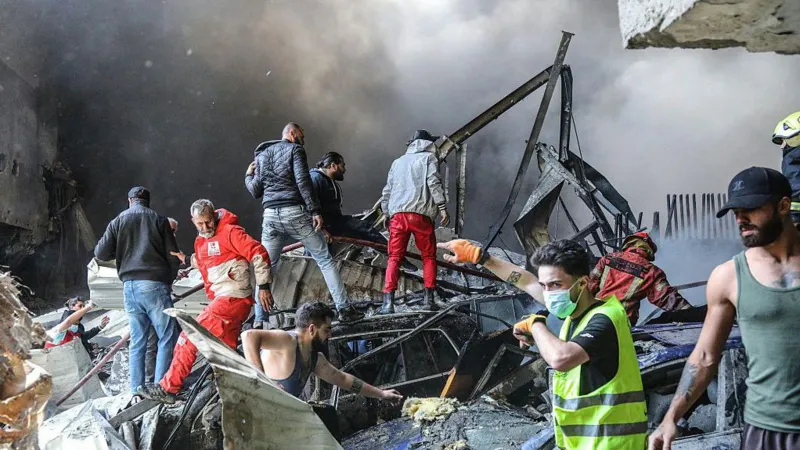
Israeli Prime Minister Benjamin Netanyahu has ordered his government to begin direct talks with Lebanon, he said in a statement on Thursday.
Netanyahu said the talks would focus on the disarmament of Hezbollah, the Iran-backed Lebanese political and militant group, and establishing peaceful relations.
A US State Department official confirmed it would host a meeting next week “to discuss ongoing ceasefire negotiations with Israel and Lebanon”.
Lebanese officials called for a ceasefire before the talks begin, but Netanyahu in a subsequent address to residents of northern Israel said: “There is no ceasefire in Lebanon.”
The Israeli military continued to strike Lebanon on Thursday – targeting what it described as Hezbollah rocket launch sites in the south. It also issued a new evacuation warning for residents in the southern suburbs of the capital, Beirut.
The head of the World Health Organization (WHO), Tedros Adhanom Ghebreyesus, said on X that this included the Jnah area, which includes two major hospitals.
“At this time, no alternative medical facilities are available to receive approximately 450 patients from the two hospitals (including 40 patients in the ICU), rendering their evacuation operationally unfeasible,” he said.
Among those being treated at the hospitals, Tedros added, were some of the 1,150 people that Lebanon’s health ministry said were wounded in Wednesday’s massive wave of Israeli strikes. At least 303 people were killed.
Tedros also said that the headquarters of the Ministry of Public Health, which “hosts five shelters accommodating more than 5,000 people”, is in the evacuation area.
That ceasefire began with confusion over whether Lebanon, Israel’s second front, was to be included. Iranian officials and mediators from Pakistan said it was, US and Israeli officials said clearly that it was not.
Amid the confusion, the wave of Israeli strikes on Lebanon – the heaviest since the conflict began six weeks ago – prompted Iran to declare that Israel was break8ng the terms of the ceasefire, once again halt passage of shipping through the Strait of Hormuz, and to threaten retaliatory strikes.
Israel’s military continues to occupy a large part of the south of Lebanon, where it has destroyed villages in recent days. Without a commitment to a temporary ceasefire at least, it is not clear how productive talks could proceed between the two sides.
(BBC)
Latest News
Sun directly overhead Nagawilluwa, Galgamuwa, Sigiriya, Palugasdamana and Mankerni about 12:11 noon today (10)

On the apparent northward relative motion of the sun, it is going to be directly over the latitudes of Sri Lanka from the 05th to 15th of April in this year.
The nearest areas of Sri Lanka over which the sun is overhead today (10th) are Nagawilluwa, Galgamuwa, Sigiriya, Palugasdamana and Mankerni about 12:11 noon.
Latest News
Mukul Choudhary stuns Kolkata Knight Riders to seal last-ball thriller for Lucknow Super Giants
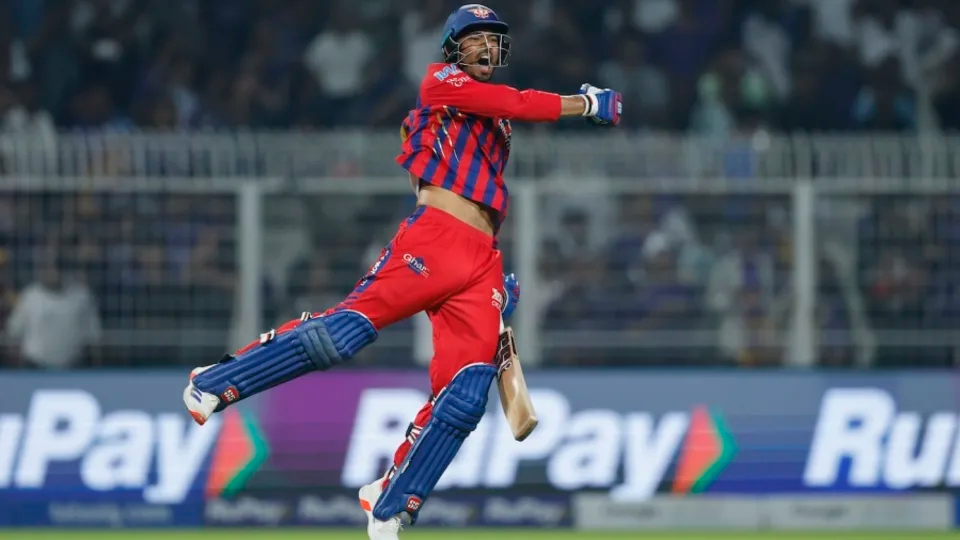
In the lead-up to IPL 2026, Lucknow Super Giants coach Justin Langer believed that rookie <ukul Choudhary had the potential to become the “scariest” finisher in India. The 21-year-old showcased his potential and power in only his third IPL game, bashing a 25-ball half-century, which snatched victory for LSG from Kolkata Knight Riders’ grasp.
When Choudhary came into bat, LSG were 104 for 5 in the 13th over in pursuit of 182. Choudhary watched them slump further to 125 for 6 and then 128 for 7. He was on 2 off eight balls at one point. But with LSG needing 54 off 24 balls, he single-handedly won it for them. Only one other batter – Kieron Pollard in 2013 – has scored more than 50 runs in the last four overs of a successful IPL chase.
It was anybody’s game when LSG required 14 off the final over, with three wickets in hand. After Avesh Khan got a single off the first ball, Choudhary monstered Arora over square leg for six. Arora then responded with two dots, but a barely believable six off the next ball – a near wide yorker – brought the equation to one off one.
Choudhary swung and missed the slower bouncer, but he scampered across for a leg-bye and completed a stunning turnaround for LSG. A new star was born in the IPL.
At the halfway stage of the game, Rovman Powell said this wasn’t a typical Eden Gardens pitch. As the game wore on, the deliveries dug into the surface, especially the slower ones, were difficult to put away. Aiden Markram, Mitchell Marsh, Nicholas Pooran and Rishabh Pant were all done in by steepling bounce.
Arora had bounced out Markram and Marsh with the new ball, but when he tried something similar against Choudhary with the older one, Choudhary muscled him over square leg. When Arora tried to york him next ball, Choudhary helicoptered the seamer over long-on. Of the seven sixes Choudhary hit in 27 balls, this was the pick of the lot. “MS Dhoni, eat your heart out! The helicopter shot is back,” Faf du Plessis said on commentary
But still KKR were favourites with 42 to defend off 18 balls. Until Choudhary intervened again. He tonked Kartik Tyagi for a brace of sixes and reduced the equation to 30 needed off 12 balls.
Cameron Green, who had earlier bested Pant with a slower bouncer, bowled that variation to Choudhary and drew a mis-hit, but it fell into no-man’s land. Choudhary missed another slower bouncer next ball, but struck back to hit Green for 6,4,6 in his next four balls.
Choudhary then whacked another slower short ball from Arora for six in the final over. Arora responded by switching his angle to around the wicket and nailed two wide yorkers. He marginally missed his mark the next ball, but Choudhary scythed it flat and hard over cover with his fast hands to stun KKR.
Earlier Ayush Badoni had laid the platform, from which Choudhary launched, for LSG with a contrasting 54. Coming in at No.4, Badoni helped LSG overcome an early wobble with his calculative approach. He was particularly circumspect against Sunil Narine, who had recovered from an illness that had put him out of KKR’s previous game, scoring only eight off ten balls from him. In all, Narine conceded just 13 runs in his four overs for the wicket of Mohammed Shami.
Badoni found runs from elsewhere. He took 26 off 12 balls from Tyagi and Navdeep Saini, the weaker links in the KKR attack. He brought up his half-century, off 33 balls, when he carted left-arm spinner Anukul Roy over midwicket for six. Next ball, however, Roy hid the ball away from Badoni’s reach and had him holing out to wide long-off.
Prince Yadav had struck in his first over when he had Finn Allen caught at deep third by Digvesh Rathi in controversial circumstances. After a few replays, Allen was given out for 9 off 8, but later another replay suggested that Rathi’s foot was touching the boundary when he was holding the ball with both hands.
KKR captain Ajikya Rahane and Angkrish Raghuvansh, who was promoted to No.3 ahead of Green, then countered the early blow with an 84-run partnership off 52 balls. Rahane manufactured swinging room and pumped both Rathi and M Siddharth for fours over cover.
Raghuvanshi was slow to start: he was on 6 off 12 balls at one point, but shifted gears when he lined up Avesh Khan for 4,6,4 in the last over of the powerplay.
LSG’s spinners Rathi and Siddharth then loosened KKR’s grip on the game by taking out Rahane and Raghuvanshi in successive overs.
Green needed 14 balls to find the boundary and in all managed only three fours and a six in the 24 balls he faced. Rovman Powell, who retained his place in KKR’s XI, was more fluent, finishing with an unbeaten 39 off 24 balls.
KKR went 31 balls without a boundary until Powell charged at Siddharth and cracked him over his head for six. Then when Prince missed his yorker, his drilled drive down the ground left both the bowler and the umpire in the firing line.
KKR were firm favourites – they had an 86% chance of beating LSG after 36 overs in the game – but Choudhary flipped the script and overpowered the hosts.
Brief scores:
Lucknow Super Giants 182 for 7 in 20 overs (Mitchell Marsh 15, Aiden Markram 22, Rishbah Pant 10, Ayush Badoni 54, Nicholas Pooran 13, Mukul Choudhary 54*; Anukul Roy 2-32, Vaibhav Arora 2-38, Sunil Narine 1-13, Kartik Tyagi 1-31, Cameron Green 1-28) beat Kolkata Knight Riders 181 for 4 in 20 overs (Angkrish Raghuvanshi 45, Ajinkya Rahane 41, Cameron Green 32*, Rovman Powell 39*; Prince Yadav 1-47, Manimaran Siddharth 1-34, Digvesh Rathi 1-25, AveshKhan 1-44) by three wickets
[Cricinfo]

PM on inspection tour of newly renovated Colombo Central Bus Stand

Israel to hold direct talks with Lebanon but no ceasefire, Netanyahu says

Sun directly overhead Nagawilluwa, Galgamuwa, Sigiriya, Palugasdamana and Mankerni about 12:11 noon today (10)

Showers expected in the Western, Sabaragamuwa, Southern and Uva provinces and in Kandy and Nuwara-Eliya districts after 2.00 p.m

Opposition tells Minister Kumara Jayakody to resign

Coal tender scandal: FSP to move court against illegal deals

‘Dates have the highest sugar content to fight Coronavirus’

Sunday Island 27 December – Headlines

#SundayIsland 17th December – Headlines

Sunday Island – 28th March

Sunday Island Headlines – 21 March

Sunday Island – 21st February – Headlines
-

 Features5 days ago
Ranjith Siyambalapitiya turns custodian of a rare living collection
-

 News5 days ago
Global ‘Walk for Peace’ to be held in Lanka
-

 News3 days ago
Lankan-origin actress Subashini found dead in India
-

 Features5 days ago
Beyond the Blue Skies: A Tribute to Captain Elmo Jayawardena
-

 Features5 days ago
Aspects of Ceylon/Sri Lanka Foreign Relations – 1948 to 1976
-

 Business1 day ago
Hayleys Mobility introduces Premium OMODA C9 PHEV
-

 News1 day ago
AG: Coal procurement full of irregularities
-

 Sports1 day ago
DS to face St. Anthony’s in ‘Bridges of Brotherhood’ cricket encounter