
Latest News
IPL2025 : Nehal Wadhera and Harpreet Brar take Punjab Kings closer to playoffs


The break in the IPL witnessed the departure of two huge pillars of Indian Test cricket. It resumed with a 23-year-old and a 14-year-old taking T20 batting to new heights.Yashaswi Jaiswal and Vaibhav Suryavanshi put on a 76-run opening partnership where 74 runs had come in boundaries. But even with that head start, it was heartbreak for Rajasthan Royals (RR) as they lost by 10 runs. Punjab Kings (PBKS) are now up to 17 points. They aren’t assured of a playoffs spot just yet but it looks like a matter of time.
PBKS equalled an IPL record for most 200-plus totals in a season (6). They made 219 for 5. That it happened after they lost three wickets in the first 19 balls just added even more sheen to their achievement. The top-scorer Nehal Wadhera (70 off 37) attended a mid-innings interview where he said his captain Shreyas Iyer had told him to keep hitting despite wickets falling and that mentality was the reason why they made the most of beautiful batting conditions in Jaipur.
Most of PBKS’ firepower has come from their openers. But on Sunday, both Prabhsimran Singh and Priyansh Arya couldn’t get going. That though allowed Wadhera all the time he needed to come into his own. He is a lovely spin-hitter (strike-rate 156, average 84 this IPL). Two of his best shots came off Wanindu Hasaranga on either side of Iyer’s wicket – one where he picked the googly and hit down the ground for six and the next where he picked the leg break and slog swept it for six.
Wadhera could’ve been out on 48 had Hasaranga been able to hold onto a tough caught and bowled chance.
Tushar Deshpande went into death overs mode in the 15th itself, using yorkers and bouncers of varying pace to save himself. Akash Madhwal, who was having a rough evening, might have thought he’d bought his team some relief when he dismissed Wadhera with four overs still left. Shahshnak Singh, at the time, was looking scratchy. He could’ve been dismissed for 11 off 10 if Dhruv Jurel had not misjudged where the boundary line was at long-off while trying to take a catch.
Shashank made the most of the life he got and became a menace for an RR attack that had plans to deal with him. The wide yorker was a big part of that, but the finisher one-upped them by moving around in his crease, twice scooping off the wide line to find the fine leg boundary and once taking guard almost two feet outside his crease in order to meet the yorkers on the full. Shashank made 59 off 30 balls.
Nobody was ready for how the RR innings began. Jaiswal went 4, dot, 4, 4, 6, 4 in the very first over bowled by Arshdeep Singh. Suryavanshi wasn’t lagging behind. From his place deep in his crease, and with the kind of power that doesn’t really tally with his age, he found leverage to hit bowlers looking for his nose and his toes out of the park. RR were 51 for 0 in three overs. Fifty of those runs in fours and sixes. One run off a wide. The first scoring shot that wasn’t a boundary took 26 balls to arrive. On the back of this unreal partnership, RR put up their highest powerplay total (89 for 1) in IPL history.
With the ball flying to all parts – and regular captain Shreyas Iyer subbed out to manage a finger injury – PBKS turned to Harpreet Brar (4-0-22-3) to see if pace off the ball would work. It did. Brar bowled one in the powerplay, got the benefit of a spread-out field after that, he still had to deal with a left-handed batter for most of his spell, nothing fazed him. Because he was clear with what he wanted to do. If he went full, he was not going to give RR the chance to get under the ball. He offered no room either. If he went short, he bowled it quick and kept the stumps in play to deny the batter time to swing. Riyan Parag found that out when the speed of his hands was no match for the skid of Brar’s arm ball. RR hit 19 boundaries in the powerplay. Brar came on to control the middle overs and they hit only four boundaries between overs 7 and 14.
RR’s finishers have been under the scanner all season. Shimron Hetmyer has the fifth-lowest strike rate of all batters who have at least 50 runs in the death overs. Jurel has been found out by spin. Here too, he made only 15 off 13 against Brar and Yuzvendra Chahal, but he was able to get on top of the PBKS quicks. He had a season strike rate of 179 against pace coming into this game. He upped it to 211 on Sunday.
A tense finish was on the cards, but Arshdeep came back for the 19th over, and nailed his lengths, whether he went yorker, or knuckle-ball into the pitch, and gave away only nine runs. That left RR with 22 runs to get off the last six balls. They managed to do that once in this game. Twice was asking for too much.
Brief scores:
Punjab Kings 219 for 5 in 20 overs (Nehal Wadhera 70, Prabhsimran Singh 21, Shreyas Iyer 30, Shashank Singh 59*, Azmatullah Omarzai 21*; Tushar Deshpande 2-37, Kwena Maphaka 1-32, Riyan Parag 1-26, Akash Madhwal 1-48) beat Rajasthan Royals 209 for 7 in 20 overs (Dhruv Jurel 53, Yashaswi Jaiswal 50, Vaibhav Suryawanshi 40, Sanju Samson 20, Riyan Parag 13, Shimron Hetmyer 11; Marco Jansen 2-41, Harpreet Brar 3-22, Azmatullah Omarzai 2-44) by 10 runs
[Cricinfo]


Five members of the Iranian women’s football team have been granted humanitarian visas in Australia after their elimination in the Asian Cup, the government in Canberra says.
Immigration Minister Tony Burke said the women “were moved to a safe location” by Australian police. He said other squad members had been told they are welcome to stay in the country.
The women had been due to fly home, but supporters had raised fears for their safety after the team declined to sing the national anthem ahead of their match against South Korea last week.
This prompted criticism in Iran, with one conservative commentator accusing the team of being “wartime traitors” and pushing for harsh punishment.
Australia’s humanitarian visa programme grants permanent protection to refugees and people in humanitarian need. Visa holders can live, work and study in the country.
Speaking early on Tuesday, Burke said the five players were happy for their names to be confirmed as Fatemeh Pasandideh, Zahra Ghanbari, Zahra Sarbali, Atefeh Ramazanzadeh, and Mona Hamoudi.
“They want to be clear they are not political activists. They are athletes who want to be safe,” he said, adding that talks had been going on over several days.
He said that on Monday “it was made clear that there were five women who wanted to be able to stay in Australia”.
The group left their hotel the same day and were moved to a safe location by police.
Burke said he met the women at that location and then signed off for their applications to go onto humanitarian visas – a process completed at about 01:30 local time on Tuesday (15:30 GMT Monday).
“I say to the other members of the team, the same opportunity is there. Australia has taken the Iranian women’s soccer team into our hearts. These women are tremendously popular in Australia.
“But we realise they are in a terribly difficult situation with the decisions that they’re making,” the Australian minister said.
Australian Prime Minister Anthony Albanese later confirmed that the five players had been given humanitarian visas.
On Sunday evening, hundreds of supporters surrounded the Iranian Lionesses’ coach as it left the stadium on the Gold Coast, with chants of “save our girls”.
On Monday, the BBC witnessed dramatic scenes inside the team’s five- star hotel when several players left the lobby in a group after speaking to activists.
Shortly after they departed, a second group – including a translator and the head coach – burst in looking panicked, and rushed through the hotel before returning to their rooms.
A family member of one of the women – speaking on condition of anonymity – told Australian news site ABC they were being protected by police, and intended to claim asylum.
“I want to kiss the hands of everyone who helped,” the unnamed relative told ABC.
On Monday, US President Donald Trump took to his Truth Social platform to demand action.
Australia should “give asylum” to the women, Trump said in his initial post. “The US will take them if you won’t,” he added.
Around an hour later, Trump posted again to say he had spoken to Australia’s Prime Minister Anthony Albanese and “five have already been taken care of, and the rest are on their way”.
Trump’s post appeared to also suggest some of the team feared for the safety of their families back in Iran and so felt they must “go back”.
“In any event, the Prime Minister is doing a very good job having to do with this rather delicate situation. God bless Australia!” Trump said.
The Trump administration put all asylum decisions on hold at the end of last year, and has stopped issuing immigrant visas for citizens from dozens of countries including Iran. It has said the administration wants to bring “an end to the abuse” of the system.
Last year, two groups of Iranians – including people whose asylum applications had been unsuccessful – were deported from the US back to Iran. The groups reportedly included members of the LGBT community,who face severe legal and social repercussions in Iran.
[BBC]
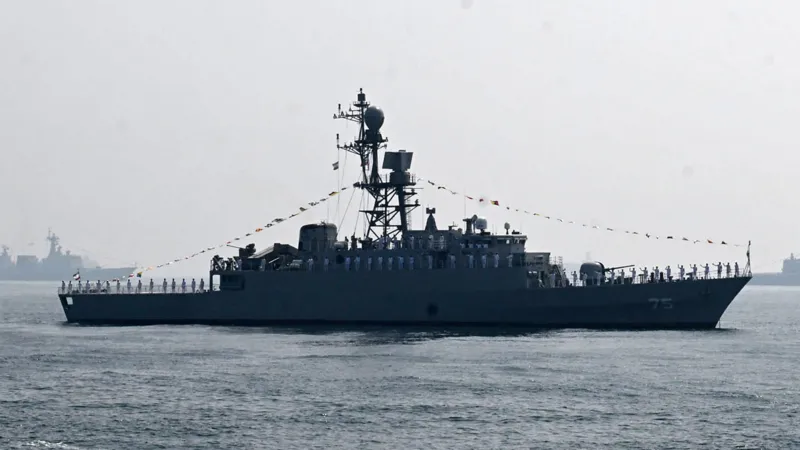
The Iranian warship Iris Dena was given permission by India to dock three days before it was torpedoed by a US submarine, India has said.
Foreign Minister S Jaishankar said Iran had sought permission for three of its ships to dock at Indian ports on 28 February – the day the US and Israel began a war on Iran – and permission was granted by India on 1 March.
The ships’ movements between 1 and 4 March are not clear and nor is why only one of them made it to India.
The sinking of the Iris Dena, with 130 sailors on board, in international waters off Sri Lanka’s southern coast on 4 March marked a dramatic widening of the war – and raised questions about India’s authority in its backyard.
It was the first military strike outside the Middle East since the US and Israel launched their war on Iran. President Donald Trump has said destroying Iran’s navy is one aim of the assault.
The three Iranian ships – Iris Dena, Iris Bushehr and Iris Lavan – had all participated in a military exercise hosted by India between 15 and 25 February in the coastal city of Visakhapatnam.
They left Indian waters on 25 February and were likely to have been in international waters on 28 February – when the US and Israel began attacking Iran.
“The Iranian side had requested permission on 28 February for three ships in the region to dock at our ports. This was accorded on 1 March,” Jaishankar told parliament on Monday. “Iris Lavan actually docked on 4 March in Kochi. The crew is currently in Indian naval facilities. We believe that this was the right thing to do.”
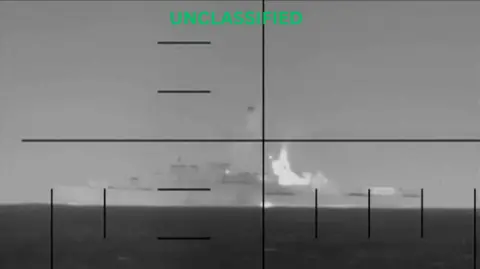
On 4 March, Iris Dena sank after being hit by a torpedo fired from a US submarine, killing at least 87 of its crew members.
According to the Indian Navy, the Iris Dena was operating about 20 nautical miles – roughly 23 miles (37km) – west of Galle in waters that fall under Sri Lanka’s designated search-and-rescue zone on the day it was struck.
The US tracks vessels across the world’s oceans, and a quarter of its submarine fleet of 65-70 is at sea at any given time, according to analysts.
Iran’s Foreign Minister Abbas Araghchi said last week the US had “perpetrated an atrocity at sea, 2,000 miles away from Iran’s shores” and that the warship was “struck in international waters without warning.”
Later, Sri Lanka said it had provided sanctuary for Iris Bushehr on 5 March, a day after it requested for docking following an engine malfunction.
Eventually, India also confirmed that Iris Lavan was docked in its southern city Kochi.
The BBC has written to the Iranian embassy in India and India’s external affairs ministry seeking clarification on the movements of the three Iranian naval vessels after Delhi granted them permission to dock.
US Defence Secretary Pete Hegseth has touted the attack on Iris Dena as an example of America’s military prowess, claiming it was “the first sinking of an enemy ship by a torpedo since World War Two”.
While it is the first time since 1945 that an American submarine has sunk an enemy ship this way, the UK and Pakistan have both sunk vessels using torpedoes since then.
The Iris Dena was one of about 20 Iranian navy vessels destroyed since Israel and the US launched co-ordinated strikes on Iran.
[BBC]

The white ball series between Afghanistan and Sri Lanka, scheduled to be held in the UAE from March 13 to 25, is likely to be postponed indefinitely due to the ongoing military conflict in West Asia.
While neither ACB nor SLC has issued an official statement, ESPNcricinfo has learned that both boards have agreed the series cannot take place in the UAE, keeping the ongoing crisis in mind. While both boards are still discussing alternatives, the bilateral series is unlikely to be shifted elsewhere due to logistical challenges.
The series comprising six white-ball matches was scheduled to start on March 13 starting with the three T20Is. The T20I leg was scheduled in Sharjah – on March 13, 15 and 17 – while the three ODIs were scheduled in Dubai on March 20, 22 and 25.
The series was set to be Afghanistan’s first under Ibrahim Zadran’s leadership, with the opener taking over the reins from Rashid Khan after a group-stage exit in the World Cup.
Last week, six matches of the ICC Men’s Cricket World Cup League 2 in Nepal involving Oman, UAE and the hosts were postponed because of the conflict.
The travel plans of several teams that were in India and Sri Lanka for the men’s T20 World Cup have also been disrupted owing to airspaces being closed or limited in West Asia.
Despite being knocked out over the last week, the contingents from West Indies and South Africa have been stuck in Kolkata, and received clarity only on Sunday, that they will be flying out on Tuesday.
[Cricinfo]

Five Iranian footballers granted Australian visas after anthem protest

Prime Minister on official visit to Manila, Philippines

It is the government’s responsibility to ensure women’s rights are realized in everyday Life, and are not confined merely to Laws – PM

North Korea cancels Pyongyang Marathon for ‘some reasons’

Canadian officials rescue 23 people who floated away on ice sheet

India offered sanctuary to Iranian ship three days before US sank it

‘Dates have the highest sugar content to fight Coronavirus’

Sunday Island 27 December – Headlines

#SundayIsland 17th December – Headlines

Sunday Island – 28th March

Sunday Island Headlines – 21 March

Sunday Island – 21st February – Headlines
-

 News4 days ago
University of Wolverhampton confirms Ranil was officially invited
-

 News5 days ago
Legal experts decry move to demolish STC dining hall
-

 News4 days ago
Female lawyer given 12 years RI for preparing forged deeds for Borella land
-

 News3 days ago
Peradeniya Uni issues alert over leopards in its premises
-

 Business5 days ago
Cabinet nod for the removal of Cess tax imposed on imported good
-

 News4 days ago
Library crisis hits Pera university
-

 News3 days ago
Wife raises alarm over Sallay’s detention under PTA
-

 Business6 days ago
War in Middle East sends shockwaves through Sri Lanka’s export sector