Connect with us

Latest News

IPL 2025: Mumbai Indian’s bowling tricks on slow pitch get them second straight win

Published

on

Mumbai Indians (MI) won an important toss, got the best of the conditions, and made excellent use of them to run away to their third win of IPL 2025,  beating Sunrisers Hyderabad (SRH) by four wickets. They sent SRH in on an unusually sluggish pitch at the Wankhede Stadium and restricted them to 162 for 5. They then hunted down their target with 11 balls to spare, with a bit of help from dew – though not enough to force a ball change.

MI’s biggest match-winner on the day was Will Jacks,  who had made a quiet start to the season, but showed all his value in his sixth match with his new team. His 26-ball 36 was an important innings, but he made an even bigger impact with his offspin, bossing his match-up against SRH’s entirely left-handed top three and finishing with 2 for 14 in three overs.

Jacks’ three overs allowed MI to delay their use of their Impact Player, even though they lost their legspinner Karn Sharma – Player of the Match in their last game against Delhi Capitals – to an injury before he could bowl a ball. Not being forced to bring on a bowler as his replacement allowed MI to sub in Rohit Sharma at the start of their chase, and he gave them impetus with an early cameo. With Ryan Rickelton, Suryakumar Yadav, Tilak Varma and Hardik Pandya also contributing handily, MI never allowed SRH’s bowlers to get a sniff.

For all that, though, this was a match won by MI’s bowlers. Jasprit Bumrah executed best, but their other fast bowlers also played their part in constricting SRH with a plan heavy on slower balls and yorkers on a surface where powering the ball down the ground seemed impossible at times.

This was why SRH only managed to post 162, despite a 59-run opening stand from Abhishek Sharma and Travis Head  both of whom enjoyed major slices of luck along the way. That SRH got that far was down to a strong finish, with the 18th and 20th overs bringing 21 and 22 runs respectively as Heinrich Klassen, Aniket Verma and Pat Cummins hit the only five sixes of their innings.

The first over of the match was an ominous one for MI. Deepak Chahar found Abhishek’s edge first ball only for the overhead chance to burst through Jacks’ hands at slip. Then Head flicked uppishly only for the ball to fall short of the diving Karn at midwicket.

The latter event happened in the third over as well, this time off Abhishek’s bat, and this time Karn’s futile dive also gave him a split webbing. He left the field and didn’t return to bowl.

Fortune smiled on SRH again in the 10th over, when Head was caught on the square-leg boundary off a no-ball from Hardik. But the bigger story was that Head was batting on 24 off 24 at that point, struggling to time the ball on a pitch where the ball simply wouldn’t come on to the bat. Abhishek had looked a little more fluent, scoring 40 off 27 before being caught on the point boundary off Hardik in the eighth over.

That wicket had come right after another ominous moment for MI, when Hardik had pulled up in his follow-through with what seemed like an injury to his left shin or ankle. He even seemed to gesture to his dugout to call for a substitute, but in the end he dusted himself off and continued bowling.

SRH only scored 46 in the powerplay despite not losing a wicket, and while the slow, grippy conditions played their part, MI’s bowlers also used them beautifully, with Bumrah standing out, giving away just 10 runs in his two powerplay overs.

MI brought on Jacks as soon as the powerplay ended, and he immediately began finding grip and turn. After Hardik had broken the opening stand in the eighth over, Jacks struck his first blow in the ninth, turning an offbreak sharply past the flailing bat of the charging Ishan Kishan to have him stumped.

Then, changing ends to bowl the 12th over, Jacks ended Head’s miserable stay, having him caught at long-off for 28 off 29 balls.

Head’s dismissal – a failure to clear the straight boundary – was a theme of SRH’s innings, with all their batters struggling for power down the ground. Only four fours came from the eighth to the 15th overs, and all four were hit behind the wicket. Klaasen and Nitish Kumar Reddy batted through most of this period, putting on 31 off 33 balls.

A three-run 17th over from Trent Boult,  which included the wicket of Reddy, caught at long-on, left SRH 115 for 4 with 140 looking a fair distance away.

But they managed to collect 47 off the last three, with Klaasen, Aniket and Cummins finally ending their sixes drought. Two of the five sixes involved exquisite skill from Klaasen and Aniket over the covers, but three came off hittable full-tosses. There were seven full-tosses in all in the last three overs, suggesting that dew may have already started setting in.

One of those full-tosses, however, came from Bumrah, who bowls the most unhittable full-tosses in world cricket, and bowled Klaasen as he attempted to make room. His 19th only went for four runs, sandwiched between expensive overs from Deepak Chahar and Hardik.

Impact sub Rohit took his chances early on, enjoyed a bit of luck, including an edged six over deep third, and hit a couple of trademark pulled sixes off his hip to give MI early impetus. Rickelton struggled early on, got going with three successive fours off Eshan Malinga and enjoyed a strange stroke of luck when he was caught in the covers off Zeeshan Ansari only for an umpire’s review to confirm a no-ball – for keeper Klaasen’s gloves encroaching in front of the stumps before the batter had hit the ball. But Rickelton was out soon after, miscuing a Harshal Patel slower ball to backward point.

Between them, though, the openers had shaved 57 runs off MI’s target.

Then Jacks and Suryakumar combined for the decisive partnership of the match, putting on 52 for the third wicket in just 29 balls. They hit four sixes and a four in three overs from legspinners Ansari and Rahul Chahar – who came on as Impact Sub, replacing Mohammed Shami who still had an over of his quota remaining – who were still finding grip off this surface but ever so often erred in line or length.

By the time Cummins broke this stand, MI needed 42 at less than a run a ball. Hardik hurried them towards victory, hitting a six and three fours – including a glorious back-foot punch through wide long-on off Cummins – and they finally got home at the start of the 19th over, after a bizarre 18th that brought Malinga two wickets for just one run.

Brief scores:
Mumbai Indians 166 for 6 in 18.1 overs (Will Jacks 36, Ryan Rickelton 31,Rohit Sharma 26, Surykumar Yadav 26, Tilak Varma 21*, Hardik Pandya 21; Pat  Cummins 3-26, Eshan Malinga 2-36, Harshal Patel 1-31) beat Sunrisers Hyderabad 162 for 5 in 20 overs (Abhishek  Sharma 40, Travis Head 28, Nitish Kumar Reddy 19, Heirich Klaasen 37, Aniket Verma 18*; Will Jacks 2-14, Trent Boult 1-29, Jasprit Bumrah 1-21, Hardik Pandya 1-42) by four wickets

[Cricinfo]


Continue Reading
Click to comment

Leave a Reply

Your email address will not be published. Required fields are marked *

Latest News

Northern Japan hit by M7.5 earthquake, tsunami advisories lifted

Published

on

By

A magnitude 7.5 earthquake struck northern Japan on Monday. Tsunami advisories have been lifted for the Pacific coastline in northern Japan. But officials have issued an alert for a potential megaquake in northern Japan.

Strong tremors felt across the region

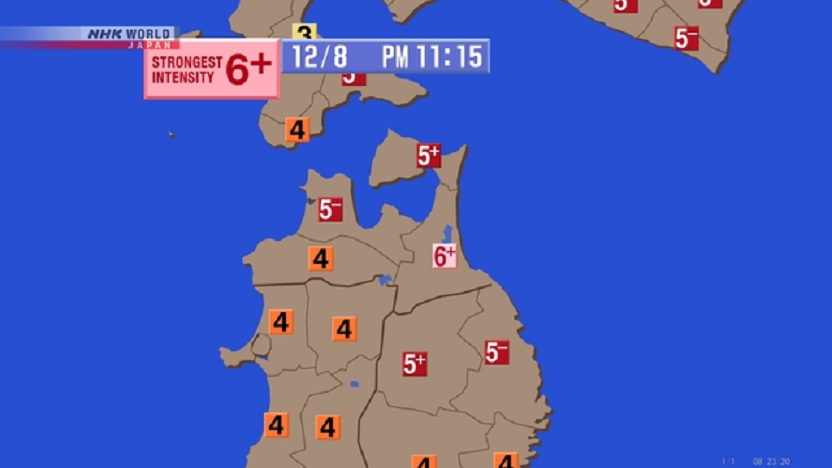
The earthquake struck off the eastern coast of Aomori Prefecture at 11:15 p.m. on Monday.

The Japan Meteorological Agency has downgraded the magnitude of the quake centered off the Pacific coast in Aomori Prefecture to 7.5 from 7.6.

The depth has also been adjusted to 54 kilometers, from an initial estimate of 50 kilometers.

Tremors with an intensity of upper 6 on the Japanese intensity scale of 0 to 7 were observed in the city of Hachinohe in Aomori Prefecture.

As of 1:00 a.m., six people in Aomori have been injured by either falling down or getting hit by falling objects at their homes.

Tsunami advisories lifted

Authorities had issued a tsunami warning for Iwate Prefecture and parts of Hokkaido and Aomori.

At Kuji Port in Iwate, a tsunami measuring 70 centimeters was observed. In Hokkaido, a 50-centimeter tsunami was seen in Urakawa Town and a 40-centimeter tsunami was observed at Mutsuogawara Port.

The Japan Meteorological Agency says: it is the first time the agency has issued a tsunami warning since July, when a powerful quake off Kamchatka, Russia, prompted it to issue one for Japan’s Pacific coastal areas.

Over 3 hours later, authorities downgraded the tsunami warning to advisories. And they lifted all tsunami advisories for the Pacific coastline of northern Japan at 6:20 a.m. on Tuesday.

‘Long-period ground motions’ recorded

According to authorities, long-period ground motions were recorded during the Monday earthquake.

The motions are slow, large-amplitude seismic waves with frequencies of 2 seconds or longer that occur during a large earthquake. Such motions are known to have a significant impact on high-rise buildings.

Strong long-period motions, classified class-3, the second highest in the 4-level scale were observed in the village of Rokkasho in Aomori Prefecture. Such class-3 waves are strong enough to make it difficult for people in a high-rise building to stand up.

‘An alert for a potential mega quake’ issued

Officials at Japan’s Meteorological Agency have issued an alert for a potential mega quake following Monday’s quake.

A mega quake could trigger tsunami along Japan’s Pacific coast from Hokkaido to Chiba Prefecture.

Officials are urging people to check evacuation routes, prepare emergency kits, secure home furniture and confirm backup food, water and portable toilets.

People along the Pacific coast in those areas should remain on the alert during the next week, even though an evacuation recommendation will not be issued.

The alert is the first since this category of warning was started in 2022.

Morikubo Tsukasa, Cabinet Office official for disaster preparedness, has held a news conference over a potential mega quake.

Morikubo: Based on the statistics of earthquakes that have occurred around the world so far, there is a possibility that a large-scale earthquake with a magnitude of 8 or higher could occur as a follow-up earthquake along the Japan Trench and the Chishima Trench off Hokkaido. It is unclear whether a large-scale earthquake will occur. But everyone should heed the call to take precaution to protect their own lives.

Residents ordered to evacuate

After tsunami warnings were issued, some municipalities in Hokkaido, and the Tohoku region issued evacuation orders to residents.

Traffic disrupted on Monday

East Japan Railway Company says that as of Tuesday, outbound trains on the Tohoku Shinkansen have been suspended between Fukushima and Shin-Aomori stations due to the earthquake. The company says three trains stopped in this section.

The company says that it is checking for any damage to railway tracks and that it remains unclear when services will resume.

The Morioka branch of East Japan Railway says that as of midnight on Tuesday, services on the Tohoku Main Line were suspended in Iwate Prefecture.

It says two trains made emergency stops. It remains unclear when services will resume. There are no reports of injuries.

As for Hokkaido, the operator of its busiest airport, New Chitose Airport near Sapporo, says that as of 11:40 p.m. on Monday, it was checking whether there are any abnormalities on two runways.

Highways have been affected. East Nippon Expressway Company says that as of 11:45 p.m. on Monday, traffic was completely stopped between the Shiraoi and Shinchitose Airport Interchanges and between the Tomakomai Higashi and Numanohata Nishi Interchanges.

Major traffic disorder unlikely on Tuesday

East Japan Railway Company says there has been no impact on its bullet train and regular train services after authorities issued the alert for potential megaquake following magnitude-7 or over quakes related to Monday’s quake. The operator, however, warns that delays or cancellations are still possible if damage to infrastructure is confirmed.

All Nippon Airways and Japan Airlines say they plan to operate as usual starting Tuesday.

According to Cabinet Office guidelines, no restrictions will be placed on railways, airports and roads, even after such an alert is issued. The authorities are supposed to provide the public with information about locations they consider being vulnerable to a possible major quake, as well as evacuation sites.

In August 2024, authorities issued a Nankai Trough megaquake advisory after a powerful earthquake struck in southern Japan. The operator of the Tokaido Shinkansen was forced to slow down its bullet trains in some sections over the ensuing one-week period.

Power Companies: No abnormalities at nuclear plants

Tokyo Electric Power Company says it has confirmed that there are no abnormalities at the Fukushima Daiichi and Daini nuclear plants.

The company says it halted the release of treated and diluted water from the Fukushima Daiichi nuclear power plant at 11:42 pm on Monday, as per predetermined procedures.

The facility suffered a triple meltdown during the March 2011 earthquake and tsunami. The water used to cool molten fuel has been mixing with rain and groundwater.

That has been treated to remove most radioactive substances, except tritium. It’s then diluted, reducing levels of tritium to well below the World Health Organization’s guidance for drinking water, before it is released into the ocean.

TEPCO also ordered some employees at the facility to evacuate. There have been no reports so far of injuries at the nuclear power plant.

Tohoku Electric Power Company says no abnormalities have been detected at the Higashidori nuclear power plant in Aomori Prefecture and the Onagawa plant in Miyagi Prefecture.

Hokkaido Electric Power Company says no problems have been found at the Tomari nuclear power plant in the prefecture.

Government bracing for damages

The Japanese government set up a task force at the crisis management center in the prime minister’s office at 11:16 p.m. on Monday in response to the earthquake.

Prime Minister Takaichi Sanae entered the prime minister’s office shortly after 11:50 p.m.

She instructed the government to immediately provide information on any tsunami and evacuation orders to the people in an appropriate manner, take thorough measures to prevent harm, such as evacuating residents, and get a grasp of the extent of damage as soon as possible.

Takaichi: The central government will work closely with local governments and make the utmost effort to carry out measures, such as emergency response, including rescue for the affected people.

Chief Cabinet Secretary Kihara Minoru held a news conference on Tuesday. Kihara said the government continues to assess the extent of the damage.

He added that the government is devoting all its efforts to disaster prevention measures, with rescue and relief efforts as its top priority, led by the police, fire departments, Self-Defense Forces, and Japan Coast Guard.

Expert view on the quake

Sakai Shinichi, professor at the Earthquake Research Institute of the University of Tokyo, says: If this was a shallow earthquake centered in the sea, there is a high possibility that a tsunami has already occurred. People should stay away from the coast. It is important to evacuate and to take measures to stay warm.

Sakai says: The epicenter may be north of the epicenter area of the 2011 Great East Japan Earthquake. This time, the earthquake is believed to have occurred at the plate boundary, so I think it was a slightly larger earthquake. The magnitude could be revised in the future.

[NHK]

Continue Reading

Latest News

New mpox strain identified in England

Published

on

By

A new strain of mpox, previously called monkeypox, has been detected in a person in England, say UK health officials.

The virus is a mix of two major types of the mpox virus, and was found in someone who recently returned from travelling in Asia.

Officials say they are still assessing the significance of the new strain.

The UK Health Security Agency (UKHSA) says it is normal for viruses to evolve. Getting vaccinated remains the best way to protect against severe disease – although an mpox infection is mild for many.

The new virus strain contains elements of two mpox strains, called clade Ib and clade IIb. It currently has no name.

UK health officials recently encouraged gay, bisexual and other men who have sex with men to make sure they were vaccinated against mpox.

That call came as a strain called ‘clade Ib’ showed early signs of local spread in some European countries.

‘Clade IIb’ is linked to a global outbreak of mpox in 2022 which affected many countries worldwide.

In the UK, vaccination is available for groups of people at highest risk of catching mpox:

  • those who have multiple sexual partners
  • those who engage in group sex
  • those who visit sex-on-premises venues

Health officials say the vaccine is 75-80% effective at protecting against mpox.

There have been no studies on how well the vaccine protects against this latest strain, although it’s thought there will be a high degree of protection.

Dr Katy Sinka, head of sexually transmitted infections at UKHSA, said genomic testing had allowed it to be detected.

“It’s normal for viruses to evolve, and further analysis will help us understand more about how mpox is changing.

“Getting vaccinated is a proven effective way to protect yourself against severe disease, so please make sure to get the jab if you are eligible,” she said.

Prof Trudie Lang, director of the Global Health Network at the University of Oxford, said there were “excellent systems” to identify cases and control onward infection in the UK, but in other parts of the world, in more vulnerable populations, “this is harder to achieve”, where access to vaccines is not as reliable.

Prof Lang said if further cases of this strain appeared in the UK and elsewhere, it would be important to understand how it’s being spread and how ill it makes people, in order to assess whether it’s more or less dangerous than previous strains.

There have been nearly 48,000 confirmed cases of mpox globally in 2025, and 2,500 in the past month, with most occurring in central Africa.

Dr Boghuma Titanji, assistant professor of medicine at Emory University, said the new strain is what experts feared would happen if mpox continued to spread worldwide.

“The more mpox circulation we permit, the more opportunities the virus has to recombine and adapt, further entrenching mpox virus as a human pathogen that is not going away,” she said.

Mpox can be a unpleasant illness.

Common symptoms are lesions or a skin rash, which can last for two to four weeks, plus fever, headaches, back pain, muscle aches and tiredness.

The virus spreads from person to person through close physical contact, coughs or sneezes and touching infected clothing, bedding or towels.

UK Health officials say anyone who thinks they might have mpox, should contact NHS 111 for advice on what to do.

[BBC]

Continue Reading

Latest News

Powerful earthquake strikes off Japan, triggers tsunami warning

Published

on

By

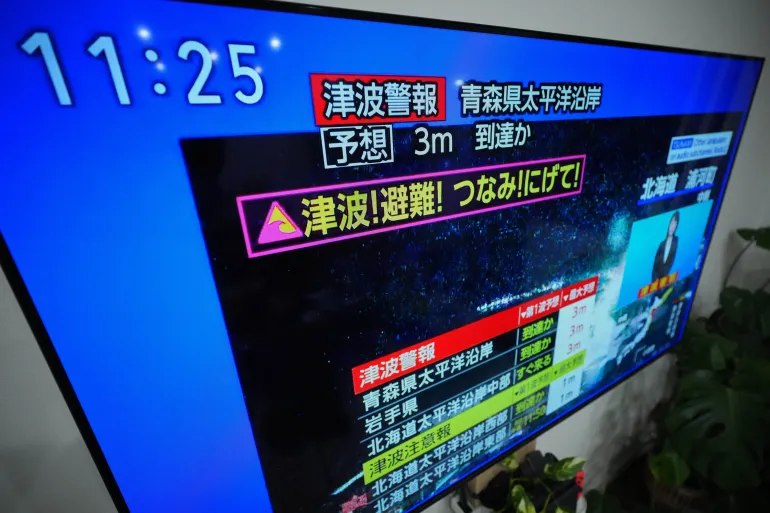
A tsunami warning is displayed on a television in Yokohama A tsunami warning is displayed on a television in Yokohama, near Tokyo [Aljazeera]

A powerful earthquake has struck off Japan’s coast, triggering a tsunami alert, according to local media reports.

An initial report by Japan’s Meteorological Agency put the magnitude of the quake on Monday at 7.2.

It said the earthquake struck off the coast of Aomori and Hokkaido, adding that a tsunami as high as three metres (10 feet) could hit Japan’s northeastern coast

Continue Reading

Trending