
Latest News
IPL 2025: Buttler 73* leads Gujarat Titans past Royal Challengers Bengaluru after Siraj derails former team

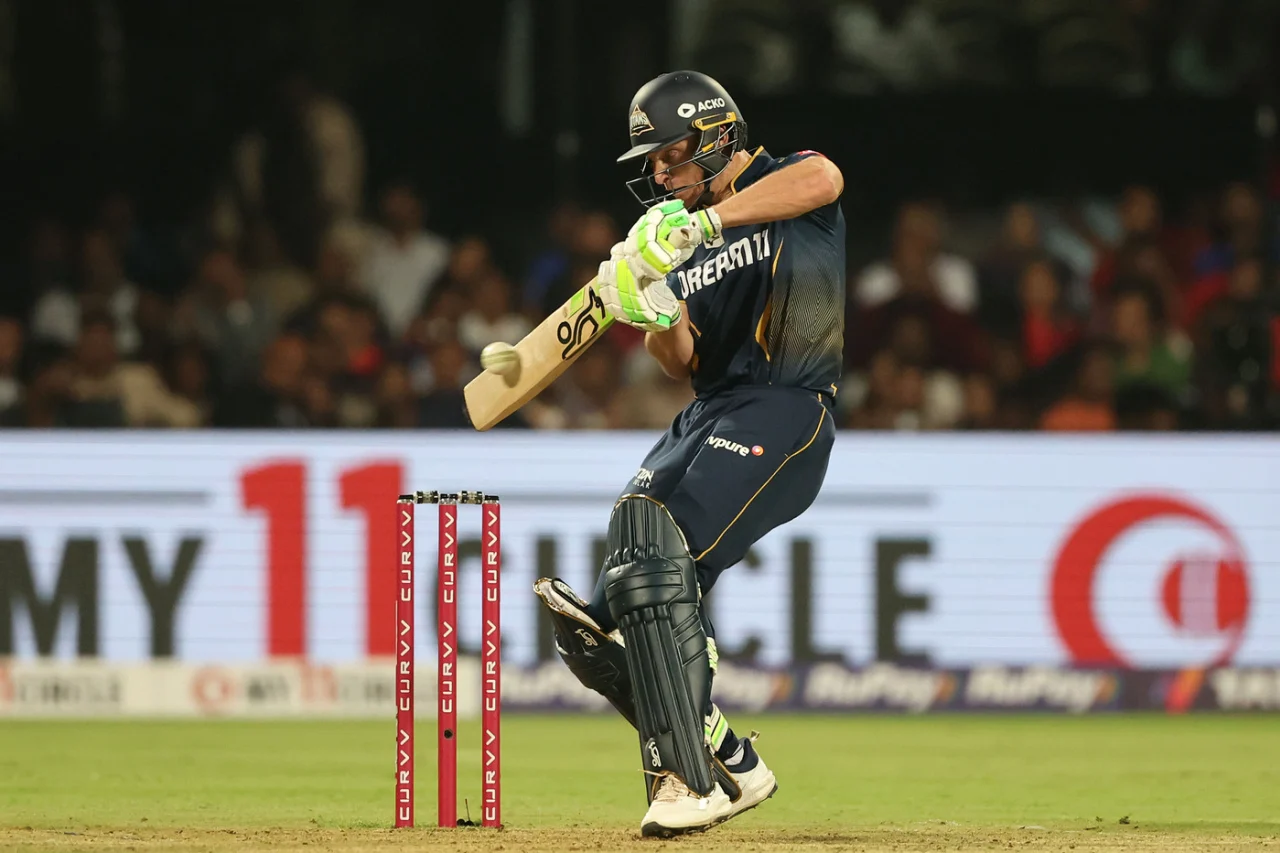
Mohammed Siraj’s fiery 3 for 19 against his former team, backed up by Jos Buttler’s unbeaten 73 off 39 balls, helped Gujarat Titans (GT) spoil Royal Challengers Bengaluru (RCB)‘s homecoming and coast to an eight-wicket victory at the Chinnaswamy Stadium.
Playing against RCB for the first time after seven years with them, Siraj returned to Bengaluru with a point to prove. Bowling at speeds in excess of 140kph, he rattled the batters in the powerplay and also picked up a key wicket in the death overs. Despite Siraj’s efforts, RCB notched up 169 for 8, riding largely on Liam Livingstone’s fifty and cameos from Jitesh Sharma and Tim David.
With the ball, Josh Hazlewood and Bhuvneshwar Kumar were on the mark in the powerplay for RCB. But as the ball got older, the bowling also fizzled away. While Shubman Gill fell cheaply, Sai Sudarshan and Buttler added 75 off just 47 balls to give the chase impetus. Sherfane Rutherford then came in as Impact Sub and added an unbroken 63 off 32 balls with Buttler, as GT romped home with 13 balls to spare.
This was GT’s second win in three games, while RCB’s loss was their first of IPL 2025 after two stellar wins.
Siraj has done his siuuu celebration several times at the Chinnaswamy in the last seven years. Most times, it has been met with a roaring response. On Wednesday, he went on his celebratory run twice in the powerplay to pin-drop silence. Having not been retained by RCB ahead of the auction, Siraj, now playing for GT, had matters to settle. And he did it in style.
It was his spell in the powerplay that stood out. Operating at mid-140kph, Siraj was not just bowling heat but was also precise with his lengths. According to ESPNcricinfo’s data, of the 18 balls Siraj bowled in the powerplay, six of his deliveries landed on a length, off which he picked up two wickets. More importantly, eight of his deliveries finished in line with the stumps, which meant he barely gave the batters any room to work with. RCB managed a control percentage of just 50 against Siraj in the powerplay.
Siraj should have had Phil Salt in his opening over, but Buttler dropped a sitter behind the stumps. Soon after, Siraj had the zing bails flashing when Devdutt Padikkal waltzed down the track, missed, and saw his stumps in a mess. Salt thumped Siraj for a 105m six over midwicket in his next over, to which Siraj responded by flattening Salt’s off stump with a 145.9kph thunderbolt.
Siraj later returned and picked up the key wicket of Livingstone in the 19th over to finish with 3 for 19, sending down 14 dots in his four overs.
At 42 for 4 after 6.2 overs, RCB were in big trouble. Rajat Patidar had just fallen to Ishant Sharma, and the Chinnaswamy was silent. But Jitesh made his intentions clear quite early. He got going with a stylish pull off Ishant before going big. He first brought his wrists into play to loft Ishant over long-on, and dispatched him for two more fours as RCB collected 17 runs off the ninth over.
Livingstone, at the other end, was struggling to get away before finally walloping Rashid Khan over deep square leg. Livingstone was dropped twice, and also survived a missed stumping, and made the best of his luck. Jitesh and Krunal Pandya fell in quick succession to R Sai Kishore, who picked up 2 for 22 in his four overs, which included breaking a flourishing 52-run stand between Jitesh and Livingstone in the 13th over. He tossed one up at Jitesh, who ended up skying it to long-on.
Two overs later, Sai Kishore got Krunal when the ball seemed to hold on the pitch, and a leading edge went right back to the bowler. It was after that that Livingstone took over for RCB. He broke the shackles with a huge six over deep midwicket against Rashid, while David also hit a six and a four. Despite that, RCB were struggling on 129 for 6 after 17 overs. But Livingstone pumped Rashid for three sixes in the 18th to reach his fifty off 39 balls. In all, he smashed Rashid for 39 runs off 17 deliveries, with five sixes.
RCB tonked 64 runs in the last five overs, thanks largely to David’s hitting, as he thumped 32 off 18 balls. But 169 at the innings break looked under-par.
Buttler came into this IPL under pressure. He had just quit the England white-ball captaincy after a disastrous Champions Trophy, and he had not been among the runs either. He was going to a new IPL team after flourishing with Rajasthan Royals, and was going to bat at No. 3, having mostly opened previously.
But in just three innings, Buttler has proved that nothing has changed. He was coming into the game with scores of 70*, 8, 106*, 0, 0 and 100* against RCB since IPL 2022. On Wednesday, he shored up his record further.
Buttler came in to bat with GT struggling a touch. Hazlewood and Bhuvneshwar were making the ball talk, and not giving much away. Gill struck Bhuvneshwar over long-on but fell the next ball, caught at deep third. At that stage, GT were 32 for 1 after 4.4 overs.
Brief scores:
Gujarat Titans 170 for 2 in 17.5 overs (Joss Buttler 73*, Sai Sudharsan 49, Sherfane Rutherford 30*, Shubman Gill 14; Bhuvneshwar Kumar 1-23, Josh Hazlwood 1-43) beat Royal Challengers Bengaluru 169 for 8 in 20 overs (Phil Salt 14, Rajat Patidar 12, Liam Livingstone 54, Jitesh Sharma 33, Tim David 32; Mohammed Siraj 3-19, Arshad Khan 1-17, Prasidh Krishna 1-26, Ishant Sharma 1-27, Sai Kishore 2-22) by eight wickets
[Cricinfo]


A crane collapse has killed two people on the outskirts of Thailand’s capital Bangkok, one day after a falling crane in the country’s northeast killed 32.
Thursday’s accident in Samut Sakhon province involved a crane being used to construct an elevated highway that fell onto the road below, Police Colonel Sitthiporn Kasi, superintendent at the local district police station, told the Reuters news agency. Another police official from the station told Reuters that five people had also been injured in the accident.
Transport Minister Phiphat Ratchakitprakarn said the same building firm was also involved, linking Italian-Thai Development to the country’s second deadly crane collapse in two days, according to local media.
The company was contracted to build a section of a China-backed high-speed rail project where a huge crane collapsed on Wednesday in Nakhon Ratchasima province, northeast of Bangkok.
Local media reported that Thursday’s incident occurred in front of the Paris Inn Garden Hotel. Footage showed clouds of dust and rubble scattered across the site after the crane collapsed.
The Rama II Expressway, the site of the latest accident, hosts several major infrastructure projects, including tollway construction, and has seen several deadly accidents in recent years, earning it the nickname “Death Road”.
On Wednesday, the crane involved was being used to build an elevated track as part of a joint Thai-Chinese high-speed rail project, according to reports. The crane fell onto a moving train below, causing it to derail and briefly catch fire.
[Aljazeera]

India has shut down a medical college in Indian-administered Kashmir in an apparent capitulation to protests by right-wing Hindu groups over the admission of an overwhelming number of Muslim students into the prestigious course.
The National Medical Commission (NMC), a federal regulatory authority for medical education and practices, on January 6 revoked the recognition of Shri Mata Vaishno Devi Medical Institute (SMVDMI), located in Reasi, a mountainous district overlooking the Pir Panjal range in the Himalayas, which separates the plains of Jammu from the Kashmir valley.
Of the 50 pupils who joined the five-year bachelor’s in medicine (MBBS) programme in November, 42 were Muslims, most of them residents of Kashmir, while seven were Hindus and one was a Sikh. It was the first MBBS batch that the private college, founded by a Hindu religious charity and partly funded by the government, had launched.
Admissions to medical colleges across India, whether public or private, follow a centralised entrance examination, called the National Entrance Examination Test (NEET), conducted by the federal Ministry of Education’s National Testing Agency (NTA).
More than two million Indian students appear for NEET every year, hoping to secure one of approximately 120,000 MBBS seats. Aspirants usually prefer public colleges, where fees are lower but cutoffs for admission are high. Those who fail to meet the cutoff but meet a minimum NTA threshold join a private college.
Like Saniya Jan*, an 18-year-old resident of Kashmir’s Baramulla district, who recalls being overwhelmed with euphoria when she passed the NEET, making her eligible to study medicine. “It was a dream come true – to be a doctor,” Saniya told Al Jazeera.
When she joined a counselling session that determines which college a NEET qualifier joins, she chose SMVDMI since it was about 316km (196 miles) from her home – relatively close for students in Kashmir, who often otherwise have to travel much farther to go to college.
Saniya’s thrilled parents drove to Reasi to drop her off at the college when the academic session started in November. “My daughter has been a topper since childhood. I have three daughters, and she is the brightest. She really worked hard to get a medical seat,” Saniya’s father, Gazanfar Ahmad*, told Al Jazeera.
But things did not go as planned.

As soon as local Hindu groups found out about the religious composition of the college’s inaugural batch in November, they launched demonstrations demanding that the admission of Muslim students be scrapped. They argued that since the college was chiefly funded from the offerings of devotees at Mata Vaishno Devi Temple, a prominent Hindu shrine in Kashmir, Muslim students had “no business being there”.
The agitations continued for weeks, with demonstrators amassing every day outside the iron gates of the college and raising slogans.
Meanwhile, legislators belonging to Prime Minister Narendra Modi’s Bharatiya Janata Party (BJP) – which has been accused of pursuing anti-Muslim policies since coming to power in 2014 – even wrote petitions to Kashmir’s lieutenant governor, urging him to reserve admissions in SMVDMI only for Hindu students. The lieutenant governor is the federally appointed administrator of the disputed region.
In the days that followed, their demands escalated to seeking the closure of the college itself.
As the protests intensified, the National Medical Commission on January 6 announced that it had rescinded the college’s authorisation because it had failed to “meet the minimum standard requirements” specified by the government for medical education. The NMC claimed the college suffered from critical deficiencies in its teaching faculty, bed occupancy, patient flow in outpatient departments, libraries and operating theatres. The next day, a “letter of permission”, which authorised the college to function and run courses, was withdrawn.

But most students Al Jazeera talked to said they did not see any shortcomings in the college and that it was well-equipped to run the medical course. “I don’t think the college lacked resources,” Jahan*, a student who only gave her second name, said. “We have seen other colleges. Some of them only have one cadaver per batch, while this college has four of them. Every student got an opportunity to dissect that cadaver individually.”
Rafiq, a student who only gave his second name, said that he had cousins in sought-after government medical colleges in Srinagar, the biggest city in Indian-administered Kashmir. “Even they don’t have the kind of facilities that we had here,” he said.
Saniya’s father, Ahmad, also told Al Jazeera that when he dropped her off at the college, “everything seemed normal”.
“The college was good. The faculty was supportive. It looked like no one cared about religion inside the campus,” he said.
Zafar Choudhary, a political analyst based in Jammu, questioned how the medical regulatory body had sanctioned the college’s authorisation if there was an infrastructural deficit. “Logic dictates that their infrastructure would have only improved since the classes started. So we don’t know how these deficiencies arose all of a sudden,” he told Al Jazeera.
Choudhary said the demand of the Hindu groups was “absurd” given that selections into medical colleges in India are based on religion-neutral terms. “There is a system in place that determines it. A student is supposed to give preference, and a lot of parameters are factored in before the admission lists are announced. When students are asked for their choices, they give multiple selections rather than one. So how is it their fault?” he asked.
Al Jazeera reached out to SMVDMI’s executive head, Yashpal Sharma, via telephone for comments. He did not respond to calls or text messages. The college has issued no public statement since the revocation of its authorisation to offer medical courses.

Meanwhile, students at SMVDMI have packed their belongings and returned home.
Salim Manzoor*, another student, pointed out that Indian-administered Kashmir, a Muslim-majority region, also had a medical college where Hindu candidates are enrolled under a quota reserved for them and other communities that represent a minority in the region.
The BJP insists it never claimed that Muslim students were unwelcome at SMVDMI, but encouraged people to recognise the “legitimate sentiments” that millions of Hindu devotees felt towards the temple trust that founded it. “This college is named after Mata Vaishno Devi, and there are millions of devotees whose religious emotions are strongly attached to this shrine,” BJP’s spokesman in Kashmir, Altaf Thakur, told Al Jazeera. “The college recognition was withdrawn because NMC found several shortcomings. There’s no question of the issue being about Hindus and Muslims.”
Last week, Omar Abdullah, chief minister of Indian-administered Kashmir, announced that SMVDMI students would not be made to “suffer due to NMC’s decision” and they would be offered admissions in other colleges in the region. “These children cleared the National Entrance Examination Test, and it is our legal responsibility to adjust them. We will have supernumerary seats, so their education is not affected. It is not difficult for us to adjust all 50 students, and we will do it,” he said.
Abdullah condemned the BJP and its allied Hindu groups for their campaign against Muslims joining the college. “People generally fight for having a medical college in their midst. But here, the fight was put up to have the medical college shut. You have played with the future of the medical students of [Kashmir]. If ruining the future of students brings you happiness, then celebrate it.”
Tanvir Sadiq, a regional legislator belonging to Abdullah’s National Conference party, said that the university that the medical college is part of received more than $13m in government aid since 2017 – making all Kashmiris, and not donors to the Mata Vaishno Devi shrine – stakeholders. “This means that anyone who is lawfully domiciled in [Indian-administered Kashmir] can go and study there. In a few decades, the college would have churned out thousands of fresh medical graduates. If a lot of them are Muslims today, tomorrow they would have been Hindus as well,” he told Al Jazeera.
Nasir Khuehami, who heads the Jammu and Kashmir Students’ Association, told Al Jazeera the Hindu versus Muslim narrative threatened to “communalise” the region’s education sector. “The narrative that because the college is run by one particular community, only students from that community alone will study there, is dangerous,” he said.
He pointed out that Muslim-run universities, not just in Kashmir but across India, that were recognised as minority institutions did not “have an official policy of excluding Hindus”.
Back at her home in Baramulla, Saniya is worried about her future. “I appeared for a competitive exam, which is one of the hardest in India, and was able to get a seat at a medical college,” she told Al Jazeera.
“Now everything seems to have crashed. I came back home waiting for what decision the government will take for our future. All this happened because of our identity. They turned our merit into religion’
[Aljazeera]
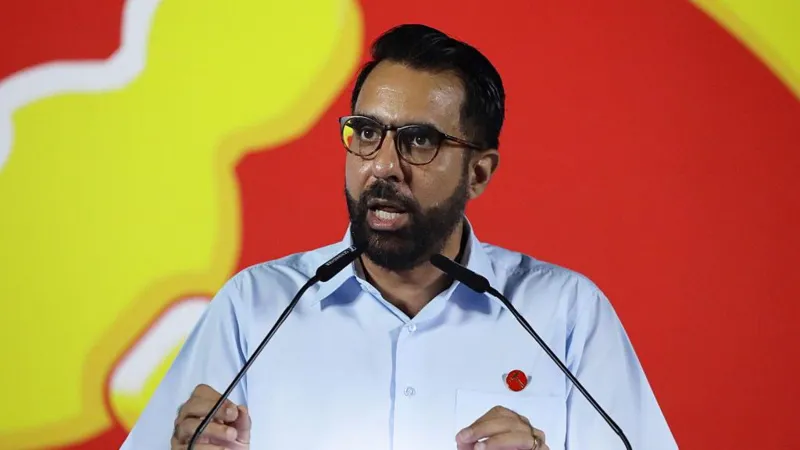
Singapore’s Leader of the Opposition in parliament, Pritam Singh, has been stripped of his title by the prime minister following a vote by lawmakers.
The vote took place on Wednesday in parliament, which is overwhelmingly dominated by the ruling People’s Action Party (PAP).
The move follows Singh’s conviction for lying under oath to a parliamentary committee. Singh has consistently maintained his innocence.
He remains a member of parliament and secretary-general of the largest opposition party, Workers’ Party (WP), but will lose privileges such as additional allowances and the right of first reply during parliamentary debates.
Singh’s case stands out as one of the only criminal convictions against a sitting opposition lawmaker. He was also the first person to hold the title of Leader of the Opposition.
Critics have previously accused Singapore’s government of using the judiciary to go after its political opponents – charges authorities have always denied.
On Wednesday, Indranee Rajah, the Leader of the House who had initiated the debate, said that Singh’s lies “strike at the trust” Singaporeans place in parliament and accused him of “failing to take responsibility”.
Singh defended himself during the debate, saying that his “conscience remains clear” and disagreed with the debate’s resolution that his behaviour was “dishonourable and unbecoming”. He also vowed to continue his work as an MP.
After three hours of debate, the parliament backed a motion that agreed Singh should not be the Leader of the Opposition. All 11 present WP members voted against it.
The parliament also agreed to review the implications for two other WP lawmakers at another time.
On Thursday, Prime Minister Lawrence Wong said in light of Singh’s conviction and the vote that it was “no longer tenable” for him to continue as the Leader of the Opposition.
He also invited the WP to nominate another of their MPs to take the title.
In response to BBC queries over text messaging, Singh responded with a single word: “#WeContinue”.
The WP said it will deliberate on the move and respond “in due course”. It previously said it would conduct an internal review of whether Singh contravened their rules.
The party holds 12 seats in Singapore’s 108-seat parliament.
The saga began in 2021, when WP lawmaker Raeesah Khan claimed in parliament that she had witnessed police misbehave towards a sexual assault victim.
She later admitted that her anecdote was not true, but said during a parliamentary committee investigation that the party’s leaders, including Singh, had told her to “continue with the narrative” despite knowing about the lie.
Khan has since resigned from the party and parliament, and was fined for lying and abusing her parliamentary privilege.
A criminal case was subsequently brought against Singh for lying under oath to the parliamentary committee during hearings for Khan’s case.
Last February a court found him guilty and fined him several thousands of dollars. It ruled that Singh’s actions were “strongly indicative” that he had not wanted Khan to clarify her lie.
But Singh, who maintained his innocence throughout the closely-watched trial, argued that he had wanted to give Khan time to deal with what was a sensitive issue.
In December he lost an appeal against the conviction.
[BBC]

Another crane collapses in Thailand, killing two, after 32 die previous day

India shuts Kashmir medical college – after Muslims earned most admissions

Singapore’s opposition leader stripped of title after conviction for lying

BCB issues show cause notice to Nazmul Islam but Bangladesh players firm on boycott

From behind bars, Aung San Suu Kyi casts a long shadow over Myanmar

Senegal beat Egypt 1-0 in AFCON semifinal as Sadio Mane scores late

‘Dates have the highest sugar content to fight Coronavirus’

Sunday Island 27 December – Headlines

#SundayIsland 17th December – Headlines

Sunday Island – 28th March

Sunday Island Headlines – 21 March

Sunday Island – 21st February – Headlines
-

 Business4 days ago
Dialog and UnionPay International Join Forces to Elevate Sri Lanka’s Digital Payment Landscape
-
 News4 days ago
Sajith: Ashoka Chakra replaces Dharmachakra in Buddhism textbook
-

 Features4 days ago
The Paradox of Trump Power: Contested Authoritarian at Home, Uncontested Bully Abroad
-

 Features4 days ago
Subject:Whatever happened to (my) three million dollars?
-

 News4 days ago
Level I landslide early warnings issued to the Districts of Badulla, Kandy, Matale and Nuwara-Eliya extended
-

 Business1 day ago
New policy framework for stock market deposits seen as a boon for companies
-

 Business11 hours ago
Koaloo.Fi and Stredge forge strategic partnership to offer businesses sustainable supply chain solutions
-

 Opinion6 days ago
The minstrel monk and Rafiki, the old mandrill in The Lion King – II