
Latest News
IPL 2025: 14 year old Suryavanshi, shatters records to keep Rajasthan Royals alive


In his third IPL match, the 14-year-old Vaibhav Suryavanshi brought down to their knees seasoned pros from the best bowling unit in the tournament, some of whom have been playing for longer than he has lived.
The youngest T20 centurion, among the youngest handful centurions in all representative cricket, the second quickest century in the IPL in 35 balls, joint-most sixes – 11 – for an Indian in an IPL innings, highest boundary percentage in a T20 ton, with 94 of his runs coming in boundaries, Suryavanshi knocked off plenty of records. Oh, did we mention that it sealed the chase of 210 in 15.5 overs, the fastest successful chase of 200-plus in an IPL match, after Rajasthan Royals (RR) had lost three straight chases despite bossing 35 overs of those matches?
Suryavanshi’s opening partner Yashaswi Jaiswal played a lovely unbeaten T20 innings of 70 off 40, but he was the first one to admit he was left in the background by “one of the best innings I have seen”.
Suryavanshi tried to hit boundaries off 26 out of the 38 balls he faced. He nailed 15 of those attempts, but also got 25 off the 11 false shots when he tried to attack. The most impressive was a six over long-off off a slower hard-length ball from the tall Prasidh Krishna.
A perfect mix of intent, skill and luck. All at an age when most kids are dreaming of doing exactly what he did. Or do they even dare dream so high?
Surely, there must be teams thinking it is a matter of two wickets, and GT can be toppled. Yet their top three keep churning out runs while making them look easy and risk-averse. At the end of the 20 overs, GT had all their top three in the top six run getters in IPL 2025.
B Sai Sudarshan regained his orange cap, but he wasn’t quite at his most fluent. Dropped on nine, he was dismissed for 39 off 30, but thanks to Shubman Gill’s quick start, GT still had 93 in 10.2 overs. This was the fifth stand of 50 or more for the pair in just nine innings.
Sai Sudharsan’s wicket brought a period of lull created by Wanindu Hasaranga’s three boundaryless overs. There was a period of four overs for 23 runs, which Gill broke with two sixes off Yudhvir Singh’s pace in the 14th over. Immediately after that, Jos Buttler who had got off to a slow start of 7 off 10 balls, laid into Hasaranga first and then compatriot Jofra Archer.
Hasaranga’s figures were rearranged to 4-0-39-0, and Archer went for 19 in the 18th over. Thought RR pulled things back with just 21 runs off the two last overs, not many gave them a chance of avoiding being knocked out.
It might be tempting to think that RR had nothing to lose, which freed Suryavanshi up, but we have seen enough of him in the first two games to know he doesn’t need any external freedom. His first act of disdain came in the first over, off the second legal delivery he faced. Mohammed Siraj, rejuvenated after a break from international cricket, 12 wickets to his name, bowled on a good length, not half-volley, but Suryavanshi launched him over long-on.
At the start of the second over, Jaiswal was dropped, and he celebrated it with a six and three fours by the end of the third over. That was the last time Jaiswal enjoyed any kind of lead. Ishant Sharma was bowling that one extra over to Ricky Ponting in the Perth Test back in 2007-08. Suryavanshi was born in 2011.
Ishant tried to bounce the kid, the kid hooked him for six. He overpitched slightly, and Suryavanshi whipped him over midwicket. Ishant did him in with a slower one, but the momentum of charging down and his amazing bat speed put enough in the mis-hit to clear mid-off. Then he played the regulation cut so hard that the top edge flew over straight third for a six.
Missing Gill because of back spasms in the second innings, GT were being led by Rashid Khan, who went to the offspin of Washington Sundar to the two left-hand batters. At 21, Washington was helping India win the Gabba Test and with that the most ridiculous Test series win of all time. There are levels to it, he was being shown now. Pull, sweep, inside-out drive over cover, and we had the youngest IPL half-centurion of all time, and the quickest this season, in 17 balls.
Prasidh and Rashid brought some sanity to proceedings with ten runs in two overs. Prasidh is the second highest wicket taker this IPL. He is tall and generates disconcerting bounce from hard lengths. He can also bowl a mean slower ball into the pitch. That is exactly what he did. He might have expected some respect, but Suryavanshi hit him for a six over long-off off the back foot. The exclamation mark of the innings.
IPL debutant Karim Janat was just a lamb thrown to slaughter with his gentle medium pace as Suryavanshi hit a boundary off each ball of the 30-run tenth over to take RR to 144. And himself to 94 off 34. The asking rate was now only a trickle above a run a ball.
It was only fitting that the century came through a six. A six off someone who will be on the Mount Rushmore of T20 bowling. Rashid, who bowled four overs for just 24 amid all the mayhem. Just too quick and too accurate to punish. Suryavanshi kept trying without success, but finally broke even Rashid down.
It took a pinpoint yorker from Krishna to send Suryavanshi on a slow walk back. The night he made his debut, Suryavanshi went back with tears in his eyes despite having wowed everyone with a six first ball. He wanted to show more of his batting. Did he ever?
Brief scores:
Rajasthan Royals 212 for 2 in 15.5 overs (Vaibhav Suryavanshi 101, Yashasvi Jaiswal 70*, Riyan Parag 32*; Prasidh Krishna 1-47, Rashid Khan 1-24) beat Gujarat Titans 209 for 4 in 20 overs (Sai Sudarshan 39, Shubman Gill 84, Jos Buttler 50, Washington Sundar 13; Joffra Archer 1-49, Maheesha Theekshana 2-35, Sandeep Sharma 1-33) by eight wickets
[Cricinfo]

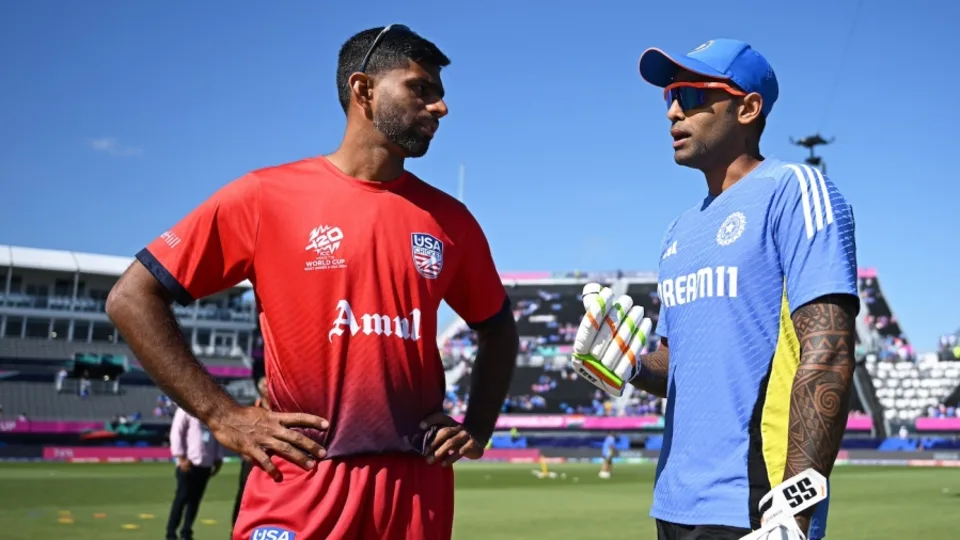
The USA national team has only four players born in the USA, all of them children of immigrants. The other 11 are first-generation immigrants.
Three of those 11 were born in Pakistan. Their captain Monank Patel, and four others, were born in India. Monank recently told PTI there is “no Indian or Pakistani when you represent the USA.”
This team of Indian, Pakistani, South African and Sri Lankan immigrants will get under the star-sprangled banner and start, against India, their campaign in this T20 World Cup, during whose build-up the world has seemed to grow increasingly polarised.
Make of it what you will. Be relieved that cricket still has room for these niceties, or be despondent that this small win is worth celebrating.
Amid all the politicking, what has probably not been celebrated enough is the T20 excellence India have put together. Over nine editions, the T20 world title has neither been defended successfully nor been won at home. On Saturday, in front of a packed Wankhede Stadium where they won the 2011 ODI title, India will begin their campaign promising that both can be achieved in a month’s time.
Fourteen years ago, Ian Chappell wrote that left-arm spinner Harmeet Singh, born in Mumbai and an Under-19 World Cup winner for India, was ready for international cricket. Watching Harmeet, Chappell was put in the mind of Bishan Singh Bedi. Here he is, an international cricketer via a circuitous route, back in his place of birth to take on the team representing his country of birth.
Six months ago, Ishan Kishan was not even on the World Cup radar. Then Shubman Gill got injured and fell short of runs on his T20I comeback. Kishan blasted all comers during the Syed Mushtaq Ali Trophy. So he entered the World Cup squad as the back-up wicketkeeper-batter. Then Sanju Samson fell short of runs. Now, if India’s World Cup warm-up fixture was anything to go by, Kishan is the No. 1 choice to partner Abhishek Sharma at the top. And if he can get off to a good start, he is likely to keep his place for the business end of the tournament.
Washington Sundar, still recovering from a side strain, was not with the squad during their warm-up match against South Africa, but India are going to keep him in their squad. As it is, he is a back-up for Axar Patel, who is the first-choice spin allrounder. Harshit Rana was seen in some discomfort during the warm-up fixture and walked off after bowling just one over. The prognosis for Rana’s participation in this tournament ” doesn’t look good”, India captain Suryakumar Yadav has said, and it is particularly a cause for concern since he is the only genuine fast bowler in the squad who can contribute a few sixes down the order. Tilak Varma has made a successful return to fitness.
India (probable): Abhishek Sharma, Ishan Kishan (wk), Tilak Varma, Suryakumar Yadav (capt), Hardik Pandya, Rinku Singh, Shivam Dube, Axar Patel, Arshdeep Singh, Jasprit Bumrah, Varun Chakravarthy.
Andries Gous, who missed USA’s last T20I, the final of the North America T20 Cup last April, should come back as wicketkeeper and opener. Others could drop down a slot each to make up for the absence of the suspended Aaron Jones.
USA (probable): Saiteja Mukkamalla, Andries Gous (wk), Shayan Jahangir, Monank Patel (capt.), Milind Kumar, Harmeet Singh, Shubham Ranjane, Mohammad Mohsin, Shadley van Schalkwyk, Saurabh Netravalkar, Ali Khan
[Cricinfo]

An apparent suicide attack at a Shia mosque in Islamabad has killed at least 31 people and wounded dozens more, in one of the worst such incidents to hit Pakistan’s capital.
The powerful explosion occurred at Khadija Tul Kubra mosque, in southeastern Islamabad’s Tarlai Kalan area, during Friday prayers.
A senior police official told Al Jazeera on condition of anonymity the explosion appeared to be a suicide attack but the conclusive cause is yet to be determined.
“Our team is present at the site and we’re in process of confirming the cause,” he said.
A security source told told AFP news agency on condition of anonymity the attacker detonated himself after being stopped at the gate of the mosque.
In a statement, Islamabad administration said 169 people were transferred to hospital after rescue teams reached the site of the explosion.
Footage shared on social media and verified by Al Jazeera showed bloodied bodies laying on the floor of the mosque, surrounded by broken glass and debris.
At the Pakistan Institute of Medical Sciences hospital, AFP journalists saw several adults and children being carried in on stretchers or by their arms and legs.
Medics and bystanders helped unload victims with blood-soaked clothes from the back of ambulances and vehicles. At least one casualty arrived in the boot of a car, while friends and relatives of the wounded screamed as they arrived at the hospital’s heavily guarded emergency ward, the news agency reported.
In a statement, Pakistan’s Prime Minister Shehbaz Sharif expressed his “deep grief” following the incident.
In November last year, a suicide bomber blew himself up at the entrance of the Islamabad District Judicial Complex, killing at least 12 people and wounding dozens
(Aljazeera)
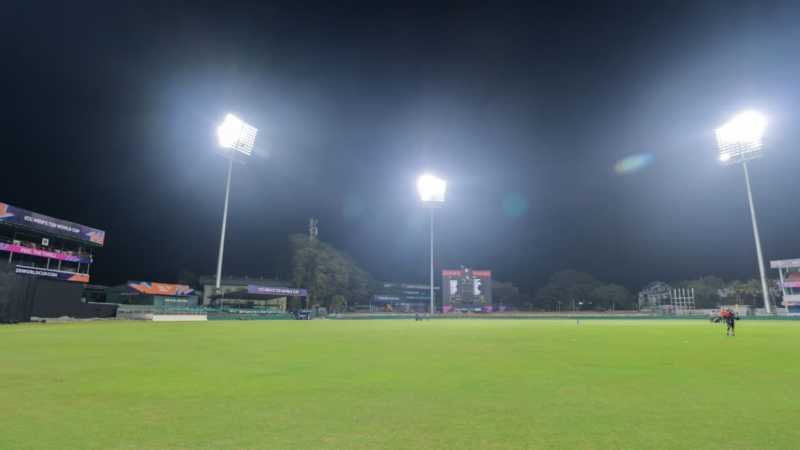
For over a century, the Sinhalese Sports Club (SSC) has been the quiet, dignified heartbeat of Sri Lankan cricket. To walk through its gates is to walk through a gallery of greats, and ghosts. This is where Muthiah Muralidaran turned the ball as if by magic, claiming 166 of his 800 Test wickets – a world record for a single venue to date. It is where Mahela Jayawardene and Kumar Sangakkara built their 624 run monument to patience, and where Chaminda Vaas’ 8 for 19 left Zimbabwe in ruins.
But for all the prestige the SSC had as the ‘Lord’s of Sri Lanka,’ the modern game had begun to grow beyond its reach. For years, the ground was a sanctuary for the traditionalist, a place of white kits and long afternoon shadows. One that has fed more players and captains to the national team than any other. But while the world embraced the floodlit frenzy of T20 cricket, the SSC remained a daytime relic.
The last limited-overs international hosted there was a women’s T20I in 2023, while the last men’s white-ball game was an ODI in 2020. Its T20I history, meanwhile, frozen in time, preserved in the memory of Associate clashes between Canada, Ireland, and Afghanistan in the afternoon heat of 2010.
This Saturday, while the sun will still be high over Colombo, the 16-year drought finally ends. As the rumble of the T20 World Cup curtain-raiser between Pakistan and the Netherlands echoes across the ground, six towering sentinels will stand watch over the turf – an LKR. 1.8 billion crown of LED floodlights waiting to signal the club’s belated arrival to the present. The journey to this moment, though, has been long.
“My God, for the last two decades,” exclaimed SSC cricket committee chairman Samantha Dodanwela, his voice carrying the relief of a man who has finally crossed the finish line.
Since 2009, the dream of floodlights was mired in the complexities of a private members’ club – disputes, corporate hesitancy, and protective instincts of a historic membership. It took the backing of Sri Lanka Cricket and the skills of a legal firm to ensure that this modernisation wouldn’t cost the club its soul or autonomy.
The result is a venue that feels both intimate and international. With a capacity of 12,000, it is a ’boutique’ World Cup experience, though a plan for a 6000-seater three-tier stand is already moving from the boardroom to the western hill.
“This venue is in the heart of the city,” Dodanwela noted, eyeing the urban sprawl of Colombo that surrounds the club. “You will see members patronising the club in the evenings; the crowd will always be there.”For Dodanwela, who joined the club in 1990 and took stewardship of its Cricket Committee in 2011 – albeit with a short gap when Jayawardene took over briefly from 2020-22 – the lights are a guarantee of relevance. While the heritage of the SSC is built on the craft of Test cricket, he knows the future is T20.
“The SSC pitch is the best in Sri Lanka. If you are a good bowler, there is life early on. But if you survive? There are loads of runs. And in T20, what we need is runs.”
As the Oman vs Zimbabwe clash kicks off at 3pm on February 9, and Pakistan vs USA plays out fully under lights the following night, the transition will be complete.
The membership may look back fondly on a past defined by Test cricket, but the SSC’s future is set to begin with the glow of flood-lit mayhem in the heart of Colombo.
(Cricinfo)

Mighty India meet multicultural USA in polarised World Cup

At least 31 killed, dozens wounded in Islamabad mosque blast

The SSC finally steps out of the sunshine and into the floodlights

SAARC journalists meet in New Delhi

Governor of Gujarat met with Sri Lanka PM to discuss exposition of Devnimori Relics

India chase sixth Under-19 World Cup title, England their first since 1998

‘Dates have the highest sugar content to fight Coronavirus’

Sunday Island 27 December – Headlines

#SundayIsland 17th December – Headlines

Sunday Island – 28th March

Sunday Island Headlines – 21 March

Sunday Island – 21st February – Headlines
-

 Business7 days ago
Hayleys Mobility ushering in a new era of premium sustainable mobility
-

 Business4 days ago
SLIM-Kantar People’s Awards 2026 to recognise Sri Lanka’s most trusted brands and personalities
-

 Business7 days ago
Advice Lab unveils new 13,000+ sqft office, marking major expansion in financial services BPO to Australia
-

 Business7 days ago
Arpico NextGen Mattress gains recognition for innovation
-

 Business6 days ago
Altair issues over 100+ title deeds post ownership change
-

 Editorial7 days ago
Govt. provoking TUs
-

 Business6 days ago
Sri Lanka opens first country pavilion at London exhibition
-

 Business5 days ago
All set for Global Synergy Awards 2026 at Waters Edge