
News
India’s Defence ministry is world’s biggest employer:‘Statista’ report

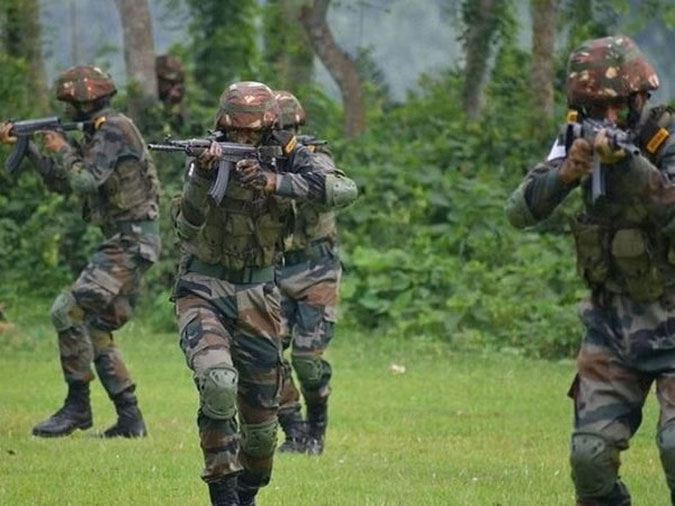
ANI: India’s Ministry of Defence is the world’s biggest employer with 2.92 million people, which includes combined active service personnel, reservists and civilian staff, according to a report in ‘Statista’.A close second to the Indian Defence Ministry is the US Department of Defence which employs 2.91 million people, according to the Statista infographic on employers with the largest workforces worldwide in 2022 Statista is a Germany-based private organisation that provides data and statistics about various issues worldwide.
“At the top of the ranking for the world’s largest employers is India’s Ministry of Defence. Combining active service personnel, reservists and civilian staff, the total headcount comes to 2.92 million – a touch ahead of the United States equivalent, the Department of Defence,” the report said. In China, the People’s Liberation Army, which doesn’t include civilian positions, employs around 2.5 million people, the Hamburg-based firm specializing in market and consumer data said.
“The Chinese equivalent of the U.S. Department of Defense, the Central Military Commission may have as many as 6.8 million people in its employment, though that figure was not deemed sufficiently reliable to be included in this list,” the report adds
According to the report, no company in the world has more employees than Walmart. “The latest information from the US retail giant put the figure at a massive 2.3 million. Not even the behemoth that is Amazon comes close, despite being in second place with a 1.6 million-strong workforce,” cites Statista.This latest infographic by Statista doesn’t come as surprise after total global military expenditure reached USD 2113 billion in 2021.
According to Stockholm International Peace Research Institute (SIPRI), the five largest spenders in 2021 were the United States, China, India, the United Kingdom and Russia, together accounting for 62 per cent of expenditure.US military spending amounted to USD 801 billion in 2021 while China, the world’s second-largest spender, allocated an estimated USD 293 billion to its military.Meanwhile, the SIPRI report says India’s military spending of USD 76.6 billion ranked third highest in the world.


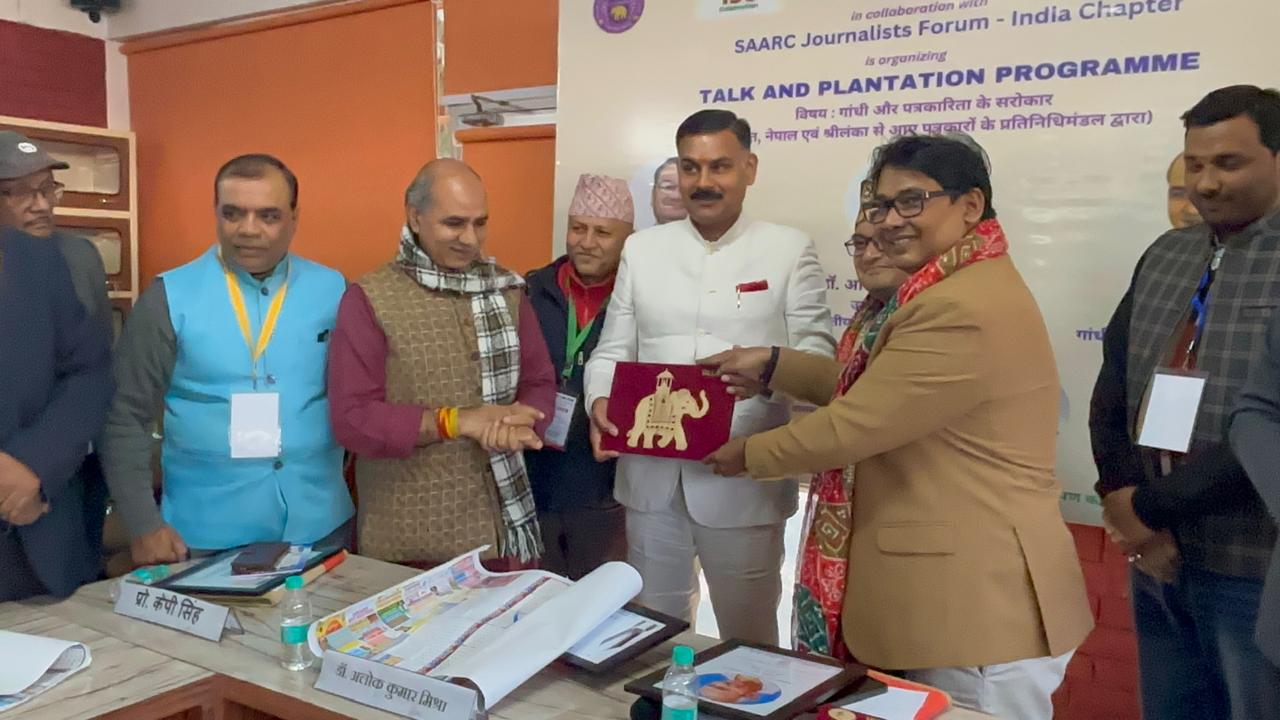
Members of the South Asian Journalists Forum have gathered at the University of New Delhi for a two day conference themed ‘Peace and Co-operation’.
Journalists from Bangladesh, Nepal, Sri Lanka and India are attending the conference hosted by the University of Delhi in collaboration with the India Chapter of SJF, and will deliberate on how the media can act as a catalyst for regional stability and mutual coexsistence.
A tree plantation campaign was also held at the Ghandi Bhawan premises of the University to mark the event and symbolize growing regional ties.
The Sri Lanka delegation is led by President of SJF’s Sri Lanka Chapter Rahul Samantha Hettiarachchi.

The Governor of the of Gujarat, Acharya Devvrat, along with the Deputy Chief Minister of Gujarat, Harsh Sanghvi, met with Prime Minister Dr. Harini Amarasuriya on Thursdy [February 05] at the Parliamentary Complex to discuss the arrangements related to the exposition of the Devnimori Sacred Relics of Lord Buddha, which have been brought to Sri Lanka under the patronage of Indian Prime Minister Narendra Modi and the Government of India.
These sacred relics of Lord Buddha were discovered during archaeological excavations conducted in the 1960s at the historic Devnimori site in Gujarat, the home state of Indian Prime Minister Narendra Modi. Until now, these relics had never been taken outside India. As a result of discussions held between President Anura Kumara Dissanayake and Indian Prime Minister Narendra Modi during his recent visit to Sri Lanka, the people of Sri Lanka have been granted this rare opportunity to venerate these sacred relics.
The exposition of the relics is being held for a period of seven days, from February 05 to February 11, at the Gangaramaya Temple in Hunupitiya, Colombo. Discussions were held between both parties regarding the arrangements related to this event.
The discussion was attended by Samar Nanda, Joint Secretary of the Indian Ministry of Culture; Dr. Satyanjal Pandey, Acting High Commissioner of India in Sri Lanka; Abhijit Halder, Director General of the International Buddhist Confederation; along with several others.
[Prime Minister’s Media Division]

The Indian Naval Ship (INS) GHARIAL made a port call in Colombo for operational turnarounds on 04 Feb 26. The Sri Lanka Navy welcomed the visiting ship in compliance with naval traditions.
Commanded by Commander Gaurav Tewari, INS GHARIAL is a vessel with a length of 124.8 meters.
During this visit, ten (10) Bailey Bridges, brought by ship, through the coordination of the High Commission of India in Sri Lanka, will be handed over to the Disaster Management Center. These bridges will provide temporary transportation links while bridges damaged across the island by adverse weather conditions are repaired.
The crew’s itinerary features scheduled goodwill activities with the Sri Lanka Navy, alongside visits to several tourist attractions across the island.

Mighty India meet multicultural USA in polarised World Cup

At least 31 killed, dozens wounded in Islamabad mosque blast

The SSC finally steps out of the sunshine and into the floodlights

SAARC journalists meet in New Delhi

Governor of Gujarat met with Sri Lanka PM to discuss exposition of Devnimori Relics

India chase sixth Under-19 World Cup title, England their first since 1998

‘Dates have the highest sugar content to fight Coronavirus’

Sunday Island 27 December – Headlines

#SundayIsland 17th December – Headlines

Sunday Island – 28th March

Sunday Island Headlines – 21 March

Sunday Island – 21st February – Headlines
-

 Business7 days ago
Hayleys Mobility ushering in a new era of premium sustainable mobility
-

 Business4 days ago
SLIM-Kantar People’s Awards 2026 to recognise Sri Lanka’s most trusted brands and personalities
-
 Business7 days ago
Advice Lab unveils new 13,000+ sqft office, marking major expansion in financial services BPO to Australia
-
 Business7 days ago
Arpico NextGen Mattress gains recognition for innovation
-

 Business6 days ago
Altair issues over 100+ title deeds post ownership change
-

 Editorial7 days ago
Govt. provoking TUs
-

 Business6 days ago
Sri Lanka opens first country pavilion at London exhibition
-

 Business5 days ago
All set for Global Synergy Awards 2026 at Waters Edge