
News
Indian school teacher wins $1-million Global Teacher Prize for promoting girls’ education


bY S VENKAT NARAYAN,
Our Special Correspondent
NEW DELHI. A primary school teacher from India was on Thursday named the winner of the $1-million annual Global Teacher Prize 2020 in recognition of his efforts to promote girls’ education and trigger a quick-response (QR) coded textbook revolution in India.
Ranjitsinh Disale, 32, from Paritewadi village in Maharashtra state’s Solapur district, emerged the winner from 10 finalists from across the world for the annual prize founded by the Varkey Foundation in 2014 to recognise an exceptional teacher who has made an outstanding contribution to the profession.
Disale, who believes that teachers are the world’s real change-makers, announced that he will be sharing 50% of his prize money with his fellow finalists to support their incredible work.
The coronavirus (COVID-19) pandemic has exposed education and the communities it serves in a multitude of ways. But in this hard time, teachers are giving their best to make sure every student has access to their birth right of a good education, said Disale.
“Teachers are the real change-makers who are changing the lives of their students with a mixture of chalk and challenges. They always believe in giving and sharing. And, therefore, I am very pleased to announce that I will share 50% of the prize money equally among my fellow top 10 finalists to support their incredible work. I believe, together, we can change this world because sharing is growing,” he said.
His generous gesture means the other nine finalists will receive just over $55,000 each as he made history as the first winner to share his prize money. By sharing the prize money, you teach the world the importance of giving, said Indian education philanthropist Sunny Varkey, the founder of the prize.
“I now encourage you to use this platform to give all teachers a voice. There is not a moment to lose as it will fall on young people to find solutions to problems that their parents and grandparents have lacked the will to solve, including climate change, conflict and global pandemics,” he said.
In another first, the Global Teacher Prize 2020 winner’s announcement was made at a virtual ceremony broadcast from the Natural History Museum in London by British actor-broadcaster Stephen Fry.
“Teachers like Ranjitsinh will stop climate change and build more peaceful and just societies. Teachers like Ranjitsinh will eliminate inequalities and drive forward economic growth. Teachers like Ranjitsinh will save our future,” said Stefania Giannini, Assistant Director General for Education at UNESCO (the United Nations Educational, Scientific and Cultural Organisation), a partner of the initiative.
When Disale arrived at the Zilla Parishad Primary School at Paritewadi in Solapur in 2009, it was a dilapidated building, sandwiched between a cattle-shed and a storeroom.
He took on the task of turning things around and ensuring the textbooks were available in the local language for the pupils and not only translated the class textbooks into his pupils’ mother tongue Marathi, but also embedded them with unique QR codes to give students access to audio poems, video lectures, stories and assignments.
The impact of his interventions has been that there are now no reported teenage marriages in the village and 100% attendance of girls at the school.
Disale’s school went on to become the first in the State of Maharashtra to introduce QR codes and after submitting a proposal and successful pilot scheme, the State Ministry announced in 2017 that they would introduce QR coded textbooks across the State for all grades.
In 2018, the Human Resources Development Ministry announced that all the National Council of Education Research and Training (NCERT) textbooks would have embedded QR codes.
Disale is equally passionate about building peace between young people across conflict zones and through a “Let’s Cross the Borders” project, he connects young people from India and Pakistan, Palestine and Israel, Iraq and Iran, and the United States and North Korea.
Over a six-week programme, students are matched with a peace buddy from other countries with whom they closely interact. So far, Disale has initiated an incredible 19,000 students from eight countries into this programme.
Besides, with the use of the Microsoft Educator Community platform, the enterprising teacher spends his weekends taking students from schools around the world with depleted resources on virtual field trips. He is well-known for demonstrating scientific experiments from the science lab he has built in his home.
Disale was selected in the final 10 from over 12,000 nominations and applications from over 140 countries, alongside Olasunkanmi Opeifa from Nigeria, Jamie Frost from the UK, Carlo Mazzone from Italy, Mokhudu Cynthia Machaba from South Africa, Leah Juelke from the US, Yun Jeong-hyun from South Korea, Samuel Isaiah from Malaysia, Doani Emanuela Bertan from Brazil and one from Vietnam.
The Global Teacher Prize is paid out in equal instalments over 10 years, with the Varkey Foundation providing winners with financial counselling and support through an ambassadorial role for the profession.


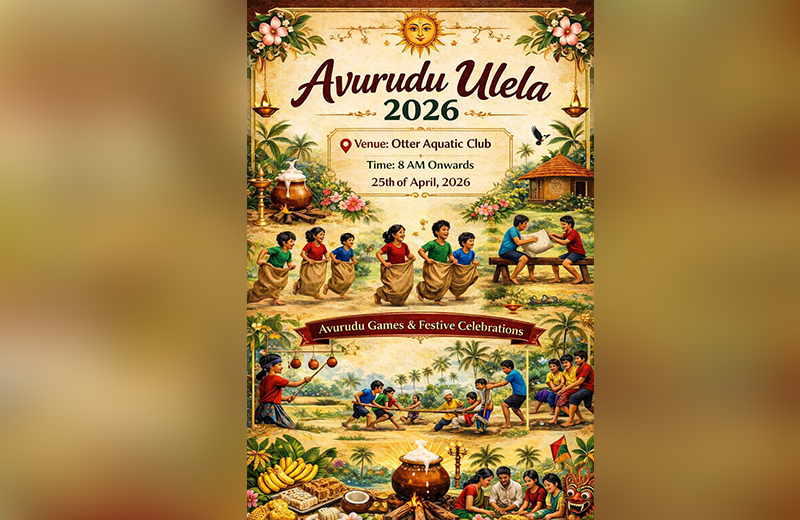
The Otter Aquatic Club, Colombo 7 will host its annual Bak Maha Ulela on April 25, 2026, with a full day of festivities to mark the Sinhala and Tamil New Year.
The celebration will feature traditional games, cultural activities, creating a vibrant atmosphere for families and friends to enjoy together. Organisers invite everyone to take part in this joyous occasion.

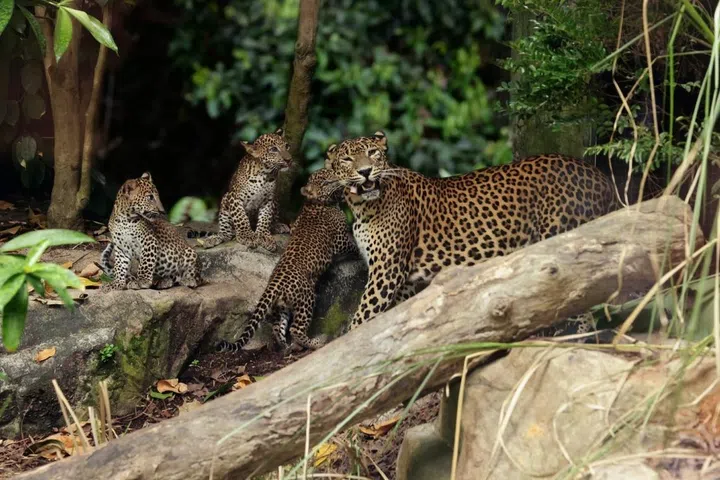
Three Sri Lankan leopard cubs that were born at the Singapore Zoo on Jan 1 have now made their public debut at the facility.
The two males and one female, born to mother Yala and father Asanka, are the first of their species yo be born at the Singapore Zoo. The last successful birth in Singapore was recorded at the Night Safari three decades ago.
The triplets, which are the pair’s first litter, are among around 80 Sri Lankan leopards in zoos worldwide.
The species is listed as vulnerable on the International Union for Conservation of Nature (IUCN) Red List, with fewer than 800 individuals estimated to remain in the wild.
Visitors can now see the triplets at the Wild Africa exhibit, said the Mandai Wildlife Group in a statement on April 16.
The cubs can be found in the exhibit with their mother daily until mid-May and, subsequently, every Wednesday, Saturday and Sunday.
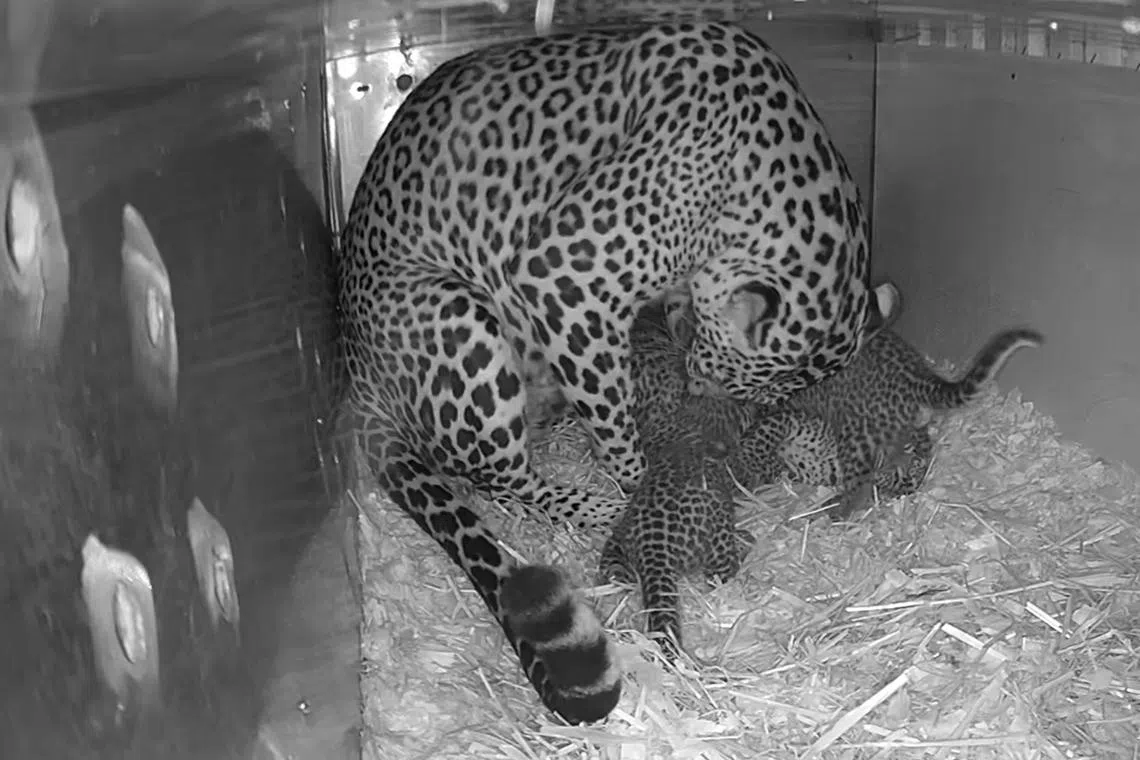
Yala with her cubs in their nest box, a month after their birth on Jan 1. (Straits Times)

A leopard cub investigating a piece of meat suspended from a tree – one of the several enrichment items in the Wild Africa exhibit designed to keep the cats mentally and physically stimulated. (Straits Times)
Mandai Wildlife Group curator Anand Kumar said it took nearly three years and close collaboration across continents to bring together a compatible pair of Sri Lankan leopards.
(Straits Times)
https://www.straitstimes.com/singapore/singapore-zoos-first-sri-lankan-leopard-cubs-make-their-public-debut?ref=top-stories

The Sri Lanka Navy has seized a local multi- day fishing trawler, it’s four man crew together with a consignment suspected to be narcotics off the Southern Coast of the island.
The vessel is presently being escorted to the Dikowita fisheries harbour for further investigations and legal proceedings.

So, who is going to tell the rest of the world?

Mahindra Ideal Finance celebrates debenture listing at Colombo Stock Exchange

New kid on the block – AI drug prescriber from the US

From the Handbook for Bad Political Appointments

Sailing between Scylla and Charybdis

Customs to halve container checks, easing Colombo Port congestion amid IMF push

‘Dates have the highest sugar content to fight Coronavirus’

Sunday Island 27 December – Headlines

#SundayIsland 17th December – Headlines

Sunday Island – 28th March

Sunday Island Headlines – 21 March

Sunday Island – 21st February – Headlines
-

 News5 days ago
CEB orders temporary shutdown of large rooftop solar systems
-
 Features5 days ago
From Royal College Platoon to National Cadet Corps: 145 years of discipline, leadership, and modern challenges
-

 Latest News4 days ago
PNS TAIMUR & ASLAT arrive in Colombo
-

 News6 days ago
Anura Solomons passes away
-

 Features5 days ago
CIA’s hidden weapon in Iran
-

 Latest News4 days ago
Prasidh, Buttler set up comfortable win for Gujarat Titans
-

 Business6 days ago
SL’s economic outlook for 2026 being shaped by M-E conflict
-

 Latest News5 days ago
Heat index likely to increase up to ‘Caution level’ at some places in the Northern, North-central, North-western, Western, Sabaragamuwa, Southern and Eastern provinces and Monaragala district