
Foreign News
India may be linked to Canadian Sikh leader’s death – Prime Minister Justin Trudeau

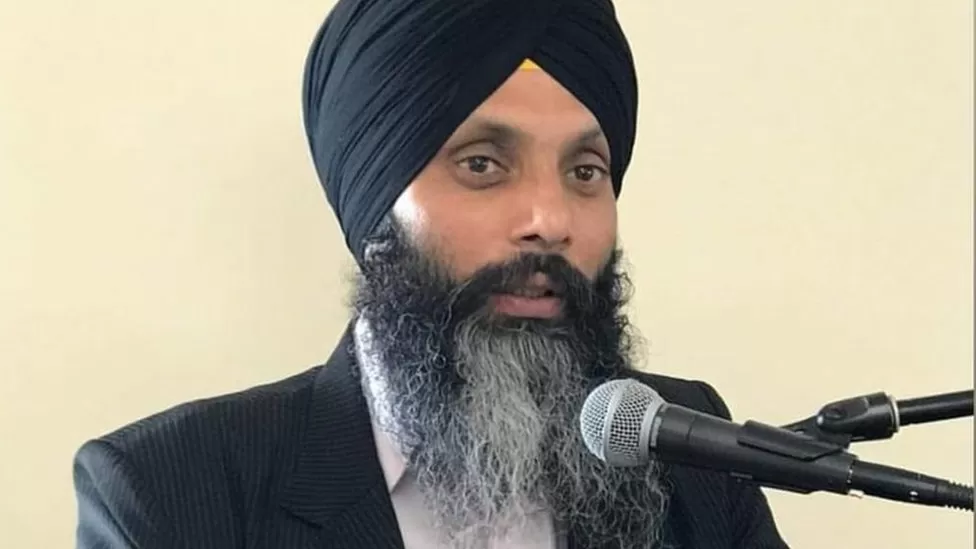
Prime Minister Justin Trudeau says the Indian government could be behind the fatal shooting of Canadian Sikh leader Hardeep Singh Nijjar.
Nijjar was shot dead outside a Sikh temple on 18 June in British Columbia (BC).
Mr Trudeau said Canadian intelligence has identified a “credible” link between his death and the Indian state. He raised the issue with Indian Prime Minister Narendra Modi at the recent G20 summit, he said. “Any involvement of a foreign government in the killing of a Canadian citizen on Canadian soil is an unacceptable violation of our sovereignty,” Mr Trudeau said on Monday in the House of Commons. “It is contrary to the fundamental rules by which free, open and democratic societies conduct themselves.”
India has previously denied any involvement with Mr Nijjar’s murder.
Canada also expelled an Indian diplomat, Pavan Kumar Rai, on Monday over the case, Foreign Minister Melanie Joly told reporters following Mr Trudeau’s remarks.
The BBC has contacted the Indian embassy in Canada for comment.
Ms Joly said Canadian officials are limited in what they can say in public about the case due to the ongoing homicide investigation into Mr Nijjar’s death.
Investigators have previously categorised the 45-year-old’s death as a “targeted incident”. Hardeep Singh Nijjar was shot dead in his vehicle by two masked gunmen on a mid-June summer evening in the busy car park of the Guru Nanak Sikh Gurdwara in Surrey, a city about 30km (18 miles) east of Vancouver.
He was a prominent Sikh leader in the western-most province of British Columbia and publicly campaigned for Khalistan – an independent Sikh homeland in the Punjab region of India. His supporters have said that he was a target of threats in the past because of his activism.
India has previously described him as a terrorist who led a militant separatist group – accusations his supporters call “unfounded”.
Mr Trudeau said Canada has expressed its concerns about Mr Nijjar’s death to high-level security and intelligence agencies in India. He also raised it with US President Joe Biden and UK Prime Minister Rishi Sunak. “I continue to ask with a great deal of firmness that the government of India co-operate with Canada to shed light on this situation,” he said.
Mr Trudeau said that Mr Nijjar’s shooting has angered Canadians, leaving some fearful for their safety.
Some Sikh groups in Canada, including the World Sikh Organisation, welcomed the prime minister’s statement, saying Mr Trudeau confirmed what was already widely believed in the community. There are an estimated 1.4 to 1.8 million Canadians of Indian origin. The country has the largest population of Sikhs outside the state of Punjab in India.
Mr Trudeau’s remarks come after his tense meeting with Mr Modi last week during the G20 summit in India.
During that meeting, according to a statement from the Indian government, Mr Modi accused Canada of not doing enough to quell “anti-India activities of extremist elements”, referring to the Sikh separatist movement in the country.
Canada also recently suspended negotiations for a free trade agreement with India. It gave few details on why, but India cited “certain political developments”.
Mr Nijjar is the third prominent Sikh figure to have died unexpectedly in recent months.
In the UK, Avtar Singh Khanda, who was said to be the head of the Khalistan Liberation Force, died in Birmingham in June under what has been described as “mysterious circumstances”.
Paramjit Singh Panjwar, who was designated a terrorist by India, was shot dead in May in Lahore, the capital of Pakistan’s Punjab province.
(BBC)





Along Beirut’s downtown waterfront, Alaa is looking for somewhere to rest his head.
The Syrian refugee, originally from the occupied Golan Heights, is now homeless. He explained that he had already spent the day wandering around the Lebanese capital trying to find shelter.
He used to live in Dahiyeh – the southern suburbs of Beirut that have been pummelled by Israeli attacks, which have now killed MORE THAN 1,000 across Lebanon.
Now, he’s just looking for somewhere he can be safe. And in that context, Eid al-Fitr, the Muslim festival that began on Friday, is far from his mind.
When asked if he had any plans for Eid, he replied in the negative. Instead, his focus was on getting a tent.
“I got rejected from staying in a school, then I went to sleep on the corniche,” Alaa said. “Then people from the municipality told me to come here to downtown Beirut’s waterfront.”
Alaa wasn’t able to find a tent and is sleeping in the open air for now. But others in the area have, transforming a downtown more famous for its expensive restaurants and bars into a tent city for those displaced by the fighting. Across Lebanon, more than a million people have been displaced.
Lebanese are uncertain when this war will end, particularly as they have barely recovered from the conflict with Israel that ran between October 2023 and November 2024.
It makes celebrations difficult – a common theme across the countries affected by the current conflict.
In Iran, now in its third week of US-Israeli attacks – with no sign of an immediate end and an economic crisis that preceded the conflict, people are struggling to afford any of the items typically bought during the holiday season.
And it is potentially dangerous for people to shop at places like Tehran’s grand bazaar, which has been damaged by the bombing.
The religious element of Eid adds an extra sensitivity for antigovernment Iranians, some of whom now see any sign of religiosity as support for the Islamic Republic. The fact that Nowruz – the Persian New Year – falls on Friday this year means that some in the antigovernment camp will be focused on that celebration instead, and eschewing any events to mark Eid.
[Aljazeera]

King Charles has hosted a spectacular state banquet for the president and first lady of Nigeria, praising the strengths of Nigeria’s partnership with the UK.
After greeting the 160 guests in the Yoruba language, the King spoke of the “living bridge” of the Nigerian community in the UK, in a speech in St George’s Hall at Windsor Castle.
Famous figures at the banquet included England rugby union captain, Maro Itoje, Olympic athlete Christine Ohuruogu and poet Sir Ben Okri, alongside senior royals including Queen Camilla and the Prince and Princess of Wales.
There were special adaptations for Muslims, with the banquet taking place in the fasting month of Ramadan.
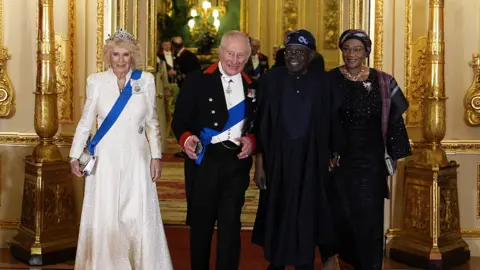
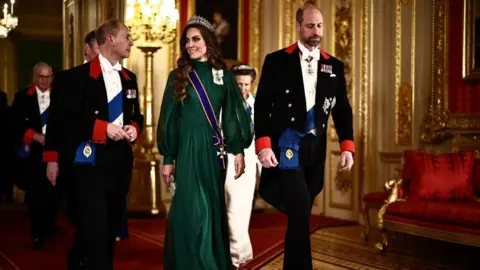
A prayer room was set aside in Windsor Castle and the usual lunch hosted by the King on such state visits did not take place.
It’s become a tradition to invent a cocktail for state visits – and in this case the “crimson bloom” was made from non-alcoholic ingredients, combining the Nigerian drink Zobo with English rose soda and hibiscus and ginger syrup.
There were also alcoholic drinks available for guests in St George’s Hall, including fine red and white wines, port and whisky.
The King’s speech reflected on the importance of religious tolerance, in which “people of different faiths can, do, and must live alongside one another in peace”.
He also told President Bola Ahmed Tinubu and First Lady Oluremi Tinubu of the importance of partners such as Nigeria and the UK standing together in difficult times “when rain clouds gather”.
As well as diplomatic ties, King Charles spoke of “Afrobeats filling our concert halls and Nollywood captivating our screens”.
There was also a reflection by the King on the “painful marks” of a shared history, in a reference to colonialism.
“I do not seek to offer words that dissolve the past, for no words can,” said the King, but he hoped for a more optimistic future “worthy of those who bore the pains of the past”.
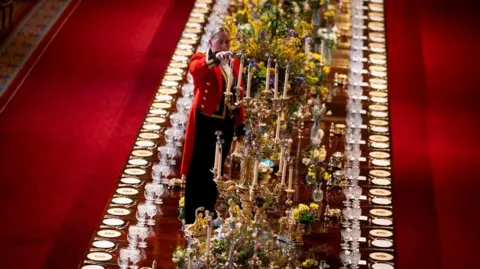
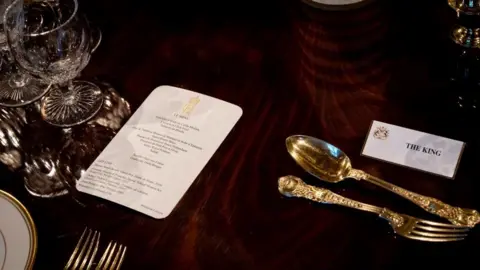
The banquet, on an elaborately decorated table filled with spring flowers, saw a meat-free menu.
It included:
- Soft boiled quail egg tartlet with watercress and kale and a basil sabayon
- Fillet of turbot, lobster mousse wrapped in spinach, beurre blanc sauce, sprouting broccoli with hollandaise sauce, fricassee of peas and broad beans, Jersey Royal potatoes
- Iced blackcurrant souffle with red fruit coulis
The two-day state visit began on Wednesday morning with a ceremonial welcome at Windsor.
In warm spring sunshine, the president and first lady – wearing traditional robes – were given the ceremonial grandeur of a royal welcome.
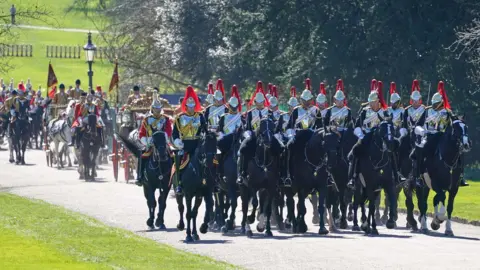
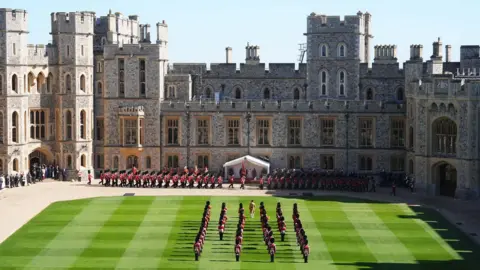
There was a carriage procession, bringing the Nigerian visitors into the quadrangle inside Windsor Castle, where a military band, with careful symmetry, paraded on the chequerboard lawn.
There was a gun salute, national anthems were played, guards were inspected and the Household Cavalry kicked up dust as they paraded inside the castle, in front of a viewing stand for the King and Queen and their visitors.
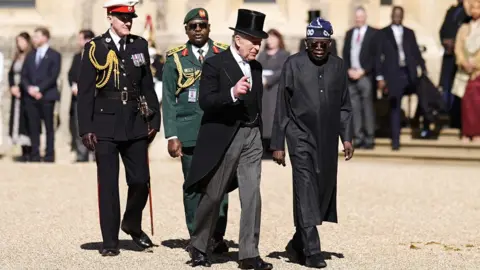
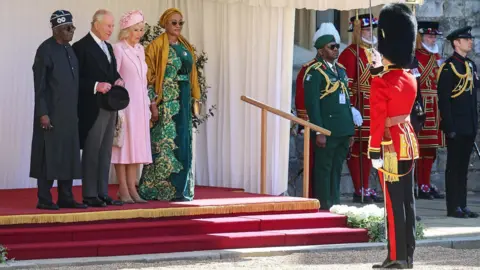
Official gifts were exchanged. The president and Mrs Tinubu were given hand-crafted pottery, a silver photo frame containing a picture of the King and Queen and a silver and enamel bowl.
In return, the King and Queen were given a traditional Yoruba statuette and a jewellery box featuring the faces of important Nigerian women.
President Tinubu is a Muslim and his wife is a Christian and the couple attended an interfaith event at Windsor Castle, designed to build bridges between religions.
It’s at a time of tensions within Nigeria, with a series of suspected suicide bombings this week in the north-eastern state of Borno, in which at least 23 people were killed and 108 injured in attacks blamed on hard-line Islamist militants from the Boko Haram group.
This is Nigeria’s first state visit to the UK for 37 years and such visits are a way of building relationships with international partners.
The Nigeria visit will see a strengthening of business links, including financial services. And there are personal and family connections, with more than 270,000 Nigerian-born people living in the UK.
“This state visit is about turning a historic relationship into a modern economic partnership – transforming trust into opportunity,” said Nigeria’s government spokesman Mohammed Idris.
“Nigeria’s economic reforms are unlocking the potential of Africa’s largest consumer market. The United Kingdom is a natural partner in what comes next.”
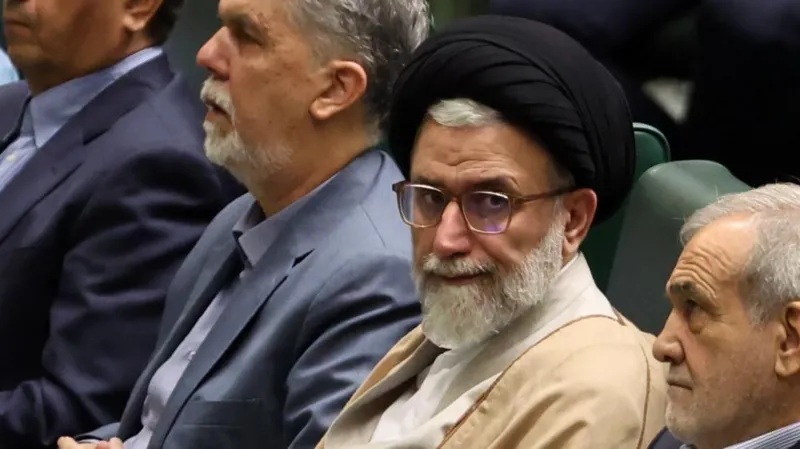
Iran’s intelligence minister Esmail Khatib has been killed, the country’s president has confirmed.
Masoud Pezeshkian said the “cowardly assassination” had left Iran “in deep mourning”, after Israel said on Wednesday it had killed Khatib in an air strike.
It comes a day after Israel announced it had killed Iran’s top security official, Ali Larijani, and head of the paramilitary Basij force, Gholamreza Soleimani, in strikes.
Since the assassination of Supreme Leader Ayatollah Ali Khamenei on the first day of the war on 28 February, multiple senior Iranian officials and commanders have been killed in efforts by Israel and the US to weaken the regime’s leadership.
In a post on X, Pezeshkian extended his condolences to the Iranian people over the officials’ deaths, adding he was “certain their path will continue more steadfastly than before”.
Speaking to the BBC, a woman from Tehran said the “killing of Khatib might help the people since he was among the leadership”.
“It might be that when people come out after a call to protest, the likelihood of them being killed is lower now,” she said. “Even though they all have replacements, these were the main figures.”
Earlier on Wednesday, Israel’s defence minister Israel Katz announced that Khatib had been “eliminated” in an Israeli strike on Tehran.
“Prime Minister Benjamin Netanyahu and I have authorised the IDF to eliminate any senior Iranian official for whom the intelligence and operational circle has been closed, without the need for additional approval,” he said.
[BBC]

Gura: The unsung hero

The Iran War, Global Oil Crisis, and Local Options

President in Parliament

River of Life in Peril: Shantha Jayaweera’s Four-Decade Vigil in Boralugoda

Champa Stores Marks 70 Years of Trusted Service in Kandy

Dialog Voted Service Brand and Telecommunication Brand of the Year at SLIM-KANTAR People’s Awards 2026

‘Dates have the highest sugar content to fight Coronavirus’

Sunday Island 27 December – Headlines

#SundayIsland 17th December – Headlines

Sunday Island – 28th March

Sunday Island Headlines – 21 March

Sunday Island – 21st February – Headlines
-

 Business6 days ago
Browns EV launches fast-charging BAW E7 Pro at Rs. 5.8 million
-

 News4 days ago
CIABOC questions Ex-President GR on house for CJ’s maid
-

 News5 days ago
Sri Lankan marine scientist Asha de Vos honoured at UNGA opening
-

 Features6 days ago
Achievements of the Hunduwa!
-

 Latest News7 days ago
QR code system will be implemented for fuel with effect from 06.00 a.m. today (15th)
-

 News5 days ago
Australian HC debunks misleading travel risk claims for Sri Lanka
-

 Latest News5 days ago
Wednesdays declared a government holiday with effect from 18th March
-

 News3 days ago
Pay hike demand: CEB workers climb down from 40 % to 15–20%