
News
India asks Canada to prevent anti-India activities by individuals, groups based there


India, on Thursday, reiterated its concern over certain forces planning a so-called referendum in Canada on their demand for Khalistan and called upon that country to prevent anti-India activities by individuals and groups based there, the Press Trust of India reported.India also urged Canada to designate as terrorists under its laws those individuals and entities who have been declared as terrorists under Indian laws.
Asked about the issue of the so-called Khalistan referendum in Canada, Ministry of External Affairs (MEA) Spokesperson Arindam Bagchi said, “I think we have made our position clear a couple of times. Our position on the efforts by anti-India elements to hold a so-called Khalistan referendum is well known. It has been conveyed to the Canadian government, both in New Delhi and in Canada.”
The government of Canada has conveyed that it respects India’s sovereignty and territorial integrity and will not recognise the so-called referendum, which is to take place in two parts in Canada, Bagchi said.
“The Canadian High Commissioner here and their d\Deputy Foreign Minister reiterated this perspective earlier this week in separate statements. However, let me also reiterate what we said earlier, which is that we find it deeply objectionable that politically-motivated exercises by extremist elements are allowed to take place in a friendly country, and you are all aware of the history of violence in this regard,” he added.
“We will continue to press the government of Canada in this matter. We call upon them to prevent anti-India activities by individuals and groups based in their country, and to designate as terrorists under their laws the individuals and entities who have been declared as terrorists under our laws,” the MEA official said. The Sikhs For Justice (SFJ) has proposed the so-called referendum in Mississauga, near Toronto, on November 6.









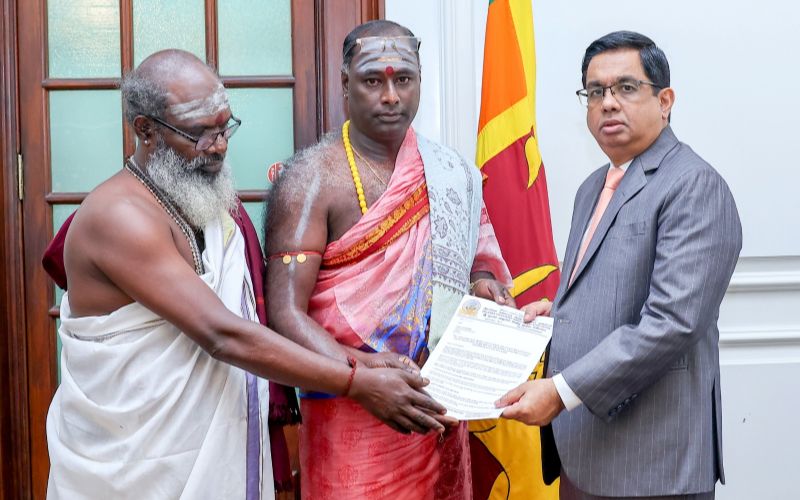
The Kandyan Hindu Priests’ Association of Sri Lanka has submitted a memorandum to President Anura Kumara Dissanayake, requesting the necessary government intervention to secure the release of Sivarasa Anojan, who has been sentenced to death in Saudi Arabia.
Accordingly, the memorandum was handed over to Dr Nandika Sanath Kumanayake, Secretary to the President, at the Presidential Secretariat this afternoon (30), by the General Secretary of the Kandyan Hindu Priests’ Association of Sri Lanka, Dr Siva Sri Velu Suresh Sharma Kurukkal.
Dr Nandika Sanath Kumanayake, Secretary to the President, pointed out that the necessary government intervention to secure the release of Sivarasa Anojan is already being carried out.
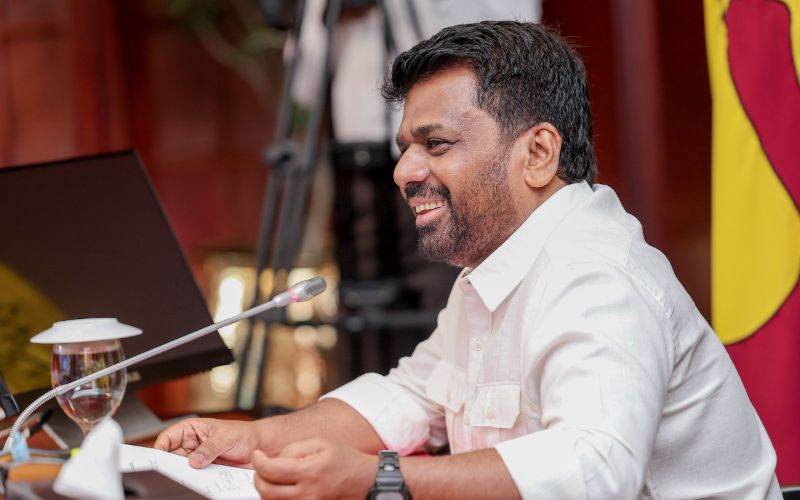
President Anura Kumara Dissanayake instructed officials to establish a mechanism to actively engage parents in protecting children from the drug menace. He emphasised that protecting children from this menace depends more on strong parent-child relationships than on the law alone. He also stressed the need to directly educate parents on the seriousness of the drug menace and how to monitor their children’s behaviour.
The President issued these instructions while participating in a meeting of the “A Nation United” National Steering Committee, established to eradicate the drug menace from the country, held this morning (30) at the Presidential Secretariat.
The President also highlighted the need for a trusted individual to provide guidance to parents if their children are at risk of being exposed to drug use. He noted that parents generally seek the assistance of a teacher or religious leader in such situations. Accordingly, he instructed officials to develop a systematic programme to provide reliable guidance, taking this into consideration. He also pointed out the need for special training if teachers are to be involved in this programme.
The President further emphasised the need to strengthen the programme being implemented to dismantle the distribution networks linked to the drug trade.
It was also noted that the number of forensic reports completed daily has increased following the expansion of facilities and improved efficiency at the Government Analyst’s Department. A total of 8,000 forensic reports related to drugs were completed during September alone. Data entry activities have also been strengthened with the assistance of Navy personnel. It was further revealed that the improved efficiency in obtaining forensic reports has enabled a significant number of persons remanded in custody for drug-related offences to be released on bail, thereby helping to reduce prison overcrowding.
The President also instructed officials to refer the new Bill on drug control, which has been presented to Parliament, to the Committee in the first week of October, obtain approval and take steps to have it passed by Parliament by the third week of October.
Discussions were also held on developing a centralised digital system and software linking the Police, the Government Analyst’s Department, the Department of Prisons and the judicial system. The President instructed officials to discuss the matter with the Secretary to the Ministry of Defence and other relevant officials and take steps to address the practical issues involved.
The President also inquired into the measures taken to facilitate the direct submission of expert reports and Government Analyst’s reports to the courts by email, in accordance with the Act No. 07 of 2025. He also reviewed the measures taken to fill vacancies in the Legal Draftsman’s Department.
Programmes implemented in international schools to combat the drug menace and their effectiveness were also reviewed.
The President also highlighted the need to develop social media programmes targeting the younger generation to raise awareness of the dangerous consequences of drug use.
Discussions were also held on the drug-related challenge spreading in the Northern and Eastern regions following the war, and the programmes being implemented to address this challenge.
The President also highlighted the importance of maintaining the 1818 hotline, introduced to provide information on drug trafficking, distribution and related illegal activities and conducting a publicity programme on the response to information received through the 1818 hotline to strengthen public confidence in the service.
The President also reviewed the progress of the rehabilitation process, including measures to increase the capacity of rehabilitation centres.
The Maha Sangha, including Most Venerable Narampanawe Ananda Thera, the Anunayake of the Asgiri Chapter, Most Venerable Waleboda Gunasiri Thera, Anunayake of the Ramanna Maha Nikaya and Most Venerable Kuppiyawatte Bodhananda Thera, together with members of the clergy, including Reverend Nishantha Fernando, Sri Velu Suresh Sharma Kurukkal, Muththusamy Alagesan Kurukkal and Sheikh Mohamed Arkam Nooramith Moulavi, also participated in the occasion.
Secretary to the President Dr Nandika Sanath Kumanayake, Senior Additional Secretary to the President Roshan Gamage, Secretary to the Ministry of Defence, Air Vice Marshal Sampath Thuyacontha (Retd), Secretary to the Ministry of Public Security Ravi Seneviratne, Secretary to the Ministry of Public Administration, Provincial Councils and Local Government S. Aloka Bandara, Secretary to the Ministry of Justice and National Integration Ayesha Jinaseena, other ministry secretaries, government officials, the Inspector General of Police, and representatives of the security forces, including the Commanders of the three Armed Forces, Members of the “A Nation United” National Steering Committee were also present.
[PMD]

[Prime Minister’s Media Division]

Hindu Priests Seek State Intervention for Sivarasa Anojan

“A Nation United” National Steering Committee meets under President’s Chairmanship

PM declares open 2nd Day of National AI Expo 2026

Waste management and recycling to receive priority in the 2027 Budget – PM

Rain stays away as India and Sri Lanka look for fair contest to enter final

Gold winner Tharanga gets brand-new Honda Vezel from SLAAJ

‘Dates have the highest sugar content to fight Coronavirus’

Sunday Island 27 December – Headlines

#SundayIsland 17th December – Headlines

Sunday Island – 28th March

Sunday Island Headlines – 21 March

Sunday Island – 21st February – Headlines
-

 Latest News7 days ago
Showers above 100 mm are likely at some places in the Western, Sabaragamuwa, Central and North-western provinces and in Galle and Matara Districts
-

 Editorial7 days ago
Crimes punished and unpunished
-

 Features6 days ago
Beyond traditional jobs: Why Sri Lanka needs to facilitate the gig economy
-

 Editorial5 days ago
Birth of a bad law
-

 News3 days ago
Police remove Thileepan statue in Jaffna
-
 Latest News6 days ago
Kusal, Wellalage star as Sri Lanka defend 322 in Headingley thriller
-

 News5 days ago
TIN mandatory for key transactions from Nov. 1
-

 News7 days ago
IMF: Sri Lanka on course for 2027 market return