
Latest News
India beat the weather and the clock to sweep Bangladesh 2-0

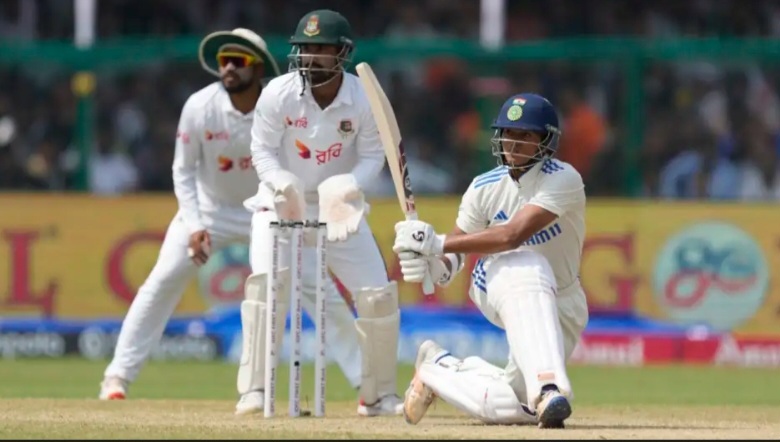
Less than 24 hours after sparking off a near-unthinkable push for victory in a game in which only 35 overs had been bowled in the first three days, India’s batters completed the task they had started by smashing down their target of 95 in just over an hour.
The highlight of India’s performance on Tuesday came from another record-breaker from the fourth day; Ravindra Jadeja’s triple-strike started a slide for Bangladesh in an extended first session, in which they were bowled out for 146. India lost three wickets in pursuit before Rishabh Pant hit the winning runs in the chase set up by a 43-ball fifty from Yashasvi Jaiswal and extended their lead at the top of the WTC points table with a 2-0 series sweep.
The 312 balls India batted for in this Test is the second fewest they have faced – and the fourth-fewest overall – to win a Test match, behind the 281 against South Africa in Cape Town earlier this year.
Bangladesh started the day on 26 for 2, and with Jadeja starting things off in the company of Akash Deep, suffered a collapse of 7 for 55. Ravichandran Ashwin and Jasprit Bumrah also finished with three each. Jadeja first broke the stubborn stand of 55 between Najmul Hossain Shanto and Shadman Islam when he struck in three successive overs, also sending back Litton Das and Shakib Al Hasan. Bangladesh went from 91 for 3 to 94 for 7. After that, Bumrah wiped out the tail. There were no demons in the pitch, no vicious turn, just tight and skiddy bowling from Jadeja and the mounting pressure.
Bangladesh were trailing by 26 when the day of 98 overs started and it was Ashwin who struck first. After using the sweep effectively in his unbeaten century in the first innings, Mominul Haque fell to the same shot when he handed a catch to leg slip for 2. Many might have expected Bangladesh to buckle under pressure but Shadman replied with a string of boundaries against Ashwin. He struck three confident cover drives and a back-foot cut for four fours in seven balls against Ashwin, which gave Bangladesh confidence and the lead.
A few loose deliveries from Mohammed Siraj leaked a few more boundaries; he was struck for two fours each by Shadman and Shanto in his opening spell, although one of them would have been a chance had third slip been in place.
It’s possible Jadeja was the last one to get the ball because only left-hand batters had been at the crease. But it took him only two balls to strike. Shanto missed a reverse sweep on his first ball against Jadeja to lose his leg stump before the bowler extracted extra bounce on a pitch that has been keeping low to have Litton caught behind on the cut for 1. Between those two overs, Akash Deep pitched one up to Shadman soon after the batter’s half-century, and the push to gully ended his 101-ball stay.
Jadeja was all over Bangladesh by now. In his third over he sent back Shakib with an innocuous delivery bowled slow through the air, which Shakib only chipped back to give Jadeja figures of 2.2-1-3-3 early in his spell.
With Bangladesh seven down for 94, Rohit Sharma brought back Bumrah and the spearhead did his job straightaway. His third ball of the fresh spell was a beauty that got Mehidy Hasan Miraz’s edge. It was only Mushfiqur Rahim who delayed the inevitable, extending the lead towards 100. He saw off the quicks and belted two back-to-back fours against Jadeja.
Bumrah trapped Taijul Islam lbw to extend the first session at the stroke of lunch before Mushfiqur frustrated the hosts further. He started to farm the strike with only one wicket left but again it was Bumrah who made the difference. Back for one over before lunch, his slow offcutter at 125kph went through a big swing from Mushfiqur on the last ball of the session as he put to waste all his hard work.
India again came out all guns blazing as Bangladesh didn’t use any pace in search of wickets. Rohit missed a big swing to the leg side in the first over and when he middled a sweep, he found deep backward square-leg in Mehidy’s second over. Shubman Gill was trapped lbw for 6 by Mehidy to a delivery similar to the one that kept low and dismissed Rohit on Monday. Otherwise India cruised in their chase thanks to Jaiswal’s third half-century of the series. He muscled his back-foot punches and sweeps and came down the track to smash a few boundaries, including a six, down the ground. His brisk partnership of 58 with Virat Kohli nearly saw India through except that Jaiswal miscued a swing to the off side with only three runs required.
Brief scores:
India 285 for 9 dec ( Yashasvi Jaiswal 72, KL Rahul 68, Mehidy Hasan Miraz 4-41, Shakib Al Hasan 4-78) and 98 for 3 (Yashasvi Jaiswal 51, Virat Kohli 29*, Mehidy Hasan Miraz 2-44) beat Bangladesh 233 (Mominul Haque 107*, Jasprit Bumrah 3-50) and 146 (Shadman Islam 50, Bumrah 3-17, Jadeja 3-34, Ashwin 3-50) by seven wickets
(Cricinfo)

Latest News
M. M. D. J. Senarathne, appointed Director General of the Department of National Botanical Gardens

The Cabinet of Ministers approved the resolution furnished by the Minister of Environment to appoint M. M. D. J. Senarathne, who is the senior most officer in Grade I of Sri Lanka Scientific Service se
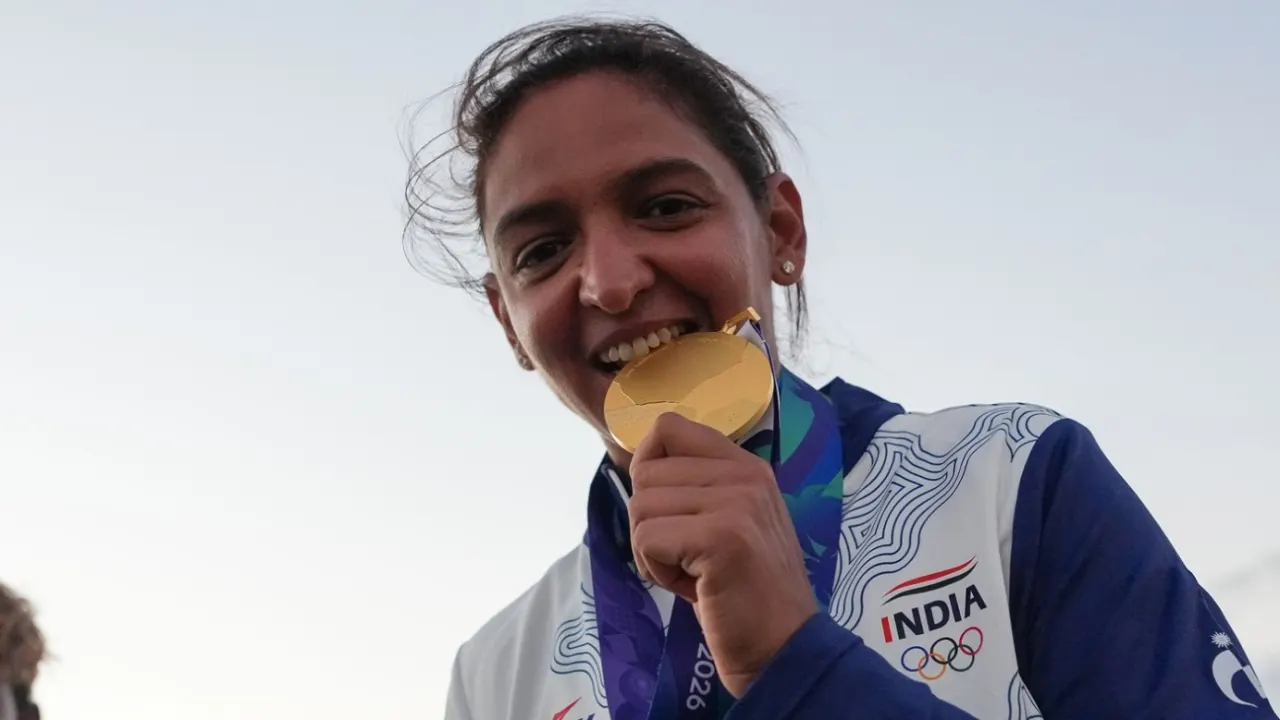
Harmanpreet Kaur, who led India to their first women’s global title at last year’s ODI World Cup, has stepped down as captain from all three international formats. She announced her decision via an Instagram post on Tuesday morning. Having given up the captaincy and left the team in a “good place”, she has said she’s now “ready to play for the love of the game again”.
Harmanpreet, 37, led India in five Tests, 51 ODIs and 155 T20Is. Her last act as captain was leading India to their second successive Asian Games gold medal, in Nisshin last month.
The decision came a day after Harmanpreet, India vice-captain Smriti Mandhana and head coach Amol Muzumdar met BCCI secretary Devajit Saikia in Guwahati to discuss the roadmap of the women’s team going forward.
“This is not an easy decision,” Harmanpreet wrote. “It carries years of memories, emotions, sacrifices, and moments that will stay with me for the rest of my life.
“I have given everything I had to this team and to Indian women’s cricket – my blood, my sweat, my time, and many times, a part of my own game and personal ambitions. There were moments when I had to put my individual performance, my own growth, and what I wanted for myself aside, because I believed the team had to come first.
“As a captain, I have had to make difficult decisions. Decisions that were not always understood, not always easy, and sometimes came at a personal cost. But every decision I made was with one intention – to make this TEAM better and to give other players the opportunity to grow, believe in themselves and become the best versions of themselves.”
Murmurs about a possible change in captaincy had been on for a while, especially after India’s second successive group-stage exit from the T20 World Cup in June this year. The selection committee, chaired by Amita Sharma, is understood to have been divided, but Harmanpreet had indicated a desire to lead India at the 2028 Olympics in Los Angeles.
“I leave the captaincy today with a heart full of emotions , but also with PEACE,” Harmanpreet said. “Because I genuinely believe My team is in a good place. A team with talent, character, belief and a future that I am incredibly excited to watch and be a part of.
“I feel I have done my duty. I gave this team everything I had. I carried the responsibility with pride, and I will always be grateful for the privilege of leading Indian women’s cricket.
“Now, it is time for me to turn the page. Captaincy may end today, but my love for Indian cricket never will. Thank you to every teammate, coach, support staff, management , BCCI , family members every single fan who stood by me through the highs and lows.”
The noise for Smriti Mandhana to take over has been getting louder in recent months. In the past six months, Mandhana has been vocal about her readiness for the top job, and has given evidence of her credentials by leading Royal Challengers Bengaluru to twin WPL titles (in 2024 and 2026).
Harmanpreet first captained the T20I team in 2012, but it wasn’t until after India’s group-stage exit from their home T20 World Cup in 2016 that she was considered a serious candidate for the role.
In 2018, she led the team to the T20 World Cup semi-finals in the Caribbean after having taken over the role in a full-time capacity from Mithali Raj, and followed it up with a runners-up finish at the T20 World Cup in Australia in 2020.
Harmanpreet’s stepping down as India captain will not, however, change her stance as far as playing the shortest format goes. She is expected to continue leading Mumbai Indians in the upcoming WPL edition as the team chases their third title.
[Cricinfo]
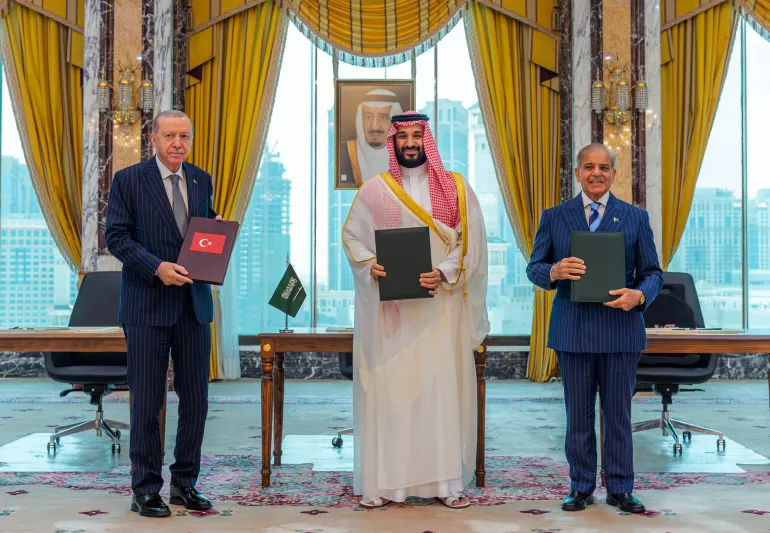
Turkiye, Pakistan and Saudi Arabia have agreed to activate “deterrence measures” under a mutual defence pact and rapidly deploy forces to the Gulf kingdom to counter attacks by Yemen’s Houthis.
The decision was announced on Monday after the three countries’ defence and foreign ministers held an emergency meeting in Riyadh. It marked the first time the alliance – known as the Mecca Alliance for Defence – has been invoked since it was signed on August 7.
The agreement declares that an attack on any of the three nations will be treated as an attack on all, mirroring a central provision of NATO’s founding treaty.
“The committee agreed to activate collective deterrence measures, within the framework of the Alliance, in response to the attacks and all those responsible for them,” Khalid bin Salman, Saudi Arabia’s defence minister, said in a social media post.
He said the alliance had “reaffirmed the solidarity and unity of our countries, in confronting the heinous attacks against the Kingdom, and holy sites”.
A separate joint statement published by Pakistan’s Foreign Ministry said the three countries would “provide the agreed military forces and capabilities and ensure their rapid deployment” to Saudi Arabia.
The commitments, the joint statement said, would be carried out under “approved arrangements” and in accordance with each country’s laws.
The announcements came hours after forces aligned with Yemen’s internationally recognised government launched a counteroffensive to retake territory the Iran-aligned Houthis captured last month. The Yemeni forces, who are backed by Saudi Arabia, said they have retaken the port city of Mocha on the Red Sea and are now in control of the strategic Bab al-Mandeb strait.
The Saudi-led coalition has confirmed its participation in the Yemeni government offensive, saying 100 of its fighter jets are providing air support.
The Houthis, meanwhile, claimed an attack on the King Khalid International airport in Riyadh and the Aramco refinery in coastal Rabigh.
The group also said it hit a series of sites, including an airport, an airbase and other critical locations.
There was no confirmation from Riyadh on the Houthi claim.
The Mecca Defence Alliance emerged as a response to intensifying conflicts in the region, triggered by the United States and Israel’s war on Iran.
The defence pact was signed in August, shortly before the Houthis launched their offensive in Yemen, which has included attacks against Saudi targets.
The three members of the alliance combined have nearly 1.4 million active troops, about 3,400 military aircraft, 6,000 tanks and more than 340 naval assets, according to the 2026 Global Firepower Index.
The agreement initially offered few details about each country’s military obligations, though steps to formalise the alliance followed.
After the Houthis fired a barrage of missiles towards Saudi Arabia in early September, Pakistani Defence Minister Khawaja Asif said an attack on the kingdom could set the pact in motion.
“If there is unprovoked aggression, or a spillover of whatever is happening in Yemen into Saudi Arabia, definitely the Mecca agreement will become operational,” Asif told Geo News, a Pakistani outlet.
Until Monday, however, the alliance had taken no action. Analysts had said that Pakistan and Turkiye were reluctant to abandon their roles as mediators in the US-Israel war on Iran.
Abdulaziz Alghashian, a senior non-resident fellow at the Gulf International Forum, said the decision to activate the Mecca defence pact will have a major impact on security in the region.
“The Houthi attacks and provocations in recent weeks and months really hastened the Mecca alliance, inspired it, even,” Alghashian told Al Jazeera. They “helped” push forward its structure, he said.
Alghashian said the episode also offered a glimpse of a regional security architecture taking shape.
“A lot of the times we keep talking about regional security architecture, it’s one of these very fancy words,” he said. “A lot of the times, it’s hollow, and not many people know what it means in detail. But I think now, we’re beginning to see how this is fleshed out. It’s a critical juncture in the history of the region.”
[Aljazeera]

Establishment of an Institutional Framework to Inagurate Upper Hydro Catchment Areas Management Authority
Introduction of Flora and Fauna (Regulation of actions of the Indigenous Community within the nominated areas) Regulations
M. M. D. J. Senarathne, appointed Director General of the Department of National Botanical Gardens

Harmanpreet Kaur steps down as India captain

Turkiye, Pakistan agree Saudi Arabia military deployment under Mecca pact

Rumesh Tharanga among nominees announced for World Athlete of the Year 2026

‘Dates have the highest sugar content to fight Coronavirus’

Sunday Island 27 December – Headlines

#SundayIsland 17th December – Headlines

Sunday Island – 28th March

Sunday Island Headlines – 21 March

Sunday Island – 21st February – Headlines
-

 Latest News7 days ago
Gold winner Tharanga gets brand-new Honda Vezel from SLAAJ
-

 News6 days ago
US-assisted ‘Ice’ detection: NPC to examine IGP’s move to transfer drug-busting team
-

 Features7 days ago
Why Sri Lanka needs an Inclusive Civic Nationalism – urgently
-

 Editorial5 days ago
Colombo Port drug bust: The plot thickens
-

 News7 days ago
Civil society activist accuses govt. of favouring Ven. Gnanasara
-
 Midweek Review7 days ago
Dappula’s Easter Sunday ‘grand conspiracy’ claim demolished
-

 Editorial7 days ago
When crime bosses rise above law and shrines
-
Editorial6 days ago
Drug busting, transfers and trust deficit